



Security Trends  fedora security assessment
fedora security assessment A Fedora contributor account recently came under scrutiny for apparently AI-generated activity that disrupted the project's bug tracker. . Questionable Bugzilla comments, flawed patches, and improperly closed or reassigned bugs forced maintainers to spend time cleaning up the fallout. There is no evidence that malware was deployed or a backdoor reached production, but the incident exposed a different problem. Open-source projects can be disrupted without compromising a single line of code....
 Jun 12, 2026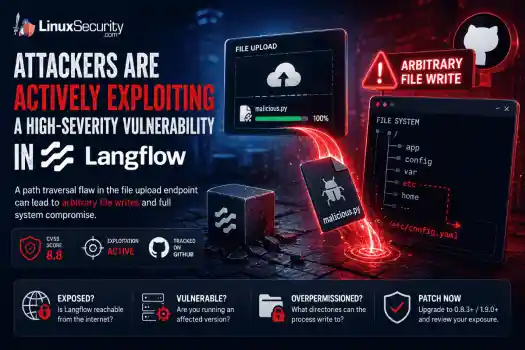
Security Vulnerabilities security advisory critical
security advisory critical Attackers are actively exploiting a high-severity vulnerability in Langflow , an open-source platform used to build and run AI workflows. . The flaw turns a file upload into a filesystem write, allowing a user-controlled file to escape the application's intended upload directory and land in locations Langflow was never supposed to touch. The vulnerable upload endpoint permits path traversal through crafted filenames. From there, the impact depends heavily on how the platform is deployed. A...
Jun 11, 2026 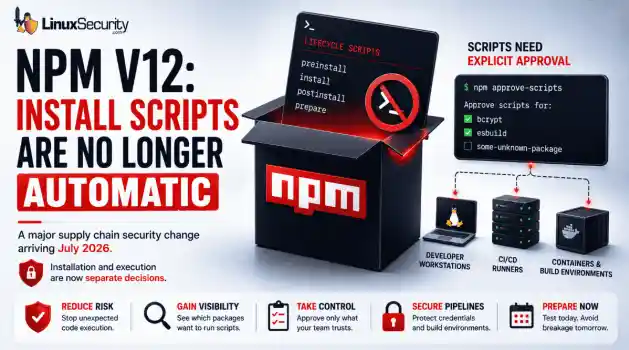
Vendors/Productssecurity advisory linux
security advisory linux With npm v12 , dependency preinstall, install, and postinstall scripts will no longer execute automatically during package installation. Script execution will require explicit approval through new controls such as npm approve-scripts, with the change expected to arrive in July 2026. . The announcement targets a part of the software supply chain that has repeatedly appeared in package registry abuse, credential theft, and CI/CD compromise investigations. A single npm install could trigger code...
Jun 11, 2026 
Security Vulnerabilities security advisory zero-day
security advisory zero-day CISA added CVE-2026-11645 to its Known Exploited Vulnerabilities catalog after Google confirmed active exploitation of the flaw. The bug sits in V8, the JavaScript engine behind Chrome and Chromium. . That's where this gets more interesting. Most coverage will focus on Chrome because that's where the patch landed. But the affected component is V8. Chromium relies on it. Electron relies on it. Plenty of desktop software Linux users interact with every day relies on it too, often without much...
Jun 10, 2026 
Network Securitysecurity advisory networking
security advisory networking For years, IPv4 was the only proxy type that really mattered for anyone running automation off a Linux box. IPv6 was the protocol everyone said they’d migrate to, but almost nobody actually did. In 2026, that’s finally starting to shift. . The problem is that most admins stick with IPv4 out of habit. They know it; it’s what their tooling defaults to, and they don’t see a reason to change. Some are overpaying for addresses they don’t need. Others would quietly break their scrapers, scripts, or...
Jun 09, 2026  Refine news
X Clear Filters Get the latest News and Insights
Get the latest Linux and open source security news straight to your inbox.
Community Poll
What got you started with Linux?
Loading...
Explore Latest Linux Security news
We found 26 articles for you...
74
 mail serverspam managementsmtp proxy
Employing Qpsmtpd SMTP Proxy For Advanced Spam Management
A simple means to adding additional anti-spam checks to your mailserver is to place it behind an SMTP-proxy. One common proxy is the extremely flexible qpsmtpd server. The nice part of this setup is that is allows the network to have the SMTP-proxy in front of the Mail Server so there is no need to change mail server. I feel is this a nice feature. But how effective is this from preventing spam and allowing real emails to come through What do you think? Does this method have the ability to learn what is spam? . There are many methods used to fight spam which are tied to particular mailserver implementations. This means that unless you're using that specific software you cannot take advantage of them. A simple means to adding additional anti-spam checks to your mailserver is to place it behind an SMTP-proxy. One common proxy is the extremely flexible qpsmtpd server. The link for this article located at Debian-administration is no longer available. . Investigate proficient methods for filtering spam using qpsmtpd. Discover strategies to bolster the security of your mail server by utilizing an SMTP proxy.. SMTP Proxy, Spam Filtering, Qpsmtpd. . Bill Locke
 Jul 30, 2007 •
 Network Security
 81
cybersecurity techniquesemail securityemail filteringEffective Strategies For Eliminating Spam Emails In Your Inbox
The facts are staggering... Spam emails are estimated to cost anywhere between US$10 to $87 billion per year in direct costs and lost productivity. What's more, 90% of computer viruses are spread by email attachments. Spam has become so insidious that every company has to consider the cost and means of reducing its impact. Sometimes it's as simple as implementing a basic spam filter and applying best practices-- i.e., following a few rules for recognizing and eliminating spam. . On the other end of the spectrum are the most aggressive tactics, which involve turning the tables on spammers. This article provides ten tips to help eliminate spam email from your inbox. The link for this article located at IT Security is no longer available. . On the other end of the spectrum are the most aggressive tactics, which involve turning the tables o. facts, staggering, emails, estimated, anywhere, between, us$10, billion. . LinuxSecurity.com Team
Jan 11, 2007 • Privacy 
81
email securityspam managementsecurity tipsPreventing Spam Through Effective Email Security Strategies
Have you ever had an e-mail account that hasn. Spam, also known as junk e-mail, can come to have many definitions. Spam can be unsolicited e-mail, often of a commercial nature, sent to multiple mailing lists, individuals, or newsgroups. Chain letters can be spam. The most infamous example is any variation on The link for this article located at Info Sec Writers is no longer available. . The ongoing challenge of spam in digital communication is met with various strategies improving email security for a cleaner, more effective inbox experience. Email Filters, Junk Mail Prevention, Spam Management. . LinuxSecurity.com Team
Sep 05, 2006 • Privacy 81
email filteringspam managementclassificationEffective Spam Management Using Statistical Classifiers
Ever since Paul Graham published "A Plan for Spam" in August 2002 (prerequisite reading for this article), a lot of people have spent a great deal of time applying statistical methods to automatically classify email messages as spam. Generally, spam identification is a hard problem to solve given that the definition of spam can differ from person to person. Messages erroneously classified as spam, known as "false positives," are pretty much intolerable, which further compounds the problem. Statisitical classifiers show great promise in this area as they are able to automatically adjust to handle personal definitions of spam. The odd false positive shows up from time to time, but these become few and far between as the local statistical model continues to improve. . These classifiers already come in many forms. There are POP3 proxies, IMAP proxies, mail file processors, and even classifiers built directly into mail clients. I use POPFile (a na?ve Bayesian classifier in a POP3 proxy) at home with great success. Some work better than others, but with a little training, they all seem to work pretty well. Unfortunately, they have a common shortcoming: They don't cause the spammers any pain. And we all want to cause spammers pain. None of these classifiers are capable of causing the spammers any pain because the spammer is long gone by the time the classifier has the opportunity to process the message. What we need is a way to use the classifier against the spammer while the spammer is still connected. . Combat spam and reduce false positives with Naive Bayes classifiers, ensemble methods like Random Forests, and effective feature engineering strategies. Spam Detection, Classification System, Bayesian Classifier, Email Filtering. . LinuxSecurity.com Team
Sep 05, 2006 • Privacy 81
information sharingspam managementprivacy safeguardsLINX AGM: New Spam Management Principles and Privacy Protections
At the recent London Internet Exchange (LINX) AGM, the 200 strong membership agreed operational principles for spam management teams to share information while ensuring that customer privacy is not infringed. The decision was made following a review of a Best Current Practice (BCP) document on spam-busting techniques. . The link for this article located at Net-Security.org is no longer available. . The link for this article located at Net-Security.org is no longer available.. recent, london, internet, exchange, (linx), strong, membership, agreed, operational. . LinuxSecurity.com Team
Jul 11, 2006 • Privacy 81
security practicescyber threatemail filteringManage and Eliminate Spam With Effective Email Strategies
Industry analysts estimate that spam currently accounts for close to 80 percent of email messages sent and causes close to £5 billion in economic losses annually. The problem with spam is very similar to that of pollution: spammers profit from their activity at the expense of the rest of the population, just like polluters of the environment profit while annoying or endangering others. . The link for this article located at IT Observer is no longer available. . The link for this article located at IT Observer is no longer available.. industry, analysts, estimate, currently, accounts, close, percent, email, messages. . LinuxSecurity.com Team
Jun 13, 2006 • Privacy 74
network securitycyber threatspam managementIdentifying Compromised Computers Using Sophos ZombieAlert Service
A U.K.-based security firm is touting a new service that scours corporate networks for zombies -- PCs that have been hijacked without the owner's knowledge and turned into spam-spewing engines. . A U.K.-based security firm is touting a new service that scours corporate networks for zombies -- PCs that have been hijacked without the owner's knowledge and turned into spam-spewing engines. Sophos on Wednesday launched the alert service, dubbed ZombieAlert, that warns business, educational, and government administrators when some of the machines on their networks turn into the walking dead. So-called "zombies" account for more than half the world's spam, said Sophos. The link for this article located at Information Week is no longer available. . A tech startup in Canada introduces PhishGuard to identify spoofed email threats in enterprise systems, strengthening digital protection.. ZombieAlert, Network Security Service, Cyber Threat Management, Malware Detection. . Brittany Day
Jul 14, 2005 • Network Security 74
network threatssecurity measuresinternet service providerFTC and International Partners Tackle Remote-Controlled Spam Threats
Remote-controlled "zombie" networks operated by bottom-feeding spammers have become a serious problem that requires more industry action, the Federal Trade Commission is expected to announce on Tuesday. . The FTC and more than 30 of its counterparts abroad are planning to contact Internet service providers and urge them to pay more attention to what their customers are doing online. Among the requests: identifying customers with suspicious e-mailing patterns, quarantining those computers and offering help in cleaning the zombie code off the hapless PCs. To be sure, computers infected by zombie programs and used to churn out spam are a real threat to the future of e-mail. One report by security firm Sophos found that compromised PCs are responsible for 40 percent of the world's spam--and that number seems to be heading up, not down. But government pressure--even well-intentioned--on Internet providers to monitor their users raises some important questions. Will ISPs merely count the number of outbound e-mail messages, or actually peruse the content of e-mail correspondence? E-mail eavesdropping is limited by the Electronic Communications Privacy Act in the United States, but what about other countries without such laws? If these steps don't stop zombie-bots, will the government come back with formal requirements instead of mere suggestions the next time around?. Regulatory bodies are addressing fraudulent networks and highlighting the vital position of internet service providers in protecting consumers.. Spam Network Management, Botnet Defense, FTC Guidelines. . Brittany Day
May 23, 2005 • Network Security 
Get the latest News and Insights
Get the latest Linux and open source security news straight to your inbox.
Community Poll
What got you started with Linux?
Search Topics
Powered By

Linux Security - Your source for Top Linux News, Advisories, HOWTOs and Feature Releases
QUICK LINKS
subscribe to newsletters!
Like staying secure? So do we.
Sign up for updates, tips, and alerts!
Discover faster search, smarter navigation, and deeper Linux security insights. Read More