Explore top 10 tips to secure your open-source projects now. Read More
×



Server Security data privacy automation
data privacy automation Every system admin has lived through the same Monday morning ritual. A queue of forty tickets, half of them password resets, permission errors, or disk space warnings that any experienced technician could resolve in under two minutes. The other half require actual judgment. For years, automation promised that software would eventually sort the two apart on its own. That promise is now being tested in production Linux environments. . Early results are reshaping how IT teams think about tier-1...
 Jul 17, 2026

Privacydata collection automation
data collection automation You're running a web scraping project to collect pricing data from e-commerce sites. You set up a pool of datacenter proxies, launch your scripts, and within minutes — banned . CAPTCHAs everywhere. Your data pipeline stops before it really begins. . It's a frustrating scenario that plays out daily in ad verification, market research, and multi-account management. The website doesn't know you're doing legitimate research or monitoring. It just sees traffic coming from IP ranges it recognizes as...
Jul 17, 2026

Security Trends security advisory social engineering
security advisory social engineering Business Email Compromise used to be a numbers game — mass-blasted emails, broken English, an obvious "URGENT WIRE TRANSFER" subject line. That era is over. Generative AI has turned BEC into a tailored, low-noise operation that mimics writing style, voice, and even video presence. This piece looks at what's actually changed under the hood, what defenders are testing in response, and why so many organizations are still structurally unprepared for it. . The Infrastructure Problem Nobody Wants to...
Jul 17, 2026

Security Trends cybersecurity Linux documentation
cybersecurity Linux documentation Linux operating systems have gained prominence due to their stability, adaptability, and excellent security options. In the case of developing documentation, designing cybersecurity dashboards, or educational material, visuals are of vital importance when it comes to making things clear. The use of icons allows one to understand the message regarding alerts, authorization, encryption, authentication, or the state of the system just by looking at the visual cue without having to read long...
Jul 17, 2026
Security Vulnerabilities security advisory linux distribution
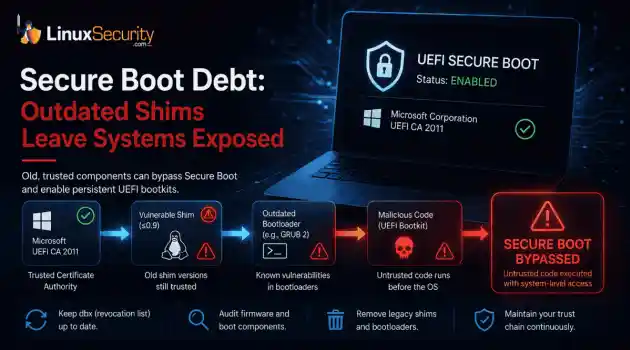
security advisory linux distribution ESET researchers identified 11 old and forgotten Linux UEFI shim bootloaders at versions 0.9 and below that can be used to bypass UEFI Secure Boot on any UEFI-based machine that trusts Microsoft’s Microsoft Corporation UEFI CA 2011 third-party certificate authority, regardless of the installed operating system (OS). Reported shims can be exploited to execute untrusted code during system boot, enabling attackers to deploy malicious UEFI bootkits even on systems with UEFI Secure Boot enabled.....
Jul 16, 2026
 Refine news
X Clear Filters
Get the latest News and Insights
Get the latest Linux and open source security news straight to your inbox.
Community Poll
Is continuous patching actually viable?
Loading...
Explore Latest Linux Security news
We found 6 articles for you...
74
 intrusion detectionbest practicessystem updates
Best Practices: Securing Linux from Bots, DDoS, and Threats
Linux systems have long been an indispensable asset to businesses and individuals alike. From running servers and cloud infrastructure to powering personal computers, Linux provides companies and individuals with unparalleled stability, flexibility, and security - making it the ideal platform for future development. . One of Linux's key advantages lies in its open-source nature. Since the code behind Linux has been made publicly accessible, developers and security professionals worldwide can use it to constantly audit, optimize, and reinforce systems for their specific needs - helping them stay ahead of everything from productivity to security issues. Linux is an attractive and secure solution, but that doesn't make it foolproof. Though its open-source nature makes Linux appealing, its vulnerability has allowed attackers to study its source code and devise exploits targeted explicitly against it. Understanding Linux Threats: How Malicious Bots Target Your System One of the most pressing threats to Linux systems today is malicious bots, which automate attacks such as brute-force login attempts, data scraping, and DDoS . Because cybercriminals have access to the same information ethical bodies do, there has been a constant race between security professionals and malicious actors ever since Linux grew popular, as both work to patch or exploit vulnerabilities as fast as possible. Because of these risks, it’s up to businesses and individuals using Linux to take a proactive approach to security, implementing all of the best practices to protect their Linux environments and ensure they can’t be successfully targeted. So, what are the best practices? Effective DDoS Prevention Strategies for Linux Systems When bots disrupt traffic, one of the best DDoS prevention strategies is combining advanced technology like AI with real-time threat analysis, creating a robust protection environment that can fight both simple and complex DDoS attacks. Looking at more straightforward attacks,security can be achieved by implementing multi-layered authentication or utilizing content delivery networks. CDNs work well to distribute traffic across multiple servers and absorb unexpected traffic spikes. But in 2025, things have become a little more complicated. Nowadays, it’s become necessary to utilize advanced software processes – processes that can analyze 5 trillion signals a day to detect and block known malicious bots and emerging threats. In the cybersecurity industry, speed is everything, and the right software will ensure you have the speed and accuracy to protect your Linux system. Boost Your Linux Security with Network Segmentation Techniques One of the big problems with cyber criminals is that they utilize lateral movement to infiltrate your network. By this, we mean if there are no barriers or segmentation between different parts of a Linux system, cybercriminals can easily access one part of the network and then most laterally or horizontally escalate their privileges. This allows them to exploit a single vulnerability to reach other critical systems across your entire network. By implementing network segmentation , however, you will mitigate this risk by dividing your network into smaller, isolated sections – or subnets. Each subnet can have its security policies and access controls, ensuring that even if a bot compromises one part of the network, reaching other areas without additional authentication is impossible. In addition to this, you should also be implementing firewalls to control inbound and outbound traffic. A well-configured firewall, for instance, can block unwanted visitors in the first place, limiting access to critical system resources and mitigating these initial attempts to exploit vulnerabilities. Stay Secure: The Importance of Regular Linux System Updates Lastly, the best practice we recommend for businesses and individuals is regularly updating their Linux systems . Even in 2025, simply keeping your Linux systems up to date is one of the mosteffective ways to protect them from malicious bots – particularly unpatched software that bots can easily leverage to compromise a network. Regularly applying security patches and updates from trusted sources ensures that your system remains strong, reliable, and consistently resistant to threats, which can ultimately minimize the risk of malicious bots exploiting any outdated components. Even without a fully-fledged IT team, this is doable. For instance, plenty of companies out there offer automated Linux patch management, helping to prevent delays in updates and ensuring they happen behind the scenes, eliminating the risk of human error and updates being missed. Implement Intrusion Detection Systems (IDS) Intrusion Detection Systems (IDSs) can help Linux administrators increase security by monitoring network traffic and system activity to detect any sign of malicious behavior or policy violations. Popular tools among Linux users for IDS use include Snort and OSSEC - two open-source network intrusion prevention systems using rule-driven language analysis of traffic while OSSEC offers a comprehensive host-based solution that integrates log analysis, integrity checking and alerting functionality - these allow administrators to quickly detect suspicious activities before any damage caused by malware infections occurs. Conduct Security Audits and Penetration Testing Conducting periodic security audits and penetration testing ensures a secure Linux environment. Security audits entail carefully reviewing your system's security posture to assess policy compliance while identifying weaknesses. Linux users can use tools like Lynis and Tiger to monitor security issues on their system, such as user accounts, software patch levels, and file permissions. Lynis is a security auditing tool, while Tiger performs in-depth system checks, including file permissions. Tiger is another Unix security checker that scans your system and provides detailed reports. Penetration testing helps identifyvulnerabilities before attackers exploit them, giving security teams time to discover them before attacks occur. Metasploit Framework and Nmap are invaluable for penetration testing on Linux systems. Metasploit provides a complete environment for writing and executing exploit code, while Nmap aids network discovery and security auditing. With these practices and tools in their arsenal, Linux users can proactively identify and mitigate security risks to safeguard themselves against potential malware attacks. Keep Learning about Best Practices for Securing Linux Systems Applying this – and the other best practices we discussed – will put you in the best position to earn all of the benefits of Linux systems without any of the negatives. We’re not saying you won’t still get targeted. Thousands of businesses and individuals are targeted every day. But through being proactive and applying these practices, you’ll be well placed to deal with the threats and keep your Linux systems operating smoothly and sufficiently. . Safeguarding Linux systems from invasive bots requires adopting best practices like regular software updates, firewalls, strong passwords, and two-factor authentication. Linux Security Practices, Malicious Bots Defense, DDoS Prevention Methods, Network Segmentation Strategies, Security Audits Tools. . MaK Ulac
 Jan 31, 2025
•
Jan 31, 2025
• Network Security
79
 security advisorysystem updatesKDE Plasma
KaOS: 2025.01 critical updates with KDE Plasma and Zen Browser
As the realm of Linux distribution expands, security admins find themselves faced with choosing a system that fits operational needs and upholds stringent security standards. Enter KaOS Linux 2025.01 , a release that promises both security and practicality. With its recent debut, this version stands out, primarily for its security-centric updates and intuitive user experience, tailored to meet the needs of administrators everywhere. . KaOS Linux 2025.01 has just hit the shelves, bringing several features that Linux security admins will find intriguing. This release is built on the robust foundation of the Linux Kernel 6.12 LTS, ensuring long-term support and frequent security updates crucial for maintaining a secure environment. With KDE Plasma 6.2, this version assures a modern, user-friendly experience and incorporates critical security enhancements that help mitigate vulnerabilities. The Firefox-based Zen Browser introduces advanced security features like phishing protection and tracking prevention, ensuring a safe browsing experience. What makes KaOS especially appealing is its rolling release model, which guarantees that systems stay up-to-date with the latest security patches and updates without major overhauls—just a simple sudo pacman -Syu keeps everything streamlined and secure. Other key components upgraded in this release are OpenSSL 3.4, Systemd 253.30, and Fwupd 2.0.4—each vital for system security and integrity. For admins looking to maintain a secure, efficient, and somewhat hands-off system, KaOS Linux 2025.01 stands out as a solid and practical choice. Let's examine this release in more depth to help you gain a better understanding of how it could benefit your Linux security administration. The Foundation: Linux Kernel 6.12 LTS A cornerstone of the KaOS Linux 2025.01 release is its Linux Kernel 6.12 LTS foundation. For those in the trenches of Linux administration, LTS is more than just an acronym—it promises stability and security over anextended period. Having an LTS kernel means regular security updates, addressing vulnerabilities as they're identified. Linux Kernel 6.12 patches existing issues and integrates enhanced security features, making it a reliable choice for environments where stability and security are paramount. Desktop Interface: KDE Plasma 6.2 The choice of KDE Plasma 6.2 as the desktop interface in this release isn't just about aesthetics, although its sleek design is a bonus. KDE Plasma is renowned for providing a stable, secure, and highly customizable user experience. KaOS 2025.01 is built on KDE Frameworks 6.10 and crafted with the latest Qt 6.8.1 technology. This means not just a beautiful interface but a secure one, with the latest protections against vulnerabilities that could be exploited through user interfaces. This represents a dual advantage for security admins: a user-friendly environment that supports productivity and a safe one that minimizes the risk of security breaches through well-managed applications and a secure windowing system. Zen Browser: A Secure Gateway to the Web Browsing the web remains one of the most common vectors for security vulnerabilities. Recognizing this, KaOS 2025.01 introduces the Zen Browser —a Firefox-based creation that prioritizes safety and modernity. By grounding itself in Mozilla’s robust security architecture, Zen Browser automatically inherits features like phishing protection, malware alerts, and tracking prevention, all vital tools for maintaining user security in a world rife with web-based threats. This is a significant boon for security administrators who must ensure that web interactions remain secure without compromising on the feature set that modern users expect. Zen Browser’s innovative edge also means staying ahead with features that promote security, efficiency, and ease of use. Continuous Security with a Rolling Release Model Perhaps one of the most compelling reasons for security admins to consider KaOS 2025.01 is its rollingrelease model. This approach ensures that software updates—including security patches—are released continuously. Instead of waiting for a major update or taking the risk of overlooking patches, admins can keep systems secure with a simple command: sudo pacman -Syu . It’s a straightforward method that significantly reduces downtime and keeps your security posture robust. In practical terms, this means fewer headaches managing updates and a streamlined process that security personnel can appreciate, knowing that their systems will always be at the cutting edge of security. Key Component Updates Beyond its primary features, KaOS 2025.01 updates several core components integral to preserving system security. Frequent updates to crucial software—such as OpenSSL 3.4 , Systemd 253.30, and Fwupd 2.0.4 —represent a commitment to maintaining a secure base for all operations. These components are critical for encryption, system initialization, and firmware updates. For instance, OpenSSL 3.4 is crucial for secure communications, offering robust encryption to safeguard data in transit. Similarly, Systemd's updates ensure a reliable and efficient startup sequence, mitigating risks that could arise from vulnerabilities in the system initialization phase. With Fwupd 2.0.4, firmware management becomes more secure, further fortifying the defense against potential security flaws. A Practical Choice for Security Administrators KaOS Linux 2025.01 represents a well-rounded choice for those managing Linux environments where security cannot be compromised. Integrating the latest technologies and updates in this distribution reflects a focus on current and long-term security needs. While the technical enhancements are impressive, the real selling point is their practical benefits. The user-friendly nature and robust security protocols make KaOS 2025.01 an intelligent, forward-thinking choice with fewer manual interventions to maintain system health and security. Linux security admins can divert theirattention to other critical tasks, confident in the reliability and safety of their operating system. Our Final Thoughts on KaOS Linux 2025.01 In a world where security is increasingly paramount, having an operating system like KaOS Linux 2025.01 is akin to having a dependable ally. Its LTS kernel, secure desktop environment, innovative Zen Browser, and effective update model combine to create a system that meets and exceeds the expectations of security-conscious admins. For those seeking a distribution that offers both security and practicality, KaOS 2025.01 undoubtedly deserves consideration. As threats evolve and the cybersecurity landscape becomes ever more complex, having a robust, secure, and up-to-date system is not just beneficial—it's essential. KaOS Linux 2025.01 provides precisely that. . ArchLinux 2025.02 brings stability and innovation for system administrators, highlighting essential enhancements alongside a contemporary user interface.. KaOS Linux 2025.01, Linux security updates, KDE Plasma security, Zen Browser features, rolling release Linux. . Brittany Day
Jan 30, 2025
•
Security Projects

77
 network monitoringmalwaresecurity threat
Bifrost Malware Targets Linux Servers With Deceptive Techniques
A new variant of Bifrost, a remote access Trojan (RAT), has been observed attacking Linux servers. The new variant, dubbed Bifrose, employs a deceptive domain name to evade detection. . Security researchers have stated, "The latest version of Bifrost reaches out to a command and control (C2) domain with a deceptive name, download.vmfare[.]com, which appears similar to a legitimate VMware domain." This is significant because it shows that attackers are getting more sophisticated in using socially engineered techniques to trick users. The use of this domain made domain name system (DNS) monitoring and blocking more difficult. To avoid detection, the malware also uses misleading domain names such as C2 instead of IP addresses. Why Is this Malware So Dangerous? The fact that stripped binaries were used indicates that the attackers employed this tactic to hinder analysis. This makes reverse engineering more difficult and time-consuming for security professionals. Additionally, it is concerning that researchers discovered that a malicious IP address hosts an ARM version of Bifrost, suggesting that attackers are attempting to increase the area of attack. These developments pose profound implications for Linux admins, infosec professionals, sysadmins, and internet security enthusiasts. These security practitioners must stay informed and prepared to defend against these types of attacks. They must be increasingly vigilant with system updates, network monitoring , staying up-to-date with the latest security patches , and access controls. It is important to be proactive in securing networks and systems against cyber threats. Our Final Thoughts on Bifrose Malware The new Bifrost malware targeting Linux servers employs enhanced deceptive tactics to infect systems and steal confidential information. The malware can bypass traditional security measures using typosquatting techniques, making it harder for even experienced security teams to detect and mitigate. With the rise of newly developedmalware using this deception, we must remain vigilant with our defensive measures. It is crucial for Linux admins, infosec professionals, internet security enthusiasts, and system administrators worldwide to actively look for and eliminate such malware to safeguard sensitive information and maintain the integrity of computer systems. . The latest iteration of Bifrost employs cunning strategies to avoid being spotted, specifically aiming at Linux systems, heightening the potential for security vulnerabilities.. Bifrost Malware, Linux Server Security, Remote Access Trojan. . Dave Wreski
Mar 02, 2024
•
Server Security
209
user managementsecurity strategysystem updatesEssential Strategies for Enhancing Linux Security Practices
Implementing robust security measures in Linux-based systems is essential and doesn't need to be complex. In this article, we'll provide an overview of key concepts and basic strategies you can use to fortify your Linux environment against evolving threats. . Key Concepts & Basic Strategies for Robust Linux Security It is crucial to understand that Linux security is multifaceted and encompasses user management, network design, and consistent system updates. User management forms the foundation of Linux security. Controlling user access and privileges to minimize the risk of unauthorized access and potential breaches is of critical importance. Regular system updates are also essential in maintaining overall security and integrity. Updates provide patches for vulnerabilities that attackers could exploit. The implementation of network segmentation is also a key defense mechanism against breaches. Admins should divide networks into smaller segments to limit the spread of breaches and use firewalls like iptables or ufw to control traffic flow and block unauthorized access. It is important to consider the impact of network design on security and how segmentation and firewalls can be optimized to safeguard Linux systems. Our Final Thoughts: What Are the Implications of These Insights? The implications of these suggestions for security practitioners are significant. The continuous nature of securing Linux environments and the need for constant vigilance and adaptation must be emphasized. The dynamic landscape of cyber threats has heightened the importance of keeping abreast of vulnerabilities and security advisories . In summary, the practical advice provided in this article will help admins and organizations strengthen their Linux security posture. User management, network design, and regular system updates are crucial in fortifying Linux environments against evolving threats. We hope that this overview has contributed to your understanding of the impact of Linux security on your roleas a security practitioner and open-source community member! . Understand essential principles and techniques to boost Linux defenses and safeguard against emerging risks efficiently.. Linux Security Strategies, User Management in Linux, System Updates Importance. . Brittany Day
Feb 08, 2024
•
Security Trends
212
 security advisorykernel securitysystem updates
Amazon Linux 2023 Enhanced Security And Predictable Updates
Earlier this week, Amazon announced the availability of Amazon Linux 2023, its third-generation Linux distribution. With this distribution, Amazon is promising three benefits: a high-security standard, a predictable lifecycle, and deterministic updates. . On the security front, Amazon says that its latest operating system comes with preconfigured security policies to help you set your system up to meet various common industry guidelines. The company says that these can be set during launch time or run time. Amazon Linux 2023 also comes with a hardened Linux kernel by default for added security. With regards to the lifecycle, Amazon will release new versions of its operating system every two years. These bigger updates will bring big changes to the kernel, toolchain, GLib C, OpenSSL, and other system libraries and utilities. In addition to these, security updates will be made available when ready and there will be quarterly updates that include security updates, bug fixes, and new features and packages. These quarterly updates will update stuff like language runtimes and popular software packages. . Amazon's latest Linux operating system boasts advanced security, consistent updates, and an enhanced kernel for better protection.. Amazon Linux, Cloud Optimization, Kernel Security, Lifecycle Management. . Brittany Day
Mar 23, 2023
•
Cloud Security
78
 system updateslinux mintupdate manager
Linux Mint Update Manager User Notifications Stir Controversy
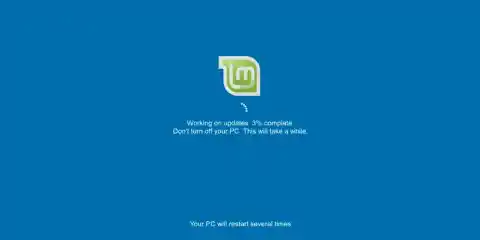
Linux Mint developers have decided to notify users about pending updates on their system, raising a controversial question - is Linux Mint turning into Windows? . The developers of Linux Mint, a popular Linux distribution, have announced a new feature for the Update Manager that's meant to encourage regular and frequent updates. Some users in the Linux community have scoffed at this, saying it's too much like Windows' infamous forced updates. So what's really going on? . The introduction of the Update Manager in Linux Mint has ignited conversations regarding the balance of user notifications and the schedule of updates relative to Windows operating systems.. Linux Mint, Update Manager, User Notifications. . LinuxSecurity.com Team
Apr 14, 2021
•
Vendors/Products
79
 security measurespatch managementopen source
Essential Security Updates for Linux Distros And Patch Management
If you. Today we The link for this article located at ITS Tatictical is no longer available. . Enhance your Linux security with effective patch management and timely software updates. Discover essential strategies to strengthen system resilience against threats. Linux Patch Management, System Update Practices, Open Source Security Protocols. . LinuxSecurity.com Team
Dec 19, 2011
•
Security Projects
77
security advisoryrisk managementsecurity protocolsCrucial Steps to Ensure Security in Linux Operating Systems
There's no dearth of Linux distributions to choose from. With so many to choose from, one might think it's as easy as picking up the Linux kernel, throwing in a few applications, setting up respositories, making ISOs and you've got a shiny new Linux distro. Well, there's more to a Linux distro than assembling applications and making sure everything works. A lot of time and effort, at least for major distros, is spent on making the distribution secure and getting updates out in a timely fashion. To start with, all major distributions have security teams that collaborate with the main release team to ensure no vulnerable packages make their way into the final release. For example, Chris Gianelloni, release engineering strategic lead of Gentoo says that the release engineering team works with Gentoo's security team and individual architecture teams to make sure Gentoo doesn't have security vulnerabilities when Gentoo is released. . The link for this article located at Linux.com is no longer available. . The link for this article located at Linux.com is no longer available.. choose, there's, dearth, linux, distributions, might. . LinuxSecurity.com Team
Dec 08, 2006
•
Server Security

Get the latest News and Insights
Get the latest Linux and open source security news straight to your inbox.
Community Poll
Is continuous patching actually viable?
Search Topics
Powered By

Linux Security - Your source for Top Linux News, Advisories, HOWTOs and Feature Releases
QUICK LINKS
subscribe to newsletters!
Like staying secure? So do we.
Sign up for updates, tips, and alerts!