Explore top 10 tips to secure your open-source projects now. Read More
×


HTTP/2 Bomb: Why Linux Infrastructure is Vulnerable to a New Low-Bandwidth DoS Attack
 Jun 04, 2026
•
Jun 04, 2026
•
 MaK Ulac
3 - 5 min read


A newly disclosed attack technique called HTTP/2 Bomb is drawing attention because it targets the software that sits at the front of much of the Linux internet. Apache HTTP Server, NGINX, Envoy, and the ingress layers that many Kubernetes environments depend on can be forced into consuming disproportionate amounts of memory using relatively small amounts of attacker traffic.
For Linux administrators, the concern is not the HTTP/2 protocol itself. It is the possibility that a single low-bandwidth attacker could disrupt the web servers, reverse proxies, and application gateways responsible for keeping production workloads online.
The "Resource Amplification" Trap
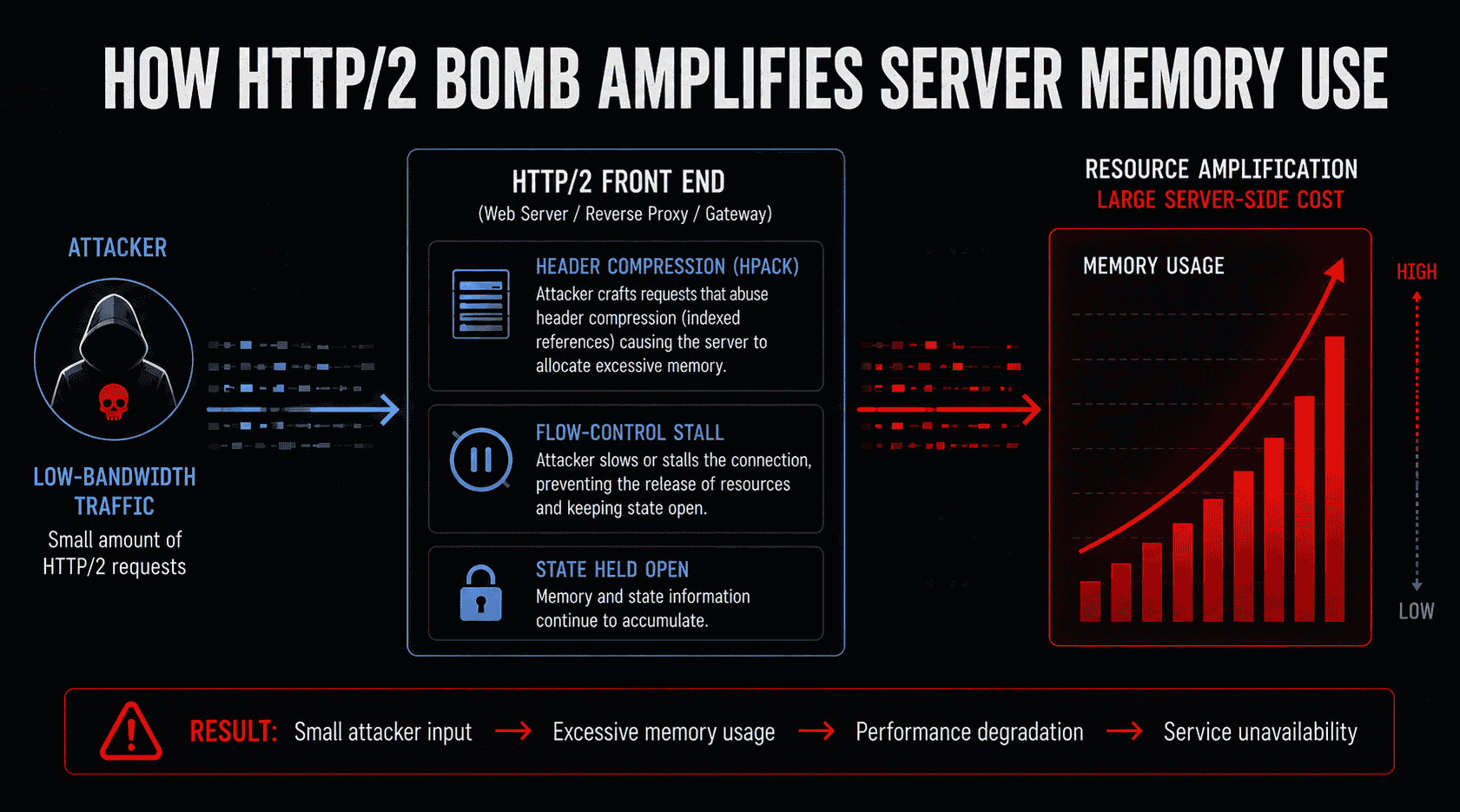
Researchers at Calif recently disclosed the technique, describing how HTTP/2 header compression and flow-control mechanisms can be abused to trigger significant memory consumption on affected systems. The attack combines a compression bomb with connection-stalling behavior, creating a situation where server resources continue accumulating while requests remain active.
Most denial-of-service planning assumes attackers need large botnets or substantial network capacity. HTTP/2 Bomb shifts the burden onto the server itself. The attacker sends relatively little traffic while the target allocates memory, maintains state information, and struggles to reclaim resources quickly enough to remain responsive.
Why Apache, NGINX, and Envoy are Ground Zero
This attack is generating noise because it affects the technologies Linux administrators deploy every day.
- Apache and NGINX remain dominant web server platforms across hosting providers, enterprise environments, and public-facing applications.
- Envoy has become a foundational component of modern cloud-native infrastructure, appearing inside API gateways, service meshes, and Kubernetes ingress controllers.
When these components experience resource exhaustion, the consequences extend beyond a single application. Reverse proxies stop accepting connections. API gateways become bottlenecks. Load balancing layers degrade. Kubernetes workloads may remain perfectly healthy while the infrastructure responsible for routing traffic to them begins failing under pressure.
How the Mechanics Work: HPACK and Flow-Control Abuse
HTTP/2 was designed to improve efficiency by reducing the overhead associated with traditional web traffic. One of the core features is HPACK, a header compression mechanism that minimizes data exchange by storing and reusing previously transmitted header information.
According to the research, attackers can abuse HPACK’s indexed-reference system to trigger memory expansion on the receiving server. Relatively small requests force the target to allocate significantly larger amounts of memory than the attacker contributes.
The second stage is what makes this a practical threat. Researchers combined this header abuse with HTTP/2 flow-control behavior that slows the release of allocated resources. Instead of freeing memory, affected systems hold state information while additional requests accumulate. The resource consumption grows until performance degrades or services become unavailable—effectively creating a "Slowloris" for memory.
Why Kubernetes Operators Should Pay Attention
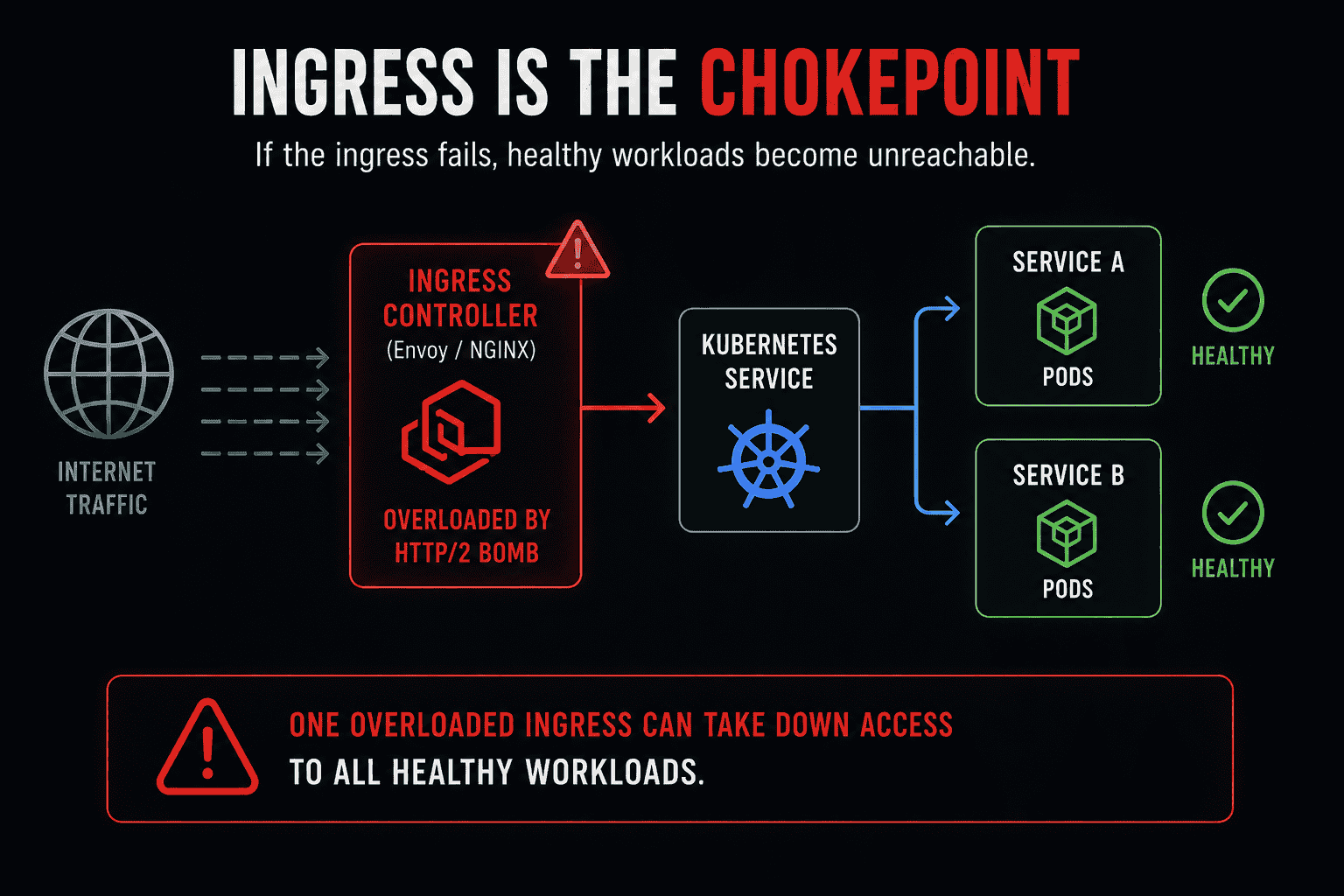
The Kubernetes angle is particularly critical. Many organizations have shifted infrastructure toward Envoy-based architectures and gateway technologies. Traffic that once flowed directly to a web server is now routed through increasingly sophisticated networking layers designed to provide observability and security.
That architecture delivers benefits, but it also concentrates risk. When ingress or gateway infrastructure becomes unstable, healthy workloads become inaccessible. For Kubernetes operators, the question is not simply whether a workload is vulnerable; it is whether the infrastructure supporting that workload can continue handling traffic efficiently when exposed to this style of resource amplification.
Current Patch Status and Mitigation
Vendors have already begun responding:
- NGINX introduced a new max_headers directive to limit accepted request headers.
- Apache updated mod_http2, improving header accounting and addressing conditions associated with the attack.
Administrators should review vendor guidance directly and verify patch levels across production environments rather than assuming repository updates have reached every system. Internet-facing systems—specifically reverse proxies, API gateways, and ingress controllers—should be prioritized.
What Linux Administrators Should Do Right Now
The immediate priority is visibility.
- Identify Exposure: Identify which internet-facing systems currently support HTTP/2. Many organizations enabled it years ago and have rarely revisited those configurations.
- Validate Patching: Review vendor guidance, confirm software versions, and ensure updates are applied consistently across production, staging, and disaster recovery.
- Monitor Resource Patterns: Attacks based on resource amplification look different from volumetric DDoS. Monitor for growing memory utilization, worker exhaustion, connection failures, or unstable performance from systems that appear to be receiving modest traffic.
- Evaluate Ingress Routing: Kubernetes operators should review how HTTP/2 traffic terminates, is inspected, and is routed. Identifying where requests are handled is the first step in determining which components will experience pressure.
The Bigger Lesson for Linux Defenders
The most interesting aspect of HTTP/2 Bomb is the reminder that modern Linux infrastructure depends heavily on layers of software designed to improve efficiency. Those same optimizations can become attack surfaces when researchers discover ways to force systems into consuming resources faster than they can recover them.
Linux administrators spend considerable effort defending against exploits and privilege escalation, but some of the most disruptive incidents begin with something far less dramatic. A trusted protocol feature behaves in an unexpected way, critical infrastructure starts consuming resources faster than anticipated, and the systems responsible for keeping applications online become the weakest point in the environment. HTTP/2 Bomb is a story about infrastructure resilience—ensure your Apache, NGINX, and Envoy deployments are ready for it.
Related Reading
- Critical NGINX Vulnerability CVE-2026-42945: What Linux Admins Should Check Now
- Securing Remote Access to Linux Servers: Best Practices for 2026
- Linux IDS vs IPS: Operational Differences and Deployment Tradeoffs
- How to Diagnose Suspicious Outbound Connections on Linux Servers
- How to Respond After Detecting a Compromised Linux Server
 PREVIOUS

 NEXT
NEXT

Powered By

Linux Security - Your source for Top Linux News, Advisories, HOWTOs and Feature Releases
QUICK LINKS
subscribe to newsletters!
Like staying secure? So do we.
Sign up for updates, tips, and alerts!