


Stay Ahead With Linux Security Features

 security advisory attack
 A Linux server gets cleaned up after an intrusion. The suspicious process is terminated, credentials are rotated, and the system is rebooted during maintenance. Everything seems secure. A few hours later, the same outbound connection appears again. . Situations like that point to persistence . The attacker no longer needs the original exploit because something on the host continues restoring access behind the scenes. Finding that mechanism is often more important than understanding how the...
 Jun 08, 2026
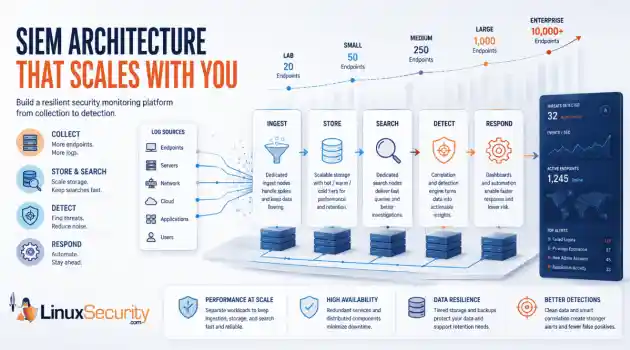 threat detection scalability
 Building a SIEM is easier than scaling one. Most open-source deployments start as a simple "all-in-one" server. It is easy to set up, but that design rarely survives the transition from a lab to a production workload. . A SIEM watching 20 endpoints is not doing the same job as one watching 500. More endpoints mean more logs; more logs require more storage; more storage makes search heavier. Eventually, the very architecture that made your lab easy to deploy becomes the reason your production...
Jun 04, 2026
 security advisory apache
 A newly disclosed attack technique called HTTP/2 Bomb is drawing attention because it targets the software that sits at the front of much of the Linux internet. Apache HTTP Server, NGINX, Envoy, and the ingress layers that many Kubernetes environments depend on can be forced into consuming disproportionate amounts of memory using relatively small amounts of attacker traffic. . For Linux administrators, the concern is not the HTTP/2 protocol itself. It is the possibility that a single...
Jun 04, 2026
 security advisory important
 The compromise of Nx Console shows how much infrastructure now sits behind a single developer account. GitHub repositories, CI/CD pipelines, container build systems, Terraform projects, Kubernetes deployments. None of those systems was the initial target. The workstation was. . Attackers did not need a Linux privilege escalation bug or a remote code execution chain. They needed developers to trust a tool they were already using. For many organizations, that was enough. What Happened? Federal...
Jun 03, 2026
 security advisory open-source
 You remove the malware. You rotate the compromised credentials. You patch the original vulnerability and close the ticket. Two weeks later, the attacker is back. . What happened? You didn't lose the battle at the exploit; you lost it at the cleanup. In many modern Linux intrusions, the malware you found wasn't the main problem—it was the fallback mechanisms left behind. These hooks quietly restore attacker access the moment you look away. If you clean a host but miss these persistence layers,...
Jun 02, 2026
 Refine features
X Clear Filters
Get the latest News and Insights
Get the latest Linux and open source security news straight to your inbox.
Community Poll
What got you started with Linux?
Loading...

Explore Latest Linux Security features
We found -4 articles for you...
102
 social engineeringdns securitymalware prevention
AI-Driven Cybersecurity Upgrades: 3 Strategic Uses
With the increasing pace and complexity of digital attacks, analysts are turning to AI threat detection to stretch IT resources and keep out cyber threats. No matter the size of a company's operations, AI-driven data analytics tools can provide threat intelligence and enable cybersecurity professionals to select appropriate protection measures. . Various industries have been using AI-powered cybersecurity strategies to: Protect employees from social engineering attacks Ensure network safety against DNS threats Prevent malware attacks In this article, we’ll discuss these three use cases to examine the impact of artificial intelligence on cybersecurity. 1. Protection From Social Engineering Attacks Today, social engineering comes in many shapes, and phishing attacks are always a problem. They could start with a weird-looking email that pops up on your company’s account. Maybe it’s a bad actor impersonating a partnered brand in an attempt to swindle information. Attackers could also try to get employees to click on a link to their malicious website. It mimics real login portals for entering sensitive information about clients or the business. The major problem with these types of attacks is that it can be hard to separate what’s genuine from what’s not. That’s where AI threat detection has an advantage: deep learning tools can analyze patterns to determine if an incoming message has hostile intent, and warn users before they click. In this way, AI security tools can shield businesses from phishing, spear phishing, and other social engineering attacks. Google is already using deep learning to protect its Gmail users from phishing attempts in the same manner. The search engine giant uses a combination of deep learning and computer vision to screen billions of image-based emails, like you’d do in a big data analytics project , and then quarantine possible threats. Deep learning is a more comprehensive approach to machine learning, in which an AI“brain” learns to solve problems on its own. Unlike basic machine learning, where algorithms learn only from labeled data, deep learning takes in large quantities of statistics. A deep neural network forms and evolves beyond examples to deal with new threats, unfamiliar to the system. So even if your business faces a new threat that the system hasn’t learned from yet, the algorithm should still be able to offer protection. If you were to receive spam or phishing emails, the DL neural network would block these emails from even getting into your company's networks. The criteria for social engineering blocking may flag down newly created domain messages and suspicious hard-to-read emails, among other metrics that cybersecurity analysts can fine-tune according to their needs. 2. DNS Threat Detection DNS is essentially the Internet’s directory. When we look up some of our favorite websites, we type in phrases or domain names such as espn.com or google.com. A DNS translates these website names into a language that devices can understand and work with, namely IP addresses. In a nutshell, the DNS enables movements between websites. Your company may be vulnerable to a DNS security threat in one of two ways. The first is a Distributed Denial-of-Service attack. During DDoS attacks , your DNS server is overloaded with so much traffic that it cannot attend to legitimate queries from real clients. The second type of DNS threat is an amplification attack. What happens here is that your client is directed to a knock-off version of the business website. Despite typing in the correct address, the compromise in the DNS means your clients land elsewhere and type in sensitive login details into this deceptive website. There are various ways to prevent DDoS attacks before they happen. Businesses can defend against DNS cyberattacks like these by identifying threats with AI-driven network monitoring. AI intrusion detection systems watch all network traffic as it flows in and out ofDNS servers. Then, it can separate legitimate website user requests from malicious requests meant to overwhelm the system. Financial institutions, an industry prone to DNS threats, are putting AI-driven DNS solutions to work with software that entails a database of previous cyber threats, and cross-checks all the DNS traffic against a checklist of what an attack would look like. When this software notices data anomalies that may indicate a DNS maneuver, it alerts human IT staff, who then take corrective action. They could deny the request, or even call up the client in the case of a pending transaction. 3. AI-Driven Malware Identification Relying on traditional antivirus packages means limited protection, because they are programmed to protect companies from known threats. Signature-based antivirus software isn’t much help when businesses are up against new malware signatures they cannot detect. An AI-powered antivirus software, on the other hand, protects your business from both the known and emerging varieties of malware. Adaptive antivirus technology runs on AI/ML frameworks . Instead of relying on a signature list to identify threats, AI-driven antivirus software uses an anomaly detection system. It doesn’t need to sync with known malware signatures because it monitors individual programs to detect suspicious behavior. So if a new type of malware has hijacked one of your workplace programs, like MS Office, the AI-powered antivirus will take note of the app’s unusual behavior. The program will then be singled out for a scan, and the threat is excavated from hiding and eliminated. Add AI Threat Detection to Your Cybersecurity Strategy There are many benefits to be gained from AI defensive measures. AI-powered antivirus software, DNS threat-detecting networks, and AI social engineering protection offer adaptability to new threats and faster detection and response times. Cybercriminals are leveraging new technologies to circumvent traditional digital securitystrategies and forcing Linux security systems to adapt. By incorporating AI threat detection into their networks, businesses can effectively counter emerging cyber threats. . Artificial intelligence is transforming cybersecurity by improving defenses against threats like ransomware and phishing through advanced AI algorithms for quick detection. AI Cybersecurity Solutions, Threat Protection Methods, Machine Learning in Security. Lerma. Andrew Kowal
 Apr 25, 2026
•
Apr 25, 2026
•

Get the latest News and Insights
Get the latest Linux and open source security news straight to your inbox.
Community Poll
What got you started with Linux?
Search Topics
Powered By

Linux Security - Your source for Top Linux News, Advisories, HOWTOs and Feature Releases
QUICK LINKS
subscribe to newsletters!
Like staying secure? So do we.
Sign up for updates, tips, and alerts!
Discover faster search, smarter navigation, and deeper Linux security insights. Read More