


Stay Ahead With Linux Security Features

 security advisory attack
 A Linux server gets cleaned up after an intrusion. The suspicious process is terminated, credentials are rotated, and the system is rebooted during maintenance. Everything seems secure. A few hours later, the same outbound connection appears again. . Situations like that point to persistence . The attacker no longer needs the original exploit because something on the host continues restoring access behind the scenes. Finding that mechanism is often more important than understanding how the...
 Jun 08, 2026
 threat detection scalability
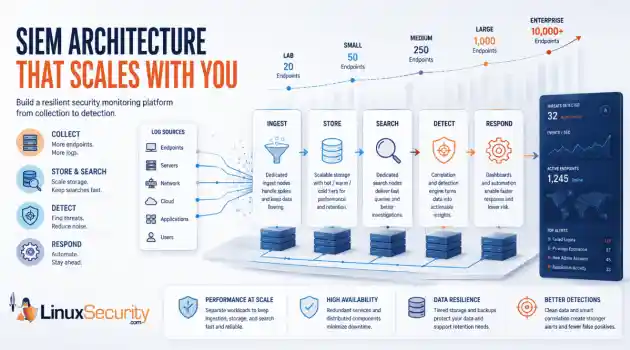
 Building a SIEM is easier than scaling one. Most open-source deployments start as a simple "all-in-one" server. It is easy to set up, but that design rarely survives the transition from a lab to a production workload. . A SIEM watching 20 endpoints is not doing the same job as one watching 500. More endpoints mean more logs; more logs require more storage; more storage makes search heavier. Eventually, the very architecture that made your lab easy to deploy becomes the reason your production...
Jun 04, 2026
 security advisory apache
 A newly disclosed attack technique called HTTP/2 Bomb is drawing attention because it targets the software that sits at the front of much of the Linux internet. Apache HTTP Server, NGINX, Envoy, and the ingress layers that many Kubernetes environments depend on can be forced into consuming disproportionate amounts of memory using relatively small amounts of attacker traffic. . For Linux administrators, the concern is not the HTTP/2 protocol itself. It is the possibility that a single...
Jun 04, 2026
 security advisory important
 The compromise of Nx Console shows how much infrastructure now sits behind a single developer account. GitHub repositories, CI/CD pipelines, container build systems, Terraform projects, Kubernetes deployments. None of those systems was the initial target. The workstation was. . Attackers did not need a Linux privilege escalation bug or a remote code execution chain. They needed developers to trust a tool they were already using. For many organizations, that was enough. What Happened? Federal...
Jun 03, 2026
 security advisory open-source
 You remove the malware. You rotate the compromised credentials. You patch the original vulnerability and close the ticket. Two weeks later, the attacker is back. . What happened? You didn't lose the battle at the exploit; you lost it at the cleanup. In many modern Linux intrusions, the malware you found wasn't the main problem—it was the fallback mechanisms left behind. These hooks quietly restore attacker access the moment you look away. If you clean a host but miss these persistence layers,...
Jun 02, 2026
 Refine features
X Clear Filters
Get the latest News and Insights
Get the latest Linux and open source security news straight to your inbox.
Community Poll
What got you started with Linux?
Loading...
Explore Latest Linux Security features
We found -1 articles for you...
102
 Linux securityopen source toolsrisk mitigation
Enhancing Linux Security with Breach Simulation Techniques
Cybersecurity threats have reached a new level of prevalence and sophistication, and innovative methods and tools are urgently needed to protect sensitive information. Recent statistics are eye-opening: According to Statista, 2,365 recorded cybersecurity attacks in 2023, a surprising 72% growth compared to 2021. . As these attacks become increasingly advanced, traditional security measures must be more robust. Organizations must know the latest forensic Linux distro updates and adopt advanced security protocols that protect them from data breaches and operational disruptions. Breach and attack simulation, or BAS, is emerging in this domain as one of the best modern protection methods. In this article, we will discuss BAS, why it is so essential for Linux environments, and some of the most well-known open-source tools available. What is Breach and Attack Simulation? Breach and Attack Simulation , BAS, is a cybersecurity mechanism conducted to act much like real-world attackers. BAS permits an organization to identify the weak points of its security frameworks by simulating controlled cyberattacks. According to MarketsandMarkets, the BAS market is expected to grow at a CAGR of 22.1% during the forecast period, reaching $3.5 billion by 2032. BAS offers essential insight into an organization's security posture by emulating cybercriminal tactics. It provides a balance sheet of strengths and weaknesses, offering an overall perspective on the capability of security measures to withstand real cyberattacks. In this dynamic world of cyber threats, BAS is earmarked as one of the pivotal weapons in the cybersecurity armory. Why is BAS So Important in Linux and Open-Source Systems? Linux and open-source environments are a dream for an attacker, both because of widespread enterprise usage and due to some inherent vulnerabilities that might persist within the code contributions that occur in open-source. With BAS, organizations can stay one step ahead of cybercriminals by discovering what maygo wrong in the security framework before it happens. It is integral to proactive risk mitigation against data breaches , regulatory fines, and reputational damage. By emulating a range of attack vectors using comprehensive feeds of up-to-date data on emerging threats, organizations get to shore up the gaps in their defenses before those gaps can be leveraged. Most Famous Breach and Attack Simulation Open Source Tools for Linux BAS is a fundamental approach to cybersecurity improvement, and several open-source tools make implementing it possible. The following are some of the most well-known BAS tools for Linux: Metasploit Framework Metasploit Framework is generally regarded as among the most advanced open-source tools for penetration testing and security validation. It consists of tools intentionally developed to mimic actual attacks and assess a security posture. Its immense repository of publicly available exploits permits users to deliver various attack vectors against the exploited systems by crafting custom-made payloads. Critical capabilities of Metasploit include: Post-Exploitation Modules: Such modules provide post-exploitation information gathering, privilege escalation, and access maintenance. Automation Capabilities: It allows users to run scripts, increasing efficiency in security testing and information-gathering processes. Vulnerability Scanning: Metasploit is usually used to exploit any known vulnerability on a Linux system and to test the effectiveness of the available security controls. Start with Metasploit. Install it on any Linux system, open the framework, and use auxiliary modules for vulnerability scanning . Then, look for exploits, identify them, and launch them, using meterpreter to post-exploit. Infection Monkey Another well-known open-source BAS tool is Infection Monkey by Guardicore. This tool emulates various attack techniques to test the security of a data center or cloud environment from cyber threats. It identifies weakspots, misconfigurations, and gaps in an organization's security posture. Key Features of Infection Monkey: Lateral Movement Simulation: This feature exposes how an attacker can move inside a network after gaining initial access. Compliance Testing: Infection Monkey does compliance testing against CIS benchmarks , ensuring a system is securely configured. Customizable Attack Vectors: Users can define attack scenarios fitting for organizational needs. To deploy Infection Monkey, ensure your environment matches the system requirements. Then, clone the software from its GitHub repository , install the required dependencies, and open the user interface with a web browser, where you can create and configure attack scenarios. CALDERA CALDERA is an open-source, next-generation tool that provides automated adversary emulation, red teaming, and security assessment. It uses the MITRE ATT&CK framework to perform realistic attack scenarios and help organizations improve their security posture insights. Key Features of CALDERA include: Modularity: Caldera's modularity makes it extensible through plugins, allowing organizations to tailor simulations for threats specific to their concerns. Automation and Central Management: This is done by providing a server-side interface from which the administration of simulations is quickly done centrally. Realistic Attack Scenarios: Because its actions map to ATT&CK techniques, CALDERA helps an organization fix critical vulnerabilities in its defenses. For the use of CALDERA, target systems will need to have Python, Git, and Docker installed. A clone can be made from GitHub and placed in a virtual environment where one creates and installs the requirements to open a web interface to generate and execute attack scenarios. Understanding the Importance of Including BAS in Cybersecurity Strategies Organizations can no longer afford to implement only responsive cybersecurity measures. Proactive steps arecritical to protect digital assets. Some of the top benefits derived from integrating BAS into cybersecurity include: Enhanced Security Posture : BAS allows organizations to detect and fix vulnerabilities before attackers can leverage them. This proactive approach improves the security posture overall, lessening the chances of successful cyberattacks. Data-Driven Decision Making: BAS gives valuable insights to organizations through attack simulations, after which informed decisions can be made on investments and improvements in security. It facilitates resource optimization for them by prioritizing areas of enhancement. Improved Incident Response: BAS assists an organization in refining its incident response plan by emulating realistic attack scenarios. Teams will know where their response mechanisms are lacking and can incorporate improvements for swift and effective responses against live threats. Cost Savings: Proactively addressing vulnerabilities using BAS can save an organization millions of dollars in costs related to data breaches, regulatory fines, and damage to brand reputation. The investment made in tools and simulations can result in significant long-term savings. Our Final Thoughts on the Importance of BAS for Robust Linux Security With the increased Linux security threats, protecting digital assets requires advanced tools and techniques. For organizations to adapt to today’s evolving threats, Breach and attack simulation is necessary. BAS replicates real-world attacks to assess security postures and provide actionable insights. Tools like Metasploit Framework, Infection Monkey, and CALDERA will automatically help an organization identify weak links and thus improve security measures and incident response. Organizations must stay current on emerging threats and the tools required to mitigate them. Equipped with BAS at the forefront of their cybersecurity strategies, they are better set to navigate this complex world of cybersecurity successfullyand defend against an expanding array of attacks. In other words, adopting BAS is not an option but a necessity for organizations committed to robust security postures in this digital age. Are you using BAS to improve your cybersecurity strategy? We'd love to hear about it! Reach out to us on X @lnxsec, and let's discuss it. . As cyber threats grow sophisticated, organizations must adopt breach simulation techniques and tools to improve Linux security.. cybersecurity, threats, reached, level, prevalence, sophistication, innovative. . Dave Wreski
 Oct 31, 2024
•
Oct 31, 2024
•
102
 security toolslinux securityattack simulation
Advanced Breach And Attack Simulation Tools For Linux Security Strategies
Cybersecurity threats are becoming more imminent daily in today's fast-paced digital landscape. In 2023, there were 2365 cybersecurity attacks, an increase of 72% from 2021. These attacks are also becoming more sophisticated daily, making traditional security measures inadequate. . Companies must resort to more advanced security methods to prevent the loss of sensitive data and operational disruption due to security threats. In this article, we’ll explore how you can use Breach and Attack simulations (BAS), a cutting-edge cybersecurity technique, to protect your organization from cybersecurity threats. What Is Breach and Attack Simulation (BAS)? Breach and attack simulation, abbreviated as BAS, is a modern-day cybersecurity mechanism replicating real-world attackers' behavior. It's rapidly gaining popularity, with a market value projected to reach $3.5 million by 2032 with a CAGR of 22.1%. BAS technology allows you to simulate controlled cyberattacks to assess how ready your company’s security posture is against a real cyberattack. It copies real-world cybercriminals' tactics and helps point out your organization’s strengths, weaknesses, and areas for improvement when faced with cyberattacks. Why Is BAS Critical in Linux and Open-Source Ecosystems? BAS is critical for robust cybersecurity in Linux and open-source environments for the following reasons: Identifying Threats Proactively BAS allows you to stay one step ahead of cyber criminals by letting you identify potential vulnerabilities in your company’s security framework beforehand. These simulations are based on vast data on emerging threats and can implement various scenarios in your company. That way, your organization can mitigate the risk of costly data breaches, regulatory fines, and reputation damage before it even happens. It also facilitates a culture of constantly improving your security system, a need of the current dynamic cybersecurity world. Your security and IT team can conduct simulationsregularly and incorporate lessons learned in each iteration to identify repetitive issues in your system over time. With this iterative approach, you can build a strong security posture over time. Realistic Threat Scenarios Another significant advantage of BAS is that you can analyze your organization’s security posture. Unlike traditional tests of system vulnerability, which apply across the entire system, BAS has a more holistic approach to evaluating system security by launching a controlled attack on a specific aspect of your security infrastructure. You can use hacker TTPs, tactics, and procedures to identify blindspots you might not see unless an actual attack happens. Resource Allocation A holistic and iterative approach to improving your company’s security footprint means your budget is allocated more efficiently. With BAS, you can reallocate limited resources to address critical security issues. This will let you eliminate threats on a priority basis and significantly reduce the probability of an imminent damaging attack. What Are the Top Open-Source Breach and Attack Simulation Tools for Linux? BAS is a vital strategy in cybersecurity , and different tools facilitate BAS simulations. Here are some of our favorite open-source tools: Metasploit Framework The Metasploit framework is one of the most popular and powerful open-source tools for penetration testing and security validation. It provides a comprehensive suite of tools to stimulate real-world attacks and assess the security posture of systems and networks. In Metasploit, you have a vast repository of publicly available exploits for Linus and customizable payloads that can be delivered to exploited systems to perform various tasks, such as establishing remote access. It also has some auxiliary modules that perform scanning, fuzzing, and other types of testing without exploiting vulnerabilities. Post-exploitation modules are available for gathering information, escalating privileges, and maintainingaccess. Metasploit also allows for the automation of tasks using scripts. It is commonly used to scan for known vulnerabilities in Linux systems and stimulate attacks by exploiting known vulnerabilities to test the effectiveness of security controls. To stimulate attacks with Metasploit, install it on a Linux system and launch it. Use auxiliary modules to scan for vulnerabilities. After you search for, figure out, and launch exploits, use the meterpreter payload to perform post-exploitation tasks. Infection Monkey Infection Monkey is an open-source BAS tool developed by Guardicore. It stimulates various attack techniques to test the resiliency of data centers and cloud environments against cyber attacks. It also helps organizations identify vulnerabilities, misconfigurations, and weaknesses in their security posture. Its key features include attack simulation by lateral movement, which stimulates how an attacker can move within the network after gaining initial access. Similarly, it also tests the network’s susceptibility to credential theft attacks. Infection Monkey is also helpful in testing compliance with CIS benchmarks to ensure systems are configured securely. It identifies common misconfigurations that attackers could exploit. It allows customization of attack vectors to match specific threat models and organizational needs, and users can define custom payloads for more specific attack simulators. To deploy Infection Monkey in Linux, verify that your environment meets the system requirements for running Monkey Island and Monkey agents. You can clone the software from its repository on GitHub and install the necessary dependencies to set it up. You can access the interface through a web browser and follow the on-screen instructions to complete the initial setup and configuration. Then, you can define attack scenarios and start your simulation. CALDERA CALDERA is an open-source platform developed by MITRE to automate adversary emulation, red teaming, and securityassessment. It runs on the MITRE ATT&CK framework to simulate realistic attack scenarios, helping organizations understand their security posture and improve their defenses. Its key features include modularity through easily extendable plugins, flexibility, automation, and central management through its server interface. CALDERA utilizes the MITRE ATT&CK framework, a knowledge base of adversary tactics and techniques based on real-world observations. CALDERA maps its actions to ATT&CK techniques to create custom attack scenarios that reflect specific adversaries or threat models relevant to the organization. This allows you to gain insights into potential attack paths and vulnerabilities, focus on the most critical vulnerabilities and misconfigurations, and improve your defenses based on the simulation results. To run CALDERA, you will need Python, 3.6+, Git, and Docker on your system. Then, clone the CALDERA repository from GitHub and create and activate a virtual environment. Once you install the necessary dependencies, start the CALDERA server and access its web interface on a web browser. You can use the web interface to generate an agent for your target Linux machines, transfer it, and execute it. CALDERA can also create attack scenarios using ATT&CK techniques. How Can I Set Up and Run Simulations? Implementing breach and attack simulations in your company includes, but is not limited to, defining clear objectives, threat intelligence, and simulation tool selection, especially if your company has a Linux-based system. The first step to implementing BAS, or any advanced security framework in Linux, is to define the program's scope. This lets you determine whether your simulations will target Linux-specific attacks like malware or insider threats or run a comprehensive broad-spectrum attack scenario irrespective of the operating system. Once you’ve defined what purpose you want BAS to serve, you can select whether you want network-based, endpoint-based, or hybrid simulations. This choicewill also depend on your system requirements. Once you’ve chosen the appropriate BAS framework, you’ll have to test run several simulations and iterate to determine the more optimized testing for your system. You can use already-designed compatible simulation tools like Metasploit, OpenVAS , etc., to improve your system’s adaptability to BAS. Best Practices for Linux Security Validation Here are some practical tips for Linux Security Validation admins should implement: Frameworks and Methodologies for Structuring BAS Exercises BAS exercises continuously assess and improve an organization’s security by stimulating a real-world cyberattack scenario. One common BAS framework is the MITRE ATT&CK framework, which is helpful in mapping exercises to cover a wide range of tactics and identifying gaps in your current detection capabilities. Similarly, the NIST ( National Institute of Standards and Technology Cybersecurity Framework (CSF) is used for BAS exercises and has five primary functions: identifying crucial vulnerabilities, protecting assets by implementing controls, detecting cybersecurity events, responding to an incident, and recovering to ensure business continuity. Strategies for Effective Vulnerability Management Effective vulnerability management involves identifying, assessing, and systemically mitigating vulnerabilities. One common strategy is patch management, in which you must develop a comprehensive policy that prioritizes patches based on the severity of vulnerabilities. You can configure management tools like Ansible, Puppet, and Chef to automate this process and reduce human errors. You should also have a framework to prioritize vulnerabilities. One such framework leverages the Common Vulnerability Scoring System (CVSS) scores. When prioritizing remediation efforts, consider how critical your affected assets are. Continual Optimization for Threat Model Validation in Linux Systems You must regularly review and update your threat models for continuousoptimization. Ideally, you should update your models once every three months. Ensure the threat model contains all components and integrations and involves key stakeholders from development, operations, and security teams in the review process. You can use automated threat modeling tools like Pytm to automatically create and update threat models and integrate them into your DevSecOps pipeline. These tools help scale your threat modeling efforts in complex environments. Similarly, red team exercises where you stimulate sophisticated attacks are also crucial for threat model validation. Case Studies and Real-world Applications BAS can be successfully implemented on Linux platforms. Let’s take the case of a financial institution using Infection Monkey to improve the security of its Linux-based servers. It deployed Infection Monkey across the institution's data centers and stimulated lateral movement, credential theft, and privilege escalation scenarios. As a result, the institution identified several vulnerabilities, such as outdated software and weak passcodes. We can also take the example of a Tech Startup utilizing Metasploit for proactive security testing to analyze the improvement of security postures through open-source BAS tools. They used the Metasploit framework to test their Linux servers' security, including SQL injection, cross-site scripting (XSS), and remote code execution attacks. These simulations helped them discover critical vulnerabilities early in the development cycle, reducing the risk of exploitation in production. BAS can also mitigate ongoing security challenges. As cyber-]attacks evolve, attackers develop new techniques to bypass existing security measures. But BAS tools like CALDERA keep up with the latest attack techniques, ensuring simulations are relevant and up-to-date. They provide a realistic view of the current security measures. For example, a healthcare security provider that regularly updates CALDERA scenarios to include the latest ransomwaretechniques helps the provider stay ahead of emerging threats, significantly reducing the risk of successful attacks. Our Final Thoughts on the Importance of Comprehensive Security Validation & Attack Simulation Companies need to find ways to defend themselves from constantly changing dangers. Breach and attack simulations are one such tool. They allow you to evaluate and escalate cyber security measures by copying digital attack conditions similar to real-world hacks. Give some of these threat protection strategies and tools a try to secure your Linux systems and protect your critical data against Linux security vulnerabilities and attacks. . Investigate sophisticated breach and attack simulation methodologies to fortify defenses against changing vulnerabilities in Unix-based systems.. Breach And Attack Simulation, Linux Security Tools, Attack Simulation Techniques, Open Source Security, Cybersecurity Tools. . Brittany Day
Jul 27, 2024
•

102
network securitycyber threatsweb applicationComprehensive Guide to Penetration Testing Methods for Web Applications
Web applications are an integral part of most business operations responsible for storing, processing, and transmitting data. However, these systems are sometimes exposed to web application security vulnerabilities and risks. They attract malicious hackers who exploit these application security trends for their personal gain, thereby raising major web application concerns. . To address this growing concern, a thorough penetration testing web application should be performed to assess and identify the network security issues within them proactively. Pentesting a website is an effective way of identifying security gaps so they can be addressed immediately. In this article, we will discuss what penetration testing is and how to utilize it to protect your web applications from current and future network security threats. What is a Web Application Penetration Test? Penetration testing web applications is a technique that aims at evaluating and gathering information concerning the possible cyber security vulnerabilities and flaws in the web application system. This tactic gathers detailed information on how these network security issues could compromise the web application and impact business operations. Pentesting a website involves simulating attacks in network security on the application to gain insight into an attacker’s perspective. This could be using SQL injection techniques and others that include steps like scoping, reconnaissance, gathering information, discovering web application security vulnerabilities, exploits in cyber security, and developing reports. Penetration testing for websites can be performed manually or automated to help you find weaknesses in your application security trends so that the logic, coding, and security configurations can be adjusted to mitigate such network security issues. Why do Businesses Need Penetration Testing? Considering the evolving threat landscape and growing rate of cybercrime, performing penetration testing on websites so youcan take into account all web application security vulnerabilities that could compromise your data is essential. Organizations must consider pentesting a website as a part of the Software Development Life Cycle (SDLC) to ensure the best practices to use against various web application security vulnerabilities. Here are some reasons why we believe penetration tests are important for business: A penetration test is an effective way to identify unknown cybersecurity vulnerabilities. The test helps validate the effectiveness of the overall security measures implemented. The Penetration Test is essential to augment the web application firewall from the web application security perspective. Penetration tests help businesses identify and prioritize resources to mitigate network security issues. The test helps users discover the most vulnerable route for attacks in network security and their possible impact. The test helps you find security flaws and loopholes that can result in sensitive data and/or cloud security breaches. Why does the Web Application Require a Penetration Test? The basic objective of performing a penetration test is to identify known and unknown cybersecurity vulnerabilities and implement measures to mitigate them. The assessment helps you find flaws in web application systems as well as the effectiveness of security measures, policies, and procedures being implemented. The reason why pentesting a website is so valuable is so network security issues can be identified and taken care of ahead of time. Here are the three main components evaluated when pentesting a website: Evaluates People Penetration tests evaluate how well prepared and aware the employees are of the current network security threats and whether or not they are equipped to deal with risks and potential cloud security breaches. It further helps determine whether or not employees require advanced training programs in terms of cyber security and techniques. This can help workers to protectsensitive data from any cyber security vulnerabilities. Evaluate Process Pentesting a website also determines whether or not the processes implemented are effective and in line with the cybersecurity programs. It is important to verify whether or not the processes have been set as per the established policies and employee integration. The penetration test helps discover loopholes in the process and facilitates fixing these network security issues in the process. Evaluate Policies Security policy forms the base of any business operations and processes. It also forms the foundation of any cybersecurity program. So, penetration testing for websites may also detect gaps in policies and facilitate the addition or implementation of new policies. For instance, certain companies may focus on preventing network security threats by implementing certain security policies. However, they may not have specific policies for dealing with incidents of breaches or attacks in network security. During the process of penetration tests, such gaps in policies are highlighted, and businesses should implement policies that focus on responding to attacks. The test further highlights whether or not the security personnel is equipped to respond to situations and further prevent significant damage. Prioritization of Resources By revealing the network security issues and problems within web applications, penetration test reports can help decision-making in regards to prioritizing resources to immediately fix the gaps that need immediate attention. This information works as a guide for developers and programmers to fix web application security vulnerabilities by building strong code and secure websites. Now that we are aware of the importance of a web application penetration test let us learn and understand the different network security threats to defend against. Web Application Vulnerability Types Advancements in technology and the evolving threat landscape have resulted in the discovery of new types of webapplication security vulnerabilities. Open Web Application Security Project (OWASP) is an open community of IT professionals who aim to highlight network security issues to make the web safer for users and other entities. Below are some of the most common web application threats listed in the OWASP Community: Injection An injection is a web application security flaw that enables various types of attacks in network security. Malicious actors stage an attack to access sensitive data by inputting certain malicious information into a web application, causing alterations to the system and to command execution, and compromising data and web application services. Leveraging such flaws, attackers may delete, alter, or damage data and create Denial of Service attacks that can impact your business. Broken Authentication Broken authentication facilitates cybercriminals to stage attacks on users as a result of exploits in cyber security. A threat actor accesses information like passwords and keys that help to compromise a user’s identity. The hacker impersonates a legitimate user and gains unauthorized access to the systems, networks, and applications. This can be a result of cyber security vulnerabilities such as poor identity and access management controls, poor session oversight, and poor credential management. Sensitive Data Exposure Any sensitive and important data meant to be protected against unauthorized access could be breached during Sensitive Data Exposure attacks in network security. These web application security vulnerabilities can put companies at higher risk levels. The most common Sensitive Data Exposure attack is the Lack of Secure Sockets Layer (SSL) protocol that authenticates and encrypts data, misconfigures cloud storage locations, transmits data in clear text, utilizes outdated or weak encryption algorithms and cryptography keys, and more. This network security threat is very different from data and network security breaches, where hackers steal information and reveal data.Instead, Sensitive Data Exposure is a vulnerability that is generated unknowingly, leaving information visible to the public. Broken Access Control Access controls are critical to prevent unauthorized access and data breaches in systems and applications. To ensure maximum and high-level security, implement effective IAM and PAM controls. However, broken access controls can tamper with these efforts, as broken access controls are web application vulnerabilities that allow hackers to gain unauthorized access to sensitive data and resources. This can result in a high-level risk of data tampering, alteration, damage, or theft. Attackers can take advantage of these weaknesses to stage their attacks and impact business operations. Security Misconfiguration Security misconfiguration is a vulnerability wherein the security controls of the web applications are misconfigured or left with unsafe security patching. Security misconfigurations are one of the most common web application security vulnerabilities that enter systems due to a company's failure to change default passwords and security settings. These breaches can result from utilizing default passwords, not enforcing secure password policies, ignoring unpatched software, incorrectly configuring files, implementing poor web application firewalls, and more. Cross-Site Scripting Cross-site scripting is a kind of attack wherein malicious scripts are injected into a trusted web application. This works by manipulating a vulnerable web application, executing malicious code, and compromising the user’s interaction with the application. Typically, when the malicious script is injected, the user opens a web page on their browser where the malicious code downloads and executes in the browser, redirecting users from a legitimate site to a malicious one. Cross-site scripting vulnerabilities grant attackers the ability to hijack the user’s session and take over the account, thereby resulting in account compromise. Insecure Direct Object References Insecure Direct Object References (IDOR) are network security issues that occur in a web application when a developer utilizes an identifier for direct access to an object in the internal database and does not implement additional access control and authorization checks. This results in data access and compromise. Although IDOR is not a direct network security threat, it allows hackers to stage attacks in network security that provide them access to unauthorized data. Cross-Site Request Forgery Cross-Site Reference Forgery (XSRF, “Sea Surf,' or Session Riding) is an attack that tricks the victim into submitting their identity and privilege to perform unwanted activities. These attacks in network security use social engineering techniques that force users to perform undesired actions, such as changing information in a web application. There are numerous ways in which the user can be tricked to perform this forced and unwanted activity. If an attacker generates a malicious request via an email or chat, users could log into the web application from where attackers can transfer funds, make unauthorized purchases, change email addresses, and more. Failed Logging & Monitoring Insufficient logging and monitoring is a vulnerability that occurs due to log failures. When the organization's log fails to capture necessary information, such as logs and audits, an organization’s activities and events can leave trails that allow for cloud security breaches and other attacks in network security. Logs and audits are reports on the happenings and activities in your systems, networks, and applications that can detect anomalies and incidents impacting the security of the organization’s operations and infrastructure. Collecting the right event log data is essential to preventing and mitigating network security issues and threats. Some of the most common web application security vulnerabilities include failed logins, failed logs of error, failed logs of high-value transactions, failed application and logmonitoring, and lack of real-time alerts, detection, escalation, and response. Such problems can lead to high-level security risks and breaches. Penetration Testing Process Active and Passive Reconnaissance The initial first step to a Web Application Penetration Test is to conduct an active and passive reconnaissance. This is also popularly known as the evidence-gathering stage, where the tester gathers information from freely available data by probing the web application. Active Reconnaissance Active reconnaissance means directly looking at the target system to get an output. The attacker engages with the target system and conducts a port scan to find any web application security vulnerabilities. Passive Reconnaissance Passive reconnaissance means collecting information that is readily available on the internet. This process does not require any direct engagement with the target system and is mostly done by using public resources or using platforms like Google for collecting information. Scanning This is the second step of pentesting a website. At this stage, workers inspect the application to understand its performance on a real-time basis. This step involves identifying open ports and discovering cybersecurity vulnerabilities in the application. The basic objective of conducting a web application scan is to determine network security issues and misconfigurations in web-based applications so that they can be mitigated. Gaining Access After collecting all relevant information pertaining to the application, the tester stages an attack on the application to uncover a target’s weaknesses . Thereafter, the tester tries to take advantage of these exploits in cyber security to escalate privileges, steal data, and intercept traffic. This is done to gauge the level of risk, damage, and impact that can be caused if web application security vulnerabilities are ignored. Maintaining Access Next, testers see if they can maintain prolonged access and presence in the exploitedapplication. This is to understand whether the attacker can gain in-depth access to sensitive systems, networks, and information for the duration of time they are actively inside the web application. This process typically imitates the advanced persistent network security threats that an attacker stages to remain in the application for months at a time to steal sensitive information. Report & Analysis The results of pentesting a website are compiled into a report and provide details regarding the web application security vulnerabilities exploited, the sensitive data exposed, and the amount of time a penetration tester maintained access and remained undetected. All the information collected from the test is then analyzed, and security solutions are provided as actionable guidance for closing security gaps. The report helps organizations with security patching to protect against all network security threats. Testing Methods Pentesting a website can be done through various methods depending on the objectives you hope to achieve through an assessment. Let’s discuss the different types of penetration testing methods: External Testing An external penetration test involves targeting the assets of the company that are visible to the internet, including web applications, company websites, emails, and domain name servers. Applications face simulated attacks in network security from externally visible devices and applications, gaining unauthorized access to extract valuable data. Internal Testing An internal penetration test involves targeting the assets of the company from inside the company, posing as a malicious insider. This does not necessarily mean simulating a rogue employee, but instead, it could involve staging an attack using various social engineering tactics in hopes of stealing the employee’s credentials. This test exposes the insider threats that sensitive data is exposed to in an organization. Such screening helps identify employees who are likely to respond to socialengineering or phishing attacks and try to mitigate the cyber security vulnerabilities at risk. Blind Testing In blind testing, the tester simulates a real-life attack on applications but with information gained from the security team. The organization’s security team will know when and where an attack will occur so they can prepare for it accordingly. However, they will have limited information about the breach strategy and techniques. The blind testing strategy highlights the effectiveness of the organization’s current cyber security program and gives an insight into how an actual attack would take place. Double-Blind Testing In the double-blind testing technique, the security team will have no prior knowledge of the simulated attack. So, similar to a real-world attack, the team will not have time to build their defenses. This testing technique helps examine the security monitoring systems, incident identification, alert systems, and response procedures of the organization, all of which are valuable in finding any web application security vulnerabilities that could interfere with the security patching process. Targeted Testing Targeted testing is a scenario wherein both the tester and security team work together in the process of targeted testing on the application. Both parties are aware of the activities and stages of testing that will be performed. Overall, targeting testing can be utilized as an important training exercise that provides the security team with real-time feedback from a hacker’s perspective. Final Thoughts on Web Application Penetration Testing Pentesting a website helps to identify where there are web application security vulnerabilities and exploits in cyber security in general. Finding these weaknesses is useful for helping workers to do any security patching needed ahead of time so that real-time attacks are not as harmful, if harmful at all. We suggest organizations proactively run a web application penetration test to address potential network securityissues that could impact the company during a security incident. Depending on the goals of a penetration test, testers can utilize techniques that provide organizations with opportunities to improve security posture and general defenses against various network security threats. Performing the web application penetration test is a great way to patch security gaps and vulnerabilities that may otherwise go unnoticed. . Conducting vulnerability assessments is essential for reducing online application threats and protecting confidential information and operational workflows.. Penetration Testing Strategies, Cyber Threat Assessment, Web App Defense Techniques. . Justice Levine
Jul 23, 2023
•
102
 traffic managementnetwork defensehoneypot
Explore Innovative Honeypot Strategies For Engaging Attackers
Most of the papers deal with the potential gains a honeypot can give you, and the proper way to monitor a honeypot. Not very many of them deal with the honeypots themselves.. Honeypots are a hot topic in the security research community right now. It seems everyone is starting up their own honeypot system. Most of the papers deal with the potential gains a honeypot can give you, and the proper way to monitor a honeypot. Not very many of them deal with the honeypots themselves. Most honeypots as deployed as just an extra box someone has lying around. They slapped an OS on it, checksummed all the files, installed an IDS, and set about waiting for the hackers to arrive. Those kinds of honeypots ignore some of the most interesting parts of what a honeypot can do. Honeypots can be used to ensnare and beguile potential hackers; entice them to give you more research information, and actively defend your production network. We decided to write down some of what we think is cool and fun to do with honeypots. These techniques can be used to create an environment that keeps hackers interested in your honeypot, encourages them to upload new toys, and extract the maximum amount of data from them. Simulated Traffic One of the reasons most people do not see hackers doing interesting things on their honeypots is because there is nothing interesting for the attacker to play with. If you are going to find out what the attacker is all about, you need to make your honeypot interesting. One of the easiest ways to do that is to create simulated traffic to and from the honeypot. Replaying interesting traffic on the network can prompt the attacker to investigate other portions of your honeypot. Simulated traffic replayed over the wire can include e-mails, passwords, hostnames, or other common traffic. You want juicy traffic to entice the attacker to further investigate your machine and or network (honeynet). Simulated traffic can be used in conjunction with simulated targets. A simulatedtarget is where you can replay traffic from those simulated hosts to lure the attacker to further investigate those targets. Such traffic could be pop3, samba, FTP, or HTTP traffic coming from the simulated targets. Traffic from services known to have a bad security history will definitely prompt the attacker to investigate further. If you want to really see what the attacker is all about, simulate traffic that looks like someone trading MP3s, or traffic that looks like someone transferring business documents. If the attacker spends most of his time looking at the MP3 traffic, he is probably pretty harmless. If he spends his time looking at the documents, he is probably pretty dangerous. Simulated traffic can be used as a kind of referral service among honeypots. Drop some packets on the wire that contain usernames and passwords or contain hints that the really good stuff is stored at a different location. Different breeds of attackers will chase down different leads and attack your other honeypots. Simulated Targets Once an attacker has taken all the trouble to set up shop on your honeypot, he'll probably want to see what else there is to play with. If your honeypot is like most traditional honeypots, there's not much for an attacker to do once he gets in. What you really want if for the attacker to transfer down all the other toys in his arsenal so you can have a copy as well. Giving an attacker additional targets with various operating systems and services can help him decide to give you his toys. The targets can be real, but you'll get almost as much mileage if they're simulated. A good place to start is to put a phantom private network up hung off the back of the honeypot. Most corporate networks are divided into a private internal network and a public DMZ. It is poor security but common to find direct links from DMZ machines into the private network. If the attacker takes over the box and finds such a link, he is probably going to want to explore it. You cancreate whatever environment you want for him to explore. It should probably include a number of different operating systems running different services. Hopefully, the attacker will spot a service he has an exploit for and try to take it over. When the attacker transfers down the exploit, you'll get a copy to add to your library. The more compelling you make the simulated back end network; the more likely you'll get additional toys. Switching to a vulnerable OS/Service You have an exploit for a Wu-FTP server? I have one of those. Here you go. Keeping your production servers patched is a must, but keeping your honeypot patched just limits the amount of fun you can have with it. New exploits are generated for old vulnerabilities all the time. If you just ignore those exploits, you'll miss what's going on behind the scenes in the root kit development, distributed hacking tools, and anything else that requires them to actually get on your box. Nearly everyone that attempts an exploit has useful data to give. The trick is getting it from them. The best way to extract all the data is to let the exploit succeed and watch to see what they do. Even if they use an old exploit, they may use a new root kit or start up an IRC session that will lead you to some zero days. If someone has an exploit and take time out of their busy day to send it at your network, the least you can do oblige them with a root shell. To build an OS/Service switch, you'll need a public box, a switching box, and a number of boxes with various vulnerable services loaded on them. To cut down on the amount of real hardware, the vulnerable boxes can be replaced with VMWare instances. The switching box is an inline box with multiple interfaces. All new traffic is routed to the public box by default. Whenever and exploit is attempted on the public box, the IDS on the switching box looks up the OS and revision of attack and switches it over to the appropriate target. The operating system and services ofthe public box are what the attacker is going to see when he scans the box. You can use a few tricks to get people to try more exploits. One is to obfuscate the banners. Instead of having your web server identify itself as Apache, Identify it as Foobar.com front end proxy for Apache 1.3.19 and IIS 5.0 . Anything to get attackers to throw exploits at the honeypot. You're really interested in what he does after the exploit. After you're sure that you've extracted all useful data from a particular set of attackers, you can use utilities such as Hogwash or Snort-Inline to filter out that particular exploit or that particular root kit. The attacker may respond by changing their root kit or modifying their exploit in some way, but that in itself is interesting data. The hard part about running such an open honeypot is the recovery time. After each break-in, you need to clean off the attacker and reset everything for the next one. The two most popular methods are using ghost or VMWare. If you opt for ghost, you can simply ghost the drive before you put it up on the network and then restore the image as needed. With VMWare, you can keep a copy of the hacked image in an archive and the restart with a clean VMWare image. I've seen a few honeypots where the administrators used a file system mounted on a loop back interface. I believe they met with limited success. There are also some people experimenting with user-space Linux. It looks promising. Traffic Mangling Once you've got the Wiley hacker attacking your honeypot, the last thing you want to do is let him attack the rest of your network from the honeypot, or worse, attack someone else's network. A good line of defense in this instance is traffic mangling. Traffic mangling requires an inline box running software like Hogwash. The inline box can replace parts of an exploit with a broken equivalent. An example of a common mangler is to replace all instances of /bin/sh coming from the honeypot with /bin/hs. The attacker'sattempt to execv a shell on the remote box will fail. This particular mangler has provided me with hours of entertainment while I watched the attacker download his debugging tools, source code, and favorite traffic analyzers to try and find out why his exploits weren't working. A good policy is to set up manglers for all the exploits you can get your hands on and then some general rules such as replacing all sam._ with mas._ . It's impossible to stop all outgoing exploits with manglers, but it can give you peace of mind that the outside world is relatively protected from your compromised honeypot along with hours of fun watching attackers failed attempts to continue their attacks elsewhere. This implementation can be considered a form of data control which every honeypot/net should employ. Data control is a defense mechanism to stop attackers from attacking other machines or networks on the Internet from your honeypot. Connection and Byte Limiting Connection limiting can be used for both ingress and egress traffic. Connection limiting, like traffic mangling can provide you many hours of enjoyment watching intruders not understand why they can't have multiple outbound/inbound connections. If you only allow certain number of outbound connections and vice versa, these method can be somewhat easier to fingerprint, thus hinting to the attacker that he is currently on a honeynet or a system with traffic control. You can limit n number of connections inbound per x time frame. This would allow you control over your honeypot system in an attempt to control inbound recon and exploitation attempts. I have seen multiple compromises happen simultaneously. Egress connection limiting is a must for most honeypots. There are a number of ways you can go about it. You can restrict the honeypot to n simultaneous outbound connections. This will stop a number of DDOS agents and port scanning tools. As well as limit the damage an attacker can do by attempting to port-scan or even exploitexternal hosts. One of the things that will make the network folks and your ISP take an active interest in your honeypot is if you're infected with a DDOS agent. Most of the time the network admin, has his pager set to go off when the external link hits 100% saturation. To make matters worse, this usually happens at around 3 o'clock in the morning. You can limit the number of bytes transferred per second inbound or outbound. This method would be employed to stop the DDOS situation discussed above. This could also help kill some exploit attempts (e.g.: FreeBSD telnetd exploit). Unlike connection limiting, byte limiting is somewhat harder to fingerprint. A somewhat more elegant approach is to set the TCP window size in each packet to a small number. Although any of these methods will help, you should probably have a general purpose strategy to kill the honeypot if you see this process running somewhere. Bait-n-Switch The most basic, but among the most useful concepts a honeypot can be used for is to divert hackers from attacking your production network. This is commonly known as the bait-and-switch method. Bait-and-Switch consists of a production machine, the bait-and-switch machine, and a honeypot. A Bait-n-Switch honeypot needs three machines: your real web server, which can be an exact mirror of your web server minus all the sensitive data, and a BNS (Bait-And-Switch) box. Both the Honeypot and the Production web server are plugged directly into the BNS box. The BNS box runs an Intrusion Detection System. When the IDS determines that someone is an attacker, it starts redirecting the attacker's packets to the Honeypot instead of the production machine. On most networks having two machines with the same IP address is a bad thing, but that actually works in your favor with a BNS style honeypot. If the honeypot has the same IP and MAC address as the production server, the attacker may not notice that he's been switched. If he doesn't notice, you get to see all the funthings he had planned for your production server. If he does, he no longer has access to the production server and will probably go away. One current implementation of this approach is The Bait N Switch Project from Violating Networks. This method has defensive and research capabilities rolled into one system. Research comes into play once the attacker is switched and is now targeting the compromised honeypot (assuming the attack was successful). You have successfully defended your production machine and now have further research information on the attacker. Honeypots and The Law Whenever the topic of honeypots comes up, invariably there is someone who wants to debate the legalities of it. We're not lawyers, but here are some things you should think about when those inevitable discussions do come up. Entrapment is not a crime. It only applies to law enforcement and is only used as a defense to keep from going to jail. A normal citizen can't entrap anyone even if he really wants to. Trials generally have a bunch of people just like you in a jury box. If you're just trying to protect your networks, they will understand that. The legal system is not quite that messed up. Most of the time, the lawyers only get involved when there's enough money to make it worth their time. The FBI and other law enforcement agencies generally functions in the same manner. Unless you're prosecuting them, the chances of an attacker bringing any sort of legal action against you is zero. I've port scanned someone I don't know at least once a day for the last five years. I haven't seen the inside of a court room yet. Conclusions Honeypots can be a serious research endeavor, or something you can have fun with. Your fun will translate into interesting stuff for the attacker to play with. The attacker is much more likely to spend time with an interesting site than with a boring one. He probably already has all the credit card numbers and free porn he wants, but he may bewilling to send you a few more exploits for the chance to read about the affair you're having. There's no rule that says the network topology, has to be anything conventional when you're setting up your honeypot. Once someone logs in, you can present new hosts, traffic, and subnets that don't really exist. After all, they're only packets; you can craft requests and replies as well as a hacker. A honeypot is an illusion that you weave for the attacker. Your illusion can be as creative as you want it to be. A good illusion will get you zero day exploits, root kits, and loads of information on how attackers work. Above all, have fun with it. Jason Larsen Jason Larsen is the primary author of Hogwash. You can find his code is various projects including Snort , ATS, the GTK packet decoder, and a long list of others. He has been published in a number of online security journals and medical journals. He is currently the Network Security Architect for the Idaho National Engineering and Environmental Laboratories, a DOE nuclear research lab in central Idaho. Alberto Gonzalez Alberto Gonzalez is one of the leading contributors to the Bait N Switch Honeypot system. He also contributes to various other open-source projects including Hogwash and Bigeye. He is currently an Intrusion Analyst with EDS in Northern Virginia. He is also in the process of getting his GCIA certification from SANS.. Honeypots act as traps for cybercriminals and also enhance security strategies by revealing attack vectors and behaviors through decoys and analysis. Honeypot Techniques, Cybersecurity Research, Threat Simulation, Network Defense, Attack Patterns. . Brittany Day
Jul 22, 2003
•

Get the latest News and Insights
Get the latest Linux and open source security news straight to your inbox.
Community Poll
What got you started with Linux?
Search Topics
Powered By

Linux Security - Your source for Top Linux News, Advisories, HOWTOs and Feature Releases
QUICK LINKS
subscribe to newsletters!
Like staying secure? So do we.
Sign up for updates, tips, and alerts!
Discover faster search, smarter navigation, and deeper Linux security insights. Read More