


Stay Ahead With Linux Security Features
 security advisory attack
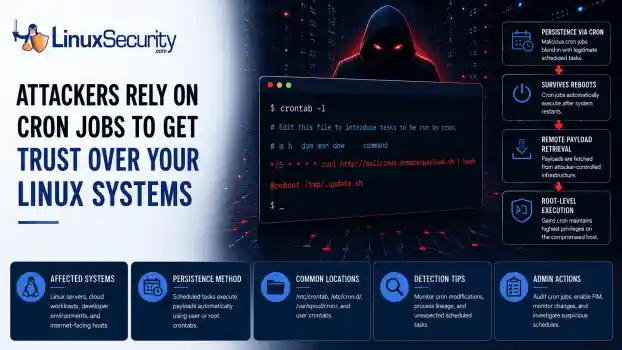
 A Linux server gets cleaned up after an intrusion. The suspicious process is terminated, credentials are rotated, and the system is rebooted during maintenance. Everything seems secure. A few hours later, the same outbound connection appears again. . Situations like that point to persistence . The attacker no longer needs the original exploit because something on the host continues restoring access behind the scenes. Finding that mechanism is often more important than understanding how the...
 Jun 08, 2026
  threat detection scalability
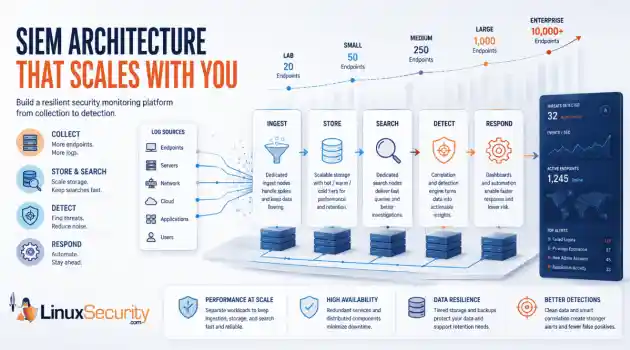
 Building a SIEM is easier than scaling one. Most open-source deployments start as a simple "all-in-one" server. It is easy to set up, but that design rarely survives the transition from a lab to a production workload. . A SIEM watching 20 endpoints is not doing the same job as one watching 500. More endpoints mean more logs; more logs require more storage; more storage makes search heavier. Eventually, the very architecture that made your lab easy to deploy becomes the reason your production...
Jun 04, 2026  security advisory apache
 A newly disclosed attack technique called HTTP/2 Bomb is drawing attention because it targets the software that sits at the front of much of the Linux internet. Apache HTTP Server, NGINX, Envoy, and the ingress layers that many Kubernetes environments depend on can be forced into consuming disproportionate amounts of memory using relatively small amounts of attacker traffic. . For Linux administrators, the concern is not the HTTP/2 protocol itself. It is the possibility that a single...
Jun 04, 2026  security advisory important
 The compromise of Nx Console shows how much infrastructure now sits behind a single developer account. GitHub repositories, CI/CD pipelines, container build systems, Terraform projects, Kubernetes deployments. None of those systems was the initial target. The workstation was. . Attackers did not need a Linux privilege escalation bug or a remote code execution chain. They needed developers to trust a tool they were already using. For many organizations, that was enough. What Happened? Federal...
Jun 03, 2026  security advisory open-source
 You remove the malware. You rotate the compromised credentials. You patch the original vulnerability and close the ticket. Two weeks later, the attacker is back. . What happened? You didn't lose the battle at the exploit; you lost it at the cleanup. In many modern Linux intrusions, the malware you found wasn't the main problem—it was the fallback mechanisms left behind. These hooks quietly restore attacker access the moment you look away. If you clean a host but miss these persistence layers,...
Jun 02, 2026  Refine features
X Clear Filters Get the latest News and Insights
Get the latest Linux and open source security news straight to your inbox.
Community Poll
What got you started with Linux?
Loading...

Explore Latest Linux Security features
We found -4 articles for you...
102
 data integrityhash functionalgorithm
What Is a Checksum? Meaning, Examples & Why You Should Use Them
A checksum is a calculated value that represents the exact contents of a file or message. If the file changes — even by a single byte — the checksum changes as well. That’s why it’s often described as a digital fingerprint for data integrity. . For sysadmins and Linux users, this isn’t theory. Checksums are a routine safeguard. When you download an ISO, apply a patch, or move data across a network, the step before trust is verification. One quick command in the terminal tells you if the file you grabbed is the same one the project published. Checksums in 2026 Snapshot: What You Need to Know A checksum is a unique value tied to a file. Any change alters the value. Linux distributions rely on SHA-256 and SHA-512 for ISOs and updates. Integrity isn’t authenticity — GPG signatures prove the source. Legacy algorithms like MD5 and SHA-1 still exist, but they’re unsafe for security. In this guide, we’ll cover checksum meaning in Linux and networking, how checksum algorithms work, the ones that matter in 2026, and the weaknesses to keep in mind. You’ll also see real Linux examples alongside tools on other systems, so you’ll know exactly how and when to use checksums. What Is a Checksum in Linux and Networking? Data is processed, reduced to a smaller value, and that value rides along with the file or packet. On the other side, the same calculation runs again. If the two match, integrity holds. If not, something changed. In networking, checksums flag errors in TCP and UDP packets. The protocol runs quick arithmetic against packet data, enough to catch a flipped bit or missing piece. It works for error detection, not security — attackers can forge it. In Linux, checksums serve a stronger role. Distributions rely on cryptographic checksums like SHA-256 , where even a single byte change produces a completely different value. A checksum confirms integrity, but not authenticity. An attacker could replace a file and generate a matching checksum.That’s why distributions pair SHA-256 with GPG signatures : the checksum proves the file hasn’t changed, the signature proves it came from the right source. For a detailed guide on Linux integrity verification methods , see our complete article. In practice, this also matters when evaluating an open-source security baseline , since integrity checks sit at the foundation of trust. Overall, from packets on the wire to Linux ISOs, the purpose stays the same — verify integrity before you trust the data. What Is a Checksum Algorithm? Common Types Explained Legacy algorithms like MD5 and SHA-1 still exist, but they’re unsafe for security. Algorithm Output Size Status in 2026 Notes / Use Case SHA-256 256 bits Secure Standard for Linux ISOs, TLS, and SSH. Detects any change. SHA-512 512 bits Secure Stronger variant of SHA-256. Used where higher assurance is needed. MD5 128 bits Broken Collisions proven. Only useful for quick corruption checks, not security. SHA-1 160 bits Broken Deprecated. Still shows up in legacy systems, but not safe. SHA-0 160 bits Historical Pulled in the ’90s after flaws. Mentioned only in history. In practice, Linux admins stick with SHA-256 or SHA-512 . What Does Checksum Mean in Linux A checksum in Linux is a hash value used to confirm that a file or package hasn’t changed. Distros publish SHA-256 or SHA-512 alongside their ISOs, and sysadmins run the command before they trust the file. Whether you’re patching a server or installing a fresh image, that one step confirms integrity. Advantages of Using Checksums in Linux Checksums aren’t just a background process — they’re a daily safety net for Linux admins. Lightweight, reliable, and easy to run, they giveyou quick proof that a file hasn’t silently changed. Here’s why checksums remain essential in Linux workflows today: Fast and lightweight : checksums confirm file integrity without slowing down Linux systems. ISO and patch verification : before installing an ISO, patching a server, or pushing configs, checksums confirm the file matches the published version. Error detection beyond downloads : they can surface disk errors in backups, spot corruption in archived data, and maintain accountability in shared storage. Long-term integrity checks : Over the years, checksums ensure that data pulled from archives is the same as the original. Scalable across datasets : because they are small and computationally cheap, admins can run checksums against large datasets, log files, or repositories with minimal overhead. Reliable in 2026 Linux systems : the balance of speed and reliability is why checksums remain a standard integrity tool across Linux environments today. In practice, the advantages of using checksums in Linux come down to one thing: confidence. Whether you’re validating a fresh ISO, restoring an old backup, or syncing shared storage, a quick checksum is the simplest way to make sure the data you’re working with is still the data you trust. Limitations and Disadvantages of Checksums A checksum confirms that data hasn’t changed, but it has limits. Some errors slip through. A basic checksum might not flag reordered bytes or missing sections. More advanced algorithms reduce these gaps, but no checksum is perfect. Another drawback: detection without correction. If the numbers don’t line up, you know the file is wrong, but you still have to re-download, restore from backup, or verify against a signed copy. The risks aren’t theoretical. CVE-2025-3576 showed how RC4-HMAC- MD5 checksums in MIT Kerberos could be forged if RC4 was still enabled. Around the same time, reports highlighted new supply chain attack targets telegram bots . The message is clear:whether it’s a legacy cipher or a modern service, weak or missing verification leaves room for attackers. Generating checksums on large ISOs or archives uses resources, but the overhead is small compared to the protection they provide against corrupted or tampered files. For Linux distributions, that’s why checksums are always paired with signed releases — one verifies the data, the other verifies the source. Real-World Applications of Checksums in Linux and Beyond Checksums are everywhere. In Linux, they’re part of the daily workflow. Package managers like apt, yum, and dnf handle verification behind the scenes. They use checksums to confirm that updates and dependencies haven’t been corrupted in transit. It’s a small but vital part of the open-source software supply chain security . Admins also rely on checksums to validate logs and configuration files, where a silent edit could cause outages or weaken security. Outside Linux, the same principle applies elsewhere. Network protocols use checksums to flag dropped packets. Cloud providers apply them to detect corruption in stored data. Banks apply checksums in Know Your Customer (KYC) checks to confirm the integrity of sensitive data. Healthcare systems attach checksums to patient records and lab results, and e-commerce platforms use them to confirm transaction data hasn’t been altered. Across industries, the role remains the same: checksums provide quick proof that data is trustworthy. The contexts differ, but the role of checksums doesn’t: provide a quick, reliable way to confirm that data is still what it was meant to be. Troubleshooting Checksum Errors Checksum errors aren’t always a sign of tampering. More often, they come down to routine issues that can be fixed quickly. Common causes of checksum errors: Interrupted or incomplete downloads. Failing USB sticks, DVDs, or other install media. Bad sectors on a disk. Network hiccups that disrupt transfers. How to fix checksum errors onLinux: Re-download the file from a reliable mirror. Use a torrent for ISOs — integrity checks are built in. Always verify against the project’s GPG-signed checksum list to confirm the hash itself hasn’t been altered. A checksum mismatch should always be treated as a warning. Often, the cause is routine — a bad transfer or failing media — but the checksum is doing its job by flagging the change before you trust the file. But recent cases like Chaos Rat in AUR show that malicious uploads do happen, and the only safe move is to verify before you run the file. The point is simple: don’t trust the file until you know why the checksum doesn’t line up. Many of the mismatches that checksums catch trace back to quiet upstream changes in mirrors or metadata — the broader pattern of system drift in Linux that affects long-running environments. How to Verify a Checksum on Linux A checksum verification in Linux means comparing the file’s calculated hash against the project’s published value. The tools you need are already on every major distro — no extra installs required. Here’s how you’d do it with a Rocky Linux 9 ISO. 1. Download the ISO and checksum file First, download the ISO from the official Rocky Linux site. Then download the checksum file from the same location. Example: wget wget https://download.rockylinux.org/pub/rocky/9/isos/x86_64/CHECKSUM Both files need to be in the same directory. 2. Confirm the files are present Run: ls You should see both: the .iso file the CHECKSUM file If one is missing, the verification step won’t work. 3. Verify the checksum There are two ways to do this. Option 1: Automatic verification (recommended) Run: sha256sum -c CHECKSUM This reads the checksum file and compares it against your downloaded ISO automatically. If everything is correct, you’ll see: Rocky-9.x-x86_64-dvd.iso: OK Option 2: Manual comparison Run: sha256sumRocky-9.x-x86_64-dvd.iso This generates a hash for your file. Then open the CHECKSUM file and find the matching ISO entry. Compare the two values. If they match exactly, the file is valid. 4. What if it doesn’t match? If you see anything other than OK , or the values don’t match: The download may be incomplete The file could be corrupted In rare cases, it could have been tampered with Delete the file and download it again from the official source. Why this matters ISO files are often used to install operating systems. If the file is modified or corrupted, you could end up installing a compromised system. Checksum verification is a quick step that helps avoid that risk. How to Verify a Checksum on Other Systems A checksum on Windows or macOS works the same way: calculate the file’s hash and compare it against the official value. If you’re not on Linux, the same process works — just with different tools. Windows: certutil -hashfile SHA256 macOS: shasum -a 256 Older versions may still use: md5 Different commands, same idea: calculate the checksum and check it against what the project published before you trust the file. FAQ: Checksums in Linux Checksums come up in everyday Linux work. These are the questions that matter most. What is a checksum in Linux? A checksum in Linux is a hash value tied to a file. Distros post SHA-256 sums with ISOs and packages. You run sha256sum and compare. If it lines up, the file’s clean. What causes an inconsistent checksum? Bad downloads, failing disks, sketchy USB media, and network drops. Not always an attack — but always a reason to stop and re-verify. Is a checksum the same as a hash? Close, but not the same. A checksum uses hashing for error checks. Linux distros lean on SHA-256 for integrity. How do I check if a download is safe using checksums? Run sha256sum . Compare it against the project’s value. For ISOs, confirm with the GPG-signedlist. That’s the safest way to trust what you pulled. With the basics covered, here’s why checksums remain part of daily Linux security practice in 2026. Final Thoughts Checksums still matter. On Linux, they remain the quickest way to confirm file integrity before you run anything. In 2026, the best practice is clear: use SHA-256 or SHA-512 and always pair them with digital signatures. What is a checksum at the end of the day? A simple value that protects against silent corruption and flags tampering before it becomes a problem. One check, one command — worth doing every time. . For sysadmins and Linux users, this isn’t theory. Checksums are a routine safeguard. When you down. checksum, calculated, value, represents, exact, contents, message. . MaK Ulac
 Mar 27, 2026 •

Get the latest News and Insights
Get the latest Linux and open source security news straight to your inbox.
Community Poll
What got you started with Linux?
Search Topics
Powered By

Linux Security - Your source for Top Linux News, Advisories, HOWTOs and Feature Releases
QUICK LINKS
subscribe to newsletters!
Like staying secure? So do we.
Sign up for updates, tips, and alerts!
Discover faster search, smarter navigation, and deeper Linux security insights. Read More