


Stay Ahead With Linux Security Features
 security advisory risk management
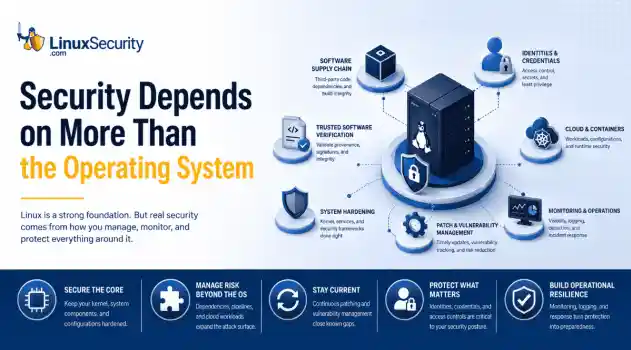
 If more than 12 million enterprise systems can be exposed by flaws in a security control designed to harden Linux, it's probably worth asking whether Linux gives people a false sense of security. That's a question that has come up repeatedly throughout 2026. . This year alone, researchers have disclosed privilege-escalation vulnerabilities, root-level kernel flaws, and multiple supply-chain compromises affecting Linux environments. That doesn't mean Linux suddenly became insecure. It means...
 Jun 15, 2026
  security advisory attack
 A Linux server gets cleaned up after an intrusion. The suspicious process is terminated, credentials are rotated, and the system is rebooted during maintenance. Everything seems secure. A few hours later, the same outbound connection appears again. . Situations like that point to persistence . The attacker no longer needs the original exploit because something on the host continues restoring access behind the scenes. Finding that mechanism is often more important than understanding how the...
Jun 08, 2026 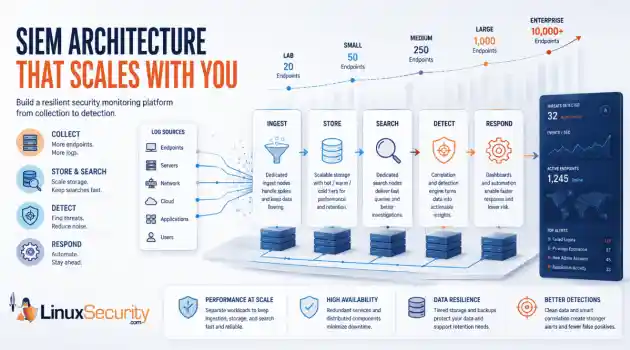 threat detection scalability
 Building a SIEM is easier than scaling one. Most open-source deployments start as a simple "all-in-one" server. It is easy to set up, but that design rarely survives the transition from a lab to a production workload. . A SIEM watching 20 endpoints is not doing the same job as one watching 500. More endpoints mean more logs; more logs require more storage; more storage makes search heavier. Eventually, the very architecture that made your lab easy to deploy becomes the reason your production...
Jun 04, 2026  security advisory apache
 A newly disclosed attack technique called HTTP/2 Bomb is drawing attention because it targets the software that sits at the front of much of the Linux internet. Apache HTTP Server, NGINX, Envoy, and the ingress layers that many Kubernetes environments depend on can be forced into consuming disproportionate amounts of memory using relatively small amounts of attacker traffic. . For Linux administrators, the concern is not the HTTP/2 protocol itself. It is the possibility that a single...
Jun 04, 2026  security advisory important
 The compromise of Nx Console shows how much infrastructure now sits behind a single developer account. GitHub repositories, CI/CD pipelines, container build systems, Terraform projects, Kubernetes deployments. None of those systems was the initial target. The workstation was. . Attackers did not need a Linux privilege escalation bug or a remote code execution chain. They needed developers to trust a tool they were already using. For many organizations, that was enough. What Happened? Federal...
Jun 03, 2026  Refine features
X Clear Filters Get the latest News and Insights
Get the latest Linux and open source security news straight to your inbox.
Community Poll
What got you started with Linux?
Loading...

Explore Latest Linux Security features
We found -4 articles for you...
102
 network securitysecurity practicesmalware protection
Keylogger Protection: Anti-Debugging Techniques for Network Security
Keylogger attacks in network security have become more popular over time. Therefore, businesses must implement procedures and tactics to prevent these network security issues from harming a server. . This article will discuss anti-debugging techniques for keyloggers so you can help your organization improve its security posture. What is a Keylogger Attack? Keyloggers, or keystroke logging, is a data collection software that keeps track of the keys you hit on your keyboard. Cybercriminals will record anything you type so they can utilize that data to learn account numbers, credit card information, and login credentials that could permit them to damage your system. Hackers can send malicious code through phishing emails that immediately install attacks once the recipient opens links or attachments. Threat actors write down the keystrokes, pass the data through encryption, and send it to another computer that unencrypted the information to use in the future. This type of threat works over malware and ransomware , so victims must pay a ransom to return their data. What is the Purpose of a Keylogger Email? This software, though typically carrying a negative connotation, can help users analyze and debug computer activity in a legal, legitimate format. Keyloggers can intercept or alter electronic data and collect application information to prevent cloud security breaches and learn more about how users interact with the system. What Is Anti-Debugging? Malware analysts must debug malware codes to run step-by-step malware, facilitate malware behavior and capabilities, and introduce changes across memory spaces, variables, and configurations. As a result, preventing malware authors from debugging is crucial to keeping a system secure. Anti-debugging focuses on preventing or terminating malicious activity involving debuggers to ensure data and network security on your server. A few techniques are generalized to any debugger, while others are specific to a particular debugger version. Hereare a few methods you can implement to stop cloud security breaches on your server: Timing analysis Detecting known processes Checking process status Self-debugging code Detecting breakpoints Detecting code patching In-memory hypervisor Non-standard architecture emulation We will discuss the first couple of options in this article, and part 2 will review the rest. What is Timing Analysis? Timing analysis seeks to detect pauses and long delays in program execution so you can decide how to alter server behavior to stop keylogging attacks in their tracks. This method is the easiest to implement but receives the most false positives and can be disabled quickly. Here is how you can set up timing analysis in your coding: #include #include #include #include using namespace std::chrono_literals; int main() { std::chrono::steady_clock::time_point begin, end; std::cout
 Apr 24, 2024 •

Get the latest News and Insights
Get the latest Linux and open source security news straight to your inbox.
Community Poll
What got you started with Linux?
Search Topics
Powered By

Linux Security - Your source for Top Linux News, Advisories, HOWTOs and Feature Releases
QUICK LINKS
subscribe to newsletters!
Like staying secure? So do we.
Sign up for updates, tips, and alerts!
Discover faster search, smarter navigation, and deeper Linux security insights. Read More