


Stay Ahead With Linux Security Features
 security advisory attack
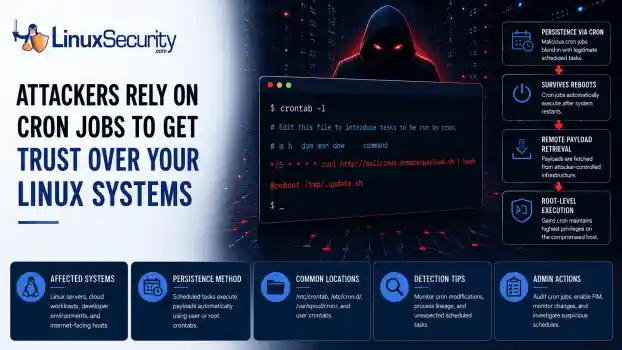
 A Linux server gets cleaned up after an intrusion. The suspicious process is terminated, credentials are rotated, and the system is rebooted during maintenance. Everything seems secure. A few hours later, the same outbound connection appears again. . Situations like that point to persistence . The attacker no longer needs the original exploit because something on the host continues restoring access behind the scenes. Finding that mechanism is often more important than understanding how the...
 Jun 08, 2026
  threat detection scalability
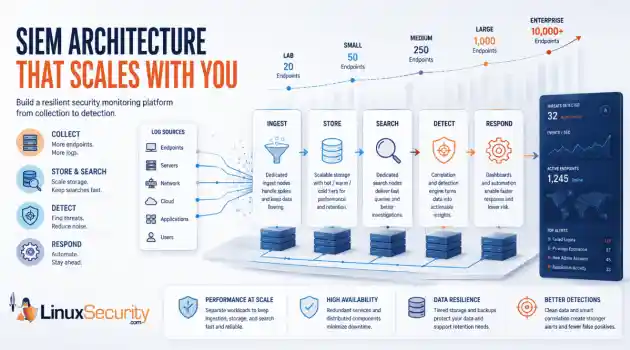
 Building a SIEM is easier than scaling one. Most open-source deployments start as a simple "all-in-one" server. It is easy to set up, but that design rarely survives the transition from a lab to a production workload. . A SIEM watching 20 endpoints is not doing the same job as one watching 500. More endpoints mean more logs; more logs require more storage; more storage makes search heavier. Eventually, the very architecture that made your lab easy to deploy becomes the reason your production...
Jun 04, 2026  security advisory apache
 A newly disclosed attack technique called HTTP/2 Bomb is drawing attention because it targets the software that sits at the front of much of the Linux internet. Apache HTTP Server, NGINX, Envoy, and the ingress layers that many Kubernetes environments depend on can be forced into consuming disproportionate amounts of memory using relatively small amounts of attacker traffic. . For Linux administrators, the concern is not the HTTP/2 protocol itself. It is the possibility that a single...
Jun 04, 2026  security advisory important
 The compromise of Nx Console shows how much infrastructure now sits behind a single developer account. GitHub repositories, CI/CD pipelines, container build systems, Terraform projects, Kubernetes deployments. None of those systems was the initial target. The workstation was. . Attackers did not need a Linux privilege escalation bug or a remote code execution chain. They needed developers to trust a tool they were already using. For many organizations, that was enough. What Happened? Federal...
Jun 03, 2026  security advisory open-source
 You remove the malware. You rotate the compromised credentials. You patch the original vulnerability and close the ticket. Two weeks later, the attacker is back. . What happened? You didn't lose the battle at the exploit; you lost it at the cleanup. In many modern Linux intrusions, the malware you found wasn't the main problem—it was the fallback mechanisms left behind. These hooks quietly restore attacker access the moment you look away. If you clean a host but miss these persistence layers,...
Jun 02, 2026  Refine features
X Clear Filters Get the latest News and Insights
Get the latest Linux and open source security news straight to your inbox.
Community Poll
What got you started with Linux?
Loading...

Explore Latest Linux Security features
We found -4 articles for you...
102
 network securitysecurity riskssecurity techniques
Keylogging in Linux (Part 2): Advanced Techniques in the Linux GUI and X Server
Why Advanced Keylogging Techniques Depend on the Linux GUI Advanced keylogging leans on the Linux GUI because once a user signs into a graphical session, the input path stops being simple. The GUI decides which window receives focus, how toolkits interpret the keystrokes, and when events get redirected or buffered, so the attacker’s visibility changes. The hardware layer still shows the raw signal. It just doesn’t reflect how people actually work on a desktop, and that gap is exactly where more capable keyloggers operate. . Capturing device events is useful, but it only tells you what the keyboard produced , not what the system delivered to an application. That difference is why we’re stepping into the GUI stack. Desktop environments reshape input constantly, and those transformations create opportunities for interception that never appear at the device layer. Teams studying adversary behavior look at these layers because this is where real workflows live, and where visibility can quietly break. So we focus on how keystrokes move through the X server and the rest of the graphical stack. This stays within authorized research, the kind defenders use to understand how attackers abuse X11’s trusted client model or how Wayland tightens the rules as it becomes the default in Fedora, Ubuntu sessions, and GNOME. Some applications still run under XWayland and behave a bit differently, which adds one more wrinkle for anyone mapping these input paths. What Is the Linux GUI Stack? The Linux GUI works as a set of stacked components rather than one built-in interface from the OS. The kernel handles raw input at the bottom, the X server manages windows and display surfaces above it, and toolkits like GTK, Qt, and WxWidgets turn those low-level signals into the controls users interact with. Desktop environments pull those parts together into the workspace people expect. It’s a simple structure on paper, but the layers change how keystrokes move once the system is fully up. Keyboard eventsstart in the kernel’s input subsystem and reach the X server before anything else touches them. From there, Xlib hands events to applications, toolkits reshape them into widget actions, and the desktop environment overlays shortcuts and policies that can shift routing. That’s why GUI-level keylogging exposes behavior. Device-level capture won’t surface. The earlier walk-through of device-event keylogging in the Complete Guide to Keylogging in Linux: Part 1 sets that baseline, so the differences here land cleanly. +---------------+ +--------------+ | Display:2 | | WxWidget |-----+ +---------------+ | | +--------------+ | | | | +---------------+ | | +--------------+ | | Display:1 | | Qt |-----+ +---------------+ | | +--------------+ | | | | +---------------+ | | +--------------+ | | Display:0 | | GTK+ |-----+ +---------------+ | | +--------------+ | | | | update +-------------+--+ ---=---> +-----+--------+ send data | +------=--| X Server | | xlib |
 Nov 13, 2025 •

Get the latest News and Insights
Get the latest Linux and open source security news straight to your inbox.
Community Poll
What got you started with Linux?
Search Topics
Powered By

Linux Security - Your source for Top Linux News, Advisories, HOWTOs and Feature Releases
QUICK LINKS
subscribe to newsletters!
Like staying secure? So do we.
Sign up for updates, tips, and alerts!
Discover faster search, smarter navigation, and deeper Linux security insights. Read More