


Stay Ahead With Linux Security Features
 security advisory attack
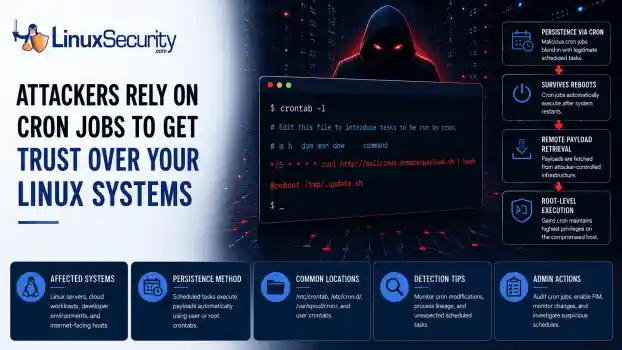
 A Linux server gets cleaned up after an intrusion. The suspicious process is terminated, credentials are rotated, and the system is rebooted during maintenance. Everything seems secure. A few hours later, the same outbound connection appears again. . Situations like that point to persistence . The attacker no longer needs the original exploit because something on the host continues restoring access behind the scenes. Finding that mechanism is often more important than understanding how the...
 Jun 08, 2026
 threat detection scalability
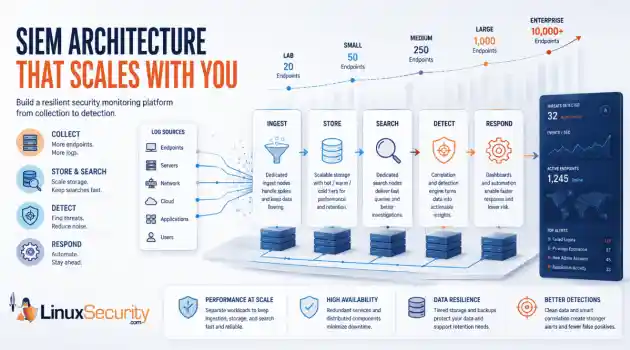
 Building a SIEM is easier than scaling one. Most open-source deployments start as a simple "all-in-one" server. It is easy to set up, but that design rarely survives the transition from a lab to a production workload. . A SIEM watching 20 endpoints is not doing the same job as one watching 500. More endpoints mean more logs; more logs require more storage; more storage makes search heavier. Eventually, the very architecture that made your lab easy to deploy becomes the reason your production...
Jun 04, 2026
 security advisory apache
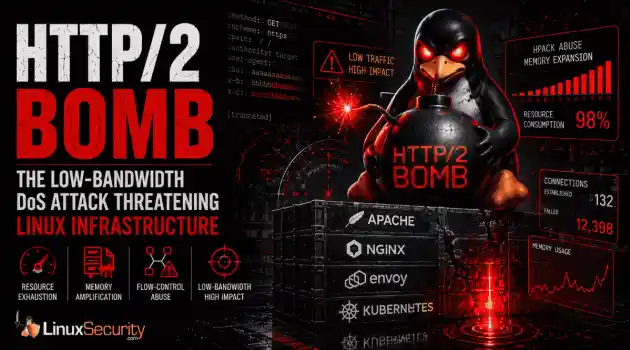
 A newly disclosed attack technique called HTTP/2 Bomb is drawing attention because it targets the software that sits at the front of much of the Linux internet. Apache HTTP Server, NGINX, Envoy, and the ingress layers that many Kubernetes environments depend on can be forced into consuming disproportionate amounts of memory using relatively small amounts of attacker traffic. . For Linux administrators, the concern is not the HTTP/2 protocol itself. It is the possibility that a single...
Jun 04, 2026
 security advisory important
 The compromise of Nx Console shows how much infrastructure now sits behind a single developer account. GitHub repositories, CI/CD pipelines, container build systems, Terraform projects, Kubernetes deployments. None of those systems was the initial target. The workstation was. . Attackers did not need a Linux privilege escalation bug or a remote code execution chain. They needed developers to trust a tool they were already using. For many organizations, that was enough. What Happened? Federal...
Jun 03, 2026
 security advisory open-source
 You remove the malware. You rotate the compromised credentials. You patch the original vulnerability and close the ticket. Two weeks later, the attacker is back. . What happened? You didn't lose the battle at the exploit; you lost it at the cleanup. In many modern Linux intrusions, the malware you found wasn't the main problem—it was the fallback mechanisms left behind. These hooks quietly restore attacker access the moment you look away. If you clean a host but miss these persistence layers,...
Jun 02, 2026
 Refine features
X Clear Filters
Get the latest News and Insights
Get the latest Linux and open source security news straight to your inbox.
Community Poll
What got you started with Linux?
Loading...

Explore Latest Linux Security features
We found -4 articles for you...
102
 security advisorycompliancelinux
OSSEC for Linux: What It Means for Your Monitoring and Risk Posture
You probably already have firewall rules in place, regular patching cycles, and logs flowing into a SIEM. That covers a lot. What it does not tell you is whether /usr/bin/ssh was replaced last night, whether /etc/sudoers changed outside of a maintenance window, or whether someone added a quiet backdoor account and cleaned up the auth logs afterward. . This is where OSSEC enters the picture. It runs on the host itself, not on the network. That sounds small, but it shifts what you can verify. Most monitoring pipelines focus on traffic patterns or aggregated events. A host-based intrusion detection system, or HIDS, looks inward. It watches file integrity, parses local logs, checks for rootkit indicators, and evaluates policy state directly on the machine that could be compromised. OSSEC does not replace your firewall. It does not patch systems. It is not an EDR platform. What it does is give you a way to validate trust at the file and log level on each Linux host. You start to see things that were previously invisible because they never crossed a network boundary. If you are already shipping logs to a SIEM, you might wonder what you are missing. The short answer is file integrity state, local correlation, and baseline enforcement. If you need file integrity monitoring for audits, the question becomes whether you can manage the signal without drowning in it. If you are worried about overlap with endpoint detection and response (EDR) platforms, that depends on how deep your existing tooling goes into host-level change tracking. In this article, we will look at what OSSEC actually monitors, how it works internally, what day-to-day operations look like once it is deployed, and where it fits into compliance and risk decisions. By the end, you should be able to decide whether adding OSSEC strengthens your monitoring posture or just creates another alert stream that no one has time to review. What Is OSSEC and Where Does It Fit in a Linux Security Stack? When people first hear about OSSEC ,they often lump it in with whatever security tooling they already have. Firewall, SIEM, maybe EDR. It helps to slow that down. OSSEC is a host-based intrusion detection system. A HIDS. That category matters because it tells you where it operates and what it can realistically see. OSSEC runs an agent on each monitored system. That agent collects local logs, monitors file integrity, performs rootkit checks, and evaluates certain policy conditions. Those events are sent to a central manager, which applies rules and generates alerts. Nothing about it inspects raw network packets. It does not watch east-west traffic. It lives inside the operating system. That distinction is practical. A firewall can block an inbound connection. A SIEM can correlate events across systems. An EDR platform can monitor process behavior and memory activity. OSSEC focuses on the state of the host itself. File changes. Authentication patterns. Configuration drift that was not approved. You start thinking less about “did traffic look strange” and more about “did this machine change in a way we did not authorize.” In a typical Linux environment, OSSEC sits alongside your existing logging and security stack. Agents run on the servers. The manager aggregates events. Alerts are often forwarded to a SIEM for centralized visibility. It does not replace those tools. It fills in a gap at the file and log layer that network-based controls simply cannot see. This changes how you reason about trust. Without a HIDS like OSSEC, you are mostly trusting that if something serious happened, it would generate visible traffic or obvious log anomalies. With it, you can validate whether core binaries, configuration files, and privilege assignments remain in the state you expect. That is a different kind of assurance. More granular, and sometimes more uncomfortable. From a stack perspective, OSSEC is not your perimeter defense, and it is not your incident response platform. It is a visibility layer on the host. If you are deciding whereit fits, start by mapping what you currently monitor at the file and configuration level. If the answer is “nowhere,” then this is likely a gap. How Does OSSEC Work Under the Hood? Before you decide whether to deploy it, you need to understand what OSSEC is actually doing on the system. Otherwise, it just becomes another agent you hope behaves. At a high level, the OSSEC architecture is straightforward. Each Linux host runs an agent. That agent reads local log files, monitors configured directories for file changes, and performs periodic checks. Events are sent to a central manager over an encrypted channel, where rules are applied, and alerts are generated. The manager is where correlation happens. The agent is mostly a collector and forwarder with some local logic. That division matters when you think about scale. A quiet file server behaves very differently from a busy web node, throwing thousands of log lines per minute. Manager sizing depends on event volume, not just agent count. If you underestimate that, queue backlogs start to build, and alerts get delayed. You will not notice it immediately. Then you will. File Integrity Monitoring is one of the core pieces. OSSEC builds a baseline of selected directories, typically /etc, /usr/bin, /bin, sometimes application paths like /var/www. It calculates checksums and records permissions, ownership, and metadata. On subsequent scans, it compares the current state to the stored baseline. If a binary hash changes or permissions shift unexpectedly, it raises an alert. This sounds simple, but the baseline is everything. If you initialize it on a system that is already compromised, you just captured a bad state as trusted. If you run it right before a large patch cycle, you will trigger a wave of integrity changes that are technically correct but operationally noisy. Timing matters more than people expect. Log analysis is the other major component. The agent reads local logs such as /var/log/auth.log, /var/log/secure, web server logs, andothers you define. Decoders parse those logs into structured events. Rules then evaluate patterns. A single failed SSH login might be low severity. Twenty from the same IP in a short window escalates. That correlation happens at the manager level, which is why accurate time synchronization across hosts is not optional. There is also rootkit detection and policy checking. OSSEC can look for known rootkit signatures, suspicious kernel modules, hidden processes, and certain configuration states. It is not deep behavioral detection. It is signature and rule-driven. Useful, but not magical. Active response is available as well. You can configure OSSEC to block an IP via firewall rules or execute scripts when certain thresholds are met. This is where caution comes in. Automated responses based on log patterns can backfire if rules are not tuned carefully. I have seen environments where legitimate traffic patterns triggered temporary blocks because someone trusted defaults too quickly. Operationally, you cannot treat this as set-and-forget. You need reliable time sync. You need to understand which directories are monitored and why. You need to tune rules to match your environment, especially around authentication noise and package upgrades. Poor tuning leads directly to alert fatigue, and once people start ignoring OSSEC alerts, the value drops fast. If you are evaluating it, start by mapping what data it will actually collect on your systems. Then look at how that flows through the manager and into your existing alerting pipeline. The mechanics are not complicated, but the impact on daily operations depends entirely on how deliberately you configure it. What OSSEC Looks Like in Day-to-Day Operations The theory sounds clean. Baselines, rules, correlation. In practice, what you see are alerts, patterns, and sometimes silence where there should not be any. One of the first things that shows up after deploying OSSEC is authentication noise. Repeated SSH failures from a single IP get grouped andescalated. On an internet-facing server, that can be constant background radiation. It is useful to see, especially if the pattern shifts or targets a specific account, but it quickly teaches you that not every alert is an incident. File integrity alerts are where things get more interesting. A change to /etc/passwd, /etc/sudoers, or a binary under /usr/bin stands out immediately. During a routine patch cycle, you will see bursts of file modifications. That is expected. The important part is whether those changes align with your maintenance window and change records. If they do not, you stop and ask why. Web servers make this even clearer. When a file under /var/www/html changes at 2:17 AM and there was no deployment scheduled, that is not theoretical. That is either a developer working outside process or something worse. OSSEC alerts give you that timestamped signal without relying on network logs. You also start to notice what is not happening. An agent that goes silent is easy to miss unless you monitor agent health. No events can mean a quiet system, or it can mean the agent crashed, the service was stopped, or communication to the manager broke. Silence is not always good news. Configuration management tools introduce another layer. If Ansible, Puppet, or another system is regularly enforcing state, OSSEC will see those file changes. If you do not scope monitoring carefully, you generate predictable noise. Over time, teams either tune it properly or begin ignoring categories of alerts, which defeats the purpose. Baseline timing shows up here again. If you built the file integrity baseline before hardening was complete, you will see a wave of expected changes. If you built it after an unnoticed compromise, you will not see anything wrong because the altered files are now considered normal. That is the uncomfortable edge of file integrity monitoring. This is where OSSEC alerts stop being abstract. They become part of patch planning, change management, and after-hours review. If you deployit, you need to align maintenance windows, baseline updates, and alert review processes. Otherwise, it becomes just another stream of notifications competing for attention. Risk, Compliance, and Policy Implications At some point, this stops being about features and starts being about accountability. Most teams do not deploy OSSEC because they are curious. They deploy it because they need evidence, or because they are tired of not knowing what changed on a host after an incident. From a compliance perspective, file integrity monitoring is not optional in certain frameworks. PCI DSS, for example, explicitly requires monitoring of critical system files and alerting on unauthorized changes. If you are responsible for systems in scope, you need a way to demonstrate that /etc, key binaries, and security configurations are monitored consistently. Screenshots of firewall rules are not enough. OSSEC gives you structured visibility at the file and log layer. That visibility translates into audit artifacts. You can show that privileged user additions were logged. You can show that changes to sensitive files generated alerts. You can demonstrate that monitoring is continuous, not periodic. Policy enforcement is the other half. It is one thing to document that logging must remain enabled or that sudo access is restricted. It is another to verify it. OSSEC can surface: Changes to critical configuration files such as /etc/ssh/sshd_config Modifications to /etc/sudoers or group membership affecting privilege Disabling or tampering with logging services Creation of new local user accounts Repeated authentication anomalies that suggest lateral movement None of this prevents exploitation. That is important to say clearly. OSSEC does not block an attacker by default, and it does not patch a vulnerable service. What it does is reduce the time between “something changed” and “someone noticed.” In post-incident reviews, that time gap is usually where the real damage accumulates. Thereis also overhead. More monitoring means more events to triage. If your change management process is informal, file integrity alerts will expose that quickly. You either tighten the process or accept a steady stream of “expected but undocumented” changes. Over time, auditors tend to ask about those patterns. If you are evaluating this from a risk angle, start by listing which systems require demonstrable file integrity monitoring and privileged access tracking. Then map how you currently prove that control works. If the answer depends on manual review or trust, OSSEC changes that conversation. It turns policy statements into verifiable signals, which is uncomfortable at first but ultimately more defensible. When OSSEC Makes Sense and When It Doesn’t Not every Linux environment benefits equally from OSSEC. That is usually clear a few months after deployment, sometimes sooner. If you are operating in a compliance-heavy space, especially where file integrity monitoring is explicitly required, OSSEC is a practical fit. It gives you traceable evidence that critical files are monitored and that privileged actions are surfaced. On internet-facing servers, particularly those exposed over SSH or running public web applications, the added visibility into authentication patterns and file changes tends to justify the overhead. It is also useful in environments that do not have a full EDR platform. OSSEC can provide a baseline level of host visibility where, otherwise, you might only have centralized logs. It is not behavioral detection in the modern sense, but it is better than trusting that nothing changed locally. Where it becomes less compelling is in short-lived infrastructure. If your workloads are mostly ephemeral containers rebuilt frequently from clean images, file integrity monitoring at the host level may not add much value. The same applies to heavily managed PaaS environments where you do not control the underlying system state. There is also a staffing reality. If your team does nothave the capacity to review alerts consistently, adding another signal source can degrade overall monitoring quality. Alert streams that are not reviewed become background noise. Once that happens, even high-severity OSSEC alerts risk being ignored. There is overlap with some EDR platforms as well. Many modern endpoint tools already track file modifications, suspicious privilege changes, and authentication anomalies. In those environments, OSSEC deployment needs to be justified by specific gaps, not by the assumption that more monitoring is automatically better. If you are deciding whether to move forward, look at three things. First, do you have a compliance requirement that mandates host-level file integrity monitoring? Second, do you have clear gaps in visibility at the file and configuration level? Third, do you have the operational discipline to tune and maintain it? If the answer to all three is yes, OSSEC deployment likely strengthens your posture. If not, it may just redistribute your attention without improving your response time. Our Final Thoughts: What OSSEC Changes for You as a Linux Admin When you step back from the feature list, OSSEC changes something simple but important. It shifts part of your security model from trusting the perimeter to verifying the host. With OSSEC in place, you are no longer assuming that core binaries, configuration files, and privilege assignments remain untouched unless proven otherwise. You are actively checking. That alters how you think about patch cycles, maintenance windows, and even routine configuration work. “Expected change” stops being a vague idea and becomes something you have to define clearly. It also changes your monitoring workflow. File integrity alerts, authentication correlations, and agent health become part of your operational picture. You have to decide which directories truly matter, how often baselines are updated, and how alerts are routed. If you do not tune it deliberately, alert volume will climb, and confidence willfall. That part is predictable. From a compliance standpoint, OSSEC strengthens your position. It gives you defensible evidence that critical files are monitored and that suspicious changes generate alerts. During audits or post-incident reviews, that visibility becomes tangible. You can point to timestamps, rule triggers, and response actions instead of relying on assumptions. At the same time, it is important to keep expectations realistic. OSSEC is detection-focused. It does not prevent exploitation. It does not replace patching, hardening, or EDR. It adds a layer of host-level verification. Nothing more, nothing less. If you are considering it, the real question is not whether OSSEC works. It does what it is designed to do. The question is whether you are prepared to own the monitoring it introduces. If you are willing to treat host integrity as something to be continuously verified rather than implicitly trusted, then it has a clear place in your stack. If not, it becomes another agent running quietly in the background, generating signals that no one fully uses. . Explore OSSEC's role in monitoring Linux systems, file integrity checks, and compliance for better risk management.. OSSEC File Integrity Host Intrusion Detection Linux Monitoring. . Brittany Day
 Feb 19, 2026
•
Feb 19, 2026
•

Get the latest News and Insights
Get the latest Linux and open source security news straight to your inbox.
Community Poll
What got you started with Linux?
Search Topics
Powered By

Linux Security - Your source for Top Linux News, Advisories, HOWTOs and Feature Releases
QUICK LINKS
subscribe to newsletters!
Like staying secure? So do we.
Sign up for updates, tips, and alerts!
Discover faster search, smarter navigation, and deeper Linux security insights. Read More