


Stay Ahead With Linux Security Features
 security advisory attack
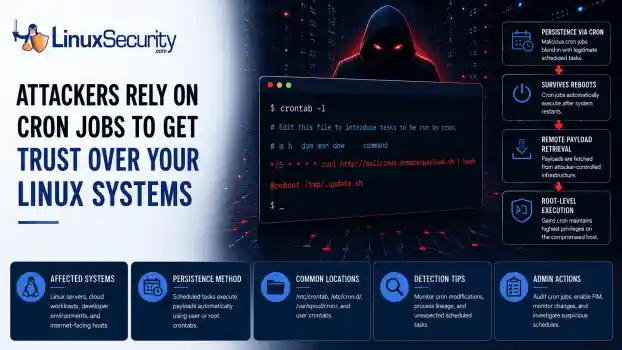
 A Linux server gets cleaned up after an intrusion. The suspicious process is terminated, credentials are rotated, and the system is rebooted during maintenance. Everything seems secure. A few hours later, the same outbound connection appears again. . Situations like that point to persistence . The attacker no longer needs the original exploit because something on the host continues restoring access behind the scenes. Finding that mechanism is often more important than understanding how the...
 Jun 08, 2026
 threat detection scalability
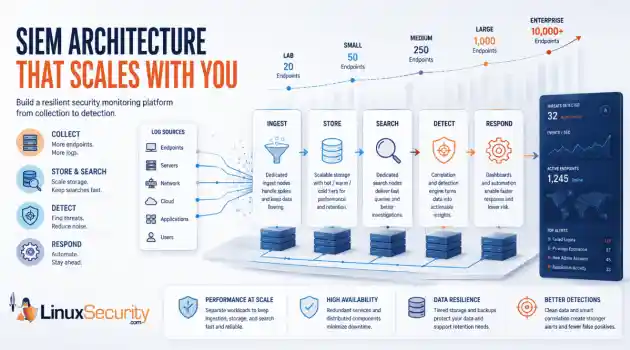
 Building a SIEM is easier than scaling one. Most open-source deployments start as a simple "all-in-one" server. It is easy to set up, but that design rarely survives the transition from a lab to a production workload. . A SIEM watching 20 endpoints is not doing the same job as one watching 500. More endpoints mean more logs; more logs require more storage; more storage makes search heavier. Eventually, the very architecture that made your lab easy to deploy becomes the reason your production...
Jun 04, 2026
 security advisory apache
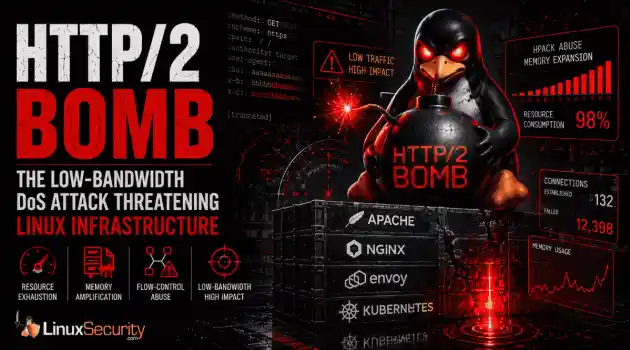
 A newly disclosed attack technique called HTTP/2 Bomb is drawing attention because it targets the software that sits at the front of much of the Linux internet. Apache HTTP Server, NGINX, Envoy, and the ingress layers that many Kubernetes environments depend on can be forced into consuming disproportionate amounts of memory using relatively small amounts of attacker traffic. . For Linux administrators, the concern is not the HTTP/2 protocol itself. It is the possibility that a single...
Jun 04, 2026
 security advisory important
 The compromise of Nx Console shows how much infrastructure now sits behind a single developer account. GitHub repositories, CI/CD pipelines, container build systems, Terraform projects, Kubernetes deployments. None of those systems was the initial target. The workstation was. . Attackers did not need a Linux privilege escalation bug or a remote code execution chain. They needed developers to trust a tool they were already using. For many organizations, that was enough. What Happened? Federal...
Jun 03, 2026
 security advisory open-source
 You remove the malware. You rotate the compromised credentials. You patch the original vulnerability and close the ticket. Two weeks later, the attacker is back. . What happened? You didn't lose the battle at the exploit; you lost it at the cleanup. In many modern Linux intrusions, the malware you found wasn't the main problem—it was the fallback mechanisms left behind. These hooks quietly restore attacker access the moment you look away. If you clean a host but miss these persistence layers,...
Jun 02, 2026
 Refine features
X Clear Filters
Get the latest News and Insights
Get the latest Linux and open source security news straight to your inbox.
Community Poll
What got you started with Linux?
Loading...

Explore Latest Linux Security features
We found -4 articles for you...
102
 information securityreconnaissancenetwork analysis
Exploring Open Source Intelligence (OSINT) Techniques And Tools For Cybersecurity Applications
Open Source Intelligence (OSINT) is the practice of collecting information from published or publicly available sources for intelligence purposes. . The term ‘Open Source’ within Open Source Intelligence refers to the public nature of the analyzed data; publicly available information includes blogs, forums, social media sites, traditional media (TV, radio, and publications), research papers, government records, and academic journals. The scope of this information is almost infinite, concerning various people, companies, and organizations. Individuals who leverage Open Source Intelligence can span from IT security professionals and state-sanctioned intelligence operatives with ethical intentions to malicious hackers with unethical intentions. Understanding The History of Open Source Intelligence The history of Open Source Intelligence dates back to the emergence of intelligence to support a government’s decisions and actions. However, it was not used in a systematic way until the United States established the Foreign Broadcast Monitoring Service (FBMS) in response to the Japanese attack on Pearl Harbor. In 1947, it was renamed the Foreign Broadcast Intelligence Service (FBIS) under the newly established CIA. In 2005, following the 9/11 attacks and the passage of the Intelligence Reform and Terrorism Prevention Act, FBIS - with other research elements - was transformed into the Director of National Intelligence's Open Source Center (OSC). Since its establishment, the OSINT effort has been responsible for filtering, transcribing, translating/interpreting, and archiving news items and information from many foreign media sources. What Role Does Open Source Intelligence Play in Different Industries? OSINT is essential for many fields, such as law enforcement, risk and fraud management, human resources, cybersecurity, and military operations. It can be used to identify data breaches, uncover vulnerabilities, back up decision-making processes, aid customer due diligence, or help users stayupdated. In business, OSINT can be used for penetration testing, breach detection, ethical hacking, and chatter monitoring. Using OSINT is also crucial when keeping tabs on vast amounts of information. Information technology users using OSINT often target three essential tasks: discovering public-facing assets, discovering relevant information outside the organization, and collecting and grouping discovered information into an actionable form. By finding public-facing assets using OSINT, IT professionals can find information that anyone can find on or about a company's assets without resorting to unethical means such as hijacking. Using OSINT to discover relevant information outside an organization helps IT professionals expand from exploring only tightly defined networks, thus increasing their scope of discovery. Using OSINT tools to help collect and group this discovered information helps shape this information into more valuable and actionable intelligence. Within fraud detection and prevention, OSINT can be used as manual review support for anti-fraud systems. For instance, if an anti-fraud system’s ruleset was insufficient to assess the case correctly, OSINT can be used as a backup assessment. OSINT can also search carder forums or the dark web to see what information is trending and what professionals should prepare for. What Techniques Are Used in Open Source Intelligence? OSINT reconnaissance involves using publicly available resources to gather information on a person or organization. OSINT reconnaissance techniques fall into three categories: passive, semi-passive, and active. Passive reconnaissance often involves searching the web using applications such as search engines. This reconnaissance method is hard to detect since no direct engagement is involved, and only archived information is collected. Semi-passive reconnaissance usually consists of searching the web to find data, but can also utilize software solutions to non-intrusively gather information. Active reconnaissance is when data iscollected directly from the target, offering more accurate and timely information. This type of probing can be detectable. The best reconnaissance technique is dependent on the organizational needs of a team. However, following a general process helps lay the foundations for effective intelligence gathering. The Open Web Application Security Project (OWASP) outlines this 5-step OSINT process. This process begins with source identification, where we can find the information for the specific intelligence requirement. Next comes harvesting, collecting relevant information from the identified source. Data processing deals with processing the identified source’s data and extracting meaningful insights. The analysis step combines the processed data from multiple sources. Reporting is the last step, creating a final report on the findings. Using OSINT investigative skills , such as identifying visual clues in photos (e.g., terrain, architecture, shadows, street signs) and leveraging tools like Google Earth or reverse image search, investigators can geolocate images effectively to uncover critical insights, enhancing their OSINT investigative expertise. What Types of Open Source Intelligence Tools Exist? OSINT tools can be divided into three main categories. Discovery tools are used to search for any information that might be found on the web. Good discovery tools can be as simple as search engines. Scraping tools ensure only the required information is filtered through for extraction to a database. Scraping tools are helpful in hiding the presence of bulky data transfers and preventing irrelevant information from mixing with relevant information. Aggregation tools help combine related information from scraping tools to display a clearer picture of what the data represents, all in a presentable format. These can be instances of relations and connections between datasets. There are many free and paid open source intelligence tools available for a variety of purposes, such as searching metadata andcode, researching phone numbers, investigating identities, verifying email addresses, analyzing images, detecting wireless networks, and analyzing packets. However, some of these tools are limited by a paywall. Here is a list of the latest open-source intelligence tools that are free and can be used to their full potential: Nmap Scraping Tool Nmap (Network Mapper) is a free, open-source tool for vulnerability checking , port scanning, and network mapping. It allows you to scan your network and discover everything connected to it, and a wide variety of information about what’s connected and other valuable information. At its heart lies port scanning, which is helpful for administrators. Nmap utilizes a large number of scanning techniques, such as UDP, TCP connect (), TCP SYN (half-open), and FTP. It also offers various scan types such as Proxy (bounce attack), Reverse-ident, ICMP (ping sweep), FIN, ACK sweep, Xmas, SYN sweep, IP Protocol, and Null scan. Nmap can also do limited deployments of network port scans or scheduled network port scans, which is helpful since massive port scans would likely trigger security alerts by the target. Users can control the depth of each scan with light or limited scans for information regarding the port status or more detailed scans for relaying information about the operating systems using these ports. Nmap can do operating system detection via TCP/IP fingerprinting, stealth scanning, dynamic delay and retransmission calculations, parallel scanning, detection of down hosts via parallel pings, decoy scanning, port filtering detection, direct (non-portmapper) RPC scanning, fragmentation scanning, and flexible target and port specification. These qualities make Nmap very versatile. Previously, controlling these scans used to require training in console commands. However, with the new Zenmap graphical interface , experienced admins can more easily use commands to help them identify a target. This makes Nmap a helpful tool for experts and professionals involved inpenetration testing. However, the tool is still very technical and not recommended for novice users. Use Scenario: A user wants to use Nmap to identify a host’s operating system. They want to identify the host’s operating system because they are performing an inventory sweep of their network and want to identify any older assets. The user uses the- A switch to determine the OS for a remote system. For example, running: $ nmap -A localhost. yields an output that says the host is running Linux 3.7 - 3.9. Using Nmap, the user could identify that the host was running a deprecated operating system. Wireshark Scraping Tool A packet analyzer tool, Wireshark, effectively lets users put their network traffic under a microscope, allowing them to zoom in on the root cause of a particular problem. Wireshark captures network traffic on local networks such as Ethernet, Bluetooth, Wireless (IEEE.802.11), Token Ring, etc (packet capture). It then breaks the packets of these local networks down (filtering) before storing the data from these packets for purposes such as offline analysis (visualization). Wireshark has many uses within the industry, such as network analysis and network security. For instance, network administrators may use Wireshark to troubleshoot network problems, while network security engineers may use Wireshark to examine security problems. Quality assurance engineers may use Wireshark to verify network applications, while developers may use it to debug protocol implementations. Beyond these uses in the industry, Wireshark can also be used as a learning tool. Those new to information security can use Wireshark to understand network traffic analysis, how communication occurs when particular protocols are involved, and where it goes wrong when certain issues present themselves. Wireshark can also help novice users learn more about network protocol internals, such as those concerning TCP/IP. However, to properly use Wireshark, a user should first learn exactly how a network operates,such as understanding the three-way TCP handshake and various protocols, including TCP, UDP, DHCP, and ICMP. Use Scenario: A user has an issue with their home network; their internet connection is very slow. Using Wireshark, the user drills down into a packet to identify a network problem. They discovered quickly that their router thought a common destination (Youtube) was unreachable using the Wireshark interface. The issue was easy to find since Wireshark’s interface marks any packet in black to reflect an issue. Once realizing this, the user restarts the cable modem to fix the problem. GHunt Discovery Tool This OSINT tool allows users to analyze a target’s Google history based on factors such as a Gmail address. From a Gmail address, GH unt can extract the target’s name, Google ID, Youtube account, and active Google services. GHunt can also discover a target’s phone model and make, firmware and installed software, public photos, and even the target’s physical location with the right data. Within the industry, white hat hackers and penetration testers may use Ghunt to test whether the emails they find are reasonable and whether they can leak other information. However, they can also be used for threat hunting to identify and track threats. This tool can also be used to understand the extent of a user’s or business’s internet footprint. These qualities make GHunt a great threat intelligence collection and attack simulation tool. Use Scenario: A user’s friend has been receiving strange messages from a “secret admirer” through their email. These messages contain statements that make them feel uncomfortable. The user decides to find the identity of this “secret admirer,” but cannot find their name from the Gmail address alone. The user chooses to use GHunt to investigate their Gmail account. By typing: $ python3 hunt.py
 Sep 04, 2025
•
Sep 04, 2025
•

Get the latest News and Insights
Get the latest Linux and open source security news straight to your inbox.
Community Poll
What got you started with Linux?
Search Topics
Powered By

Linux Security - Your source for Top Linux News, Advisories, HOWTOs and Feature Releases
QUICK LINKS
subscribe to newsletters!
Like staying secure? So do we.
Sign up for updates, tips, and alerts!
Discover faster search, smarter navigation, and deeper Linux security insights. Read More