


Stay Ahead With Linux Security Features
 security advisory attack
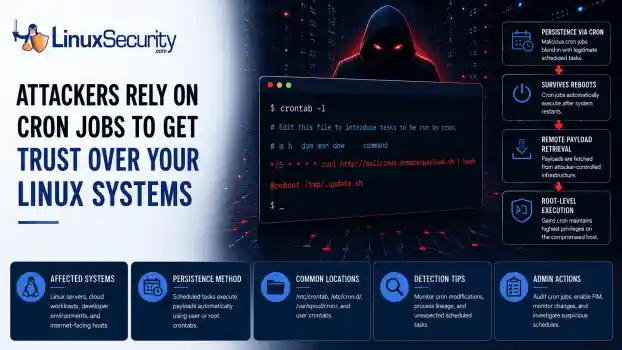
 A Linux server gets cleaned up after an intrusion. The suspicious process is terminated, credentials are rotated, and the system is rebooted during maintenance. Everything seems secure. A few hours later, the same outbound connection appears again. . Situations like that point to persistence . The attacker no longer needs the original exploit because something on the host continues restoring access behind the scenes. Finding that mechanism is often more important than understanding how the...
 Jun 08, 2026
 threat detection scalability
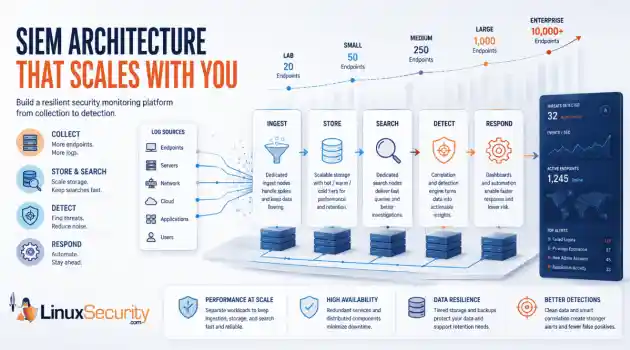
 Building a SIEM is easier than scaling one. Most open-source deployments start as a simple "all-in-one" server. It is easy to set up, but that design rarely survives the transition from a lab to a production workload. . A SIEM watching 20 endpoints is not doing the same job as one watching 500. More endpoints mean more logs; more logs require more storage; more storage makes search heavier. Eventually, the very architecture that made your lab easy to deploy becomes the reason your production...
Jun 04, 2026
 security advisory apache
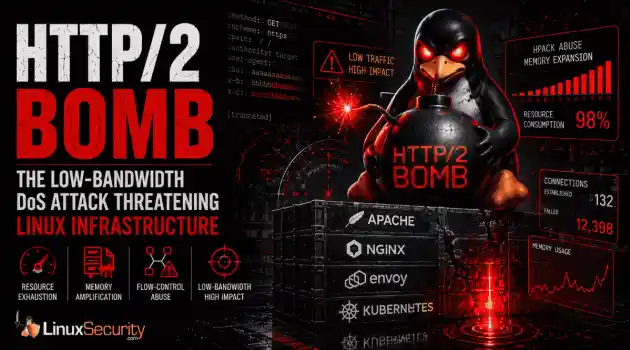
 A newly disclosed attack technique called HTTP/2 Bomb is drawing attention because it targets the software that sits at the front of much of the Linux internet. Apache HTTP Server, NGINX, Envoy, and the ingress layers that many Kubernetes environments depend on can be forced into consuming disproportionate amounts of memory using relatively small amounts of attacker traffic. . For Linux administrators, the concern is not the HTTP/2 protocol itself. It is the possibility that a single...
Jun 04, 2026
 security advisory important
 The compromise of Nx Console shows how much infrastructure now sits behind a single developer account. GitHub repositories, CI/CD pipelines, container build systems, Terraform projects, Kubernetes deployments. None of those systems was the initial target. The workstation was. . Attackers did not need a Linux privilege escalation bug or a remote code execution chain. They needed developers to trust a tool they were already using. For many organizations, that was enough. What Happened? Federal...
Jun 03, 2026
 security advisory open-source
 You remove the malware. You rotate the compromised credentials. You patch the original vulnerability and close the ticket. Two weeks later, the attacker is back. . What happened? You didn't lose the battle at the exploit; you lost it at the cleanup. In many modern Linux intrusions, the malware you found wasn't the main problem—it was the fallback mechanisms left behind. These hooks quietly restore attacker access the moment you look away. If you clean a host but miss these persistence layers,...
Jun 02, 2026
 Refine features
X Clear Filters
Get the latest News and Insights
Get the latest Linux and open source security news straight to your inbox.
Community Poll
What got you started with Linux?
Loading...

Explore Latest Linux Security features
We found -4 articles for you...
102
 security advisoryapplication securitymemory safety
The End of “Patch and Pray”: How Rust Is Reshaping Memory Safety in Linux
Most information security best practices are built on a single, comfortable assumption: that if we find a bug, we can patch it, and once it’s patched, the system is "safe" again. . We’ve lived in this cycle for thirty years. A vulnerability is found, a CVE is issued, and sysadmins scramble to update their servers. But the recent move to bring the Rust programming language into the Linux kernel—reaching a new level of stability and integration in recent kernel releases—is the first sign that the people at the top have realized the cycle is broken. We aren't just dealing with "bugs" anymore. We are dealing with a structural failure in how our systems are built. What is C, and Why Is It Killing Us? To understand why this is a strategic shift, you have to look at the language Linux is built on: C . Computers don't actually understand "software." They understand electricity moving through physical memory addresses. C is the "translator" that sits between the human programmer and the physical hardware. It’s the industry standard because it’s incredibly fast and gives you total control over the machine. But that control comes with a catch: C has no safety rails. In C, the programmer is responsible for manually managing every single "bucket" of memory the system uses. If your program needs space to store a username, you have to ask the system for exactly 10 bytes of memory, use them, and then remember to "give them back" when you’re done. The problem? C assumes the programmer is perfect. If you ask for 10 bytes, but a user sends you 100, C doesn't stop the extra data. It just lets it spill over into the next section of memory—often overwriting the very security instructions that were supposed to keep the user out. The "70% Problem" in the Kernel In systems like the Linux kernel, these aren't just "accidents"; they are a structural reality of the language. Microsoft recently estimated that 70% of all security vulnerabilities in their products over the last decade werethese exact memory safety issues. Google found the same trend, noting that these bugs are the primary cause of stability and security issues in complex systems like Android. We’ve spent three decades telling engineers to "just write better code," but humans don't scale. If the smartest engineers at Microsoft and Google can’t stop making these translation mistakes, the problem isn't the engineers—it's the tool. As we saw with the recent Pack2TheRoot disclosure (CVE-2026-41651), a tiny gap in how a background service handles a memory request can sit in a "standard" Linux install for 12 years before someone realizes the door has been unlocked. When your foundation is built on a language that trusts a local user not to overflow a memory bucket, you aren't managing a secure server; you're managing a liability. Enter Rust: The Security Guard at the Checkpoint This is where Rust changes the philosophy of system security. In a traditional C-based system, we look for security flaws after the software is already running. That’s what your EDR, firewall, and log monitors are for—they watch for the "spill" after it happens. Rust moves that check to the compiler. The compiler is the tool that translates the human-written code into a running program. In Rust, the compiler acts like a strict building inspector. It includes a "Borrow Checker" that tracks every piece of data. If you try to write code that could cause a memory spill or a "race condition" (where two processes fight over the same data), the compiler simply refuses to build the program. In Linux, this is already showing up in new drivers and subsystems being written in Rust instead of C. This isn't just a development decision; it’s a signal that memory safety is being treated as a requirement, not a best practice. As detailed on the OSS-Security mailing list, the "default" state of a Linux host is usually its biggest risk. Rust fixes this by: Eliminating Risk Classes: We stop chasing individual bugs and start removingthe possibility of those bugs existing. Reducing the "Patching Tax": If a class of bugs can't exist in a driver, you don't have to spend your weekend patching a CVE for it. The Reality Check: Trust But Validate We have to be realistic: Linux is 30 million lines of C. We aren't swapping it all out overnight. The existing C code will dominate the kernel for years to come. And Rust isn't a magic wand. A recent audit showed that specific classes of bugs Rust won't catch—like logic errors where the code is "safe," but the math is wrong—still require human eyes. Rust can prevent you from crashing the car, but it can't prevent you from driving to the wrong address. But that’s exactly why this is a strategic win. By using Rust to handle the "boring" memory safety stuff automatically, we can finally focus our energy on the actual system logic. The Real Lesson: Stop Trusting the Defaults The shift toward Rust in Linux is a declaration of structural intolerance. It’s a signal that the industry is finally losing its patience with a model that assumes the foundation is naturally leaky. The most dangerous systems are the ones that look normal. For years, we’ve treated vulnerabilities like a weather pattern—something that just happens to us. We’ve focused on "detect and respond" because we assumed the foundation was naturally porous. Security isn't about the tools you've installed to watch the perimeter; it’s about the integrity of the core. Stop trusting that the "standard" install has your back. Start validating the foundation. . Exploring Rust's impact on memory safety within the Linux kernel and the shift from traditional C management strategies.. memory safety, Linux kernel, Rust programming, security practices, application integrity. . MaK Ulac
 Apr 29, 2026
•
Apr 29, 2026
•

Get the latest News and Insights
Get the latest Linux and open source security news straight to your inbox.
Community Poll
What got you started with Linux?
Search Topics
Powered By

Linux Security - Your source for Top Linux News, Advisories, HOWTOs and Feature Releases
QUICK LINKS
subscribe to newsletters!
Like staying secure? So do we.
Sign up for updates, tips, and alerts!
Discover faster search, smarter navigation, and deeper Linux security insights. Read More