


Stay Ahead With Linux Security Features
 security advisory attack
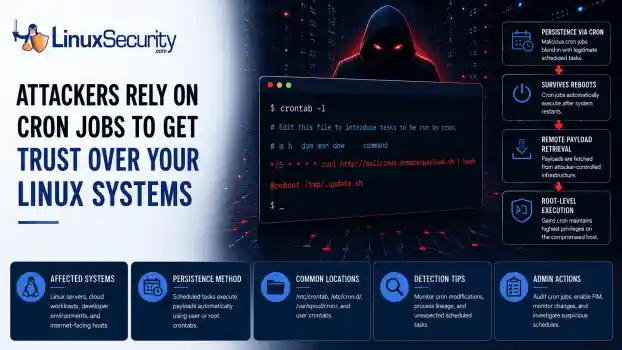
 A Linux server gets cleaned up after an intrusion. The suspicious process is terminated, credentials are rotated, and the system is rebooted during maintenance. Everything seems secure. A few hours later, the same outbound connection appears again. . Situations like that point to persistence . The attacker no longer needs the original exploit because something on the host continues restoring access behind the scenes. Finding that mechanism is often more important than understanding how the...
 Jun 08, 2026
 threat detection scalability
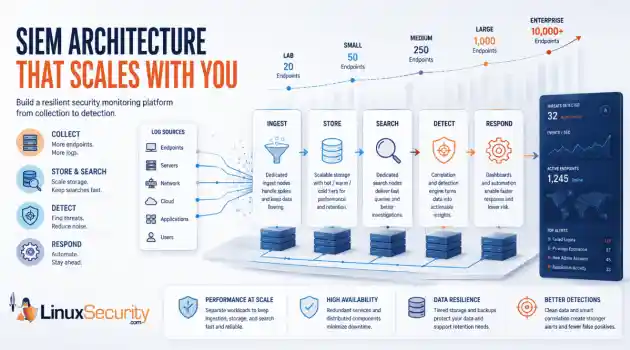
 Building a SIEM is easier than scaling one. Most open-source deployments start as a simple "all-in-one" server. It is easy to set up, but that design rarely survives the transition from a lab to a production workload. . A SIEM watching 20 endpoints is not doing the same job as one watching 500. More endpoints mean more logs; more logs require more storage; more storage makes search heavier. Eventually, the very architecture that made your lab easy to deploy becomes the reason your production...
Jun 04, 2026
 security advisory apache
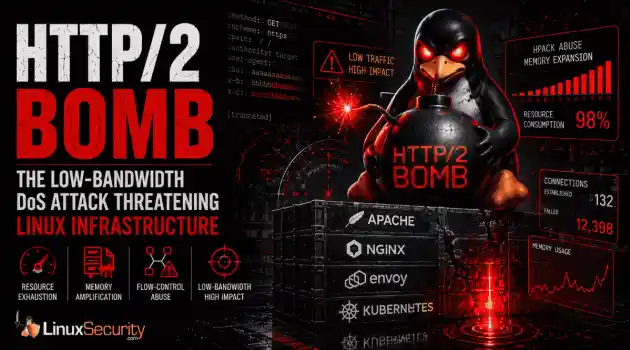
 A newly disclosed attack technique called HTTP/2 Bomb is drawing attention because it targets the software that sits at the front of much of the Linux internet. Apache HTTP Server, NGINX, Envoy, and the ingress layers that many Kubernetes environments depend on can be forced into consuming disproportionate amounts of memory using relatively small amounts of attacker traffic. . For Linux administrators, the concern is not the HTTP/2 protocol itself. It is the possibility that a single...
Jun 04, 2026
 security advisory important
 The compromise of Nx Console shows how much infrastructure now sits behind a single developer account. GitHub repositories, CI/CD pipelines, container build systems, Terraform projects, Kubernetes deployments. None of those systems was the initial target. The workstation was. . Attackers did not need a Linux privilege escalation bug or a remote code execution chain. They needed developers to trust a tool they were already using. For many organizations, that was enough. What Happened? Federal...
Jun 03, 2026
 security advisory open-source
 You remove the malware. You rotate the compromised credentials. You patch the original vulnerability and close the ticket. Two weeks later, the attacker is back. . What happened? You didn't lose the battle at the exploit; you lost it at the cleanup. In many modern Linux intrusions, the malware you found wasn't the main problem—it was the fallback mechanisms left behind. These hooks quietly restore attacker access the moment you look away. If you clean a host but miss these persistence layers,...
Jun 02, 2026
 Refine features
X Clear Filters
Get the latest News and Insights
Get the latest Linux and open source security news straight to your inbox.
Community Poll
What got you started with Linux?
Loading...

Explore Latest Linux Security features
We found -4 articles for you...
102
 mandatory access controlLinux administrationrisk mitigation
What Is AppArmor? A Practical Look for Linux Admins
Most of us don’t decide to deploy AppArmor. We inherit it. It’s already enabled on the system, already loaded at boot, and already assumed to be doing something useful. Over time, it fades into the background. That’s usually when it starts to matter. . AppArmor sits inside the kernel and quietly decides whether a process can touch a file, open a socket, or use a capability. It does this whether you are paying attention or not. In many environments, that means AppArmor is part of your Linux security posture by default, not by design. You may not know which services are confined, which profiles are permissive, or whether anything is actually being enforced. The problem is not that AppArmor exists. The problem is that it’s easy to trust it without verifying what it’s doing. Profiles can load cleanly and still fail to reflect how your services actually run. Denials can pile up in logs no one watches. Or nothing shows up at all, which feels reassuring until you realize you don’t know why. AppArmor is not a hardening switch you flip to make risk go away. It is a profile-driven control that narrows what a process can do after it has already started running. When it works, it limits how far a compromised service can reach. When it’s misunderstood, it either breaks workloads or provides a false sense of coverage. This article is about understanding what AppArmor really changes for you as an admin. How it fits into Linux security, where it meaningfully reduces risk, and where it does not. By the end, you should be able to look at AppArmor on your systems and decide whether it should be enforced, audited, tuned, or deliberately left alone. Where Does AppArmor Fit in Linux Security? When AppArmor shows up in conversations, it’s often treated as a feature instead of a control. That framing causes confusion. AppArmor is part of Linux security in the same way file permissions and sudo are. It limits behavior. It does not make decisions for you. At a basic level, AppArmor is amandatory access control system enforced by the kernel. Once a process starts, the kernel checks its AppArmor profile before allowing access to files, network resources, signals, or capabilities. Those checks happen after traditional Unix permissions are evaluated. If DAC says yes, but the AppArmor profile says no, the answer is still no. Here’s the important part to internalize early. AppArmor assumes the process is already running. It does not care how the process got there. If a service is exploited through a bug or misconfiguration, AppArmor does not stop that initial compromise. What it can do is limit what the attacker can touch next. That distinction matters when you’re reasoning about risk. Unlike label-based systems, AppArmor policies are path-based. The profile applies to a binary at a specific path and to the files it is allowed to access by path. That design choice makes AppArmor easier to reason about for many admins, especially early on, but it also introduces blind spots when paths change or when access happens in unexpected ways. Most admins first encounter AppArmor passively. It’s enabled by default on common distributions, profiles ship with packages, and nothing appears broken. Over time, you start to see it surface during incidents or upgrades, usually as a denial tied to a service that used to work. That’s often the moment people realize AppArmor has been part of their Linux security model all along. The practical shift here is how you think about damage, not intrusion. AppArmor is about constraining the blast area after something goes wrong. If you’re evaluating it as a preventive control, you’ll be disappointed. If you evaluate it as a way to keep a bad day from becoming a worse one, it starts to make more sense. What AppArmor Actually Controls (And What It Doesn’t) Once you accept where AppArmor sits, the next step is understanding its reach. This is where expectations tend to drift. People assume it covers more ground than it really does, or they dismissit entirely because it doesn’t solve the wrong problem. In practice, AppArmor focuses on a narrow but important slice of process behavior. It controls what a confined process is allowed to touch, not what logic it executes or what data it chooses to mishandle. AppArmor can restrict, per profile: Reading, writing, and executing files by path Access to specific directories or device files Network operations, depending on profile and kernel support Use of Linux capabilities, such as mounting or raw sockets ptrace and signal interactions with other processes This is effective when a service has a predictable footprint. A web server that should only read its config, write logs, and talk to the network is a good candidate. Once you’ve seen a compromised service try to read SSH keys or crawl through home directories, you start to see the value of narrowing those paths. There are clear limits. AppArmor does not understand application intent. It does not stop SQL injection , command injection, or logic flaws inside the process. If an application is allowed to read a file, AppArmor does not care why it’s reading it or how that data is used. Path-based enforcement also means that symlinks, bind mounts, and dynamic paths can complicate the picture in ways that are not always obvious. This is the point where assumptions usually break. AppArmor does not prevent lateral movement in the way people sometimes expect, and it does not compensate for weak authentication or exposed management interfaces. It reduces the set of things a process can reach, nothing more. Once you see those boundaries clearly, AppArmor becomes easier to reason about. You stop expecting it to solve application-layer problems, and you stop assuming it has visibility it simply doesn’t have. That shift alone prevents a lot of misplaced trust. Profiles, Modes, and Enforcement Reality On paper, AppArmor profiles look straightforward. A profile exists, it applies to a binary, and the kernel enforces it. Inproduction, it’s rarely that clean. Every profile runs in one of two modes. Enforce mode blocks actions that are not allowed by the policy. Complain mode allows the action but logs what would have been denied. Complain exists for a reason. Most real services do things you don’t fully understand until you watch them run under constraint. Skipping that learning phase is how profiles end up disabled instead of fixed. Profiles are loaded at boot or when the AppArmor service starts, and they’re matched by binary path. That detail shows up in incidents more often than people expect. If a package update moves or replaces a binary, or if a service is launched through a wrapper or symlink, the profile you think is active may not apply at all. The service still starts. Nothing crashes. Enforcement just quietly disappears. Includes and abstractions add another layer. Many shipped profiles rely on shared snippets for common permissions. That keeps policies manageable, but it also makes it harder to tell at a glance what a profile really allows. You start to see this when a denial doesn’t make sense until you trace it back through multiple includes. The most common mistake is assuming that a loaded profile is an effective profile. A profile can exist, be syntactically valid, and still fail to match how the service actually behaves. Over time, workloads change. Paths move. Features get added. Profiles do not update themselves. Once you’ve been bitten by this, your posture changes. You stop trusting the presence of profiles as evidence of enforcement. You start checking which mode they’re in, what paths they actually match, and whether the profile still describes the service you’re running today, not the one that shipped with the package years ago. What Breaks When AppArmor Is Turned On Most AppArmor problems don’t show up as clean failures. Services start, then behave oddly. Errors surface in places that don’t obviously point back to access control. That’s why AppArmor has a reputationfor being “random” when it isn’t. Common breakage patterns tend to repeat: Services failing with generic permission errors that don’t mention AppArmor Background tasks or helpers failing while the main process appears healthy Denials appearing only after package upgrades or configuration changes Custom install paths and non-standard directory layouts being blocked Containerized workloads hitting paths the profile never anticipated Teams disabling enforcement instead of adjusting the profile Test environments rarely expose this. They’re smaller, cleaner, and closer to defaults. Production systems accumulate history. Old paths linger. Debug flags get enabled. Temporary files move into places nobody documented. AppArmor enforces what the profile says, not what the service “usually” does. Developers often work around these failures by changing how the service runs rather than fixing the policy. That solves the immediate problem but leaves you with a control that’s technically enabled and functionally irrelevant. Over time, that’s how AppArmor becomes shelfware. The real cost here is time. If you don’t recognize AppArmor as the source, you chase file permissions, ownership, and SELinux flags that aren’t in play. Once you’ve seen a few of these incidents, you start checking AppArmor early. It saves hours. Operationally, this shifts how you plan changes. Turning AppArmor on, or moving profiles from complain to enforce, is not a toggle you flip casually. It’s something you stage, observe, and revisit, especially on systems that have grown organically over years. Logging, Alerts, and What “Good” Looks Like AppArmor’s visibility is uneven, and that’s part of why it’s easy to ignore. It logs denials, not intent. If nothing is being denied, you may see nothing at all. On most systems, AppArmor events end up in the audit stream or kernel logs, depending on how auditing is configured. A real denial is usually explicit once you know thepattern. You’ll see the profile name, the operation, the path that was blocked, and whether enforcement was active. Until you recognize that structure, it blends into the noise of other kernel messages. The harder part is interpretation. Some denials are expected and harmless. Others indicate that the profile no longer matches reality. The difference shows up over time. Repeated denials on the same path usually point to missing permissions. One-off denials tied to strange paths are often worth a closer look. Quiet systems are not automatically healthy. Sometimes it just means the profile is too permissive or not applied. Alerting is rarely out of the box. Most teams either forward AppArmor logs into existing Linux security monitoring or review them during incidents. That’s not ideal, but it’s common. The key is knowing what you would expect to see if enforcement were actually working. A system that never produces AppArmor logs at all deserves scrutiny, especially if profiles are supposedly enforced. Once you’ve watched AppArmor during a real failure, your expectations reset. You stop looking for dashboards and start looking for absence and repetition. That’s what “good” looks like here. Limited, explainable noise that tells you the control is alive and paying attention. AppArmor vs SELinux (The Non-Religious Version) This comparison comes up because admins are asked to justify choices, not because one system is universally better. Treating it like a debate usually misses the point. The operational difference that matters most is how policy is expressed and maintained. AppArmor ties rules to paths. SELinux ties rules to labels. In day-to-day work, that means AppArmor tends to be easier to read and adjust when you’re dealing with a small number of well-understood services. You can often look at a profile and understand, roughly, what it’s trying to allow. SELinux scales differently. Label-based enforcement holds up better in environments where paths change frequently, whereservices are heavily composed, or where isolation needs to be more uniform across the system. The tradeoff is complexity. When something breaks, understanding why can take longer unless the team already lives in that ecosystem. Defaults also matter. Some distributions lean heavily on SELinux and invest in keeping policies current. Others ship AppArmor profiles that cover common services and then largely leave them alone. That history affects how much work you inherit and what skills already exist on the team. The deciding factor is rarely theory. It’s who is going to maintain the policies, debug failures, and explain incidents at three in the morning. If no one on the team understands SELinux, AppArmor may be the only control that gets used at all. If SELinux is already part of your operational muscle memory, introducing AppArmor adds little. Once you see it this way, the question stops being which system is “stronger” and starts being which one you can actually operate. That’s the only comparison that tends to hold up over time. When AppArmor Is Worth It (And When It’s Not) AppArmor pays off when the behavior of a service is narrow and repeatable. You tend to see the benefits most clearly on internet-facing daemons that do one job, live in predictable paths, and rarely change how they access the system. In those cases, the profile stays stable, and the control quietly limits damage when something goes wrong. It’s also useful when you already have discipline around configuration and change management. Profiles age just like configs do. If nobody owns them, they drift. Teams that track changes, review logs, and revisit assumptions get more value out of AppArmor than teams that set it once and move on. There are environments where AppArmor adds friction without much return. Highly dynamic systems, custom-built applications with shifting paths, and workloads that constantly evolve tend to outgrow static profiles. In those cases, AppArmor often ends up permanently permissive ordisabled, which helps no one. Shelfware has a recognizable shape. Profiles exist, but stay in complain mode forever. Logs are never reviewed. Enforcement is disabled during incidents and never restored. At that point, AppArmor is consuming mental space without reducing risk. The decision doesn’t have to be permanent. Some teams enforce AppArmor only on a subset of services. Others revisit it after a major refactor or platform change. What matters is that the choice is intentional. In Linux security, an explicit decision is almost always safer than an inherited default you no longer remember agreeing to. How I Validate AppArmor Is Doing Its Job I don’t trust AppArmor because it’s enabled. I trust it when I can see it behave the way I expect. The first thing I check is whether profiles are actually loaded and in enforce mode . That sounds obvious, but it’s common to find services running under complain mode long after a rollout finished. From there, I confirm that the profile name matches the binary that’s running, not the one that used to exist. I like to generate a controlled failure. Nothing dramatic. A simple attempt to access a path that should be denied is enough. If AppArmor is enforcing, I expect to see a clear denial in the logs tied to the correct profile. If I don’t, something is wrong, even if the service appears healthy. After changes or upgrades, I review logs with a narrow time window. I’m looking for repetition. New denials clustered around a deployment usually mean the workload changed. Sporadic denials with odd paths are more concerning and worth digging into. Drift is the quiet enemy. Services accrete features. Paths move. Temporary workarounds become permanent. Periodically, I sanity-check profiles against how the service actually runs today. If a profile hasn’t been looked at in years, I assume it no longer describes reality. Before I trust AppArmor during an incident, I want to know two things. Is enforcement active, and have I seen it blocksomething before? If the answer to either is no, I treat it as unproven. In Linux security, controls earn trust through observation, not configuration state. Final Takeaways for Admins Running AppArmor AppArmor tends to fade into the background because it doesn’t announce itself. When it’s quiet, systems look fine. Services run. Nothing alerts. Over time, that quiet gets mistaken for coverage. What AppArmor actually gives you is constraint, not prevention. It limits how far a process can reach once it’s running. That’s valuable, but only if the profile still matches reality and enforcement is active. Defaults help you start, but they are not a finished control, and they rarely stay accurate on their own. A silent system still needs to be checked. Profiles drift. Workloads change. Logs stop being reviewed. None of that means AppArmor failed. It means ownership faded. That’s a normal pattern, but it’s one you need to recognize. Disabling AppArmor is not a mistake if it’s a conscious choice. Leaving it enabled without knowing what it enforces is. The difference is whether you can explain the decision when something goes wrong. If you take one thing away, it’s this. AppArmor is part of your Linux security posture, whether you like it or not. The only real question is whether you’re treating it as an active control, a monitored control, or an ignored one. Systems tend to reflect that choice sooner than you expect. . AppArmor sits inside the kernel and quietly decides whether a process can touch a file, open a socke. don’t, decide, deploy, apparmor, inherit, already, enabled, system. . Brittany Day
 Feb 05, 2026
•
Feb 05, 2026
•

Get the latest News and Insights
Get the latest Linux and open source security news straight to your inbox.
Community Poll
What got you started with Linux?
Search Topics
Powered By

Linux Security - Your source for Top Linux News, Advisories, HOWTOs and Feature Releases
QUICK LINKS
subscribe to newsletters!
Like staying secure? So do we.
Sign up for updates, tips, and alerts!
Discover faster search, smarter navigation, and deeper Linux security insights. Read More