


Stay Ahead With Linux Security Features
 security advisory attack
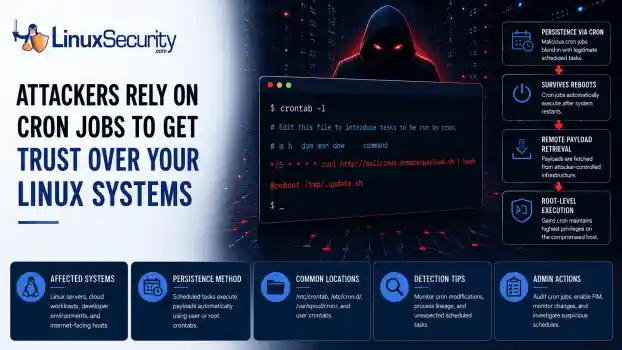
 A Linux server gets cleaned up after an intrusion. The suspicious process is terminated, credentials are rotated, and the system is rebooted during maintenance. Everything seems secure. A few hours later, the same outbound connection appears again. . Situations like that point to persistence . The attacker no longer needs the original exploit because something on the host continues restoring access behind the scenes. Finding that mechanism is often more important than understanding how the...
 Jun 08, 2026
 threat detection scalability
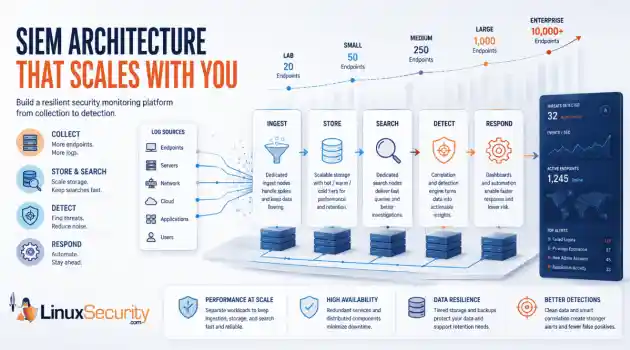
 Building a SIEM is easier than scaling one. Most open-source deployments start as a simple "all-in-one" server. It is easy to set up, but that design rarely survives the transition from a lab to a production workload. . A SIEM watching 20 endpoints is not doing the same job as one watching 500. More endpoints mean more logs; more logs require more storage; more storage makes search heavier. Eventually, the very architecture that made your lab easy to deploy becomes the reason your production...
Jun 04, 2026
 security advisory apache
 A newly disclosed attack technique called HTTP/2 Bomb is drawing attention because it targets the software that sits at the front of much of the Linux internet. Apache HTTP Server, NGINX, Envoy, and the ingress layers that many Kubernetes environments depend on can be forced into consuming disproportionate amounts of memory using relatively small amounts of attacker traffic. . For Linux administrators, the concern is not the HTTP/2 protocol itself. It is the possibility that a single...
Jun 04, 2026
 security advisory important
 The compromise of Nx Console shows how much infrastructure now sits behind a single developer account. GitHub repositories, CI/CD pipelines, container build systems, Terraform projects, Kubernetes deployments. None of those systems was the initial target. The workstation was. . Attackers did not need a Linux privilege escalation bug or a remote code execution chain. They needed developers to trust a tool they were already using. For many organizations, that was enough. What Happened? Federal...
Jun 03, 2026
 security advisory open-source
 You remove the malware. You rotate the compromised credentials. You patch the original vulnerability and close the ticket. Two weeks later, the attacker is back. . What happened? You didn't lose the battle at the exploit; you lost it at the cleanup. In many modern Linux intrusions, the malware you found wasn't the main problem—it was the fallback mechanisms left behind. These hooks quietly restore attacker access the moment you look away. If you clean a host but miss these persistence layers,...
Jun 02, 2026
 Refine features
X Clear Filters
Get the latest News and Insights
Get the latest Linux and open source security news straight to your inbox.
Community Poll
What got you started with Linux?
Loading...

Explore Latest Linux Security features
We found -4 articles for you...
102
 open sourcesoftware developmentsecurity testing
Benefits and Operations of Bug Bounty Programs for Open Source Security
Ethical hacking might sound contradictory, but leveraging the skills of the ‘white hat’ hacker community has done a great deal for safety and security on the internet. Nowhere does this show more than through so-called bug bounty programs created to tackle different issues within the code. Many bug bounty programs focus on identifying issues within software or applications. However, others focus on server or website vulnerabilities . . The Benefits of Open Source (and Its Primary Challenge) With the rapid development and sustainable iterations, open-source software (OSS) libraries and frameworks have been in massive demand. There are few traditional proprietary software that can match the fast-track development cycle using OSS. Additionally, it helps to pull down costs and reduce the time-to-market cycle by cutting down on time needed for custom coding. Instead, it mines existing OSS, which can be quickly shared, modified, and copied. While proprietary coding is far from dead, OSS now plays a huge role in the market. According to statistics: Both LAMP (Linux, Apache, MySQL, and PHP) and MEAN (MongoDB, Express.js, AngularJS, and Node.js) development stacks have become hugely popular, Android, one of the most popular Linux kernel operating systems on the market, runs on 85% of the world’s smartphones, Linux also powered three quarters of the public cloud workload over the pandemic. Statistics on the use of OpenSource suggest up to 70% of the world’s code databases are drawing on OpenSource. That’s impressive, but that means any risk related to OSS use has become critical to tackle. Open source has never been more important in the software community. The time when a vulnerability could come to light a few years later and be tackled then is long past. A fast, responsive debugging is our critical priority. What Are Bug Bounties & How Do They Work? So, how do we incentivize an unpaid, sharing space that brings the coders no revenue to produce results quickly? Cybercriminals are not going to come forward, after all. While many Linux and Open-Source developers take pride in their development and offer fixes as soon as possible, we can’t expect miracles from a product offered for free and often created in the developer’s spare time. How Do Bug Bounties Work? Bug bounty programs have stepped into this role. You’ll find them throughout the ‘Big Tech’ space, including those from Google, Microsoft, Facebook, and Apple, as well as smaller firms. Bug bounties are programs which pay out to interested parties who find and fix vulnerabilities in open-source code before impacting the platforms using them, adding an additional layer of security to software developed with OSS. Types of Bug Bounty Programs Bug Bounties fall into two categories - Private and Public. Public programs allow anyone who is interested to participate. While some may have specific restrictions based on the participants existing track rec ord or skill level, mostly anyone can report a potential exploit (and fix) to them within the bounty’s guidelines. Some are even offered off of the specific platform, focusing instead on the general body of OS code. Private programs work differently. They’re invite-only programs, choosing hand-picked ethical hackers based on their skill level and existing stats. Typically, invitees have already demonstrated great skill in testing the kind of applications the program is focusing on. While some will evolve to a public-style bug bounty later on, some remain private for their entire lifecycle. Many private programs are also specifically focused on critical coding sections of the platform, intending to boost security and limit vulnerabilities in their product offerings. What Are the Benefits of Bug Bounties? So, the primary benefit of bug bounties is easy to see. They offer a way to financially incentivize researchers to analyze code, report vulnerabilities, and close them before they become an issue. Critically, they also don’t ‘break’the primary value of OSS code - it stays free, shareable, and accessible to any party who needs it. What else do they do? Public Disclosure A more hidden side of the business is incentivizing these white-hat hackers to not publicly disclose what they find until the matter is fixed. This means cybercriminals don’t get an advanced warning of the issue until it’s too late to do anything with that information. Pay for Results Bug bounty programs only pay out when a specific chain of reporting and fixing has been followed. This means they don’t incentivize the wrong people to ‘milk the market’ by creating these issues, nor reward bad behavior - only the ethical hacker who closes, rather than exploits, the vulnerability. Discretion In some private bug bounty programs, you can even hand-pick who you want to invite to ‘hack’ your product, providing greater control and discretion to the market. Of course, a public program can get results faster, but it can also be overwhelmingly difficult to manage for smaller security teams. Continual Testing We’ve emphasized this already, but it bears repeating. Use of a bug bounty program allows programmers and software companies to keep a fresh and vigilant taskforce on the job, meaning that bug loopholes don’t only get identified in Beta, but continuously come to light. This becomes especially helpful as updates and new innovations to older software go live. Vast Body of Testers Even the largest companies cannot employ thousands of testers in-house. They can, however, access them through bug bounty programs. They give access to a huge body of willing testers, continually working to better the software and close dangerous loopholes. Diversity Working in tandem with our previous point, you also remove almost all bias when you run a bug bounty program. Testers come from wildly different backgrounds, skill sets, and walks of life, across all geographical boundaries. This allows a phenomenal testing pool. Scalability Bug bounty programscan be scaled up or down to suit the company. Smaller entities can start gently, but expand their testing if their product gains marketplace traction. You can onboard more expertise at critical times, such as during new updates or product launches, and scale it back when there’s less demand. Expense Despite the need to pay out on successful presentation of a solution, bug bounties typically work out cheaper in the long run than in-house testing. They certainly are cheaper than the loss to reputation and customer trust that can come when a critical vulnerability remains live, too. Skilled Labor It’s worth mentioning that you’re not paying for unskilled eyes, either. Private bug bounty programs get to hand-pick who they’re working with. Even public programs are working with skilled testers who have to demonstrate that they can close, not just identify, loopholes. So you’re always using the right people for the job. Control This also places a great deal of control in the hands of the company running a bug bounty. You set the rules, and the ethical hackers engaging with your product come to you with the solutions. You can choose how long the program runs, what sort of bugs are being tested for, what you pay out for, and a lot more. One single bug bounty program- the Internet Bug Bounty- has managed to uncover over a thousand defects in existing open-source programs, paying out a combined total of $750,000 to the hackers that came forward. On average, each bounty netted $500-$750, although some high-end bounties have capped at $25,000 for particularly lucrative loopholes. They’ve even used a ‘bragging rights’ billboard as extra incentive. Closing the Door on Open Source Loopholes with Bug Bounties Fortunately, Open Source software has the support of a very robust and engaged programming community. They’re already engag ed in making open source solutions faster, more effective, efficient, and secure. Bug bounties, however, offer an additional bonus for achieving results fast.They’re also a great way for an app, API, or other software to ensure it’s offering its customers only the best security in robustly examined and policed software, eliminating one of the biggest concerns with using OSS in the first place. What Are Some Notable Vulnerabilities that Were Fixed as a Result of a Bug Bounty? Part of the allure of an effective bug bounty program is that we never hear exactly what was fixed. Or, if we do, we only hear about it years after the exploit was live. While the results of ethical hackers’ hard work go live almost daily, part of the idea is that we never know quite what the original exploit was. However, one key bug bounty-created solution was the recent vulnerability patch released by Microsoft surrounding the CVE-2022-26904, which was uncovered as part of joint information shared by CrowdStrike and the US National Security Agency. This particular fix tackled a privilege escalation issue that allowed a ‘win a race condition to fall over into exploitation. In fact, a high number of the fixes now being released by Microsoft as part of their ‘Patch Tuesdays’ updates have been found through Microsoft-specific bug bounty programs. Multiply that by the many software and API updates going live daily, and you have a great idea of how important a solid bug bounty program can be to both companies and their end users. What Is Coordinated Vulnerability Disclosure? Coordinated vulnerability disclosure (CVD), formerly known as responsible disclosure, is a system for disclosure of vulnerabilities or flaws to the public after patches or remedies have been issued. This coordination distinguishes the CVD model from the "full disclosure" model. Because software developers often require time and resources to repair their mistakes, ethical hackers find these vulnerabilities. Hackers and cybersecurity experts consider it their social responsibility to make vulnerabilities public knowledge as hiding problems could cause a feeling of false security. To avoid this, thoseinvolved arrange a specific amount of time to repair the vulnerability. The time needed for an emergency fix or workaround depends on the potential impact of the vulnerability, ranging from a few days to several months. The market for bug bounties has developed over recent years, sparking heavy debate over the ethics of monetizing vulnerability reports. Some security experts have the expectation of compensation while others view this as extortion. How Do I Get Started with a Bug Bounty? What Skills Do I Need? Wondering how to get started with bug bounties? Obviously, participating in a bug bounty program needs a wealth of specialist knowledge. Participants need a solid grounding in computer networking, web technologies and protocol, and security mechanisms. This includes a solid grounding in security practices (and their hacking bypasses), common vulnerabilities in applications and the web, and how to find them. You will also need the skill set to patch and prevent these vulnerabilities, so most bug bounty program participants are either coders themselves, or the so-called ‘ethical hackers’ who test their coding boundaries with the aim to help resolve, rather than exploit, them. Remember that these are ever-evolving skill sets, and you will need to stay up-to-date on current industry trends and changes. If you’re starting from scratch, there are bug bounties for beginners resources you can use to start honing your skills. From there, most potential program participants will start in public bug bounty programs to build and polish their skills. Bug bounties lists are pretty easy to find. There’s even a bug bounties Reddit sub to explore! So it’s less a case of where to find bug bounties, and more. Focus on companies with bug bounties for software you feel most confident in. Earning a reputation in public programs is often the key first step to being invited to private programs. Is There Training on How to Get Into Bug Bounties? Yes, there are! If you’re brand new to the idea,but keen to get started, there are some quality resources you can use to help you get going. Books & e-Books Believe it or not, there’s a wealth of traditional book and e-book resources that can break you into the basics of ethical hacking. Kevin Mitnick’s Ghost In The Wires: My Adventures as the World’s Most Wanted Hacker, The Web Application Hacker’s Handbook: Finding and Exploiting Security Flaws, and Peter Yarworski’s Web Hacking 101: How to Make Money Hacking Ethically are three great places to get started if you like this learning format. There’s plenty more. Training Courses Many sites also offer training on ethical hacking, especially now that bug bounties have taken off. Of course, you’ll want to do your due diligence and make sure you aren’t forking over cash without vetting the true credentials of the learning portal. Here’s some tuition providers with the experience to back their claims: Bug Bounty Hunting on YouTube 100 Bug Bounty Training Lessons Portswigger’s Web Security Academy SANS Cybersecurity Roadmap from the SANS Institute [Would you like to be listed here? Send us a note at
 May 26, 2022
•
May 26, 2022
•

Get the latest News and Insights
Get the latest Linux and open source security news straight to your inbox.
Community Poll
What got you started with Linux?
Search Topics
Powered By

Linux Security - Your source for Top Linux News, Advisories, HOWTOs and Feature Releases
QUICK LINKS
subscribe to newsletters!
Like staying secure? So do we.
Sign up for updates, tips, and alerts!
Discover faster search, smarter navigation, and deeper Linux security insights. Read More