


Stay Ahead With Linux Security Features

 security advisory attack
 A Linux server gets cleaned up after an intrusion. The suspicious process is terminated, credentials are rotated, and the system is rebooted during maintenance. Everything seems secure. A few hours later, the same outbound connection appears again. . Situations like that point to persistence . The attacker no longer needs the original exploit because something on the host continues restoring access behind the scenes. Finding that mechanism is often more important than understanding how the...
 Jun 08, 2026
  threat detection scalability
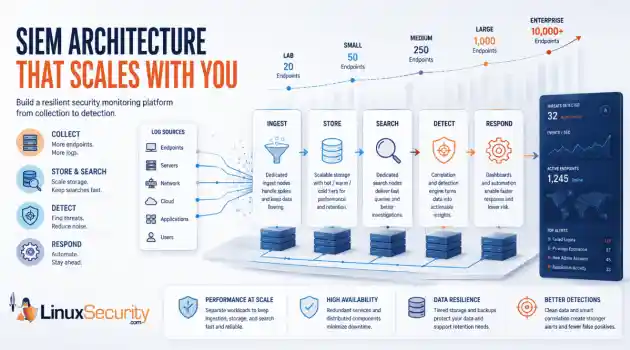
 Building a SIEM is easier than scaling one. Most open-source deployments start as a simple "all-in-one" server. It is easy to set up, but that design rarely survives the transition from a lab to a production workload. . A SIEM watching 20 endpoints is not doing the same job as one watching 500. More endpoints mean more logs; more logs require more storage; more storage makes search heavier. Eventually, the very architecture that made your lab easy to deploy becomes the reason your production...
Jun 04, 2026  security advisory apache
 A newly disclosed attack technique called HTTP/2 Bomb is drawing attention because it targets the software that sits at the front of much of the Linux internet. Apache HTTP Server, NGINX, Envoy, and the ingress layers that many Kubernetes environments depend on can be forced into consuming disproportionate amounts of memory using relatively small amounts of attacker traffic. . For Linux administrators, the concern is not the HTTP/2 protocol itself. It is the possibility that a single...
Jun 04, 2026  security advisory important
 The compromise of Nx Console shows how much infrastructure now sits behind a single developer account. GitHub repositories, CI/CD pipelines, container build systems, Terraform projects, Kubernetes deployments. None of those systems was the initial target. The workstation was. . Attackers did not need a Linux privilege escalation bug or a remote code execution chain. They needed developers to trust a tool they were already using. For many organizations, that was enough. What Happened? Federal...
Jun 03, 2026  security advisory open-source
 You remove the malware. You rotate the compromised credentials. You patch the original vulnerability and close the ticket. Two weeks later, the attacker is back. . What happened? You didn't lose the battle at the exploit; you lost it at the cleanup. In many modern Linux intrusions, the malware you found wasn't the main problem—it was the fallback mechanisms left behind. These hooks quietly restore attacker access the moment you look away. If you clean a host but miss these persistence layers,...
Jun 02, 2026  Refine features
X Clear Filters Get the latest News and Insights
Get the latest Linux and open source security news straight to your inbox.
Community Poll
What got you started with Linux?
Loading...
Explore Latest Linux Security features
We found -3 articles for you...
102
 security advisoryhardeninglinux distribution
Hardening Linux SSH Configs Against Proxy Attacks and Risks
Let’s be honest—your Linux server isn’t the fortress you hope it is if your SSH setup isn’t locked down tight. Recently, security teams have been tracking a spike in attacks, and it’s not just the usual malware game we’ve seen before. Attackers are going low-key and crafty, exploiting weak SSH security to install legitimate tools like TinyProxy and Sing-box to turn compromised servers into proxy nodes. These tools are completely normal when used properly, but they’re a dream for attackers who want to hide their tracks or sell access to your system. . Here’s the deal: the rise of attacks on misconfigured Linux SSH servers isn’t just a freak occurrence. It’s part of a growing trend—bad actors are ditching custom malware and leaning into legitimate software to fly under the radar. What does that mean for you? It means these threats can be harder to spot, more annoying to clean up, and potentially dangerous for others relying on your systems’ security. Understanding These Attacks: How Do They Work & Who Is At Risk? First off, who’s vulnerable here? Well, it’s anyone who’s too relaxed about their Linux SSH configurations. Admins dealing with servers exposed to the internet, systems relying on weak passwords, or those that let SSH requests flow freely without strict controls—you’re on attackers’ radar. And small organizations, personal VPS setups, or cloud servers lacking dedicated security resources? These attackers know there’s gold there. So, how do these attacks usually play out? It typically starts with brute-force or dictionary attacks aimed at SSH credentials. Once they slip into your server, they roll out one of their preferred proxy tools. Case 1: TinyProxy TinyProxy ’s lightweight and easy to install—exactly what an attacker wants. Once inside, a bash script grabs TinyProxy through your package manager. The real action starts when they mess with the configuration file, something like /etc/tinyproxy/tinyproxy.conf . The goal? Open it upso the proxy accepts connections from anywhere in the world. How? An Allow 0.0.0.0/0 rule gets slapped in there, scrapping the idea of restrictions entirely. To make sure their setup sticks, attackers adjust service settings to load TinyProxy automatically. Suddenly, your system—usually accessible through port 8888—becomes a platform for their next move or a product for shady dealings on the dark web. Case 2: Sing-box TinyProxy isn’t the only tool getting abused. Enter Sing-box . This one’s a flexible proxy tool that supports fancier protocols like vmess and vless. Attackers love Sing-box for its ability to bypass regional blocks or restrictions, whether they’re accessing services like Netflix or ChatGPT, or just trying to stay hidden. It installs in much the same way. A script pulls it in, and the attackers tweak it for their purposes, whether anonymity or profit. Your server? It’s just a middleman now, working overtime for someone who didn’t ask permission. Spotting Trouble How do you know if you’ve been hit? The clues are subtle but manageable if you’re alert. Start with login patterns—are there weird IPs repeatedly trying to brute-force their way into your SSH? Take note, especially when failed attempts suddenly switch to successful logins. Look for unexpected services or processes running on your system. TinyProxy or Sing-box shouldn’t be active without your knowledge. If TinyProxy is up, its configuration file is often the smoking gun. Check /etc/tinyproxy/tinyproxy.conf for suspicious edits, like an unrestricted Allow 0.0.0.0/0 line. Are your machine’s resources spiking? If attackers start monetizing their proxy node, your CPU, bandwidth, or disk I/O might take a noticeable hit. Unusual outbound network connections—especially to unknown destinations—are another hint that something’s up. Persistence techniques are popular too. Watch for cron jobs or modified systemd service files that restart proxy tools every time your system boots. GetSerious About Locking Down SSH Countering these attacks boils down to proactive defense—don’t make your system an easy target. SSH isn’t inherently insecure , but poor configurations and weak credentials invite trouble. Make SSH Authentication Solid First, dump password-based SSH authentication in favor of key pairs. No one’s brute-forcing a 4096-bit RSA key anytime soon. If you still use passwords, stop relying on ones you can recite from memory. Long, random, complex—those are the passwords that withstand dictionary and brute-force hits. Disable root access over SSH. There’s pretty much zero justification for allowing root logins directly. Just revoke that option (PermitRootLogin no) in /etc/ssh/sshd_config. Changing the default SSH port from 22 to something less obvious also makes life harder for automated scans. Cut Down Access Firewalls work, so use them. Whether you’re relying on iptables , ufw , or what’s baked into your cloud provider, lock SSH traffic down as much as reasonably possible. If your server doesn’t need to be exposed to the entire internet, don’t expose it. Use VPNs or restricted jump hosts instead. If exposure is unavoidable, use /etc/hosts.allow and /etc/hosts.deny to whitelist trustworthy IP addresses. Tools and Monitoring: Your Best Allies Install tools like Fail2Ban or DenyHosts —every repeated failed SSH login attempt should trigger a block. Regularly patch your systems , but also check your logs (e.g., /var/log/auth.log ) for anything odd. If you notice bursts of failed logins, dig deeper. Keep tabs on your network activity. Tools like netstat let you pinpoint unusual ports, processes, or outbound connections. SIEM tools are invaluable here if you’re managing multiple machines. Reduce Your Attack Surface Strip your server down to what’s actually necessary. If services aren’t actively needed, disable them. Fewer services mean fewer potential entry points. Consider proxies themselves—are youhosting a legitimate proxy service? Tighten those configurations and keep non-proxy systems clean of proxy tools entirely. The Final Word on These Attacks The fact that attackers are exploiting tools like TinyProxy and Sing-box is a frustrating reminder of how quickly legitimate software can become a security risk. These attacks are smart—they don’t rely on fancy malware but use tools that might already be installed on your system, making detection tougher. But smart doesn’t mean undefeatable. Keep your SSH configurations airtight, stay on top of your logs and processes, and never assume your server is too small to be targeted. Every system has its appeal, whether for launching attacks or making money through proxies. The best defense is vigilance. So get to work—your Linux servers are worth the effort! . Poorly set up Linux SSH servers are becoming prime targets for gateway assaults, revealing vulnerabilities that can compromise your networks.. SSH Hardening, Proxy Attacks, Linux Server Security, SSH Configuration Issues, Security Best Practices. . Brittany Day
 Jul 03, 2025 •
102
 security measuressecurity riskvulnerability management
Exploring Open-Source Security Risks And Improving Software Safety
While allowing public access to the sensitive behind-the-scenes operation of a program sounds risky, open-source software actually has the potential to be even more secure than a program with hidden code. However, as with any type of software, vulnerabilities still exist and can present a serious security risk if they remain unidentified and unpatched. . Open-source is software with publicly accessible code that anyone can view and contribute to, and forms the foundation of the Internet we use today. The popularity of open-source code is rising–not only are more programs using open-source code but a larger portion of the average software comes from open-source resources than ever. Today, open-source code can be found in virtually every application we use online, and open-source development is the focus of many of the world’s largest companies. In order to ensure our data online is secure, we must first make sure that the technology that provides this capability is secure. This article will explore the security risks that bugs in open-source software pose and measures that are being taken to secure open-source software against vulnerabilities and exploits. A Brief History of Open-Source Software Open Source first became mainstream in the 1990s thanks to the creation of Linux and the publication of the source code of the Netscape Communicator Internet suite. While the development of software has always been collaborative, the spread of open-source software represented a new step in the collaboration that is necessary for large scale software development. By allowing anyone to view, modify, and borrow from their code, developers can let anyone improve and contribute to their ideas. Security-wise, open source code means that bugs and security flaws no longer sit unnoticed until they are exploited—anyone can find, report, or fix mistakes. Vulnerabilities in Open-Source Software Pose a Great Security Risk As open source software and libraries become a bigger part of the code used for theinfrastructure of the technology that society relies upon, it is essential that open source code is properly checked for security issues. While most exploits are patched before they are taken advantage of, there have been attacks on open-source software in the past, such as the event-stream attack, in which a programmer purposely added malware to the popular event-stream Node.js library. One recent example of a major bug in open-source software is an exploit found in Log4j , an open-source library used by countless programs to log the actions that they perform. The exploit, known as Log4Shell, made it possible for attackers to execute malicious code in software that used Log4j. Because so many programs use the Log4j library, the potential for damage using the exploit was more widespread than if every program had its own unique logging code. Even though open-source software is not inherently more secure and is susceptible to larger scale attacks because of its widespread use, it has a great potential to be infinitely more secure than closed source programs because it allows anyone to contribute to its code and for users to fix bugs that they find. Because libraries like Log4j are so heavily reliant on unpaid volunteers to maintain, they often do not get enough attention relative to their importance. It has been recognized by security experts for some time that the widespread use of outdated open-source software is becoming a national security risk; however, due to Log4Shell, more people are becoming aware of the flaws of open source and the importance of only using up to date and secure open source projects. Since the log4j incident, developers and security researchers have been emphasizing the need for greater security in open-source software more than ever. Measures Are Being Taken to Improve the Security of Open-Source Software One way that open source-security is being promoted is through bug bounties . Bug bounties are a system in which organizations offer incentives forreporting bugs in their software. Bug bounties are not simply a lazy way for companies to test their code for bugs; as the scale of software grows and code gets more complex over time, bug bounties allow smaller teams to make bigger programs without sacrificing security. Additionally, it allows users to report bugs before they are taken advantage of. One bug bounty program is Open Bug Bounty, a website created in 2014 as a way to allow users to submit bugs they find using non-intrusive methods, which are then reported to the company. Over 800,000 vulnerabilities have been patched thanks to Open Bug Bounty. Another way open source is becoming more secure is sponsorship. According to Kent Walker, the President of Global Affairs at Google and Alphabet, one of the biggest flaws of open-source software is that there is “no official resource allocation and few formal requirements or standards” for its maintenance. Because open-source software is a fundamental part of so many companies– some estimates say that almost all commercial programs use open source code– organizations have begun to sponsor open-source development as a way to support the development and maintenance of the open-source code that they use. Dozens of companies recently committed $30 million dollars to fund The Open Source Software Security Mobilization Plan’s 10 step plan to improve the security of open-source software. Additionally, programs like GitHub Sponsors allow users to pay developers of open-source projects hosted on GitHub, one of the largest resources for open-source code. In addition to the measures being taken to check open source code for bugs, steps are being taken to better prevent errors. Organizations like OpenSSF, the Open Source Security Foundation, are attempting to rectify the lack of standards for open-source maintenance. In addition to hosting courses that teach secure development, OSSFs goal is to enhance the security of open-source projects by creating standards and training foropen-source software. After the Log4j incident, the government has also increased their role in the security of open-source software. The White House recently held a summit to discuss ways to improve the security of open source software, and President Biden signed an executive order recommending the writing of software bills of materials, or SBOMs. SBOMs are documents that list everything that a program uses as part of its supply chain in order to make the program easier to keep secure. For example, an SBOM might list what version of a programming language a software is written in, what libraries it uses, and what open source code it borrows from. This way, if an exploit is found in any of those individual components that could compromise the software, the software can be quickly updated. Some resources for staying up to date on software security include: LinuxSecurity Advisories NIST National Vulnerability Database CISA Known Exploited Vulnerabilities Catalog CERT Vulnerability Notes Database Final Thoughts As Open Source becomes a bigger part of software development, measures should be taken in order to improve the security of open-source projects. Software scanning tools can help analyze code for exploits and bugs in open source components that it uses. Additionally, average users can help keep open-source projects secure by contributing to code or bug bounties. It is also important to stay up to date on the latest exploits, something made easier with an SBOM. Ultimately, while open-source software has had security issues, it can be even more secure than closed source code when properly reviewed, and the growth of open-source software means greater potential for secure software. . Explore the journey of open-source software security, the challenges encountered, and tactics to protect both users and developers.. Open-Source Software Security, Security Measures, Vulnerability Management, Bug Bounty Programs, Software Development. . Yosef Davidowitz
May 31, 2022 • 

Get the latest News and Insights
Get the latest Linux and open source security news straight to your inbox.
Community Poll
What got you started with Linux?
Search Topics
Powered By

Linux Security - Your source for Top Linux News, Advisories, HOWTOs and Feature Releases
QUICK LINKS
subscribe to newsletters!
Like staying secure? So do we.
Sign up for updates, tips, and alerts!
Discover faster search, smarter navigation, and deeper Linux security insights. Read More