


Stay Ahead With Linux Security Features
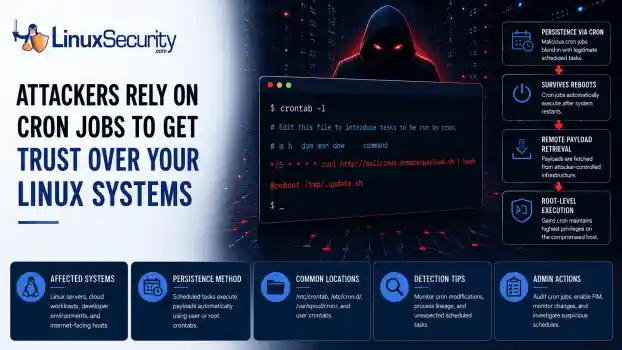
 security advisory attack
 A Linux server gets cleaned up after an intrusion. The suspicious process is terminated, credentials are rotated, and the system is rebooted during maintenance. Everything seems secure. A few hours later, the same outbound connection appears again. . Situations like that point to persistence . The attacker no longer needs the original exploit because something on the host continues restoring access behind the scenes. Finding that mechanism is often more important than understanding how the...
 Jun 08, 2026
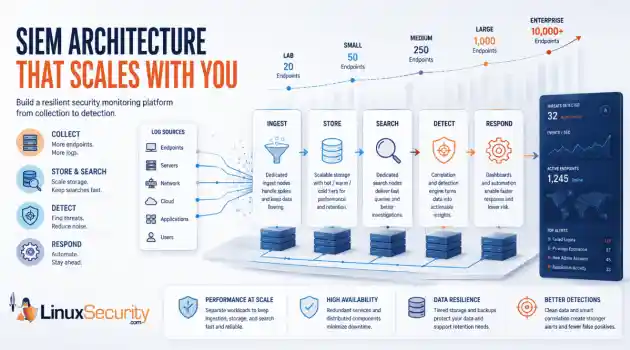 threat detection scalability
 Building a SIEM is easier than scaling one. Most open-source deployments start as a simple "all-in-one" server. It is easy to set up, but that design rarely survives the transition from a lab to a production workload. . A SIEM watching 20 endpoints is not doing the same job as one watching 500. More endpoints mean more logs; more logs require more storage; more storage makes search heavier. Eventually, the very architecture that made your lab easy to deploy becomes the reason your production...
Jun 04, 2026
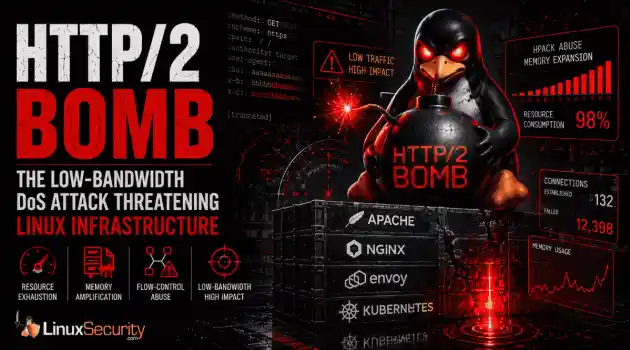 security advisory apache
 A newly disclosed attack technique called HTTP/2 Bomb is drawing attention because it targets the software that sits at the front of much of the Linux internet. Apache HTTP Server, NGINX, Envoy, and the ingress layers that many Kubernetes environments depend on can be forced into consuming disproportionate amounts of memory using relatively small amounts of attacker traffic. . For Linux administrators, the concern is not the HTTP/2 protocol itself. It is the possibility that a single...
Jun 04, 2026
 security advisory important
 The compromise of Nx Console shows how much infrastructure now sits behind a single developer account. GitHub repositories, CI/CD pipelines, container build systems, Terraform projects, Kubernetes deployments. None of those systems was the initial target. The workstation was. . Attackers did not need a Linux privilege escalation bug or a remote code execution chain. They needed developers to trust a tool they were already using. For many organizations, that was enough. What Happened? Federal...
Jun 03, 2026
 security advisory open-source
 You remove the malware. You rotate the compromised credentials. You patch the original vulnerability and close the ticket. Two weeks later, the attacker is back. . What happened? You didn't lose the battle at the exploit; you lost it at the cleanup. In many modern Linux intrusions, the malware you found wasn't the main problem—it was the fallback mechanisms left behind. These hooks quietly restore attacker access the moment you look away. If you clean a host but miss these persistence layers,...
Jun 02, 2026
 Refine features
X Clear Filters
Get the latest News and Insights
Get the latest Linux and open source security news straight to your inbox.
Community Poll
What got you started with Linux?
Loading...
Explore Latest Linux Security features
We found -3 articles for you...
102
 data protectionthreat mitigationsecurity best practices
Essential Cybersecurity Compliance Practices and Threats for Linux Users
Security is an essential consideration when using computers and other technological devices. Linux admins and organizations must be informed about applicable legal measures related to the safety of their systems to ensure compliance and protect against possible risks. . Seeking legal advice from a cybersecurity lawyer can be highly advantageous in mitigating security threats and facilitating compliance. Let’s examine cybersecurity regulations impacting your systems and data, the threats Linux users face, best practices for enhancing Linux security, and the future of cybersecurity regulations for Linux users. Understanding Cybersecurity Regulations Cybersecurity regulations are laws or rules that govern information security and the prevention of cyber threats. These regulations apply to several sectors, such as healthcare, finance, and government. Unfortunately, Linux users must learn about these regulations to meet the requirements and prevent their systems from being at risk. Some of the most significant cybersecurity regulations include: HIPAA: HIPAA, also known as the Health Insurance Portability and Accountability Act, is a law in the United States that deals with health information privacy. Users of the Linux operating system in healthcare facilities must meet HIPAA requirements. This is the one most Americans are familiar with. GDPR: GDPR stands for General Data Protection Regulation, the legal power to secure personal data in the EU area. GDPR rules apply to any Linux users who process individuals’ data. PCI-DSS: The Payment Card Industry Data Security Standard, often called PCI DSS , is a set of regulations that describes how to handle credit card information. Anyone dealing with credit card data using Linux is bound to comply with PCI-DSS policies. Linux users can ensure their systems are secure and conform to the existing security standards. Applying such measures can also prevent other types of security threats, reducing the chances of data violation. Practical Examples of Emerging Trends in Cybersecurity and Their Impact on Linux Users Let's discuss emerging cybersecurity trends and their practical implications for Linux administrators and DevOps engineers. How are advancements in Artificial Intelligence (AI) and Machine Learning , the proliferation of Internet of Things (IoT) devices , and the widespread adoption of cloud computing shaping cybersecurity practices for Linux users? I've collected a few examples to illustrate how these trends can be integrated into your Linux environments to enhance system security while ensuring compliance with evolving regulatory standards. Using this knowledge, you should be able to leverage these cutting-edge tools and strategies to safeguard your infrastructure. AI-Driven Intrusion Detection Systems (IDS) How it Works: AI-enabled IDS can analyze network traffic in real time, identifying unusual patterns that may signify a security threat. These systems can differentiate between normal and malicious behavior. Impact on Linux Users: Linux users can deploy open-source AI-driven IDS solutions like OpenAI’s Gym or TensorFlow within systems like Snort or OSSEC . Ensuring these tools are correctly integrated and maintained can help comply with emerging regulations that mandate advanced threat detection capabilities. Securing IoT Devices with Linux-based Gateways How it Works: Many IoT devices operate on Linux-based platforms. Linux gateways can be configured to use Network Firewalls and Access Control Lists (ACLs) to monitor inbound and outbound traffic, ensuring only authorized communications occur. Impact on Linux Users: As IoT regulations develop, Linux users might need to adopt these security practices to comply with new standards. For instance, securing smart devices in a home automation setup using Linux-based Home Assistant, configuring proper firewall rules, and network segmentation could be necessary to meet compliance. Encryption of Data in Cloud Storage How it Works: With the increasing use of cloud services like AWS, Google Cloud, or Azure , encryption becomes vital. Encrypting data at rest and in transit ensures that sensitive information is protected from unauthorized access. Impact on Linux Users: Linux users can use tools like GnuPG or Linux Unified Key Setup (LUKS) to encrypt data before uploading it to the cloud. As new regulations might require stricter data protection measures, ensuring compliance with solutions like Amazon S3 encryption or Google Cloud’s Key Management Service (KMS) will be crucial. By integrating these practical examples into our workflows, Linux users can improve their protection against threats and remain compliant with evolving regulations. Compliance Requirements for Linux Users Linux users must meet existing compliances, including data protection regulations, access operation, control, and incident response. They must also ensure their systems are correctly set to satisfy these needs and have the tools to secure themselves against malicious threats. Some of the compliance requirements for Linux users include: Data Protection: Linux users must ensure that the information stored on it is secure from other parties who should not access it. This includes measures such as providing the confidentiality of data through encryption, limiting access to data, and implementing measures of backing up and recovery. Access Control: It also warns Linux users that access to their systems is restricted to personnel. Some ways include authentication, authorization, accounting (AAA), and good passwords. Incident Response: Linux users need strategies to help them respond once a security threat surfaces. This encompasses incident response management and periodic security checks and evaluations. Linux users can be assured that their systems are protected and meet specific security standards and regulations. Moreover, adopting these measures may also prevent possible security breaches and/orthreats, thus enhancing security. Best Practices for Robust Linux Security The ways to secure Linux are configuration, use of patches , and vulnerability scans. Linux users must ensure that the systems they configure implement these best practices and have the tools and assets to combat these threats. Some of the best practices for Linux security include: Secure Configuration: Linux users must confirm that their systems follow the best security practices. This involves implementing secure password management practices and configuring intrusion detection and firewall systems. Vulnerability Scan: Regular vulnerability scans are needed for Linux users to find possible security issues. Patch Management: Linux users must install the most recent security updates on their PCs. Linux users may ensure their systems are safe from threats and significantly reduce the likelihood of security breaches. By implementing secure design, patch management, and vulnerability scanning, Linux users may confirm that their systems are safe and compliant with relevant security standards. Tools and Resources for Linux Security Linux users have a combination of tools available to improve their security. These tools and resources include intrusion detection systems, firewalls, and encryption software. Consider consulting a team of professional cybersecurity lawyers to guarantee that your security standards comply with all appropriate laws and regulations. Some of the tools and resources available to Linux users include: Firewalls: Linux users can use firewalls to limit system access and protect against potential threats. Encryption Software: Linux users can use encryption software to protect sensitive information from unauthorized access and disclosure. Intrusion Detection Systems: Linux users can use intrusion detection systems to detect potential security threats. Future of Cybersecurity Regulations for Linux Users New technology and changing securitythreats may influence cybersecurity laws, affecting Linux users in the future. Linux users must keep up with the most recent changes to cybersecurity laws and compliance standards as the operating system continues to gain popularity. Some of the trends that may affect cybersecurity regulations for Linux users include: Artificial Intelligence and Machine Learning: The increasing use of artificial intelligence and machine learning in cybersecurity may lead to new regulations and guidelines for Linux users. Internet of Things (IoT): The growing number of IoT devices may lead to new security threats and regulations for Linux users. Cloud Computing: The increasing use of cloud computing may lead to new security threats and regulations for Linux users. By staying informed about these emerging trends and developments, Linux users can ensure their systems are secure and compliant with relevant security regulations. Our Final Thoughts on Cybersecurity Regulations and Compliance Cybersecurity regulations and compliance requirements are critical for Linux users to protect their systems from potential threats and provide compliance. By understanding these regulations and implementing best practices for Linux security, Linux users can protect their systems and confirm compliance. Linux users should consult a cybersecurity lawyer to guarantee they meet all the necessary compliance requirements. Cybersecurity lawyers play a critical role in today's digital age by safeguarding entities and individuals from illicit data access, managing the legal aspects of cybercrime, and ensuring compliance with cybersecurity laws and policies. Their expertise is essential for navigating the complexities of cybersecurity threats and implementing effective strategies to mitigate risks and protect sensitive information. . Mitigate security threats and achieve compliance with essential cybersecurity practices for Linux users and systems.. security, essential, consideration, using, computers, other,technological, devices, linux. . Brittany Day
 Sep 27, 2024
•
Sep 27, 2024
•
102
 SQL injectionthreat mitigationDDoS protection
How WAF Solutions Protect Against Cyber Threats in Web Applications
The use of Web Applications is growing amongst businesses, however, that also makes these businesses a target for Cyber Criminals to attack. If there are vulnerabilities within your Web Application, then that means there is a flaw that attackers may exploit to really wreak some havoc to an individual, small business, or even large corporations alike. . According to recent statistics, about 95 Web Applications are attacked daily and about 3,000 Web Applications are either scanned or visited by bots every single day. As everything becomes digitized and companies and users alike start to move their daily operations to web applications, if you are amongst one of the many people who has and uses a Web Application, or are planning in using one, then using a WAF could greatly improve the security of your web applications and furthermore, put your mind at ease from being attacked just a little bit more. Brief Overview of How a WAF Works A WAF or web application firewall helps protect web applications as well as API applications by monitoring and filtering HTTP/HTTPS traffic between a web application and external users by blocking traffic from malicious sources. Since web applications and API applications are considered to be a part of Layer 7 of the OSI model, a WAF is considered to be “Layer 7 security tool”. Additionally, Discovering new vulnerabilities can be tiresome and creating new scripts to protect against these vulnerabilities isn’t really ideal as you are extending more resources for security. Rather than continuously writing scripts to keep up with the constant new vulnerabilities, with a WAF, you can just update the signature of any new vulnerability and that is that. No additional work is required. It is quite convenient and one of the most effective ways to keep your web application secure. Below, let’s look at the possible attacks a WAF can help protect against. A WAF Protects Against: DDoS Attacks: These attacks are prevented by WAFs through everyday scanning ofapplications, monitoring, Global Threat Intelligence , and AI to identify pretender bots, malicious requests, unauthorized sources, etc and block them. With managed WAFs like AWS WAF or even Azure's WAF, it gives you control over which traffic to allow or block by creating security rules. SQL Injection Attacks: WAFs mitigate almost all SQLi Attacks, however, they could produce false positives. The rulesets that are set by default, or the rulesets that you might happen to configure, will most likely flag down any instance of an SQLi attack it finds. It is not the most effective way to block out SQLi attacks so you can even specify your WAF ruleset even further. You can cross reference the SQLi attacks with popular, well known malicious source IP addresses to confirm whether the SQLi attack was a valid attack or not. This process can be very time consuming but it is all for the sake of security. Furthermore, you can establish a ruleset that sets all events of an SQLi attack to not severe and then cross examine those events with blacklisted sources or globally known threat signatures. If it comes back to a match, then you can specify an action for that event e.g block that incoming traffic or drop the connection. Cross-Site Scripting (XSS) Attacks: In the case of XSS attacks, most WAFS rely on signature based filtering to identify and block malicious requests. These signatures are usually apart of a large list of well-known signatures or blacklisted signatures that are then used to mitigate these attacks. AWS, on the other hand, allows you to block, allow, or monitor requests based on Cross-Site Scripting match conditions. Once the match condition is found within a web application and that condition is met, you can choose to do one of the following above. Moreover, being the most WAFs have some type of AI real-time detection, this ensures protection without the time-consuming process of manually configuring the web application firewall. Cookie Poisoning: A Cyber Criminal can alter a cookie to gainunauthorized access to a user's account or possibly even send false information & commands back to the back-end, or the server. A WAF will protect against cookie poisoning by detecting cookie "set" commands sent by the web server and intercepting all HTTP requests in order to compare them to the information present in the received cookie. The cookie is then only accepted if the information is deemed accurate and not tampered with, preventing any kind of forgery or manipulation by an attacker. What makes a good WAF? Web Application Firewalls are valued by security-conscious enterprises as a vital component in an efficient security system for validating website security and strengthening their security. As WAFs become increasingly mission-critical, it is also vital that they are also easy to use. On top of being easy to use, being able to scale the WAF to the amount of applications you have is just as equally important. Moreover, a good WAF protects your application against layer 7 threats by dynamically monitoring traffic and providing signatures, so security is another factor to keep in mind. Your WAF, regardless of its depth of features, is just one component of a multi-layered security plan. You can go a long way toward guaranteeing full protection for your business essential apps by ensuring that you utilize a WAF and other security measures. Some Available Commercial WAFs on the Market These are in no general order, just some of our favorite and recommended WAFs: Cloudflare WAF Solution: Personally, this is one of my personal favorites as it is scalable (due to the cloud architecture) and it thwarts many different types of attacks. The default rulesets that come with the Cloudflare WAF solution are enough to keep even some large corporations web apps safe and moreover, it allows you to customize rulesets that will tend to your specific needs. On top of being scalable and reliable, it is also fairly easy to use. Being that it is one general control panel that manages everything, it does notrequire excessive training and understanding. The Cloudflare WAF also manages to detect zero day attacks before they even emerge and is ready to use within seconds after creating new rulesets, compared to other WAFs which may take a little longer to start up. Learn more about the Cloudflare WAF here. AWS WAF: Another one of our favorites is the AWS Web Application Firewall. AWS being the most popular choice to host web applications, it is only fair that they provide a firewall solution for your web applications. The AWS WAF gives you control over the traffic that reaches your web apps and allows you to block common attack patterns, such as the attacks mentioned in the OWASP Top 10. The reason why the AWS WAF is amongst one of the most used is because of its convenience. It is all managed through AWS of course but there are also rules that you can configure yourself or you can even use a pre-configured ruleset that you can just check off if you’d like to use it. Just like the Cloudflare WAF Solution, AWS also prioritizes speed without risking security. According to AWS, they state that their “WAF supports hundreds of rules that can inspect any part of the web request with minimal latency impact to incoming traffic.” Not only does AWS provide speed, security, and reliability, but they also provide scalability within seconds and moreover, they allow you to use the AWS WAF across any web application you deploy. Not to mention that the AWS WAF is amongst a few web application firewalls that allows you to monitor, track, and mitigate bot traffic to your web applications without affecting other traffic to your application. Follow the links below to further look into the AWS WAF: Features - AWS WAF - Amazon Web Services (AWS) AWS WAF – Web Application Firewall Azure WAF: Another great WAF solution would be none other than the Azure WAF. Like AWS, Azure is considered to be a solid choice for hosting websites and applications. Being that it is amongst one of the more popular choices,it is also in the crosshairs of Cyber Criminals. The Azure Web Application Firewall provides a centralized protection of your web applications from common exploits and vulnerabilities. Azure built their Core Rule Sets around the OWASP Top 10, just as AWS has. The Azure WAF sits in the Application Gateway meaning that you can create many different WAF policies and properly route them to the correct applications using the Application Gateway. Below are some of the features from the WAF documentation provided by Microsoft, and a tutorial on how you can get started configuring your WAF: Azure WAF Service Overview What is Azure Web Application Firewall on Azure Application Gateway? Some Open-Source WAFs Available These are in no general order, just some of our favorite and recommended Open source WAFs: OctopusWAF : OctopusWAF is a highly customizable Open-Source WAF for high performance applications. It is entirely created in C language and also uses libevent to make multiple connections. Essentially, libevent is an API that returns a callback function when a specific event occurs on a file descriptor or after a timeout has been reached. The event-driven architecture is optimized for vital, high-performance Web applications. This tool is very light and can be deployed in any manner that suits your needs. This resource turns perfect for protecting specific endpoints that need customized protection. OctopusWAF has the following features: Reverse proxy functions Detects anomalies using regex using lib PCRE resources Detects security anomalies using algorithms for matching string like DFA, horspool or karp-rabin Detects security anomalies using libinjection Options to save logs ModSecurity: ModSecurity is an easy-to-install, dominant open-source web application firewall that starts working immediately after installation. It comes with a plethora of options that you can use to secure your web apps. ModSecurity gives you entire control over extending the tool'scapabilities to meet your specific demands. Additionally, the community base for ModSecurity is quite large and they are constantly rolling out releases and updates. Trustwave just recently returned ModSecurity back to the open-source community so we cannot wait to see what people come up with. ModSecurity offers: Real-time application security monitoring and access control Full HTTP traffic logging Continuous passive security assessment Web application hardening Shadow Daemon: Shadow Daemon is a web application firewall that intercepts requests and filters out potentially harmful inputs. To maximize security, flexibility, and expandability, it is a modular system that separates web application, analysis, and interface. Shadow Daemon is totally open source, which means that anybody may examine and modify it. Shadow Daemon also employs tiny connections at the application level to intercept requests. This ensures that the examined data is identical to the web application's input data, which many firewalls fail to accomplish successfully. Shadow Daemon supports the following languages: PHP Perl Python Moreover, Shadow Daemon can detect the following attacks: SQL injection XML injection Code injection Command injection XSS Backdoor access Local/remote file inclusion Shadow Daemon is a great open source WAF that provides discrete protection and secure architecture. Our Thoughts As we took a closer look at the type of attacks that can be executed against web applications and as we see how detrimental these attacks can be to daily users and companies alike, a WAF is the perfect solution to help protect your sites and applications. Whether you’re using AWS, Azure, Cloudflare, or any other hosting service, a WAF can safely and easily be deployed as a tool to protect yourself, your company, your hardware and resources, and your information by reducing the attacks carried out on them. . With increasing cyber threats, a Web Application Firewall (WAF)protects web apps by filtering traffic, blocking SQL injections and XSS to ensure security.. Web Application Firewall, Threat Mitigation, Application Security. . Brian Gomez
Aug 03, 2022
•


Get the latest News and Insights
Get the latest Linux and open source security news straight to your inbox.
Community Poll
What got you started with Linux?
Search Topics
Powered By

Linux Security - Your source for Top Linux News, Advisories, HOWTOs and Feature Releases
QUICK LINKS
subscribe to newsletters!
Like staying secure? So do we.
Sign up for updates, tips, and alerts!
Discover faster search, smarter navigation, and deeper Linux security insights. Read More