


Stay Ahead With Linux Security Features

 security advisory important
 The compromise of Nx Console shows how much infrastructure now sits behind a single developer account. GitHub repositories, CI/CD pipelines, container build systems, Terraform projects, Kubernetes deployments. None of those systems was the initial target. The workstation was. . Attackers did not need a Linux privilege escalation bug or a remote code execution chain. They needed developers to trust a tool they were already using. For many organizations, that was enough. What Happened? Federal...
 Jun 03, 2026
 security advisory open-source
 You remove the malware. You rotate the compromised credentials. You patch the original vulnerability and close the ticket. Two weeks later, the attacker is back. . What happened? You didn't lose the battle at the exploit; you lost it at the cleanup. In many modern Linux intrusions, the malware you found wasn't the main problem—it was the fallback mechanisms left behind. These hooks quietly restore attacker access the moment you look away. If you clean a host but miss these persistence layers,...
Jun 02, 2026
 security advisory Red Hat
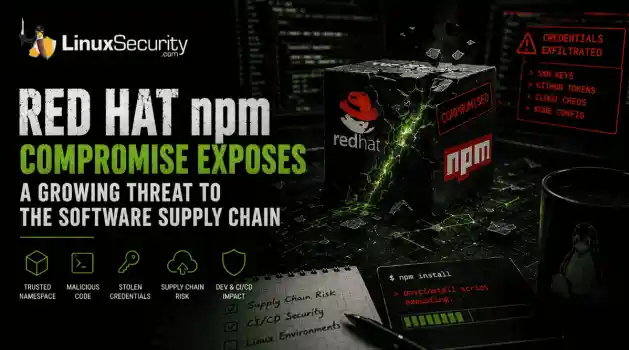
 Researchers investigating a campaign now tracked as Miasma found that more than 30 packages in Red Hat's @redhat-cloud-services npm namespace had been altered to deliver credential-stealing malware. . The packages weren't being used to deploy ransomware or sabotage systems. From what has been reported so far, the objective appears to have been much simpler: collect credentials from developer environments and use that access elsewhere. GitHub tokens, cloud credentials, SSH keys, and other...
Jun 02, 2026
 cloud security security monitoring
 Linux rootkits are old, but they never really disappeared. They just stopped attracting the same attention. . Most malware wants to execute and spread. A rootkit wants to stay invisible long enough that nobody notices the compromise until the damage is already done, and on Linux systems, that still works more often than many teams are comfortable admitting. That difference matters because modern infrastructure runs heavily on Linux underneath. Cloud workloads, ESXi hosts, telecom appliances,...
Jun 01, 2026
 access control open-source
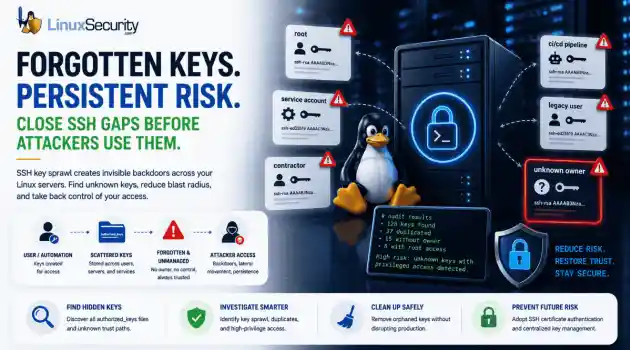
 A production Linux server gets rebuilt from an old image. A contractor leaves. A CI/CD job is retired. Months later, the same SSH public keys are still sitting in authorized_keys, silently trusted by root or a service account nobody owns anymore. . That is how SSH key sprawl usually happens. It rarely stems from one obvious failure. Instead, it accumulates through years of small access decisions that never expire. For attackers, those forgotten keys are not clutter; they represent silent SSH...
May 27, 2026
 Refine features
X Clear Filters
Get the latest News and Insights
Get the latest Linux and open source security news straight to your inbox.
Community Poll
What got you started with Linux?
Loading...

Explore Latest Linux Security features
We found -4 articles for you...
102
 security advisoryLinux communityopen-source security
CVE Database Funding Crisis: Urgent Need for Better Support
This past weekend, the globally recognized Common Vulnerabilities and Exposures (CVE) database, essential for tracking security flaws in software and systems, narrowly avoided going offline due to funding issues with the U.S. government. For us Linux security admins and open-source developers, the near-disruption wasn’t just a bureaucratic oversight—it was a stark reminder of how fragile one of the most vital cornerstones of global cybersecurity truly is. With vulnerabilities being discovered and weaponized faster than ever, the CVE database is a critical tool to help administrators track, prioritize, and remediate issues. Losing or fragmenting access to this central repository could open the door to chaos, confusion, and exploitation. . Although funding was extended at the last minute, it’s clear that relying on government contracts to sustain such a vital resource leaves the global ecosystem vulnerable to future crises. This close call raises serious questions for the Linux community and open-source developers everywhere: How would teams effectively address security vulnerabilities without reliable, coordinated information? And more critically, how can we ensure this doesn’t happen again in the next round of funding deliberations? In this article, I aim to provide further insights on this closse call and help answer these critical questions. Understanding the CVE Database's Role in Linux Security We, Linux security admins, rely on the CVE database as part of our daily workflows, and this resource serves as an indispensable foundation for our administrative tasks. Offering standardized identification numbers for vulnerabilities and risks posed by libraries like OpenSSL or flaws in the kernel itself, CVE entries offer businesses and individuals alike a common language to discuss risks and prioritize fixes effectively. Without these identifiers, assessing the scope and impact of vulnerabilities would be far more time-consuming and complex. Imagine patching an essential library inproduction without definitive knowledge about which versions are vulnerable or how severe their flaw is. CVE identifiers eliminate delays by offering clarity, allowing us to update systems securely while communicating exact risks to our teams. However, the CVE database isn't limited to our work as Linux administrators; its utility extends to Microsoft products, IoT devices, and more. While its universality makes it invaluable, its universal nature also heightens risks if its disruption were to occur. Security teams across industries could scramble for alternative methods, with potentially incongruent or duplicate efforts, and slower responses being employed to address security vulnerabilities. For Linux admins operating in fast-moving environments on tight budgets, this would become logistically treacherous quickly. Why This Near-Shutdown Was So Dangerous This recent near-shutdown wasn't just abstract or bureaucratic hassle looming large over Linux systems and security in general. MITRE is charged with maintaining CVE database continuity under a contract from DHS and CISA. Due to the funding for their CVE work expiring on April 16th, MITRE may have had no choice but to cease operations related to the CVE database, leaving its survival in doubt until funding could be renewed. This close call highlights an inherent flaw in how CVE operates: its dependence on government funding ties it directly to political cycles, budget negotiations, and potential bureaucratic hurdles — none of which keep pace with rapidly advancing cybersecurity threats. If funding were cut off entirely or cut short temporarily due to a government shutdown or another emergency, administrators and developers would no longer have instantaneous access to standard identifiers such as CVEs. Instead, they would need to resort to using nonstandard methods or fragmented approaches, resulting in inconsistent communication and delayed security patches , among other issues. Due to their inherent nature, Linux admins face increasedrisks managing open-source software projects. Open-source projects often rely on volunteer forces and distributed teams working collaboratively on fixes using CVE identifiers as central information points. A potential shutdown could magnify these rsiks by delaying updates, exposing systems to known vulnerabilities that malicious actors could exploit. Time for Diversified and Decentralized Support The CVE database's near-disruption underscores the need to rethink its funding and operational model. Relying on a single government contract to sustain what is effectively a global cybersecurity infrastructure is unnecessarily risky. Just as Linux represents decentralization in operating systems, the CVE database would benefit from a similar distributed support model. One solution could involve diversifying the funding sources for the database. Rather than depending solely on U.S. government contracts, the CVE program could seek contributions from private companies that rely on it, such as tech giants, security vendors, and open-source organizations. These groups already invest heavily in cybersecurity measures, and contributing to the sustainability of CVE would align perfectly with their interests. Moreover, collaboration with international governments and global institutions could add layers of resilience by making the database an international effort rather than one bound to a single country’s politics. Another significant step would be ensuring that the CVE program operates independently of short-term political funding cycles. Nonprofit organizations such as the CVE Foundation already exist with a mission to sustain the program and safeguard its continuity. Increasing contributions to this foundation and empowering it to manage operations more broadly could remove the funding uncertainty entirely. Strengthening the Ecosystem Around Vulnerability Tracking While the CVE database is vital, its near-disruption also highlights the need for a more decentralized ecosystem of vulnerabilitytracking tools. Security professionals have increasingly advocated for innovation in linked data technologies, such as those using JSON-LD , which enable vulnerabilities to connect multiple systems and databases. By enriching how vulnerability data is stored and shared, the global cybersecurity community could become less dependent on a single CVE database, reducing risks associated with downtime or disruption. These technologies could enable organizations to link CVE-like identifiers with external databases and detailed metadata, creating redundancy and resilience. For Linux admins, adopting these methods would mean having additional tools to manage vulnerabilities with more context and flexibility, even if CVE funding delays or other issues arise. Beyond technology, improving collaboration among cybersecurity stakeholders is equally important. The Linux and open-source community excels at collaboration, and expanding this spirit to vulnerability tracking would help mitigate risks across the board. Initiatives like Common Weakness Enumeration (CWE) , which aim to classify types of software vulnerabilities, add value to the broader landscape by adding depth to how flaws are identified and categorized. A Call to Action for the Linux Community While an immediate crisis has been avoided, we Linux security administrators and developers must treat the CVE database’s close call as a wake-up call and act accordingly. Advocacy is crucial—whether advocating for the diversification of funding for the database or contributing directly to initiatives like the CVE Foundation, every action helps to cement the system’s long-term stability. We must also stay informed about potential disruptions and prepare contingency plans for managing vulnerabilities, particularly in critical systems. If problems with the CVE database were to arise again, having internal processes in place to prioritize and coordinate fixes would reduce the impact of any downtime. The Linux community, known for its openness andcollaboration, is uniquely positioned to lead efforts that improve vulnerability tracking and cybersecurity infrastructure. Working with MITRE, the CVE program, and emerging technologies, the security world can create a more resilient system that protects the global open-source ecosystem for years to come. Our Final Thoughts on This Worrisome Incident The CVE database is far more than a list of security flaws—it’s a universal language for managing vulnerabilities across industries and borders. This past weekend’s funding scare exposed how fragile this critical system can be when tied too closely to government contracts. The implications of losing CVE identifiers would be enormous, leading to delays in vulnerability management, inconsistent communication, and increased risk of exploitation. Securing its future requires proactive steps, including diversifying funding sources, building stronger international collaborations, and investing in decentralized technologies. This near-miss reminds us that cybersecurity infrastructure must evolve to address modern threats while ensuring its survival in the face of political and financial uncertainty. We, Linux admins and the broader security community, must advocate for and contribute to safeguarding the CVE database—it’s not just a policy issue; it’s an essential part of staying ahead in today’s relentless security landscape. . The CVE database faces funding risks highlighting its vital role in vulnerability management for Linux admins and open-source developers.. weekend, globally, recognized, common, vulnerabilities, exposures, (cve), database. . Brittany Day
 Apr 17, 2025
•
Apr 17, 2025
•

Get the latest News and Insights
Get the latest Linux and open source security news straight to your inbox.
Community Poll
What got you started with Linux?
Search Topics
Powered By

Linux Security - Your source for Top Linux News, Advisories, HOWTOs and Feature Releases
QUICK LINKS
subscribe to newsletters!
Like staying secure? So do we.
Sign up for updates, tips, and alerts!
Explore top 10 tips to secure your open-source projects now. Read More