Overly broad permissions can turn one compromised account into a much larger security problem. Learn how to reduce unnecessary access, review privileges, and apply least privilege across modern Linux systems. Review Linux Privileges×


Stay Ahead With Linux Security HOWTOs
How to Secure My Network incident response network traffic
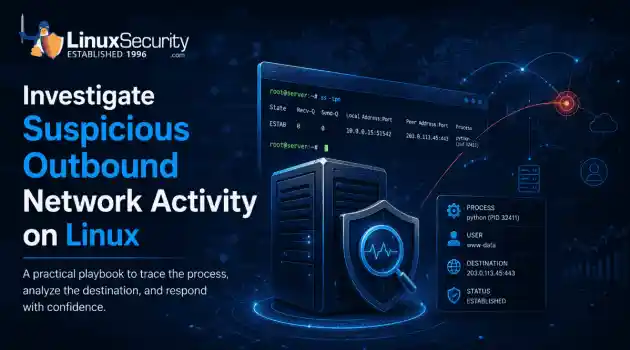
incident response network traffic Imagine logging into a production Linux server for routine maintenance and noticing background network activity connecting to an unfamiliar external IP address. Your endpoint protection agent is not popping up with an alert, there is no service failure, and on the surface, the system appears to be running normally. . For Linux administrators and security teams, such a situation is a moment of truth: Is this activity a sign of active intrusion or just a tool that was overlooked in the course of...
 Jul 21, 2026
How to Harden My Filesystemsystem hardening open source security
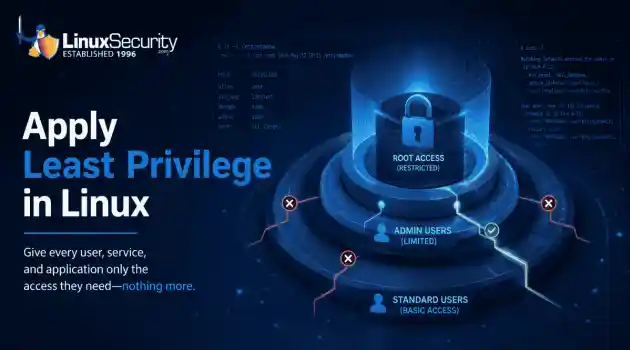
system hardening open source security We all spend a lot of time defending our systems from external threats, but the amount of damage an attacker can cause often depends on what happens after they get in. A single compromised account doesn't always lead to a major incident. The real danger begins when that account has far more access than it actually needs. . That's exactly what the principle of least privilege is designed to prevent. By limiting users, services, and applications to only the permissions required for their jobs,...
Jul 20, 2026

How to Learn Tips and Tricksthreat detection system monitoring
threat detection system monitoring For small security and IT teams, the "enterprise" dream of a fully automated SIEM often feels like a distant luxury. It’s a vision built on massive budgets and dedicated engineering teams—things that, frankly, most of us don't have. But here is the reality: you don’t need a six-figure platform to maintain a secure environment. . Linux systems are, by design, incredibly verbose. Every time a user authenticates, a process executes, or a configuration file changes, your system creates a record of...
Jul 17, 2026
How to Learn Tips and Tricksnetwork security centralized logging
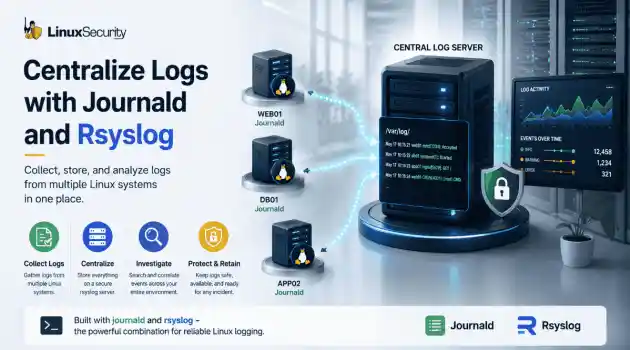
network security centralized logging Linux systems generate a steady stream of authentication, service, kernel, and application logs. On most systems, those logs never leave the machine that created them. If you're responsible for ten or twenty servers, that means checking each one separately. If one disappears before you can investigate it, its logs may disappear with it. Centralized logging solves that by sending log messages to another server as they're created. Instead of searching every machine, you have one place to review...
Jul 15, 2026
How to Secure My Networksecurity advisory audit
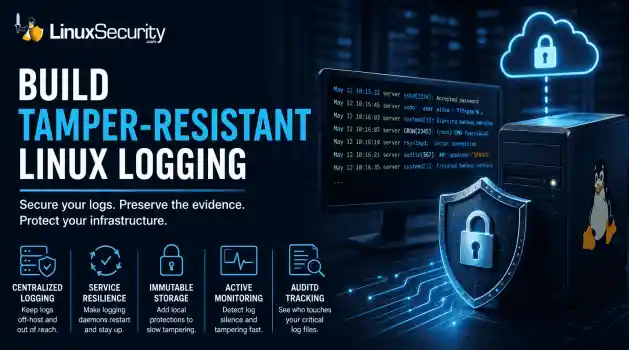
security advisory audit When you’re digging through an incident, your logs are the only thing you can actually trust. The problem is, attackers know that too. If someone gets root on your server, their first move is almost always to delete the evidence and cover their tracks. . If you aren't actively protecting your logs, you're basically flying blind the second a breach happens. It’s a miserable feeling to realize you have no idea what an attacker did because they wiped the logs before you even got there. In this...
Jul 11, 2026
 Refine HOWTOs
X Clear Filters
Get the latest News and Insights
Get the latest Linux and open source security news straight to your inbox.
Community Poll
Should Linux servers automatically install security updates?
Loading...
Explore Latest Linux Security HOWTOs
We found -1 articles for you...
160
 log analysissecurity incidentthreat detection
Linux Log Analysis: How to Investigate Suspected Log Manipulation During Incident Response
When an attacker breaks into a Linux system, their work is rarely done. Usually, the real work starts after the initial exploit: hiding their tracks. If you’re a Linux admin or security analyst, there is nothing worse than logging in, running a few commands, and realizing the logs aren't telling the whole story. When logs are missing or look "off," your primary source of truth is compromised. This guide covers how to handle that situation. We’ll walk through the workflow you need to determine if you’re looking at an attacker’s handiwork or just a system glitch. . Understanding Log Manipulation Think of this as anti-forensics. Attackers don't just delete logs; they try to make the system look normal. They might truncate a file, change timestamps (timestomping) to hide recent activity, or just kill the auditd service to stop the system from recording their next move. Sometimes, they rotate logs prematurely just to bury their activity in a compressed archive they plan to delete later. They often target the Linux Audit System directly to create a blind spot in your monitoring. Before you touch anything, pause. Don't restart services or reboot the server yet. If you do, you risk blowing away volatile evidence stored in memory. Always grab a forensic snapshot first. Why You Can’t Trust the Local System If you’re in the middle of an incident, the logs are your map. They show the entry point, the lateral movement, and the data exfiltration. If you can’t trust them, you’re flying blind. You shouldn't assume the local logs are accurate until you have specifically verified their integrity. This is where professional-grade log analysis becomes the difference between catching the actor and missing them entirely. Step 1: Check the Foundation Before diving into the "meat" of the investigation, make sure the logging services are actually up. You can't analyze what isn't being recorded. Auditd: Run systemctl status auditd. It should be active (running). Ifit's stopped, that’s a red flag. Familiarizing yourself with auditd is essential for any responder. Rsyslog: Run systemctl status rsyslog. If it’s down, the system might not be shipping logs to remote storage. Journald Persistence: Check if your journal is actually saving logs to disk. Run grep Storage /etc/systemd/journald.conf. If it doesn't say persistent, you might lose everything on a reboot. You can also run ls -ld /var/log/journal to see if that folder exists. Step 2: Spotting the Gaps Logs don't just "take a break." If you see a jump in time, someone likely messed with the files. Run journalctl to look at your timeline. If you see a gap from 10:00 AM to 2:00 PM, ask yourself why. Use journalctl --verify to check for corrupted journal objects. If it complains about corruption, it could be a sign of tampering. Note: Don't jump to conclusions. Sometimes logs just break due to bad disk sectors or weird rotation configs. Always verify with other sources. Finally, last reboot is your best friend—if the server restarted at a time you didn't authorize, you’ve found your "when." Step 3: Is Auditd Still Running? Attackers love to disable the audit system. Run auditctl -s. A healthy system will report that auditing is enabled. If it says enabled 0, that’s not an accident—that’s an intent. Use auditctl -l to see what rules are active. If you get back an empty list, the attacker stripped your rules. This is a common tactic to keep their commands from showing up in the audit logs, often involving interference with the audit subsystem . Step 4: Cross-Referencing Sources This is the core of log analysis. Never rely on just one file. Attackers are often lazy; they’ll clean up /var/log/auth.log but forget about bash_history, cron, or even systemd journals. Compare what you see in the logs against each other. If auth.log shows an SSH session, but you see zero activity for that user in the audit logs, something is wrong. Use ausearch to track specific useractivity. If the tool returns nothing for a period where you know activity happened, you’ve confirmed the logs were purged. Step 5: Detecting the Tampering When you think a file was messed with, get forensic with it: stat [filename]: Look at the access and modification times. Are they weird? find /var/log -type f -mtime -1: This shows you what changed in the last 24 hours. find /var/log -size 0: If this hits, you found a log file that was wiped to zero bytes. rpm -V [package-name]: This checks if your core system binaries were swapped out. It won't tell you about the logs, but it tells you if the system itself is compromised. When detecting Linux audit log tampering , look for files that have been truncated or archives that have been deleted. Step 6: Go Outside the Box If the local logs look fake, stop looking at them. Log into your SIEM, your remote syslog server, or your firewall logs. If the firewall shows 10GB of outbound traffic from that server, but the server's local logs show zero activity, you don't need to guess anymore. The server is compromised, and the local logs are lying. Quick Fixes Auditd won't start? It’s probably SELinux or AppArmor blocking it, or the config file is corrupted. Check /etc/audit/audit.rules. Journal is empty? Check the permissions on /var/log/journal/. Audit rules missing? Check /etc/audit/rules.d/. The attacker might have just deleted your rule files. Remote vs. Local mismatch? This is your smoking gun. Trust the remote logs every single time. When You Confirm It's Tampered If you find proof of tampering, stop your investigation on that live host immediately. Image it: Take a bit-for-bit copy. Lock down remote logs: Make sure your SIEM isn't purging the data for that host. Rebuild the story: Use network flow data and cloud logs to fill in the blanks. Document it: The fact that they tried to hide is as important as what they actually did. A Final Thought on BestPractices Consistent log analysis only works if you're sending logs off-box before an incident happens. Follow a Security Hardening Guide to establish a strong baseline. This includes configuring your systems to forward logs to a central server, and making sure those logs are read-only for everyone except your security team. Successful log analysis isn't just about finding the one log file an attacker deleted. It’s about being able to tell the story of the incident despite the gaps. If you follow this process, you’ll find the inconsistencies they left behind, and you’ll have the proof you need to respond effectively. . Investigate log manipulation during incidents to enhance response strategies and improve system integrity analysis.. Linux Log Analysis, Incident Response, Auditd Monitoring, Log Management, Threat Detection. . Dave Wreski
 Jul 10, 2026
•
Jul 10, 2026
• How to Harden My Filesystem
166
 system managementlog analysislog management
Exploring Systemd Log Files Effectively with Journalctl Commands
There are various commands available to Linux users for troubleshooting desktop and server logs. Learn the basics of the journalctl utility of Systemd and its commands that can be used to view and analyze Systemd Logs in this DebugPoint.com guide. . Many say that Systemd is not good, it is heavy on the system and it is a debated topic always. But you can not deny that it provides a well set of utilities to manage, troubleshoot a system. Imagine you end up with a broken system with no GUI. You probably messed up boot and GRUB as well. In those kinds of scenarios or in general – you can boot from a LIVE system, mount your Linux partition and explore the Systemd logs to find out about the problem. Systemd has three basic components as follows – systemd : System and service manager for Linux operating systems. systemctl : Command to introspect and control the state of the systemd system and service manager. systemd-analyze : Provides system boot-up performance statistics and retrieve other state and tracing information from the system and service manager Apart from these three, there are additional services that systemd provides such as – journald, logind, networkd, etc. In this guide we will talk about the journald service of systemd. . Learn the ins and outs of utilizing journalctl for examining Systemd log files, along with essential troubleshooting commands to enhance system oversight.. Systemd Logs, Journalctl Commands, Linux Troubleshooting. . Brittany Day
Dec 08, 2020
•
How to Learn Tips and Tricks

167
 network securitylog analysisopen source tool
Streamline Log Analysis Efforts Using the IptablesWeb PHP Tool
IptablesWeb is a free software (under GPL licence): it makes possible to inspect iptables logs by using a web browser. It's a plugin-based multilanguage software written in PHP using 3 free php classes.. The link for this article located at IptablesWeb is no longer available. . The link for this article located at IptablesWeb is no longer available.. iptablesweb, software, (under, licence), makes, possible, inspect, iptables. . Anthony Pell
Sep 03, 2005
•
How to Secure My Network
166
log analysisopen sourceinternet applicationsAnalyzing Internet Server Logs with Lire Tool for Enhanced Monitoring
This article is the first in a series about using lire to analyze log files of internet server applications. This is not limited to one service, e.g. Apache, but is an integrated analyzer for many different services. Included are DNS, WWW and email.. . Leverage Lire for efficient log file analysis from various internet server applications, enhancing monitoring and improving system performance and reliability. Log File Analysis, Internet Monitoring, Lire Tool, Open Source Solutions, Application Logs. . Anthony Pell
Nov 23, 2004
•
How to Learn Tips and Tricks

Get the latest News and Insights
Get the latest Linux and open source security news straight to your inbox.
Community Poll
Should Linux servers automatically install security updates?
Search Topics
Powered By

Linux Security - Your source for Top Linux News, Advisories, HOWTOs and Feature Releases
QUICK LINKS
subscribe to newsletters!
Like staying secure? So do we.
Sign up for updates, tips, and alerts!