Overly broad permissions can turn one compromised account into a much larger security problem. Learn how to reduce unnecessary access, review privileges, and apply least privilege across modern Linux systems. Review Linux Privileges×


Stay Ahead With Linux Security HOWTOs
How to Secure My Network incident response network traffic
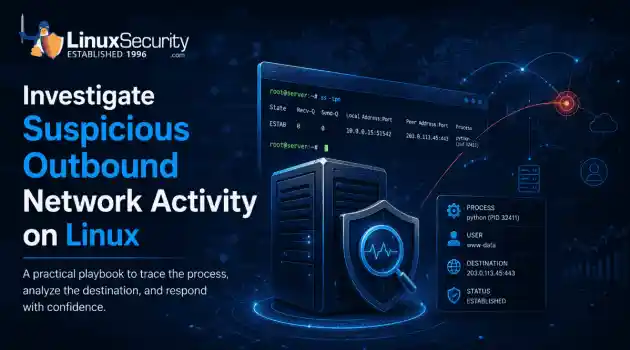
incident response network traffic Imagine logging into a production Linux server for routine maintenance and noticing background network activity connecting to an unfamiliar external IP address. Your endpoint protection agent is not popping up with an alert, there is no service failure, and on the surface, the system appears to be running normally. . For Linux administrators and security teams, such a situation is a moment of truth: Is this activity a sign of active intrusion or just a tool that was overlooked in the course of...
 Jul 21, 2026
How to Harden My Filesystemsystem hardening open source security
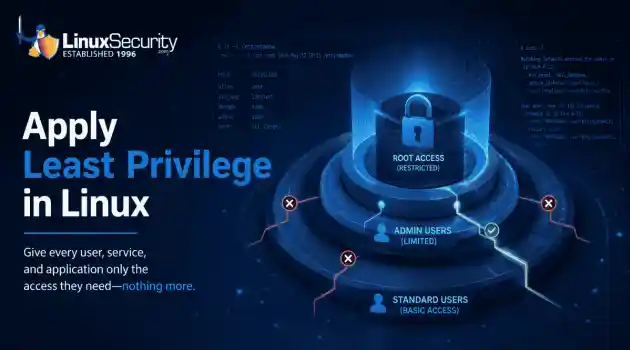
system hardening open source security We all spend a lot of time defending our systems from external threats, but the amount of damage an attacker can cause often depends on what happens after they get in. A single compromised account doesn't always lead to a major incident. The real danger begins when that account has far more access than it actually needs. . That's exactly what the principle of least privilege is designed to prevent. By limiting users, services, and applications to only the permissions required for their jobs,...
Jul 20, 2026
How to Learn Tips and Tricksthreat detection system monitoring
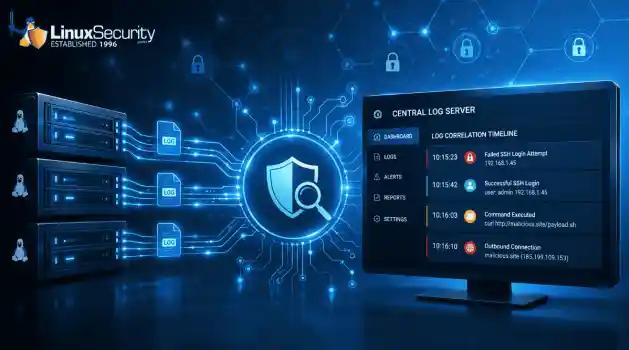
threat detection system monitoring For small security and IT teams, the "enterprise" dream of a fully automated SIEM often feels like a distant luxury. It’s a vision built on massive budgets and dedicated engineering teams—things that, frankly, most of us don't have. But here is the reality: you don’t need a six-figure platform to maintain a secure environment. . Linux systems are, by design, incredibly verbose. Every time a user authenticates, a process executes, or a configuration file changes, your system creates a record of...
Jul 17, 2026
How to Learn Tips and Tricksnetwork security centralized logging
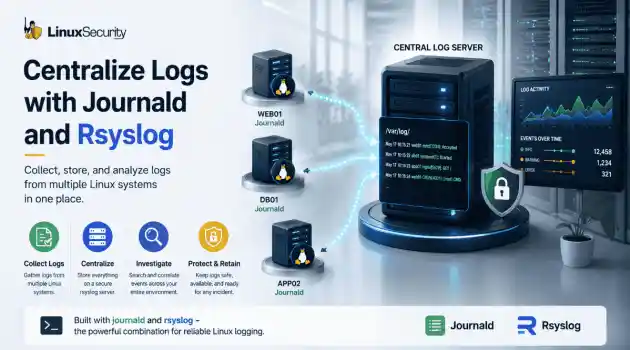
network security centralized logging Linux systems generate a steady stream of authentication, service, kernel, and application logs. On most systems, those logs never leave the machine that created them. If you're responsible for ten or twenty servers, that means checking each one separately. If one disappears before you can investigate it, its logs may disappear with it. Centralized logging solves that by sending log messages to another server as they're created. Instead of searching every machine, you have one place to review...
Jul 15, 2026
How to Secure My Networksecurity advisory audit
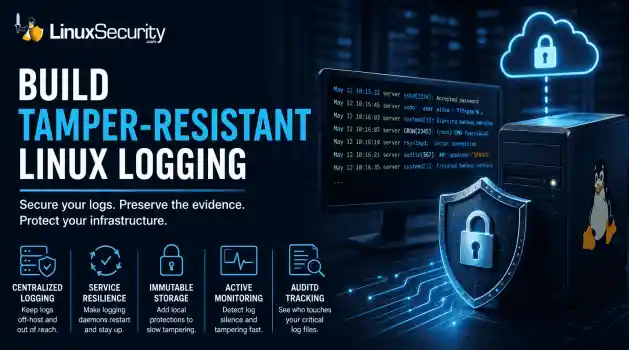
security advisory audit When you’re digging through an incident, your logs are the only thing you can actually trust. The problem is, attackers know that too. If someone gets root on your server, their first move is almost always to delete the evidence and cover their tracks. . If you aren't actively protecting your logs, you're basically flying blind the second a breach happens. It’s a miserable feeling to realize you have no idea what an attacker did because they wiped the logs before you even got there. In this...
Jul 11, 2026
 Refine HOWTOs
X Clear Filters
Get the latest News and Insights
Get the latest Linux and open source security news straight to your inbox.
Community Poll
Should Linux servers automatically install security updates?
Loading...
Explore Latest Linux Security HOWTOs
We found -2 articles for you...
160
 data protectionlinux configurationSFTP
Configuring SFTP on Linux for Secure and Efficient File Transfers
FTP (File Transfer Protocol) remains an invaluable component of the business technology landscape for those not quite adept at running an entire build system. While going full cloud may seem appealing, think twice if any files that contain sensitive information need to be uploaded and downloaded through third-party services without your control. . It is crucial to ensure that files are uploaded securely and reliably, and sometimes, that means keeping them within your local area network (LAN). Luckily, as always, Linux has your back. Secure Shell (SSH) makes setting up an FTP server more straightforward than ever. Once set up, files can be moved between servers using Secure FTP for reliable information transmission. SFTP (or Secure File Transfer Protocol) is an alternative to FTP for transferring files, adding a layer of security to the process. Today, I'm sharing an awesome tutorial on how to set up a Secure File Transfer Protocol (SFTP) to move files around your Linux servers (linked at the end of this article. But first, let's examine the security implications and considerations regarding FTP and SFTP that you should be familiar with before proceeding. FTP Security Implications & Considerations There are various security considerations and implications admins should be familiar with regarding FTP: Transmission in Clear Text: FTP does not encrypt its traffic; all transmissions, including login credentials, are made in plain text and thus vulnerable to interception and eavesdropping by third parties. Using FTP over an unprotected network is considered risky regarding Linux security. Secure Alternatives: For secure file transfers, protocols like SFTP (SSH File Transfer Protocol) or FTPS (FTP Secure, an extension of FTP with TLS security) should be utilized. SFTP, in particular, integrates seamlessly with SSH (Secure Shell) and provides encrypted channels that offer authentication and data transfer services. Firewall Configuration: Setting up firewalls to permit FTP trafficcan be complex due to its use of multiple ports and, in active mode, random connections from various clients to random ports on their client systems. Proper firewall configuration is crucial in protecting any Linux system requiring FTP access. User Isolation: Implementing user isolation on FTP servers is essential to prevent authenticated users from accessing unauthorized files, which involves configuring the FTP server to restrict users to specific directories and enforce permission settings. Regular Updates and Audits: Keeping FTP server software current is crucial to protecting against vulnerabilities, so regular security audits should also be undertaken to protect against potential issues. FTP is a popular protocol for file transfers, yet its lack of security features renders it less appropriate when transmitting sensitive information across insecure networks. Linux environments prioritize data confidentiality and integrity and often prefer alternatives like SFTP or FTPS as the transfer protocols for data transmission. What Makes SFTP More Secure than FTP? SFTP is a more secure alternative to FTP for the following reasons: Encryption: SFTP uses the SSH protocol to encrypt data in transit. This means all data, including passwords, files, and commands, are transmitted securely. Authentication: SFTP supports more robust and versatile authentication mechanisms, including passwords, public keys, or a combination of methods. This multi-factor authentication significantly improves security. Single Connection: SFTP uses a single, secure connection for commands and data transfer (over SSH), simplifying the setup. With SFTP, handling multiple ports is unnecessary, which reduces the attack surface. Integrity and Confidentiality: Because it transmits data securely via encrypted packets, SFTP ensures that unauthorized parties cannot easily view or modify data during transmission. Next Steps: Setting Up an SFTP on Linux Due to its secure nature, SFTP isrecommended over FTP in almost all cases involving the transmission of sensitive or confidential information. To get started with SFTP, I encourage you to explore the tutorial linked below to learn how to set up a Secure File Transfer Protocol (SFTP) to move files around your Linux servers. . Establish safe data exchanges by setting up SFTP on Unix systems, ensuring robust security measures for confidential documents.. SFTP Configuration, Secure File Transfer, FTP Security, Linux Data Transfer. . Brittany Day
 Jul 20, 2024
•
Jul 20, 2024
• How to Harden My Filesystem
166
 data protectionencryptionfile transfer
Croc File Transfer: Securely Move Data Between Computers
Croc is a free and open-source command line tool that enables computers to easily and securely transfer files and folders using code phrases. Learn how to install and use croc in this tutorial. . There are lots of ways to transfer files between two or more computers. Today, we will discuss about yet another utility named Croc. This tutorial we’ll show you how to install Croc and how to use it to transfer files between computers. Croc is a file transfer system that sends files securely using end-to-end encryption, via a file transfer relay. If you are curious about the name, it is inspired by the fable of the frog and the crocodile. The Croc key advantages are speed, security, and simplicity, all-in-one. Transferring data using Croc is faster, because it acts as a relay server between the systems. It creates a full-duplex real-time communication layer between the two computers, so the “uploading” and “downloading” tasks occur simultaneously between those computers. . Delve into Croc, a public-source solution designed for safeguarding file exchanges across devices, utilizing end-to-end encryption for enhanced security.. Croc File Transfer, Safe File Sharing, Open Source Security. . Brittany Day
May 14, 2021
•
How to Learn Tips and Tricks

160
 information securitydata privacyencryption techniques
Easy File Encryption Methods for Secure Linux Management
Learn how to easily and securely encrypt files on Linux in this tutorial. . As longtime readers know, while I try to stay knowledgeable on the many sub-disciplines of information technology, my passion is for information security. Since it's been a while since I've contributed any InfoSec knowhow, I wanted to rectify that. I couldn't have timed this realization better, because (as you'll see) the techniques on display are perfect for protecting your deluge of tax season documents. In this piece, I aim to provide a range of simple but effective options for encrypting a small number of files. In particular, these options are salient for use cases like tax filing, where users are sending sensitive documents to recipients with an unknown degree of technical proficiency. Fond as I am of PGP, I'll bet you your refund check that your accountant doesn't know the first thing about using it. . Quickly secure your documents on Linux by following this simple guide for effective file encryption.. Linux Encryption, Secure File Management, InfoSec Techniques. . Brittany Day
May 13, 2021
•
How to Harden My Filesystem

Get the latest News and Insights
Get the latest Linux and open source security news straight to your inbox.
Community Poll
Should Linux servers automatically install security updates?
Search Topics
Powered By

Linux Security - Your source for Top Linux News, Advisories, HOWTOs and Feature Releases
QUICK LINKS
subscribe to newsletters!
Like staying secure? So do we.
Sign up for updates, tips, and alerts!