Explore top 10 tips to secure your open-source projects now. Read More
×


Stay Ahead With Linux Security HOWTOs
How to Harden My Filesystem system hardening open source security
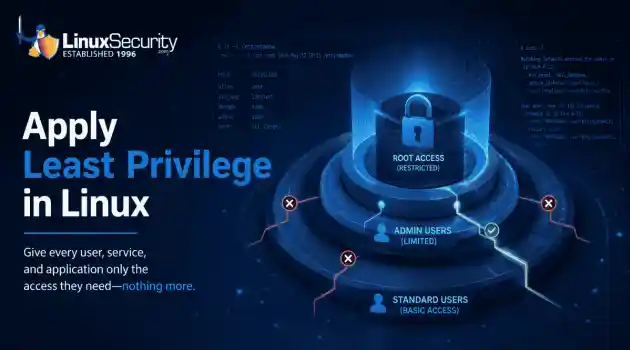
system hardening open source security We all spend a lot of time defending our systems from external threats, but the amount of damage an attacker can cause often depends on what happens after they get in. A single compromised account doesn't always lead to a major incident. The real danger begins when that account has far more access than it actually needs. That's exactly what the principle of least privilege is designed to prevent. By limiting users, services, and applications to only the permissions required for their jobs, you...
 Jul 20, 2026
How to Learn Tips and Tricksthreat detection system monitoring
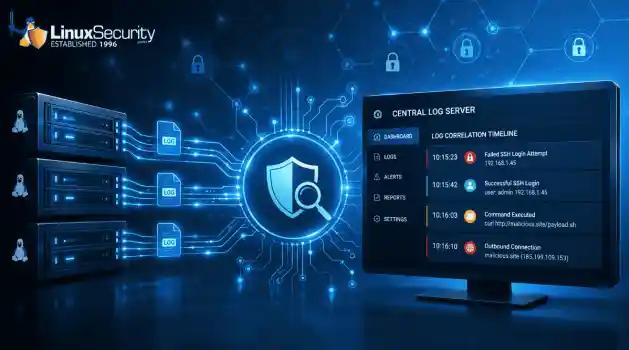
threat detection system monitoring For small security and IT teams, the "enterprise" dream of a fully automated SIEM often feels like a distant luxury. It’s a vision built on massive budgets and dedicated engineering teams—things that, frankly, most of us don't have. But here is the reality: you don’t need a six-figure platform to maintain a secure environment. . Linux systems are, by design, incredibly verbose. Every time a user authenticates, a process executes, or a configuration file changes, your system creates a record of...
Jul 17, 2026
How to Learn Tips and Tricksnetwork security centralized logging
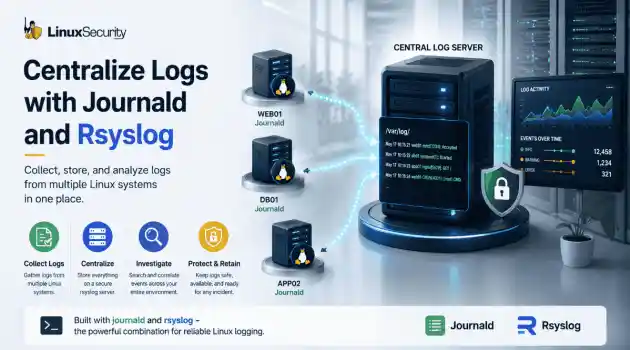
network security centralized logging Linux systems generate a steady stream of authentication, service, kernel, and application logs. On most systems, those logs never leave the machine that created them. If you're responsible for ten or twenty servers, that means checking each one separately. If one disappears before you can investigate it, its logs may disappear with it. Centralized logging solves that by sending log messages to another server as they're created. Instead of searching every machine, you have one place to review...
Jul 15, 2026
How to Secure My Networksecurity advisory audit
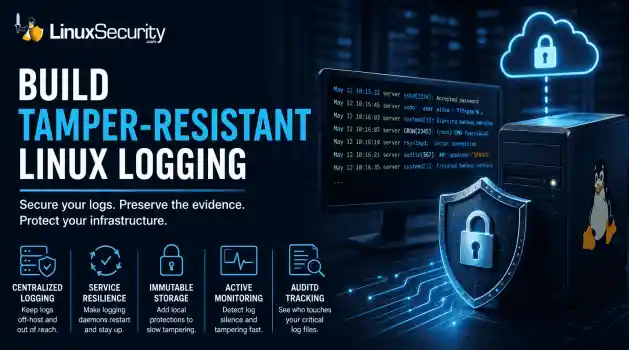
security advisory audit When you’re digging through an incident, your logs are the only thing you can actually trust. The problem is, attackers know that too. If someone gets root on your server, their first move is almost always to delete the evidence and cover their tracks. . If you aren't actively protecting your logs, you're basically flying blind the second a breach happens. It’s a miserable feeling to realize you have no idea what an attacker did because they wiped the logs before you even got there. In this...
Jul 11, 2026
How to Harden My Filesystemlog analysis security incident
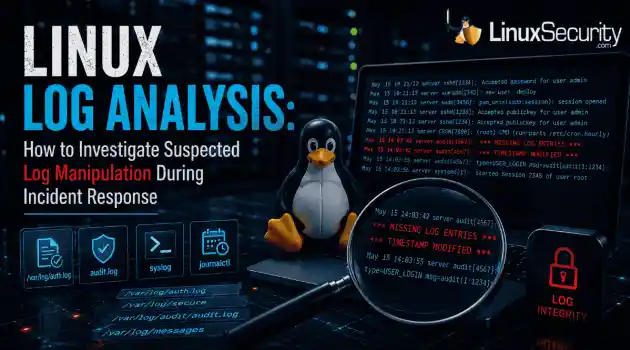
log analysis security incident When an attacker breaks into a Linux system, their work is rarely done. Usually, the real work starts after the initial exploit: hiding their tracks. If you’re a Linux admin or security analyst, there is nothing worse than logging in, running a few commands, and realizing the logs aren't telling the whole story. When logs are missing or look "off," your primary source of truth is compromised. This guide covers how to handle that situation. We’ll walk through the workflow you need to determine...
Jul 10, 2026
 Refine HOWTOs
X Clear Filters
Get the latest News and Insights
Get the latest Linux and open source security news straight to your inbox.
Community Poll
Should Linux servers automatically install security updates?
Loading...
Explore Latest Linux Security HOWTOs
We found -2 articles for you...
166
 incident responselinuxsecurity analysis
How to Read Linux Audit Logs During an Intrusion
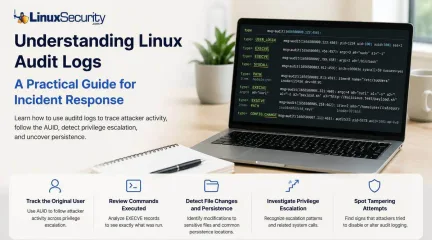
When a security alert fires, the panic often sets in before the analysis. Many administrators instinctively reach for /var/log/auth.log or journalctl , but those logs tell only a partial story. They document successful logins and authentication attempts, but they rarely capture the granular "how" of a post-compromise environment. To truly reconstruct an attack, you need to master audit logs . Unlike standard authentication logs, Linux audit logs (managed by auditd ) record system-level activity, including specific syscalls, file modifications, and command executions. In this guide, we’ll move beyond administrative documentation to show you exactly how to reconstruct an attacker’s activity during a live investigation. . Quick Incident Response Checklist Define the scope: Identify the first suspicious timestamp. Find the entry point: Search for USER_LOGIN events. Anchor the AUID: Capture the original user ID to track activity post-escalation. Trace execution: Filter EXECVE events for the auid . Audit persistence: Check for file modifications in ~/.ssh/authorized_keys or cron . Detect tampering: Inspect CONFIG_CHANGE events. Correlate: Match audit events with firewall and EDR logs. What Linux Audit Logs Reveal (The Forensic Anatomy) Before running commands, understand that auditd creates a chain of evidence. Every action (like running whoami ) generates a syscall, and every syscall is tagged with an Event ID and an auid . The auid (Audit User ID) is your "golden thread." Even if an attacker runs sudo su - to become root, their original auid remains the same. You aren't tracking a changing uid ; you are tracking the session's source. Step-by-Step: Reconstructing an Intrusion Let’s walk through a standard attack: The Compromised Session. Step A: Identify the Entry Start by searching for the login event around your alert time : Bash ausearch -m USER_LOGIN -ts 2026-06-29:02:10 -i Look for: The auid field in the output. If the auid is 1001 , every subsequent command you search for will use that specific ID. Step B: Follow the Attacker (The AUID Trail) Once you have the auid , you can ignore the uid (which will switch to 0 when they become root) and follow their specific trail: Bash ausearch -ua 1001 -i Sample Output: Plaintext type=EXECVE msg=audit(1656500000.123:456): argc=3 a0="curl" a1="-o" a2="payload.sh" ... This shows the attacker downloading a script. The auid links this activity directly to the 1001 session, even if they are currently acting as root. Step C: Identify Sensitive File Changes Attackers follow a pattern when establishing persistence or escalating. Use this table to prioritize what to investigate : File Why Attackers Target It /etc/passwd To create or alter accounts for permanent access. /etc/shadow To crack password hashes or escalate privileges. /etc/sudoers To grant themselves permanent sudo privileges. ~/.ssh/authorized_keys To maintain persistence via SSH keys. To find these, use: Bash ausearch -f /etc/sudoers -i Step D: Investigate Privilege Escalation You will often see related syscalls. When an attacker elevates privileges, look for the sequence: execve : The execution of sudo or pkexec . setuid : The transition of the effective uid to 0 . chmod / chown : Attempts to manipulate file permissions to ensure their "backdoor" remains accessible. Correlation: The Key to Context Audit logs are powerful, but they are not a standalone truth. To verify the "why," correlate them: Network Logs: If audit logs show a curl to a suspicious IP, check your firewall logs to see if that connection was successful or blocked. EDR Process Trees: Compare the pid from your audit record to your EDR telemetry to see the fullparent-child relationship of the processes. FIM (File Integrity Monitoring): If you see a file access in the audit log, verify if your FIM tool flagged the file's hash as changed. Common Investigation Mistakes Chasing the uid : Never follow the uid . It resets when an attacker uses sudo . Always stick to the auid . Missing CONFIG_CHANGE : Sophisticated attackers will run auditctl -e 0 to disable logging. If you see a gap in your logs, search ausearch -m CONFIG_CHANGE to see if the logging service was tampered with. Forgetting Timezones: Ensure your ausearch timestamps match your system's UTC or local time settings to avoid missing the window. Final Thoughts The next time an alert fires, don’t stop at the authentication logs. Audit logs can reveal every command an attacker executed, every sensitive file they touched, and every privilege escalation path they navigated. By shifting your focus from "did they log in?" to "what did they do after they logged in?", you transform audit logs from simple compliance records into a high-fidelity forensic trail. Are you ready to harden your environment? Subscribe to the LinuxSecurity Newsletter for upcoming tutorials on writing custom audit.rules and building automated detection logic for your SIEM. Related Reading Auditd vs eBPF: Effective Strategies for Modern Linux Monitoring Linux Logs Often Miss Critical Attack Details and Detection Gaps Understanding Log Management and Analysis Tools for Linux Systems Effective File Integrity Monitoring Techniques for Linux Systems Understanding Linux Persistence Mechanisms and Detection Tools Linux EDR: Essential Tool for Cybersecurity and Incident Response . Learn how to analyze Linux audit logs to uncover activity during security incidents and strengthen your incident response.. Linux Audit Logs, Incident Response, Security Analysis, Intrusion Forensics, System Activity Tracking. . MaK Ulac
 Jun 29, 2026
•
Jun 29, 2026
• How to Learn Tips and Tricks
160
 network toolsecurity analysisinformation gathering
Security Administrator Integrated Tool for Network Analysis
"SAINT is the Security Administrator's Integrated Network Tool. In its simplest mode, it gathers as much information about remote hosts and networks as possible by examining such network services as finger, NFS, NIS, ftp and tftp, rexd, statd, and ot. . 'SAINT is the Security Administrator's Integrated Network Tool. In its simplest mode, it gathers as . 'saint, security, administrator's, integrated, network, simplest, gathers. . Anthony Pell
Nov 29, 2004
•
How to Harden My Filesystem

160
Unix systemssecurity analysisforensicsExploring Unrm And Lazarus Tools On Sun Solaris Systems
This documentation discusses the use of two TCT tools, unrm and lazarus, on the Sun Solaris operating system, version 2.x. You can use this approach with other UNIX operating systems and hosts.. . This documentation discusses the use of two TCT tools, unrm and lazarus, on the Sun Solaris operatin. documentation, discusses, tools, lazarus, solaris, operatin. . Anthony Pell
Nov 23, 2004
•
How to Harden My Filesystem

Get the latest News and Insights
Get the latest Linux and open source security news straight to your inbox.
Community Poll
Should Linux servers automatically install security updates?
Search Topics
Powered By

Linux Security - Your source for Top Linux News, Advisories, HOWTOs and Feature Releases
QUICK LINKS
subscribe to newsletters!
Like staying secure? So do we.
Sign up for updates, tips, and alerts!