Explore top 10 tips to secure your open-source projects now. Read More
×



Security Vulnerabilities  security advisory moderate
security advisory moderate For organizations that run a self-hosted Git platform, it’s no longer just about hosting static code repositories. Today, Git servers are responsible for deployment pipelines, API tokens, SSH keys, package repositories, and the automation scripts that push code directly. Confirm that the upgrade addresses known vulnerabilities but also provides production environments. . That makes them trusted systems within the development environment and attractive targets for attackers looking to move...
 Jul 20, 2026

Server Securitydata privacy automation
data privacy automation Every system admin has lived through the same Monday morning ritual. A queue of forty tickets, half of them password resets, permission errors, or disk space warnings that any experienced technician could resolve in under two minutes. The other half require actual judgment. For years, automation promised that software would eventually sort the two apart on its own. That promise is now being tested in production Linux environments. . Early results are reshaping how IT teams think about tier-1...
Jul 17, 2026

Privacydata collection automation
data collection automation You're running a web scraping project to collect pricing data from e-commerce sites. You set up a pool of datacenter proxies, launch your scripts, and within minutes — banned . CAPTCHAs everywhere. Your data pipeline stops before it really begins. . It's a frustrating scenario that plays out daily in ad verification, market research, and multi-account management. The website doesn't know you're doing legitimate research or monitoring. It just sees traffic coming from IP ranges it recognizes as...
Jul 17, 2026

Security Trends security advisory social engineering
security advisory social engineering Business Email Compromise used to be a numbers game — mass-blasted emails, broken English, an obvious "URGENT WIRE TRANSFER" subject line. That era is over. Generative AI has turned BEC into a tailored, low-noise operation that mimics writing style, voice, and even video presence. This piece looks at what's actually changed under the hood, what defenders are testing in response, and why so many organizations are still structurally unprepared for it. . The Infrastructure Problem Nobody Wants to...
Jul 17, 2026

Security Trends cybersecurity Linux documentation
cybersecurity Linux documentation Linux operating systems have gained prominence due to their stability, adaptability, and excellent security options. In the case of developing documentation, designing cybersecurity dashboards, or educational material, visuals are of vital importance when it comes to making things clear. The use of icons allows one to understand the message regarding alerts, authorization, encryption, authentication, or the state of the system just by looking at the visual cue without having to read long...
Jul 17, 2026
 Refine news
X Clear Filters
Get the latest News and Insights
Get the latest Linux and open source security news straight to your inbox.
Community Poll
Should Linux servers automatically install security updates?
Trending News
Loading...
Explore Latest Linux Security news
We found 1 articles for you...
209
 security advisorysocial engineeringphishing
Business Email Compromise with AI Enhancements and New Defense Strategies
Business Email Compromise used to be a numbers game — mass-blasted emails, broken English, an obvious "URGENT WIRE TRANSFER" subject line. That era is over. Generative AI has turned BEC into a tailored, low-noise operation that mimics writing style, voice, and even video presence. This piece looks at what's actually changed under the hood, what defenders are testing in response, and why so many organizations are still structurally unprepared for it. . The Infrastructure Problem Nobody Wants to Admit Here's an uncomfortable truth: most BEC defenses fail not because the AI is too clever, but because the mail infrastructure behind them is ancient. Legacy MTAs bolted together over a decade, half-configured SPF records, DKIM keys nobody rotated since 2019 — this is fertile ground for attackers who no longer need to guess your CFO's writing style, because a language model can extract it from three publicly available press releases in under a minute. Sysadmins carrying that kind of technical debt aren't fighting AI-generated phishing on equal footing; they're fighting it with one hand tied to a mail server that was never designed for this threat model. Modernizing that stack — replacing brittle, unmonitored legacy pipelines with something observable and policy-driven — has stopped being an IT hygiene task and become a security requirement. A proper software modernization solution addresses exactly this gap, turning fragmented legacy email and identity infrastructure into something that can actually enforce Zero Trust principles instead of just gesturing at them in a compliance document. That's not a hypothetical concern. According to industry incident data, BEC remains one of the costliest categories of cybercrime tracked by the FBI's IC3 division year over year, and the losses keep climbing even as awareness training budgets grow. Something isn't adding up — and the honest answer is that awareness training was built for a threat that has since evolved past it. What Attackers AreActually Testing Right Now Personalized Phishing at Machine Speed Large language models didn't just make phishing emails more grammatically correct. They collapsed the reconnaissance phase from days to minutes. Feed a model a target's LinkedIn history, a few earnings call transcripts, and a handful of public Slack or GitHub posts, and it will draft a message that references internal project codenames, mirrors the CEO's typical sentence rhythm, and lands in an inbox with zero red flags for a spam filter trained on 2021-era phishing patterns. A few technical shifts worth flagging: Style transfer at scale. Attackers fine-tune or prompt open-weight models on scraped email threads (often from prior breaches or public archives) to replicate an executive's tone precisely enough to fool colleagues who've worked with them for years. Multi-turn social engineering. Instead of one-shot emails, attackers now run conversational threads — the model adapts replies in real time, handling objections ("can you confirm this on a call?") with plausible, context-aware pushback. Automated OSINT pipelines. Reconnaissance that used to require a skilled human analyst is now a scripted pipeline chaining search APIs, scraping tools, and an LLM summarizer — cutting attacker prep time from days to under an hour. Voice Cloning and Deepfake Verification Calls This is the part that should genuinely worry anyone running finance operations. Voice cloning tools now need as little as three seconds of clean audio — pulled from a conference recording, a podcast appearance, an earnings call — to produce a convincing synthetic voice. Combine that with a deepfake video call (even a low-resolution one over a "bad connection," which conveniently masks artifacts), and you've defeated the exact verification step most finance teams were told to rely on: "just call them to confirm." Voice authentication as a control is quietly becoming obsolete. Not gone yet, but the trend line is unambiguous, and financeteams that still treat a phone call as a hard confirmation step are working from an outdated threat model. Business Logic Abuse Over Malware One detail that surprises people outside the field: a huge share of modern BEC doesn't involve malware at all. No payload, no exploit, nothing for an EDR agent to catch. It's pure social engineering wrapped around legitimate business processes — invoice changes, payroll redirects, vendor bank detail updates. Mapped against MITRE ATT&CK, this activity sits almost entirely in the Initial Access and Collection tactics, rarely touching Execution or Persistence in any way a traditional security stack is tuned to detect. That's precisely why signature-based and payload-based defenses keep missing it. What Defenders Are Building to Counter It The defensive side isn't standing still, and there's some genuinely interesting engineering happening — though most of it is still maturing from prototype into production reliability. Behavioral and Linguistic Baselining Instead of scanning for malicious links or attachments, newer platforms build a behavioral fingerprint per sender: typical sending hours, sentence length distribution, vocabulary patterns, even punctuation habits. When a message claiming to be from a known executive deviates from that baseline — arriving at 3 a.m., using unusually formal phrasing, requesting an action that's never occurred in that thread's history — it gets flagged for review, regardless of whether it contains any traditionally "malicious" content. AI-Driven Anomaly Detection Across Mail Flows Security teams are increasingly running anomaly detection models across aggregate mail flow data rather than individual messages: sudden changes in reply-to domains, unusual DKIM signature patterns, mismatches between the claimed sending infrastructure and actual delivery path. This is where solid fundamentals still matter enormously — a well-configured DMARC policy with strict alignment, properly rotated DKIM keys, andenforced SPF still catch a meaningful share of spoofing attempts before any AI layer even needs to look at content. For teams building this out on Linux mail infrastructure, the practical groundwork is covered well in Zero Trust for Email: Implementing Advanced Protections on Linux — worth revisiting even if your DMARC rollout already feels "done," because alignment mode and reporting configuration drift over time in ways nobody notices until an audit. Adaptive Filtering That Learns Per Organization Generic, vendor-wide filtering models struggle with BEC precisely because these attacks are so context-specific — there's no universal signature for "email pretending to be your specific CFO." Adaptive filtering approaches train lightweight models on an organization's own historical mail corpus, learning what "normal" actually looks like internally rather than applying a one-size-fits-all threat model. Early deployments show promise here, though false-positive tuning remains the genuine bottleneck; block too aggressively and you're fielding help desk tickets from the actual CFO. A quick summary of where the technical controls stack up: SPF/DKIM/DMARC enforcement — foundational, still catches a real share of spoofing, but useless against compromised legitimate accounts Behavioral baselining — effective against style mimicry, resource-intensive to maintain accurately Voice/video verification protocols — need a second, out-of-band channel (a pre-shared code phrase, a callback to a known number, not one provided in the suspicious message itself) Payload-agnostic anomaly detection — necessary given how much BEC skips malware entirely, but requires mature baseline data to avoid alert fatigue Attachments Still Matter — Just Not the Way They Used To It would be a mistake to assume BEC 2.0 has made malicious attachments irrelevant. Attackers still pair social-engineering pretext with weaponized documents in a meaningful minority of campaigns — usually as asecondary payload once initial trust is established through a convincing AI-generated thread. The detection techniques covered in Enhancing Linux Email Security: Identify Malicious Attachments Effectively remain directly relevant here; sandboxed detonation and macro analysis haven't gone anywhere; they've just become one layer among several rather than the primary defense. Where Server-Level Hardening Fits In None of the AI-era detection tooling matters much if the underlying mail transfer agent itself is exploitable. The disclosure and patch cycle around Exim 4.98 is a good reminder that MTA-level vulnerabilities remain very much alive as an attack surface, and BEC campaigns increasingly chain infrastructure compromise with social engineering — gaining a foothold through an unpatched mail server, then using that legitimate infrastructure to send convincing internal-looking messages that sail past reputation-based filtering entirely. NIST's guidance on email security practices (SP 800-177 and related publications) has aged surprisingly well as a baseline framework, even against threats its authors couldn't have fully anticipated — encrypted transport, authenticated sending domains, and least-privilege access to mail infrastructure are still exactly the right starting points. What's changed isn't the framework; it's the sophistication of what's probing for gaps in it. So What Should Actually Change on the Ground? Not a full teardown of existing security stacks — that's neither realistic nor necessary. But a few shifts in priority are overdue: Treat voice and video confirmation as compromised by default; require a genuinely out-of-band verification step for any financial or credential-related request. Audit DMARC alignment and DKIM key rotation schedules now, not after the next quarterly review — this is cheap to fix, and attackers are actively scanning for the gaps. Shift detection budget toward behavioral and flow-based anomaly detection, since a growing share ofBEC never triggers payload-based defenses at all. Stop treating legacy mail and identity infrastructure as untouchable. Every unpatched, unmonitored legacy component is one more surface a language model can map faster than your team can document it. Is this an arms race? Sure, in the sense that every era of email security has been. But the pace has changed — attacker tooling that took a skilled operator days to build manually is now a weekend project with off-the-shelf models. Defenders who treat that shift as just another line item in next year's budget request are going to keep losing ground. The ones who close the infrastructure gaps now, while also investing in behavior-aware detection, are the ones who'll actually keep pace. . Generative AI is revolutionizing Business Email Compromise, enhancing phishing tactics and challenging your existing defenses.. Business Email Compromise, AI Security, Phishing Attacks, Identity Infrastructure, Cyber Defense Strategies. . Anthony Pell
 Jul 17, 2026
•
Jul 17, 2026
• Security Trends
79
 security advisoryvulnerability managementopen source initiative
Linux Foundation Launches Akrites to Strengthen Software Supply Chain Security
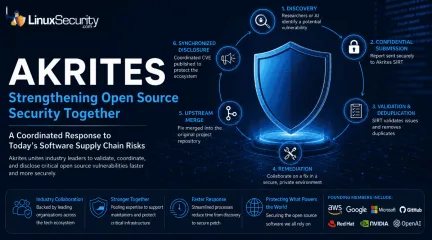
The Linux Foundation has officially launched Akrites , a coordinated industry initiative designed to improve how critical open source vulnerabilities are validated, coordinated, and disclosed before patches reach downstream users. Backed by a diverse coalition—including AWS, Google, Microsoft/GitHub, Red Hat, NVIDIA, and OpenAI—Akrites establishes a shared Security Incident Response Team (SIRT) to streamline the validation, remediation, and disclosure of vulnerabilities in the foundational code that underpins the modern digital economy. . AI Is Changing Software Supply Chain Security One detail in the Linux Foundation announcement stands out more than the launch itself. The organization isn't suggesting that open source projects suddenly need more vulnerability reports. They already receive plenty. The problem is volume. AI-assisted analysis has made it possible to review large codebases much faster than before. Researchers can identify suspicious patterns, compare projects, and generate vulnerability reports in a fraction of the time that manual analysis once required. That is good news for open-source security, but it has also exposed a weakness in the current response model. Every report still has to be reviewed by a person. Someone has to reproduce the issue, determine whether it affects supported releases, understand its severity, decide whether a CVE is appropriate, develop a patch, and move that fix through coordinated vulnerability disclosure before technical details become public. None of those tasks has become significantly easier simply because AI can produce findings more quickly. According to Endor Labs, one of Akrites' founding members, fewer than 5% of recently validated open source vulnerabilities have been patched . Whether that percentage changes over time, it illustrates the same trend. Discovery is accelerating faster than remediation. Why Existing Open Source Security Processes Are Under Pressure The reality for many maintainers looks verydifferent from how people imagine open-source security working. A widely used library isn't necessarily maintained by a large engineering team. In many cases, it's a handful of contributors or even a single developer balancing maintenance with a full-time job. Now imagine that the project suddenly receives dozens of reports describing the same underlying issue. One submission comes from a commercial scanner. Another is generated by an AI coding assistant. A third arrives through a bug bounty program. None are identical, but all require investigation. The difficult part isn't opening the email. It's figuring out whether the report is accurate, whether the vulnerability can actually be reproduced, whether downstream users are affected, and how the issue should move through vulnerability disclosure without exposing organizations before a fix is available. Akrites is intended to reduce that burden by acting as a shared Security Incident Response Team. Instead of every organization independently contacting maintainers, the initiative provides a coordinated process for validating reports, removing duplicates, and helping projects prepare fixes before disclosure begins. Recent Incidents Showed Why Coordination Matters Recent security incidents have demonstrated that identifying a vulnerability is often only the beginning. Log4Shell became a global response effort almost overnight. The challenge wasn't limited to understanding the vulnerability itself. Linux distributions, software vendors, cloud providers, security teams, and enterprise administrators all had to coordinate patches, advisories, testing, and deployment under intense time pressure. The XZ Utils backdoor exposed a different weakness. It showed how much critical infrastructure still depends on software maintained by very small teams. When one upstream project experiences a security problem, the consequences spread through Linux distributions, enterprise products, containers, cloud platforms, and countless applications built ontop of that code. Akrites would not have prevented either incident. The Linux Foundation isn't making that claim. Instead, the initiative attempts to strengthen the coordination that happens after a vulnerability is discovered and before it reaches the wider ecosystem. What Akrites Means for Open-Source Security Akrites represents a clear realization: open source security can no longer rely solely on the efforts of individual maintainers. Every critical project eventually hits the same wall: the software becomes indispensable long before the maintenance team has the resources to manage it. One interesting aspect of this initiative isn't just the technology—it's the list of founding members. Organizations like Citi, JPMorgan Chase, Ericsson, and Cisco rarely launch joint initiatives unless they share a massive, systemic problem. In this case, they do. Modern infrastructure shares an enormous amount of upstream code, which means one overwhelmed maintainer is now a systemic risk for banks, power grids, and cloud providers alike. What This Means for Linux Administrators Linux administrators rarely work directly with upstream maintainers, yet they depend on them every day. Enterprise distributions such as Red Hat Enterprise Linux, Ubuntu, Debian, SUSE, AlmaLinux, and Rocky Linux package software only after upstream projects have investigated reports, developed patches, and coordinated disclosure. Improvements at the upstream level can ripple through the entire software supply chain, ultimately affecting how quickly organizations receive trusted updates. : Faster upstream patch coordination: Verified fixes land in your distribution’s repositories sooner because the "middle work" of validation and deduplication is handled upstream. More consistent security advisories: Standardized reports make it easier to track and prioritize updates across your fleet. Better support for widely used components: Akrites says it can serve as a "maintainer of last resort" for certain criticalprojects by helping coordinate remediation when active maintenance is no longer sufficient. How Akrites Coordinates Vulnerability Response The initiative formalizes the vulnerability disclosure lifecycle to ensure confidentiality and speed. Instead of maintainers fielding reports from hundreds of sources, they have one predictable partner. Discovery: A researcher or AI surfaces a potential flaw. Confidential Submission: The report is sent to the Akrites SIRT, not a public bug tracker. Validation & Deduplication: The SIRT verifies the issue and removes duplicates. Remediation: Maintainers and industry engineers collaborate on a fix in a secure environment. Upstream Merge: The fix is merged into the original project's repository. Synchronized Disclosure: A coordinated CVE is published to alert the ecosystem. Akrites Won't Replace Vulnerability Management It is vital to note that Akrites is an upstream coordination body, not an enterprise security product. Organizations still need robust internal programs, including vulnerability management processes, asset inventories, and monitoring tools to detect threats within their specific environments. Akrites improves the upstream coordination of security, but the responsibility for securing the downstream enterprise environment remains with the organization. Akrites complements existing vulnerability management programs rather than replacing them. Organizations will still need scanners, patch management workflows, asset inventories, and software bills of materials (SBOMs) to identify affected systems and deploy updates. Akrites focuses on the upstream coordination that happens before those updates reach enterprise environments. Conclusion For years, the industry invested heavily in tools designed to identify software vulnerabilities faster. Akrites reflects a strategic recognition that discovery is no longer the limiting factor. As AI continues to accelerate vulnerability research, the challenge hasbecome how quickly maintainers can validate reports, coordinate fixes, and deliver patches before attackers exploit them. Whether Akrites succeeds will ultimately be measured not by the number of vulnerabilities it processes, but by whether it successfully shortens the time between discovery and remediation across the open source ecosystem. By professionalizing the "messy middle" of the response process, Akrites is attempting to build the operational infrastructure needed to keep our most critical software secure in an age of AI-accelerated threats. Want more Linux security news, open source security analysis, and software supply chain insights? Subscribe to the LinuxSecurity Newsletter for the latest vulnerability disclosures, security advisories, threat analysis, and expert coverage of the technologies shaping the Linux ecosystem. Related Reading Why Linux Supply Chain Attacks Are Becoming a Nightmare for DevOps Teams Targeted Attacks on Open Source Maintainers Highlight Security Risks . The Linux Foundation's Akrites aims to improve the response and management of open source vulnerabilities through collaborative efforts.. Linux Foundation, Akrites, Open Source Security, Vulnerability Coordination, Software Supply Chain. . MaK Ulac
Jun 29, 2026
•
Security Projects

209
 data analysisLinux systemsthreat intelligence
Exploring AI Predictive Cybersecurity Models for Linux Systems
It's always been a matter of responding to cybersecurity. Threats happen, defenses are made, attackers adjust their plans, and the cycle starts all over again. But what if we could make that different? What if AI could detect attack patterns before they happen? This would give defenders a head start instead of continually having to catch up. . The promise sounds too good to be true. But predictive security models that use machine learning are already giving results that would have seemed like science fiction ten years ago. It's not an issue of AI predicting the exact future; it's a question of how well these systems perform in the actual world and where they don't. How Predictive Security Models Transform Linux Cyber Defense Traditional security systems only respond to threats that have already been found. The malware's signatures can be found by your antivirus software. Your firewall stops traffic based on rules that are already in place. Your intrusion detection system sends you notifications when it sees certain patterns of suspicious behavior. For any of these options to work, someone has to have seen the threat before and developed a response. Models that make predictions work in a different way. They look at a lot of information about how networks usually work, how people use them, how systems are set up, Linux security logs, and feeds of threat intelligence. Modern AI and ML frameworks on Linux make it possible to analyze this data at scale.. Machine learning algorithms can perceive connections that people might not. Over time, these algorithms get better at spotting indicators that an attack may be developing. It's like trying to figure out what the weather will be like. Meteorologists can't determine for sure where lightning will hit, but they can get better at guessing how storms will act. AI security tools can't tell you exactly when an attacker will get into a system, but they can tell you where the conditions are most likely to be right for an attack. WhyHigh-Quality Linux Log Data Matters for AI Security Tools Predictive models function because of the data they are trained on. For most businesses, this immediately makes things difficult. Your AI must first understand what normal in your environment looks like before it can identify issues. This entails gathering a large amount of data from networks, apps, endpoints, cloud infrastructure, and especially Linux logs such as syslog, auditd, and SSH activity. This fundamental degree of visibility is lacking in many businesses. They have data silos that make it difficult to provide a comprehensive analysis, they don't maintain accurate logs, and they don't regularly monitor all of their systems. Prior to implementing predictive security, a number of fundamental issues with data collection must be resolved. Another issue is the quality of the training data. While machine learning models trained primarily on historical attack data may be highly effective at identifying known threats, they may not be as effective at identifying emerging ones. The best predictive systems combine real-time monitoring of human and system behavior with historical threat intelligence. Where AI Excels in Predicting Cyber Threats on Linux Systems Certain attack types are more predictable than others. Distributed denial of service attacks frequently exhibit early warning indicators when botnets are deployed, and reconnaissance probing is initiated. These accumulations can be detected by predictive models, which can then activate pre-existing defenses. Insider threat detection is another area where AI prediction can be effective. Typically, malicious insiders don't start off with nothing and start stealing data right away. Unusual access, activity outside of regular business hours, and odd data searches are often patterns. Machine learning can pick up these subtle behavioral shifts that might not trigger conventional rule-based alerts. Phishing attacks also follow patterns. Similar attacks typically target otherbusinesses in your industry before a large wave of phishing attacks targets your company. You can learn about new phishing techniques before they reach your inbox thanks to AI algorithms that process large amounts of threat data. New opportunities for predictive defense have emerged as a result of the growing adoption of AI for cybersecurity, particularly when it comes to automating the extensive analysis of threat intelligence and connecting it to information about organizational vulnerabilities. With this combination, security teams can choose which patches and defensive measures to prioritize, not just based on severity scores but also on the most likely ways an attacker will gain access—especially on Linux systems that power most server infrastructures. The Limitations of AI and Predictive Security in Real-World Attacks There are limitations to predictive security; it is not magic. False positives continue to be a persistent issue. Teams become disinterested in models when they send out too many notifications. The ratio of specificity to sensitivity must be continuously adjusted. Adversarial machine learning is another issue. Astute hackers already create difficult-to-find exploits. Hackers will figure out how to fool predictive models as they proliferate. Because defenders must continuously train models on new attack types, this is an arms race. It's also difficult to operationalize. Deep learning models frequently behave like black boxes, generating predictions without providing an explanation. Security experts must understand why an AI system suspects an attack in order to react appropriately. Explainable AI is still being studied because it affects how security works in the real world. How to Start Using Predictive Security in Your Linux Environment We should employ both human comprehension and AI prediction rather than just swapping one for the other. Predictive models excel at handling large data sets and identifying statistical outliers. Human analysts are very good at figuringout what happened and why an attack occurred. Starting small is the simplest way for businesses to maximize the benefits of predictive security. They choose certain situations where prediction is obviously helpful, like when they try to spot credential stuffing or find vulnerable Linux systems before they can be exploited. It gives you more confidence and makes sense to move on to other areas when you do well in a small one. Integration is also very important. Instead of implementing predictive capabilities as stand-alone systems, it is preferable to incorporate them into existing security workflows. The dashboards that analysts currently use should display alerts. You should use predictions to help you decide which tickets to work on first and how to resolve issues. Can AI Really Predict Cyberattacks? A Practical Outlook Can artificial intelligence predict when cyberattacks will occur? Yes—within limits. Today's technologies make it impossible to predict the precise time and location of tomorrow's breach. They can, however, identify dangerous situations, spot warning indications of an attack, and detect odd trends that require further examination. Predictive models enhance fundamental security concepts rather than replace them. You still need to be able to respond to events, maintain your Linux systems properly, check users, and update your software. By indicating where to focus your resources, where they are most needed, AI prediction improves the effectiveness of these core safeguards. Technology will advance. The ability of models to distinguish between signal and noise will improve. Our training methods will improve. It will be simpler to integrate. However, predictions are always subject to some degree of uncertainty. Making better security decisions rather than being able to predict the future is the aim fully. . Discover how AI improves predictive security models for cyber threats on Linux systems and their effectiveness.. AI Cybersecurity, Predictive Security, Linux ThreatDetection, Machine Learning, Cybersecurity Models. . MaK Ulac
Dec 03, 2025
•
Security Trends
76
 security threatslinuxai security
BlackHat USA 2024 Insights: AI, Microsoft Risks, and Core Dump Strategies
BlackHat USA , an annual cybersecurity conference with global attendance since 1997, is an essential forum for sharing cutting-edge security research, trends, and networking among IT and cybersecurity professionals. From its humble origins in Las Vegas in 1997 until today, this international event draws attendees from all around the globe. Security vulnerabilities are exposed, defensive strategies are articulated, and an overall pulse is taken on the digital security industry. . The 2024 BlackHat USA Conference once again provided vital topics and discussions. Focusing heavily on high-impact areas affecting Linux administrators and infosec professionals, findings presented at this year's event shed light on emerging threats and innovative countermeasures. Let's examine some of the highlights and key takeaways from BlackHat 2024 that directly impact our daily lives as Linux admins. Key Takeaways for Linux & InfoSec Circles From all the talks and shared research findings presented at BlackHat 2024, several key takeaways stood out for Linux administrators and infosec professionals: AI and Security At Black Hat USA 2024, Artificial Intelligence (AI) was a central theme, reflecting its growing significance within cybersecurity. Experts at the event discussed AI as an asset to boost security measures and an incursion into new risk categories. NVIDIA's AI Red Team recently identified sophisticated threats to large language models (LLMs), including indirect prompt injections and vulnerable plugins, that require strong application security measures to address. This highlights the significance of investing in robust application security as an essential means to mitigate such risks. On the positive side, experts saw GenAI and LLMs as transformative tools capable of synthesizing vast amounts of technical data and threat intelligence into more accessible formats for human analysis. Concerns were expressed over distinguishing practical AI applications from gimmicks. Skepticism regarding somecompanies' claims of AI innovation was voiced, as was caution regarding integration without fully comprehending its capabilities and implications in product environments. The conference revealed a dire outlook on the dark side of AI in cybersecurity, where AI-driven attacks aren't just possible - they're rapidly becoming a reality. According to HiddenLayer's AI Threat Landscape report, as businesses become more dependent upon Artificial Intelligence systems, threat actors have developed methods of exploiting it through data poisoning, model theft, and model evasion attacks, with more hostile exploits likely as enterprise adoption increases. It is, therefore, imperative for companies to remain agile and update their security strategies to combat AI-targeted threats effectively. Microsoft Outages and Patches Black Hat USA 2024 showcased critical discussions surrounding Microsoft vulnerabilities and security patches, revealing growing anxiety among cybersecurity professionals regarding Microsoft's software ecosystem. At this event, held against a backdrop of global geopolitical unrest and increasing reliance on Artificial Intelligence (AI), two global outages from Microsoft/CrowdStrike services were brought to light: Azure outages and those for Microsoft/CrowdStrike products. These incidents underscored the potential security ramifications of vulnerabilities within Microsoft's framework, drawing attention to its response approach. Particularly noteworthy was th e discovery of an advanced attack technique at this conference where threat actors could use zero-day vulnerabilities to perform downgrade attacks on fully updated Windows systems. Attackers could leverage this technique to reintroduce vulnerabilities patched using standard security tools, expose critical OS components, and exploit outdated DLLs and the NT Kernel without detection by standard tools. Black Hat 2024 also focused on Microsoft's response to these challenges, unveiling advisories on two unpatched zero-days, CVE-2024-38202 and CVE-2024-21302 , and offering mitigation advice pending more definitive patches. This move formed part of a broader critique against Microsoft's security posture, including ongoing concerns that the company tends to patch vulnerabilities identified by friendly researchers rather than actively redesigning programs to prevent new attacks. Critiques have arisen amid discussions of Microsoft's security responsibilities amid numerous vulnerabilities involving high-profile systems and data. Microsoft has pledged to tie security performance reviews directly with salary reviews to address vulnerabilities in its security framework in response to an ever-evolving threat landscape. Crash Reports and Core Dumps One of the more surprising but critical revelations at BlackHat USA 2024 was that log files, crash reports, and core dumps provide attackers with tools for creating denial-of-service attacks or more sophisticated system exploits. Likewise, security researchers use crash reports to detect malware payloads that often go unidentified by signature detection. Core dumps are files produced when programs crash and contain an exact snapshot of their state - often including sensitive information like passwords or encryption keys—making these reports a wake-up call to both Linux admins and developers to treat them with increased care. Detailed Insights from the Crash Report Analysis BlackHat presenters shed new light on the unintentional role of crash reports and core dumps in aiding attackers, forcing security professionals to recognize a need for a two-pronged approach: safeguarding them while using them to enhance security measures proactively. Attackers See Core Dumps As A Gold Mine Core dumps and error logs offer malicious entities an invaluable roadmap into a program's fault lines, providing an insight into its inner workings - how memory, user credentials, or transactions are managed or processed by it - providing data that could aid exploit development or identify weak points within an activesystem. Proactive Measures With Core Dumps However, from a defensive standpoint, these resources can prove invaluable. By carefully examining core dumps, security professionals and Linux system administrators can preemptively detect vulnerabilities within their systems' codebases - often by employing tools like GNU Debugger (GDB) , which enables examination of core dump contents to determine what caused a crash and identify root cause analysis solutions. Linux systems, being open-source platforms, offer numerous configuration options for managing core dumps. System administrators can configure whether and how often core dumps should be generated and their size and handling policies via kernel parameters like /proc/sys/kernel/core_pattern or user configuration options such as the ulimit command. Furthermore, Linux's robust logging systems can be easily customized depending on their environment's sensitivity or security needs. Configuring core dump handling on Linux goes beyond diagnostics. The task involves setting resource limits using ulimit , specifying core file size using core_file_size , and configuring kernel.core_uses_pid accordingly. For instance, one might store core dumps securely yet centrally so they are accessible for analysis by authorized personnel without being vulnerable to potential intruders. Furthermore, advanced platforms like Red Hat's OpenShift contain mechanisms for collecting core dumps within containers. This feature can be particularly helpful in diagnosing issues in microservice architecture where traditional core dump analysis methods might not apply directly. Why Are Future Proofing & Security Hygiene of Utmost Importance? BlackHat USA 2024 revealed that as systems become more complex, risks increase. Linux administrators and information security professionals must regularly reevaluate their security postures, incorporating lessons from events like core dump analysis. As core dumps can be dangerous tools, it is critical to implement stringent access controls , encrypt sensitive data at rest, and continuously monitor for unusual behaviors that might signal the need for deeper investigation of system stability and security. Linux community members should take advantage of the robust and granular control available to enhance system security reactively (post-incident analysis) and proactively by including core dump analysis as part of regular security practices. Our Final Thoughts on BlackHat USA 2024 BlackHat USA 2024 lived up to its longstanding legacy by providing valuable knowledge and trends resonating with Linux administrators and the larger infosec community. Its emphasis on emerging technological applications and ongoing efforts against vulnerabilities showcased cybersecurity's dynamic, ever-evolving nature. With these insights gained at BlackHat 2024, Linux professionals are better prepared than ever to navigate this ever-evolving security landscape, maintaining the integrity and trustworthiness of systems under their purview. . The 2024 BlackHat USA Conference provided insights on AI security, Microsoft risks, and core dump dangers for Linux professionals.. blackhat, annual, cybersecurity, conference, global, attendance, since, essential. . Brittany Day
Aug 12, 2024
•
Organizations/Events
209
 security awarenessmachine learningai security
AI Security Risks: Navigating Vulnerabilities in Machine Learning Projects
Does your company utilize AI or ML? Artificial intelligence and machine learning bring new vulnerabilities along with their benefits. Learn how several companies have minimized their risk in this informative CSO article: . When enterprises adopt new technology, security is often on the back burner. It can seem more important to get new products or services to customers and internal users as quickly as possible and at the lowest cost. Good security can be slow and expensive. Artificial intelligence (AI) and machine learning (ML) offer all the same opportunities for vulnerabilities and misconfigurations as earlier technological advances, but they also have unique risks. As enterprises embark on major AI-powered digital transformations, those risks may become greater than what we've seen before. AI and ML require more data, and more complex data, than other technologies. The algorithms used have been developed by mathematicians and data scientists and come out of research projects. Meanwhile, the volume and processing requirements mean that the workloads are typically handled by cloud platforms, which add yet another level of complexity and vulnerability. The link for this article located at CSO Online is no longer available. . Organizations frequently emphasize swift implementation of AI and ML technologies, yet safeguarding must remain a focal point within the intricacies involved.. AI Risk Management, Secure Machine Learning, Data Protection Strategies, Cloud Security Challenges. . Brittany Day
Sep 02, 2019
•
Security Trends
77
 network protectionsecurity applicationsai security
Innovative AI Applications for Network Attack Prevention Strategies
Unlike past attempts to manage security, these companies are concentrating on gathering real-time intelligence on attacks, vulnerabilities and exploits. Using data mining and artificial intelligence techniques, they can predict where problems could appear on a particular customer's network and then design . . . . Unlike past attempts to manage security, these companies are concentrating on gathering real-time intelligence on attacks, vulnerabilities and exploits. Using data mining and artificial intelligence techniques, they can predict where problems could appear on a particular customer's network and then design a system to counteract them. And hackers are still having their way. In the latest Computer Crime and Security Survey, released last week by the Computer Security Institute and the FBI, 85 percent of respondents said they had detected a security breach within the last 12 months. More telling was that 27 percent of those surveyed didn't even know if there had been unauthorized access or misuse of their company's site. "Companies have been spending a lot of money on security, but they can't keep up with the management of it because they don't have people with the knowledge to do it," said Stijn Bijnens, CEO of Ubizen, of Leuven, Belgium, with U.S. headquarters in Reston, Va. The link for this article located at ZDNet / eWeek is no longer available. . Safety agencies concentrate on immediate data analysis for threat mitigation through machine learning, enhancing system security from potential risks.. AI Security Solutions, Network Protection Strategies, Attack Intelligence, Security Applications. . LinuxSecurity.com Team
Mar 20, 2001
•
Server Security

Get the latest News and Insights
Get the latest Linux and open source security news straight to your inbox.
Community Poll
Should Linux servers automatically install security updates?
Trending News
Search Topics
Powered By

Linux Security - Your source for Top Linux News, Advisories, HOWTOs and Feature Releases
QUICK LINKS
subscribe to newsletters!
Like staying secure? So do we.
Sign up for updates, tips, and alerts!