



Network Security security advisory networking
security advisory networking For years, IPv4 was the only proxy type that really mattered for anyone running automation off a Linux box. IPv6 was the protocol everyone said they’d migrate to, but almost nobody actually did. In 2026, that’s finally starting to shift. . The problem is that most admins stick with IPv4 out of habit. They know it; it’s what their tooling defaults to, and they don’t see a reason to change. Some are overpaying for addresses they don’t need. Others would quietly break their scrapers, scripts, or...
 Jun 09, 2026
Network Securityopen-source python
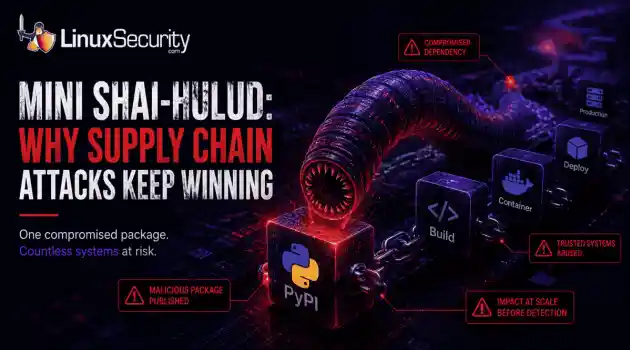
open-source python Researchers recently identified another wave of malicious packages on PyPI linked to the broader Mini Shai-Hulud campaign, a worm-like supply chain attack that spread through trusted software packages. On the surface, the packages looked no different from thousands of others published to the repository each week. . Instead of trying to break into a target network directly, the attackers hid malicious code inside software that developers were already using. A few downloads are all it takes....
Jun 09, 2026
Security Vulnerabilities malware linux
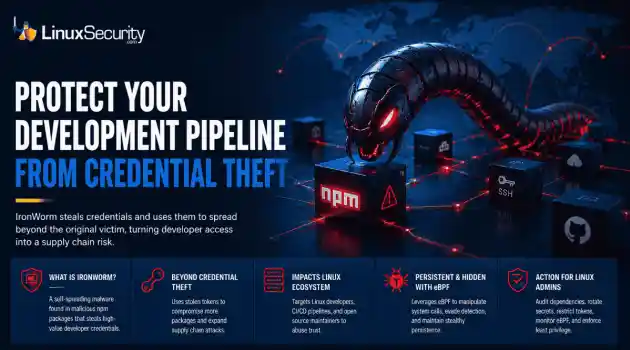
malware linux IronWorm steals credentials and uses them to spread beyond the original victim, turning developer access into a supply chain risk. . A new campaign targeting npm has evolved past simple credential theft. Researchers identified IronWorm, a self-spreading threat. It harvests high-value Linux development secrets—SSH keys, cloud tokens, package publishing credentials. One compromised workstation becomes a launchpad for downstream supply chain attacks. This is not a get-in-and-get-out operation....
Jun 08, 2026

Network Securitysystem security Linux network
system security Linux network The romanticized image of the digital nomad – a laptop on a sun-drenched balcony – rarely accounts for the actual friction of maintaining a professional development environment on the move. . The friction is amplified with Linux. We are looking for a setup that respects our kernel configurations, handles volatile network handovers, and maintains a strict security posture without the hand-holding of a consumer-grade OS – so, put simply, more than just a laptop and a sunny deck. The hardware is...
May 26, 2026

Server Securityopen-source Linux administration
open-source Linux administration Cron has existed in Unix and Linux environments for decades, handling backups, cleanup scripts, patching jobs, log rotation, monitoring tasks, and other maintenance work that administrators do not want to run manually. Most Linux servers rely on it constantly, which is exactly why attackers continue abusing it for persistence after a system has already been compromised. . Persistence through cron is not complicated. Attackers do not need a rootkit or advanced malware framework to maintain...
May 25, 2026
 Refine news
X Clear Filters
Get the latest News and Insights
Get the latest Linux and open source security news straight to your inbox.
Community Poll
What got you started with Linux?
Loading...
Explore Latest Linux Security news
We found -2 articles for you...
74
 network securitydenial-of-serviceemail filtering
Greyware: Cutting-Edge Protection from Swen Denial of Service Attacks
Greyware Automation Products, a small business, has been scrambling for the past week to keep itself alive as it's barraged by a denial-of-service attack launched by the Swen virus.. . .. Greyware Automation Products, a small business, has been scrambling for the past week to keep itself alive as it's barraged by a denial-of-service attack launched by the Swen virus. Greyware is getting 40 attempts per minute to deliver copies of the worm by e-mail. The worm makes up 51 percent of its total incoming e-mail traffic. The worm has been trying to contact the company's discussion servers 16 times every second; normal discussion server traffic is one attempted contact every minute. Those figures are current as of Friday afternoon. Left unchecked, the activity would flood Greyware's Internet connection, taken Greyware offline and put it out of business. The online business has fended off attacks by modifying the technique it -- and most e-mail services -- use to screen mail for spam and viruses. Instead of downloading each message in its entirety, then analyzing the contents, Greyware analyzes the messages as they come in, and, as soon as it determines a message is Swen-generated, the Greyware server breaks the connection. That saves bandwidth and e-mail storage, although it's processor intensive. Swen is also mounting a second attack on Greyware, flooding Greyware's NNTP-based discussion servers with connections in attempts to harvest e-mail addresses. Greyware dealt with those attacks by changing the port number users use to access the server, from Port 119 to Port 1119, which unfortunately made it impossible for some of its users to contact the discussion servers until those users had been informed of the change and reconfigured their client software to contact Greyware on the new port. The link for this article located at Security Pipeline is no longer available. . Greyware Automation Products, a small business, has been scrambling for the past week to keep itself. greyware, automation, products,small, business, scrambling, itself. . Anthony Pell
 Oct 06, 2003
•
Oct 06, 2003
• Network Security
77
patch managementIT risk managementcomplianceImproving Business Resilience and Security Compliance Today
Companies are increasingly considering their security as world events cast doubt on their ability to deal with natural disaster, human error or malicious attack. Spending on security has reached record levels, and continues to climb as businesses seek to reassure shareholders . . . . Companies are increasingly considering their security as world events cast doubt on their ability to deal with natural disaster, human error or malicious attack. Spending on security has reached record levels, and continues to climb as businesses seek to reassure shareholders and comply with standards and changing legal requirements. However, being secure is about more than simply buying firewalls, antivirus software and login technology. "Good IT security is about good management. It's more important to maintain patches and to document systems and procedures than it is to install expensive new security devices," says Bart Vansevenant, director of European security strategies at security service provider Ubizen. "Secure environments are typically well-documented, with a procedure for regularly patching systems, good monitoring and control of servers, and where good security is part of a culture." The link for this article located at VNUNet is no longer available. . Companies are increasingly considering their security as world events cast doubt on their ability to. their, companies, increasingly, considering, security, world, events, doubt, ability. . LinuxSecurity.com Team
Sep 25, 2003
•
Server Security

83
network securitycyber threatssocial engineeringUnderstanding Social Engineering Risks to Safeguard Business Networks
Bottom line: No product you can buy will protect you completely from the most serious threat to your network and your business. That's not what you want to hear after laying out six figures to arm yourself with firewalls, antivirus software, and intrusion-detection applications, is it? Nevertheless, forewarned is forearmed, and there is something you can do to fight this threat. . . .. Bottom line: No product you can buy will protect you completely from the most serious threat to your network and your business. That's not what you want to hear after laying out six figures to arm yourself with firewalls, antivirus software, and intrusion-detection applications, is it? Nevertheless, forewarned is forearmed, and there is something you can do to fight this threat. I'M TALKING ABOUT social engineering, which is simply a fancy way of saying "getting people who should know better to do what you want." A recent CERT report notes that attempts to hornswoggle those of you using instant messaging and Internet Relay Chat (IRC) via social engineering are on the rise. Victims of these hoaxes are directed to sites that ostensibly will help them, but really plant Trojan horse programs on their computers. Now what if the unsuspecting victim is infected with a Trojan horse at the office? It could be very costly to your business. The link for this article located at ZDNet is no longer available. . Bottom line: No product you can buy will protect you completely from the most serious threat to your. bottom, product, protect, completely, serious, threat. . LinuxSecurity.com Team
Apr 04, 2002
•
Hacks/Cracks

Get the latest News and Insights
Get the latest Linux and open source security news straight to your inbox.
Community Poll
What got you started with Linux?
Search Topics
Powered By

Linux Security - Your source for Top Linux News, Advisories, HOWTOs and Feature Releases
QUICK LINKS
subscribe to newsletters!
Like staying secure? So do we.
Sign up for updates, tips, and alerts!
Discover faster search, smarter navigation, and deeper Linux security insights. Read More