



Government European Commission public sector
European Commission public sector Some of the software the world depends on most is maintained by people most users will never know by name. The project might be sitting inside Linux distributions, enterprise software, cloud platforms, and government systems without most users ever realizing it is there. . The problem is not difficult to find. Critical software components can end up supporting thousands of products and services while being maintained by small teams with limited resources. By the time a vulnerability,...
 Jun 19, 2026
Server Securitysecurity advisory privilege escalation
security advisory privilege escalation The recent Keystone advisory is unusual because the vulnerabilities are scattered across several features but keep affecting the same class of security controls. Application credentials, trusts, RBAC enforcement, project ownership validation, token expiration. Different code paths. Similar failures. . Most require authentication already. The concern is what happens after access exists. Several of the disclosed vulnerabilities affect how Keystone validates identity, ownership, delegation, and...
Jun 19, 2026 Security Vulnerabilities security advisory authentication bypass
security advisory authentication bypass Fortinet has confirmed active exploitation of three FortiSandbox vulnerabilities . One allows attackers to bypass login controls, while the other two enable command execution directly on the appliance. Combined, they create a path from unauthenticated access to direct interaction with a system many organizations trust to analyze suspicious content. . In many environments, FortiSandbox sits between incoming content and the systems responsible for making security decisions about it. Before a...
Jun 18, 2026 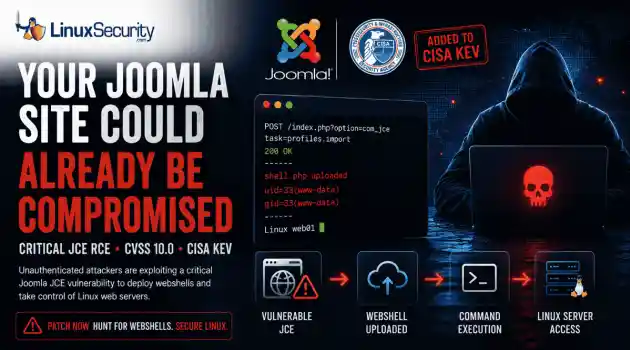
Security Vulnerabilities security advisory critical
security advisory critical The Joomla Content Editor (JCE), one of the most widely deployed editor extensions for Joomla websites, is currently under active attack due to a critical vulnerability. . The issue, tracked as CVE-2026-48907 , affects JCE versions earlier than 2.9.99.5 and carries a CVSS score of 10.0. Because JCE is installed on a large number of public-facing Joomla sites, the vulnerability has quickly become a high-priority target for attackers and automated scanning campaigns. CISA has added the flaw to...
Jun 17, 2026 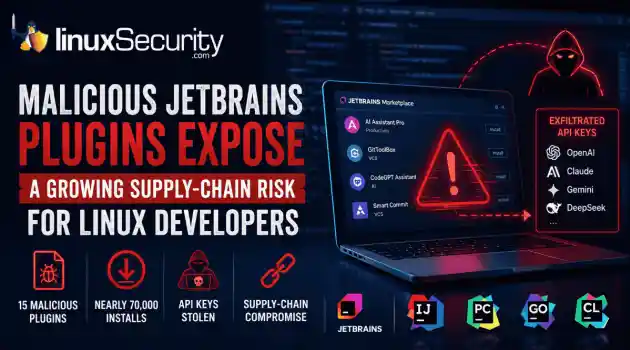
Security Trends security advisory open-source
security advisory open-source At least 15 malicious plugins and nearly 70,000 installs later, developers are being reminded that trusted marketplaces can become supply-chain attack vectors overnight. . How Malicious Plugins Steal API Credentials It’s simple. The user installs a plugin. It asks for API credentials. The developer clicks "Apply." A short time later, those keys could be sent to a third-party server. Think of an API key like a valet key to your house. It doesn't give them the deed to the property, but it lets...
Jun 17, 2026  Refine news
X Clear Filters Get the latest News and Insights
Get the latest Linux and open source security news straight to your inbox.
Community Poll
What got you started with Linux?
Loading...

Explore Latest Linux Security news
We found -4 articles for you...
74
 firewallnetworkingsecurity controls
Linux Firewall Rules Management Challenges Kubernetes Security
A Linux server running a few predictable services is relatively easy to secure. . You know which ports should be exposed and which processes are expected to communicate externally, and once the firewall rules are tuned properly, the environment usually remains stable for long periods. Troubleshooting is also fairly direct. If traffic fails, you inspect logs, trace connections, and work backward through the ruleset. Kubernetes changes almost all of that. The issue is not that Linux firewalling tools stopped working. nftables and iptables still process packets efficiently and remain deeply integrated into the networking stack. The problem is that modern orchestration layers introduced networking behavior that no longer maps cleanly to traditional host-level assumptions. Many Linux administrators discover this gradually. The first cluster may feel manageable, especially in a smaller environment. Then workloads begin to scale dynamically, service meshes are introduced, developers deploy additional namespaces, and suddenly the original firewall model becomes difficult to reason about operationally. The biggest challenge usually is not filtering traffic itself. It is understanding where enforcement is actually happening. Kubernetes Abstracts Networking Away From the Host One reason Kubernetes environments become harder to secure is that packet flow is no longer entirely controlled by the Linux machine. The host still matters, obviously. Traffic still traverses kernel networking layers, and tools like nftables remain relevant for local filtering and node-level hardening. But orchestration systems now make decisions above the operating system itself. A simple workload deployment can involve Kubernetes NetworkPolicies, cloud security groups, overlay networking, ingress controllers, service mesh policies, container runtime networking, and host firewall rules all at the same time. Those layers often interact in ways that are not immediately obvious during troubleshooting. For example,a Linux admin may inspect nftables rules and see no local traffic blocking, even though the actual restriction is enforced by a dynamically applied Kubernetes NetworkPolicy. The behavior itself is straightforward once understood, but troubleshooting becomes harder because enforcement is distributed across several layers rather than managed entirely from the Linux host. The official Kubernetes NetworkPolicies documentation gives a good overview of how these policies affect pod communication and namespace isolation in real-world environments. That changes the operational workflow considerably. Traditional Linux firewall troubleshooting was mostly linear. In containerized infrastructure, visibility becomes fragmented across multiple systems designed independently of one another. East-West Traffic Creates Most of the Operational Pain Perimeter filtering is usually no longer the hardest part. In many cloud environments, inbound traffic is already heavily restricted through load balancers, reverse prox ies, API gateways, or cloud-native filtering services. The more difficult problem is understanding internal communication between workloads. A compromised pod moving laterally inside the cluster often generates traffic that looks completely legitimate at the packet level. From the Linux host’s perspective, it may simply appear as normal encrypted communication between internal services. That is where traditional firewall logic begins to reach its limits. iptables and nftables understand ports, addresses, interfaces, and connection states very well. They do not understand workload identity, namespace trust boundaries, or application context without additional orchestration awareness layered on top. This becomes especially noticeable once teams start deploying microservices aggressively. Internal traffic volume is growing rapidly, and maintaining granular segmentation manually at the host layer is becoming operationally difficult to sustain. Most teams eventually respond by looseningcontrols simply because maintaining perfect granularity slows deployments down too much. nftables Is Cleaner Than iptables, but the Core Problem Remains Most administrators who have worked extensively with both systems would probably agree that nftables is easier to manage than older iptables configurations. The syntax is more consistent, IPv4 and IPv6 handling is unified, and maintaining larger rule sets is significantly less painful than dealing with sprawling legacy chains. Something like: nft add rule inet filter input tcp dport 22 ct state new accept It is much easier to reason about than older multi-table iptables structures. Performance improvements are also noticeable on busy systems. But migrating from iptables to nftables does not fundamentally solve the visibility problem introduced by Kubernetes and cloud-native infrastructure. The firewall still operates primarily at the node level. It still lacks awareness of workload orchestration, service relationships, and dynamic container behavior happening elsewhere in the stack. That distinction matters because many Linux teams initially expect nftables migration projects to improve security posture more than they actually do. In practice, the migration mainly improves maintainability. Why Linux Teams Started Layering Security Controls What most mature infrastructure teams eventually realize is that no single layer provides enough visibility anymore. Host-level filtering still matters. Kubernetes NetworkPolicies matter. Cloud-native ACLs matter. Identity-aware access controls matter. The environments that scale cleanly usually combine all of them rather than relying too heavily on a single approach. A fairly common operational pattern now looks something like this: The Linux host handles node-level hardening, SSH restrictions, local filtering, and outbound control. Kubernetes policies manage workload segmentation and namespace isolation. Cloud security groups enforce infrastructure-levelboundaries between services and environments. Centralized monitoring systems aggregate telemetry from all layers, enabling administrators to understand what is happening across the environment. That layered approach is more complicated initially, but it tends to age better operationally than directly managing every trust boundary from the Linux host. Logging Becomes More Important Than Rule Writing One thing that surprises many teams during Kubernetes adoption is how much time shifts away from writing firewall rules and toward understanding traffic visibility. Static environments are fairly predictable. Dynamic orchestration platforms are not. A service that behaved normally yesterday may suddenly exhibit entirely different traffic patterns due to autoscaling, deployment changes, or internal service discovery updates. That is why logging quality becomes critical. Linux administrators increasingly rely on: journal aggregation eBPF observability tools Kubernetes audit logs flow telemetry centralized traffic analytics Without visibility, troubleshooting becomes mostly guesswork. The challenge is no longer simply identifying blocked packets. It is understanding whether communication itself should exist in the first place. Where Cloud Firewalls Fit Into This One thing that changed significantly over the last few years is how organizations think about segmentation and visibility in hybrid infrastructure. In smaller environments, local firewalling may still be manageable directly from the host layer. In larger deployments spanning cloud providers, Kubernetes clusters, and mixed workloads, teams often need broader policy visibility than nftables alone can provide. That is part of why Cloud firewalls became more common operationally. Not necessarily as replacements for Linux-native controls, but as centralized enforcement and visibility layers sitting above fragmented infrastructure. For administrators dealing with distributed workloads, theoperational challenge is usually consistency rather than raw packet filtering performance. Maintaining comparable policies across cloud environments, container platforms, and traditional Linux systems manually becomes difficult over time. Final Thoughts Linux firewalling tools are still extremely effective at what they were designed to do. The issue is that modern infrastructure introduced orchestration layers and traffic patterns that extend far beyond the visibility of a single host. That does not make nftables or iptables obsolete. It simply changes where they fit inside the architecture. Most Linux teams are no longer trying to solve cloud segmentation entirely from the host layer. They are combining Linux-native controls with orchestration-aware policy systems, centralized visibility, and workload-level segmentation in order to keep dynamic environments manageable as they scale. . Explore why managing Linux firewall rules in Kubernetes is challenging and how to enhance visibility in dynamic environments.. Kubernetes Security, Linux Firewall, Cloud Security, Networking Policies, Network Visibility. . MaK Ulac
 May 08, 2026 •
 Network Security
Get the latest News and Insights
Get the latest Linux and open source security news straight to your inbox.
Community Poll
What got you started with Linux?
Search Topics
Powered By

Linux Security - Your source for Top Linux News, Advisories, HOWTOs and Feature Releases
QUICK LINKS
subscribe to newsletters!
Like staying secure? So do we.
Sign up for updates, tips, and alerts!
Discover faster search, smarter navigation, and deeper Linux security insights. Read More