Audit Linux privileges now to limit compromise, escalation, and system-wide damage. Review Linux Privileges×


Malicious JetBrains Plugins: The IDE Is Now a Supply-Chain Attack
 Jun 17, 2026
•
Jun 17, 2026
•
 MaK Ulac
2 - 4 min read

Topics Covered
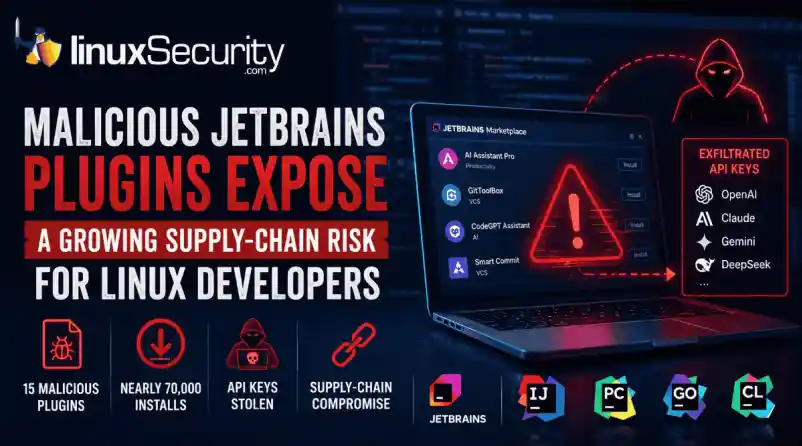
At least 15 malicious plugins and nearly 70,000 installs later, developers are being reminded that trusted marketplaces can become supply-chain attack vectors overnight.
How Malicious Plugins Steal API Credentials
It’s simple. The user installs a plugin. It asks for API credentials. The developer clicks "Apply." A short time later, those keys could be sent to a third-party server. Think of an API key like a valet key to your house. It doesn't give them the deed to the property, but it lets them walk in and grab whatever is sitting on the counter. Technical analysis from Aikido confirms that the attackers harvested active keys for several major services.
Security Risks to Linux Developer Workstations
They are gold mines. Developers run IntelliJ, GoLand, or CLion on Linux boxes that hold keys for Kubernetes, production cloud-native infra, and CI/CD pipelines. An attacker getting a foothold here doesn't just get access to your AI credits. They get a pivot point. Once they have root access on a dev box—that’s the highest level of permission on your machine—your entire deployment pipeline is vulnerable. They can watch what you write, steal your passwords, or inject backdoors into the software you are building for your company.
Why JetBrains Marketplace Security Reviews Fail
Stop assuming the JetBrains Marketplace security model is a firewall. It relies on automated scans, which can be limited by code obfuscation or delayed execution techniques. Even with plugin review guidelines and a plugin signing framework, the "verified" tag is just a label. It doesn't mean the code is safe.
The Dangers of Integrating AI Assistants in IDEs
AI keys are the new password. Integrating AI services into the IDE can expand the attack surface because prompts and code may be sent to external services.. It isn't just about someone using your subscription to save money. It’s about them reading your prompts. If you are feeding the AI your company’s proprietary code to help you debug or write, the attacker is seeing that code, too.
Understanding IDE Extension Supply-Chain Attacks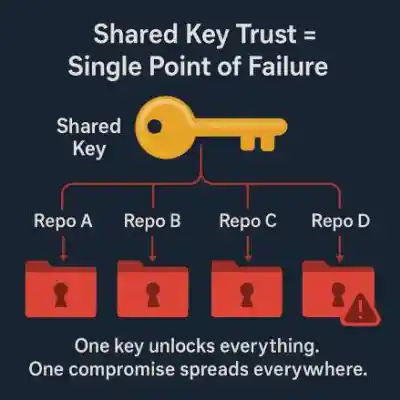

This isn't a one-off. Whether it’s npm, PyPI, or VS Code, attackers are weaponizing these ecosystems because they know we don't audit plugins like we audit our own code. We treat them like "plug-and-play" tools, but they are actually small programs running with access to your workstation's environment variables.
How to Prevent Plugin-Based Security Breaches
Start treating IDE extensions like third-party dependencies. If you can’t justify the risk, pull it out of your IDE.

- Audit your plugin list today. Remove anything you aren't using. Every plugin is a door.
- Verify the publisher. Don't trust the green checkmark; check the link to their actual GitHub repo or website. If it’s a random account with no history, skip it.
- Isolate keys. Use environment-specific credentials for AI services. Don't use your personal "master" key for every project.
- Monitor your API usage logs. If you see weird traffic or access from locations you’ve never been to, kill the keys instantly.
Those stolen AI keys were just the entry point. The real threat is that developer tools are now the perimeter. If your plugins aren't audited, your build pipeline isn't secure. That’s the reality.
Want more Linux security news, vulnerability analysis, and software supply chain updates? Subscribe to the LinuxSecurity Newsletter and get the latest threats, advisories, and expert insights delivered directly to your inbox.
Related Reading
Examines how attackers are shifting away from traditional exploits and increasingly targeting the software supply chain surrounding Linux development environments.
Explores how trust in repositories, packages, mirrors, signing infrastructure, and third-party code can become attack vectors across Linux environments.
Looks at how attackers increasingly target developer credentials, build systems, deployment infrastructure, and automation pipelines instead of applications directly.
 PREVIOUS

 NEXT
NEXT



Powered By

Linux Security - Your source for Top Linux News, Advisories, HOWTOs and Feature Releases
QUICK LINKS
subscribe to newsletters!
Like staying secure? So do we.
Sign up for updates, tips, and alerts!