


Security Vulnerabilities  security advisory critical
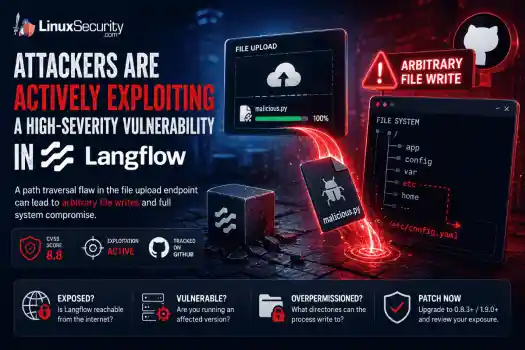
security advisory critical Attackers are actively exploiting a high-severity vulnerability in Langflow , an open-source platform used to build and run AI workflows. . The flaw turns a file upload into a filesystem write, allowing a user-controlled file to escape the application's intended upload directory and land in locations Langflow was never supposed to touch. The vulnerable upload endpoint permits path traversal through crafted filenames. From there, the impact depends heavily on how the platform is deployed. A...
 Jun 11, 2026
Vendors/Productssecurity advisory linux
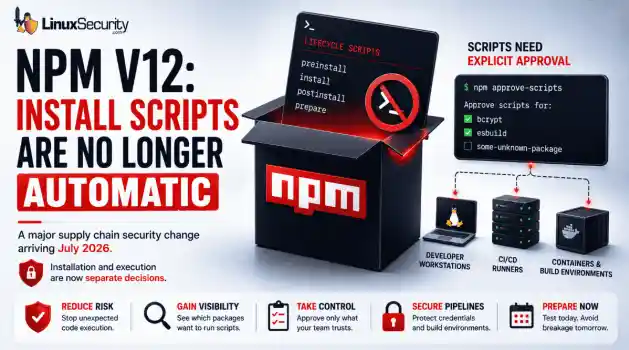
security advisory linux With npm v12 , dependency preinstall, install, and postinstall scripts will no longer execute automatically during package installation. Script execution will require explicit approval through new controls such as npm approve-scripts, with the change expected to arrive in July 2026. . The announcement targets a part of the software supply chain that has repeatedly appeared in package registry abuse, credential theft, and CI/CD compromise investigations. A single npm install could trigger code...
Jun 11, 2026

Security Vulnerabilities security advisory zero-day
security advisory zero-day CISA added CVE-2026-11645 to its Known Exploited Vulnerabilities catalog after Google confirmed active exploitation of the flaw. The bug sits in V8, the JavaScript engine behind Chrome and Chromium. . That's where this gets more interesting. Most coverage will focus on Chrome because that's where the patch landed. But the affected component is V8. Chromium relies on it. Electron relies on it. Plenty of desktop software Linux users interact with every day relies on it too, often without much...
Jun 10, 2026

Network Securitysecurity advisory networking
security advisory networking For years, IPv4 was the only proxy type that really mattered for anyone running automation off a Linux box. IPv6 was the protocol everyone said they’d migrate to, but almost nobody actually did. In 2026, that’s finally starting to shift. . The problem is that most admins stick with IPv4 out of habit. They know it; it’s what their tooling defaults to, and they don’t see a reason to change. Some are overpaying for addresses they don’t need. Others would quietly break their scrapers, scripts, or...
Jun 09, 2026
Network Securityopen-source python
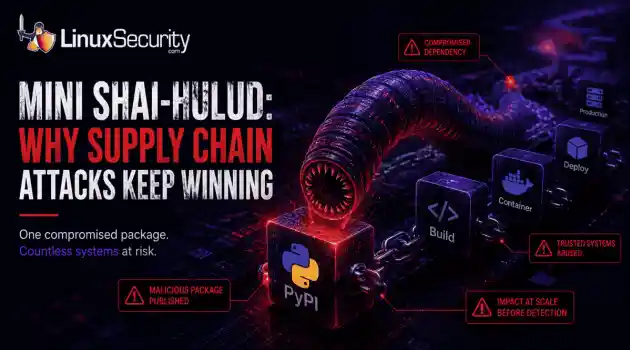
open-source python Researchers recently identified another wave of malicious packages on PyPI linked to the broader Mini Shai-Hulud campaign, a worm-like supply chain attack that spread through trusted software packages. On the surface, the packages looked no different from thousands of others published to the repository each week. . Instead of trying to break into a target network directly, the attackers hid malicious code inside software that developers were already using. A few downloads are all it takes....
Jun 09, 2026
 Refine news
X Clear Filters
Get the latest News and Insights
Get the latest Linux and open source security news straight to your inbox.
Community Poll
What got you started with Linux?
Loading...
Explore Latest Linux Security news
We found -3 articles for you...
77
 security advisorydata securityresource allocation
Cloud Linux Enhances E-Commerce Security and Performance
E-commerce businesses live and die by trust. A single data breach, a few minutes of downtime during peak traffic, or failure to meet compliance can sink customer confidence faster than any marketing campaign can build it back up. . For developers and sysadmins building resilient online stores, the operating system becomes the silent backbone – and Cloud Linux has made a serious reputation in this space. With its strong, stable performance and high-level security features, its popularity does make sense. But why does Cloud Linux matter so much for e-commerce, and how can it fit into the larger picture of scaling secure, performant online stores? Let’s dig deeper. The Case for Cloud Linux in E-Commerce Most online stores aren’t simply running a WordPress plugin with a credit card form anywhere. Modern stacks combine: A CMS (WordPress, Magento, or custom) Database servers (MySQL, PostgreSQL) Web servers (Apache, LiteSpeed) Payment gateways and fraud detection systems A CDN and caching layer for performance Essentially, the same underlying infrastructure is shared by multiple servers. A vanilla Linux distro can do the job, but Cloud Linux adds layers and features that are purpose-built for multi-tenant, high-availability hosting — exactly what online stores need. Key Strength: CageFS Cloud Linux isolates each tenant (or customer account) in its own Lightweight Virtual Environment (LVE). For e-commerce, this feature means one vulnerable plugin in a shared environment won’t open the door for an attacker to compromise neighboring stores. LVE also handles resource allocation, which matters for e-commerce stores since storefront performance is everything. Cloud Linux uses VLE to limit CPU, memory, and I/O usage on a per-tenant basis. So, if another site on the same server suddenly spikes traffic, your checkout page won’t slow down or stop working. Compliance and Data Security Payment Card Industry Data Security Standard (PCI DSS) compliance is amust for any site processing payments. Meeting PCI standards requires: Strong file system isolation Frequent kernel patching Source logging and auditing Cloud Linux already offers CageFS for isolation, meaning it prevents cross-user contamination, limiting one data breach from affecting another user. It also supports KernelCare live patching, allowing admins to apply critical security updates without rebooting. For e-commerce stores, where downtime means lost orders, this is a survival feature. Additionally, SELinux or AppArmor can be integrated easily, creating mandatory access controls that limit what processes can do, even if compromised. Combined with Cloud Linux’s tenant isolation, this layering results in a hardened environment that satisfies both auditors and security teams. Performance at Scale Traffic spikes are not what-ifs when it comes to running an online store. In fact, they are certainties in e-commerce, whether these spikes occur due to Black Friday or a random video going viral with your product in it. Cloud Linux addresses these scenarios with: Resource limits per tenant, avoiding noisy neighbor problems, and keeping LVEs stable. Optimized PHP versions, which are critical for platforms like Magento or WooCommerce. Better kernel tuning, keeping performance, stability, and security in top condition. For DevOps teams deploying containers, Cloud Linux works well with Kubernetes via KuberLogic. Resource limits from the LVE map naturally onto container orchestration policies, creating a consistent performance profile. Open Source Tools for Cloud Linux Linux admins in e-commerce often rely on a combination of: Lynis for system auditing and compliance checks OSSEC/Wazuh for log analysis and intrusion detection ModSecurity as a web application firewall (WAF) for Apache or Nginx Trivy or Clair for container image scanning These tools run cleanly in Cloud Linux environments, benefitting from resource allocation andkernel stability. AI-enhanced solutions and integrations can take it a step further, as the stability and isolation of Cloud Linux make it an ideal foundation for AI-driven security and monitoring layers. Future potential innovations with AI can offer improved intrusion detection, fraud alerts, and predictive scaling. In other words, while Cloud Linux itself isn’t an AI system, knowing how to learn AI can expand its functionality with intelligent, open-source layers that thrive in its environment. The Business Perspective From a business standpoint, Cloud Linux reduces two critical costs: Downtime costs are reduced as live patching and resource isolation prevent cascading failures. Support overhead due to fewer incidents caused by neighbors or plugin exploits. Combined with the ability to plug in AI-based fraud detection and other tools, stores can confidently scale without fear of unexpected, sudden, or unforeseen performance degradation or breaches. Why Cloud Linux Strengthens E-Commerce Security For e-commerce stores, choosing the right OS goes beyond aesthetics. It’s what affects the uptime, compliance, and trust. Cloud Linux offers a secure, resource-controlled, and performance-optimized base that solves many of the issues traditional Linux deployments face in multi-tenant hosting. And while the distro itself does the heavy lifting on isolation and stability , teams that understand the benefits of AI can build in smarter monitoring, predictive scaling, and fraud detection systems. The result is an e-commerce environment that’s not only hardened against today’s threats but adaptive enough for tomorrow’s. . Cloud Linux enhances e-commerce security with strong isolation and compliance measures, effectively segmenting accounts to prevent breaches and safeguarding data.. Cloud Linux, E-Commerce Security, Resource Management, Compliance Standards. . MaK Ulac
 Sep 24, 2025
•
Sep 24, 2025
• Server Security
77
 data protectionsystem administrationscalability
Benefits of Cloud Linux for E-Commerce: Security and Scalability Insights
Online stores are an essential part of the modern economy. Their stability, speed, and security directly affect a business's success. However, owners of online stores often have questions about the appropriate operating system. This is understandable, as they want modern solutions and high-quality service. . Among the many options, cloud Linux can be called the ideal solution. This operating system provides many advantages, especially for those working with e-commerce . If you want a suitable alternative, dedicated server hosting will be your faithful assistant. Many modern services offer access to safe and reliable equipment, enabling you to transform your business and succeed digitally. Benefits of Using Cloud Linux for Online Stores Cloud Linux has many advantages. It can make online store management more controlled and increase efficiency while strengthening eCommerce Security Stability and Fault Tolerance : Cloud technologies ensure continuous system operation, which is critical for sites with high loads. Powerful Protection : Cloud Linux provides strong security against external threats like viruses or hacking attempts . Scalability : It allows you to quickly scale your project as traffic grows without affecting the system's stability. Data Optimization : Cloud Linux is designed to handle large amounts of data efficiently, improving request processing speed and site loading time. Resource Management : Easily control the server's memory, processor, and other capabilities to distribute resources effectively. Such features are how the operating system Cloud Linux has many advantages. They are essential for the successful operation and growth of your business. Flexibility and Scalability in Cloud Linux An online store must function effectively so customers can comfortably use its offers. When pages load quickly, visitors do not have to wait long. As a result, they are happy and will visit the site repeatedly. If you want youronline store to operate exactly like this, you must worry about fast scalability and adaptability to changing market conditions. Cloud Linux perfectly copes with this task, offering high flexibility. You can add or remove resources quickly, and this is very important. This way, it’s possible to maintain your online store at the required level of performance. You will not be afraid of seasonal fluctuations in traffic. This is an excellent option for small businesses since, as they grow, you can easily switch to more powerful servers. Compare two scaling options: a physical server and a regional platform. If adding computing power becomes more difficult as the volume increases in the first case, you can do so in the cloud without unnecessary costs and complications. Advantages of Cloud Linux Scalability: Ability to increase server capacity at any time Resource customization depending on business needs Minimization of equipment costs Reduction of time for implementing new functions Capability to work with large volumes of data The privilege of Cloud Linux is that, despite the increased traffic, the system continues to work effectively at the required speed without failures or overloads. Thus, online store owners can be confident in the reliability of their platform even during peak loads. Ease of Management and Security The most critical aspects for online store owners are ease of management and high security. Cloud Linux offers flexible administration options and robust data protection tools. The system actively uses isolation and attack defense technologies to ensure the security of business and customer data. Cloud Linux can help improve security and ease of management in the following ways: Isolation of accounts and processes to prevent attacks Automatic updates and patches to avoid vulnerabilities Protection against DDoS attacks Reliable management of passwords and access rights Integration with anti-fraud systems to protect payments The Cloud Linux safe system provides more security guarantees than traditional solutions. Such features are essential for online stores, which often face fraud or data leakage threats. To use it, you need to set the proper settings. Save Your Budget with Cloud Linux Many online store owners are looking for savings. Traditional servers require significant investments in equipment, labor costs, and regular maintenance. However, Cloud Linux saves a lot on IT infrastructure and support personnel. The cloud technology platform works on a subscription model. You can more flexibly control your expenses by paying only for the features you use. Savings are available in the following methods: There’s no need for significant investments in physical equipment Reduced energy and maintenance costs Flexibility in choosing tariff plans Optimization of resource use No need for constant support The right approach to using Cloud Linux in an online store will allow you to save money greatly. This is excellent news because you can direct the saved budget to business development, marketing, improving customer service, and other areas. Final Thoughts Cloud Linux is the preferred solution for online retailers. The solution has a lot of strengths, including excellent security, required performance, flexibility, and scalability. The system has a particular appeal for companies because it is economical and easy to use. By leveraging Cloud Linux, businesses can ensure seamless operations even during peak traffic periods while maintaining robust security and cost-efficiency. The ability to scale resources efficiently provides online store owners with long-term stability and adaptability to market changes. You need to correctly select the host of your business. Investigate the options and find the best offer that will optimize the operation and maximize the returns. . Among the many options, cloud Linux can be called the ideal solution. This operating system provides. online, stores,essential, modern, economy, their, stability, speed, security. . MaK Ulac
Feb 26, 2025
•
Server Security


Get the latest News and Insights
Get the latest Linux and open source security news straight to your inbox.
Community Poll
What got you started with Linux?
Search Topics
Powered By

Linux Security - Your source for Top Linux News, Advisories, HOWTOs and Feature Releases
QUICK LINKS
subscribe to newsletters!
Like staying secure? So do we.
Sign up for updates, tips, and alerts!
Discover faster search, smarter navigation, and deeper Linux security insights. Read More