Explore top 10 tips to secure your open-source projects now. Read More
×



Server Security data privacy automation
data privacy automation Every system admin has lived through the same Monday morning ritual. A queue of forty tickets, half of them password resets, permission errors, or disk space warnings that any experienced technician could resolve in under two minutes. The other half require actual judgment. For years, automation promised that software would eventually sort the two apart on its own. That promise is now being tested in production Linux environments. . Early results are reshaping how IT teams think about tier-1...
 Jul 17, 2026

Privacydata collection automation
data collection automation You're running a web scraping project to collect pricing data from e-commerce sites. You set up a pool of datacenter proxies, launch your scripts, and within minutes — banned . CAPTCHAs everywhere. Your data pipeline stops before it really begins. . It's a frustrating scenario that plays out daily in ad verification, market research, and multi-account management. The website doesn't know you're doing legitimate research or monitoring. It just sees traffic coming from IP ranges it recognizes as...
Jul 17, 2026

Security Trends security advisory social engineering
security advisory social engineering Business Email Compromise used to be a numbers game — mass-blasted emails, broken English, an obvious "URGENT WIRE TRANSFER" subject line. That era is over. Generative AI has turned BEC into a tailored, low-noise operation that mimics writing style, voice, and even video presence. This piece looks at what's actually changed under the hood, what defenders are testing in response, and why so many organizations are still structurally unprepared for it. . The Infrastructure Problem Nobody Wants to...
Jul 17, 2026

Security Trends cybersecurity Linux documentation
cybersecurity Linux documentation Linux operating systems have gained prominence due to their stability, adaptability, and excellent security options. In the case of developing documentation, designing cybersecurity dashboards, or educational material, visuals are of vital importance when it comes to making things clear. The use of icons allows one to understand the message regarding alerts, authorization, encryption, authentication, or the state of the system just by looking at the visual cue without having to read long...
Jul 17, 2026
Security Vulnerabilities security advisory linux distribution
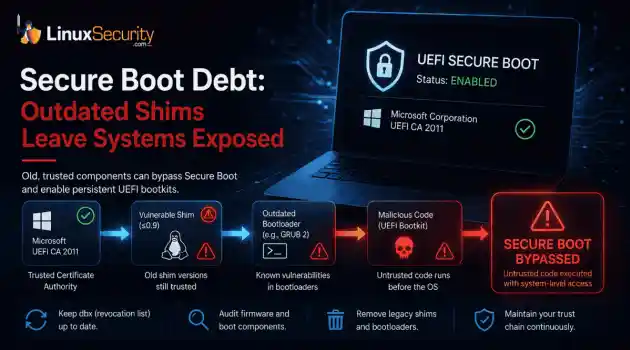
security advisory linux distribution ESET researchers identified 11 old and forgotten Linux UEFI shim bootloaders at versions 0.9 and below that can be used to bypass UEFI Secure Boot on any UEFI-based machine that trusts Microsoft’s Microsoft Corporation UEFI CA 2011 third-party certificate authority, regardless of the installed operating system (OS). Reported shims can be exploited to execute untrusted code during system boot, enabling attackers to deploy malicious UEFI bootkits even on systems with UEFI Secure Boot enabled.....
Jul 16, 2026
 Refine news
X Clear Filters
Get the latest News and Insights
Get the latest Linux and open source security news straight to your inbox.
Community Poll
Is continuous patching actually viable?
Loading...
Explore Latest Linux Security news
We found 143 articles for you...
77
 security advisorydata securityresource allocation
Cloud Linux Enhances E-Commerce Security and Performance
E-commerce businesses live and die by trust. A single data breach, a few minutes of downtime during peak traffic, or failure to meet compliance can sink customer confidence faster than any marketing campaign can build it back up. . For developers and sysadmins building resilient online stores, the operating system becomes the silent backbone – and Cloud Linux has made a serious reputation in this space. With its strong, stable performance and high-level security features, its popularity does make sense. But why does Cloud Linux matter so much for e-commerce, and how can it fit into the larger picture of scaling secure, performant online stores? Let’s dig deeper. The Case for Cloud Linux in E-Commerce Most online stores aren’t simply running a WordPress plugin with a credit card form anywhere. Modern stacks combine: A CMS (WordPress, Magento, or custom) Database servers (MySQL, PostgreSQL) Web servers (Apache, LiteSpeed) Payment gateways and fraud detection systems A CDN and caching layer for performance Essentially, the same underlying infrastructure is shared by multiple servers. A vanilla Linux distro can do the job, but Cloud Linux adds layers and features that are purpose-built for multi-tenant, high-availability hosting — exactly what online stores need. Key Strength: CageFS Cloud Linux isolates each tenant (or customer account) in its own Lightweight Virtual Environment (LVE). For e-commerce, this feature means one vulnerable plugin in a shared environment won’t open the door for an attacker to compromise neighboring stores. LVE also handles resource allocation, which matters for e-commerce stores since storefront performance is everything. Cloud Linux uses VLE to limit CPU, memory, and I/O usage on a per-tenant basis. So, if another site on the same server suddenly spikes traffic, your checkout page won’t slow down or stop working. Compliance and Data Security Payment Card Industry Data Security Standard (PCI DSS) compliance is amust for any site processing payments. Meeting PCI standards requires: Strong file system isolation Frequent kernel patching Source logging and auditing Cloud Linux already offers CageFS for isolation, meaning it prevents cross-user contamination, limiting one data breach from affecting another user. It also supports KernelCare live patching, allowing admins to apply critical security updates without rebooting. For e-commerce stores, where downtime means lost orders, this is a survival feature. Additionally, SELinux or AppArmor can be integrated easily, creating mandatory access controls that limit what processes can do, even if compromised. Combined with Cloud Linux’s tenant isolation, this layering results in a hardened environment that satisfies both auditors and security teams. Performance at Scale Traffic spikes are not what-ifs when it comes to running an online store. In fact, they are certainties in e-commerce, whether these spikes occur due to Black Friday or a random video going viral with your product in it. Cloud Linux addresses these scenarios with: Resource limits per tenant, avoiding noisy neighbor problems, and keeping LVEs stable. Optimized PHP versions, which are critical for platforms like Magento or WooCommerce. Better kernel tuning, keeping performance, stability, and security in top condition. For DevOps teams deploying containers, Cloud Linux works well with Kubernetes via KuberLogic. Resource limits from the LVE map naturally onto container orchestration policies, creating a consistent performance profile. Open Source Tools for Cloud Linux Linux admins in e-commerce often rely on a combination of: Lynis for system auditing and compliance checks OSSEC/Wazuh for log analysis and intrusion detection ModSecurity as a web application firewall (WAF) for Apache or Nginx Trivy or Clair for container image scanning These tools run cleanly in Cloud Linux environments, benefitting from resource allocation andkernel stability. AI-enhanced solutions and integrations can take it a step further, as the stability and isolation of Cloud Linux make it an ideal foundation for AI-driven security and monitoring layers. Future potential innovations with AI can offer improved intrusion detection, fraud alerts, and predictive scaling. In other words, while Cloud Linux itself isn’t an AI system, knowing how to learn AI can expand its functionality with intelligent, open-source layers that thrive in its environment. The Business Perspective From a business standpoint, Cloud Linux reduces two critical costs: Downtime costs are reduced as live patching and resource isolation prevent cascading failures. Support overhead due to fewer incidents caused by neighbors or plugin exploits. Combined with the ability to plug in AI-based fraud detection and other tools, stores can confidently scale without fear of unexpected, sudden, or unforeseen performance degradation or breaches. Why Cloud Linux Strengthens E-Commerce Security For e-commerce stores, choosing the right OS goes beyond aesthetics. It’s what affects the uptime, compliance, and trust. Cloud Linux offers a secure, resource-controlled, and performance-optimized base that solves many of the issues traditional Linux deployments face in multi-tenant hosting. And while the distro itself does the heavy lifting on isolation and stability , teams that understand the benefits of AI can build in smarter monitoring, predictive scaling, and fraud detection systems. The result is an e-commerce environment that’s not only hardened against today’s threats but adaptive enough for tomorrow’s. . Cloud Linux enhances e-commerce security with strong isolation and compliance measures, effectively segmenting accounts to prevent breaches and safeguarding data.. Cloud Linux, E-Commerce Security, Resource Management, Compliance Standards. . MaK Ulac
 Sep 24, 2025
•
Sep 24, 2025
• Server Security
214
 data securitycybersecuritythreat detection
How Edge Computing Secures Business Data from Cyber Threats
With the average number of weekly cyberattacks per company rising by 75% in Q3 of last year, the pursuit of effective cybersecurity is relentless in the ever-evolving threat landscape. And while the Internet of Things (IoT) may have introduced us to smart, hyperconnected devices, it’s also introduced a unique set of cybersecurity risks. . Luckily, there are ways to counteract these risks, such as using edge computing over cloud computing. But what is edge computing? In this article, we’ll look at what it is and discuss how implementing edge computing and edge security best practices can protect your business against data leaks, attacks, and unauthorized access. What is Edge Computing? Computing at the edge is the practice of processing, analyzing, and storing data near the source of generation—i.e., the “edge” of the network—rather than centralized cloud data centers. By bringing data closer to the location it’s being used, you reduce the distance it has to travel. This has numerous benefits, such as reducing latency, bandwidth use, and network congestion. For example, a smart warehouse might use edge devices like RFID tags and sensors to track the movement of inventory. Rather than have this data travel to and from a cloud data center, edge computing will process the data locally, either at or near the warehouse network. This allows for real-time analysis of inventory levels and, in turn, faster decision-making. IoT, Edge Computing, and Cybersecurity The IoT describes a network of physical “smart” devices and appliances that are enriched with sensors, software, and other technologies to communicate and exchange data with other devices. Smart cities, industrial IoT sensors, watches, health monitors, point-of-sale (POS) terminals—the list goes on and on, spanning vast consumer and business areas. This has caused the volume of interconnected devices across networks—and, in turn, the volume of data—to explode. Industries like healthcare andfinance handle particularly sensitive data, making them especially alluring to cybercriminals. In a single year, both industries reported a total of 1553 data compromises—and that’s just the attacks that were successful. All this sensitive information puts businesses at risk of data privacy breaches and cyberattacks. IoT devices are a prime target for threat actors, with IoT malware attacks increasing by 400% between 2022 and 2023. And, the more data you have, the harder it is to secure. So, rather than a cloud-only approach, businesses are integrating edge computing into their architecture. Luckily, the potential use cases of edge computing in IoT are abundant. How Edge Computing Enhances Data Security Let’s take a closer look at how edge computing hardens data security and reduces risk. Reduces Risks During Data Transmission The further your data has to travel, the more vulnerable it is to threats. Cybercriminals can secretly intercept and eavesdrop on in-transit data streams, allowing them to steal, redirect, or manipulate the data. In cloud models, data must travel long distances to and from the centralized data center, sometimes traversing entire continents. This leaves many opportunities for attackers to strike. Plus, when data is transmitted over long distances, it may pass any number of intermediary devices. This includes routers, switches, gateways, and hubs. Every touchpoint poses its own risk of potential exploitation, enlarging your attack surface and putting your data at risk of unauthorized access numerous times over. But in edge computing, the data is processed locally. This means that travel time and distance — and, in turn, any opportunities for interception — are significantly reduced. And, since data doesn’t need to encounter nearly as many intermediary devices en route, your attack surface is reduced. Enables Rapid Threat Detection and Response Edge computing enables near-real-time data processing and analysis, speeding up threatdetection efforts. With AI-integrated edge computing models, platforms can execute threat detection monitoring locally instead of waiting for data to travel to the central cloud server and back to the source. This means it can rapidly detect anomalies and instantly alert you to unusual activity, empowering rapid responses. This is particularly essential for fraud detection. For example, a bank or financial service can leverage edge computing to instantly analyze transaction data from POS systems, mobile banking apps, and ATMs. It can monitor patterns, identify anomalies, and pinpoint suspicious transactional behavior without the delays caused by long-distance data transmission. This isn’t just something enterprises can do — the best payment processor for small businesses should have similar capabilities. As a result, you can detect fraudulent activities like account takeovers and credit card fraud, and respond before they do any damage by immediately halting transactions and/or notifying the cardholder. Secures Data Through Decentralization Centralizing data has its benefits, including improved accessibility, consistency, and collaboration. However, widespread centralization can put sensitive data at risk of large-scale attacks. Placing sensitive data in centralized cloud servers increases its accessibility, providing more opportunities for internal and external attacks. Plus, threat actors are more likely to target centralized servers because they hold data in abundance—they’re essentially treasure troves for cybercriminals. By adopting edge computing, you decentralize sensitive data so that it's not all held in one location. If a threat actor does infiltrate your edge device, they’ll have access to a much smaller and incomplete pool of data. Edge Security Best Practices Of course, you can’t just implement edge computing and assume security is covered. There are still risks, and you need to follow key best practices to ensure multi-level data protection. Remember,as well as the below practices, to check the security policies of any services you use, such as your ESP (email service provider) or phone system. Data Encryption Encrypting data at rest (where it’s stored) and in transit (while traveling over networks) is critical. Encrypting data in transit: Data should be encrypted any time it moves between servers and devices, even if it's only travelling a short distance. Transport Layer Security (TLS) is an encryption protocol that secures communications in transit. Encrypting data at rest: IoT devices are at risk of theft and compromise, so they must be encrypted at rest to prevent hackers from reading and stealing information if a device is lost, stolen, or compromised. Strong encryption algorithms like Advanced Encryption Standard (AES) offer reliable security. Multi-Factor Authentication Multi-factor authentication (MFA) uses two or more verification factors to confirm a user’s identity. So, along with a password, it might also use biometrics, email codes, or push notifications. MFA is often used alongside risk-based authentication, which involves analyzing contextual and behavioral data to verify a user’s identity and/or identify suspicious activity. For example, it looks at the geo-location of where the device is being used, what time of the day/week it’s being used, and whether the connection is via a public or private network. So, if a user is trying to access information in a country they don’t usually reside in, or outside of their usual office hours, it could be flagged as suspicious. Microsoft fends off over 1,000 password attacks per second, and 99.9% of those that become compromised don’t have multifactor authentication. This highlights the importance of MFA in an age where simple passwords are easy to crack. Data sourced from Microsoft , image created by writer Maintaining software integrity and security One of the biggest risks posed by edge computing is that it’s designed tosupport a wide and abundant range of devices. The nuances of the different platforms or operating systems they run on can complicate the task of maintaining software integrity and security. To manage this, make sure to: Perform regular vulnerability testing across all edge devices to identify and remedy weak points. Check for device certificates and manage them appropriately Regularly update software to patch vulnerabilities, making sure to secure the process using over-the-air (OTA) updates, digital signatures, and TLS encryption. Network Segmentation Network segmentation splits your network into smaller segments. In edge computing, this typically means isolating your IoT devices from the rest of your network. Segmentation boosts network security by limiting how far attacks can spread. If one of your systems is affected by a malware attack, network segmentation means that it wouldn’t be able to spread to the other systems, minimizing damage and protecting sensitive data. Zero Trust Architecture Zero trust security operates on a clear principle: “never trust, always verify”. Every edge device must be authorized and authenticated every time it makes a request, regardless of its location in the network or its previous authentication status. Least-privilege access is a core part of zero-trust tools. With this, strict user permissions are used to make sure users only get the minimum access required to complete their tasks. That way, if a threat actor were to infiltrate the network, their exposure to sensitive data would be limited by the user's permission. Let’s say you’re looking into how to sell on Amazon without inventory. Not every member of your team will need access to customer data, so by minimizing access to your CRM, you can reduce your threat surface. Other core principles include continuous verification throughout sessions and risk-based authentication. Zero trust should also be encouraged at the user level. For example, zero-trust email securityaims to verify every email to prevent phishing attacks and other nefarious activities. Integrate AI detection tools with employee training to help them spot email spoofing, spear phishing, and other attacks. Edge Computing and the Future of Data Security Like cloud computing, edge computing does come with security risks. But when used as a strategic asset to manage the data abundance produced by IoT devices, its decentralization helps to harden your architecture against threats. By bringing data processing closer to the source, you minimize how far data has to travel to protect it from interception. You can reduce your attack surface, enable faster threat detection and response, and ultimately limit hackers’ exposure to sensitive data. To really benefit from edge computing security, implement best practices like data encryption, multi-factor authentication, and network segmentation. And finally, make sure to train your staff on their role—even the best security systems can suffer from human error. . Adopting decentralized computing strategies can bolster your organization's data protection in the face of increasing online security risks.. edge security, data protection, IoT devices, computing technology, cybersecurity measures. . MaK Ulac
Jul 12, 2025
•
IoT Security

82
 data securityencryptionprivacy law
ECHR Rules Against Backdoor Encryption And Data Surveillance Laws
The European Court of Human Rights (ECHR) has made a major decision , ruling that laws requiring weakened encryption and extensive data retention violate the European Convention on Human Rights. In a recent case involving Russia's demand for Telegram to provide encryption assistance, the Court stated that such legislation cannot be considered necessary in a democratic society. . This landmark ruling has significant implications for data surveillance legislation across Europe, including the proposed Chat Control and the UK government's Online Safety Act, which aim to weaken encryption for the purpose of scanning digital communications for illegal content. What Are the Security & Privacy Implications of This Decision? The ECHR's decision carries profound implications for security practitioners and privacy-conscious individuals. The ruling highlights the importance of encryption for maintaining privacy and security in a democratic society. It questions the legitimacy of governments' attempts to weaken encryption for the sake of law enforcement and surveillance, as it ultimately compromises the protection and privacy of all users. Weakened encryption could have significant security consequences. Ransomware attacks targeting operational technology (OT) systems, such as those used in power plants and water treatment facilities, may become more prevalent. While traditional ransomware attacks have primarily focused on financial gain, the prospect of ransomware specifically designed to disrupt critical infrastructure's operational capabilities poses a new and alarming threat. Criminal groups, as well as nation-state attackers, could exploit these vulnerabilities, potentially causing physical harm and societal chaos. These implications prompt critical questions about the long-term consequences of backdoored encryption. Will weakened encryption actually lead to improved security, or will it create more vulnerabilities for criminals to exploit? Moreover, will governments be able to maintain control overthe technology needed to exploit these backdoors, or are they unintentionally opening the door for hostile actors to wreak havoc? As security practitioners, we must consider the potential impact on our work and be mindful of the broader implications. The ECHR's ruling becomes a rallying point for privacy advocates and those who understand the importance of encryption in safeguarding individual freedoms. It empowers us to push back against intrusive surveillance measures and fight for strong encryption standards. Additionally, this ruling resonates beyond legal frameworks and poses broader challenges for international cooperation on data security and privacy. With varying approaches to encryption laws across different countries, achieving a harmonized approach becomes more complex. This fragmentation can lead to confusion and exploitation by malicious actors seeking refuge in countries with lax encryption regulations. Our Final Thoughts on The ECHR's Decision The ECHR's decision on backdoored encryption serves as a critical reminder of the significance of encryption in safeguarding our privacy and security. It challenges governments, security practitioners, and the technology industry to balance collective safety and individual rights. As security professionals, it is our responsibility to advocate for strong encryption, subvert unwarranted surveillance measures, and ensure the protection of our digital infrastructure and personal data. . This landmark ruling has significant implications for data surveillance legislation across Europe, i. european, court, human, rights, (echr), major, decision, ruling, requiring. . Brittany Day
Feb 16, 2024
•
Government
81
 data securityweb developmentonline privacy
P3P Privacy Standard Adoption Challenges in Web Development
Six months after its recommendation as an Internet standard, a major privacy initiative is entering an awkward adolescence as software heavyweights adopt it and individual Web sites leave it to languish. . . . Six months after its recommendation as an Internet standard, a major privacy initiative is entering an awkward adolescence as software heavyweights adopt it and individual Web sites leave it to languish . In ordinary economic times, a protocol like the World Wide Web Consortium's Platform for Privacy Preferences (P3P) might have a hard time gaining acceptance in the marketplace, as mainstream consumers generally exhibit lax security practices when it comes to their own online privacy. But in an economic downturn, the privacy protocol also is subject to disinterest by Web developers with scarce resources The link at news.com is no longer available. . Three quarters past its endorsement, X4Y faces hurdles in uptake as platforms allow it to stagnate due to financial obstacles.. Privacy Standard, Web Development, Data Security, Protocol Adoption, Online Privacy. . LinuxSecurity.com Team
Nov 02, 2023
•
Privacy
67
data securityresearch paperfinancial dataFC '02: Call For Papers On Financial Data Security And Digital Commerce
Original papers are solicited on all aspects of financial data security and digital commerce for submission to the Sixth Annual Conference on Financial Cryptography (FC '02). FC '02 brings together researchers in the financial, legal, cryptologic, and data security fields to foster cooperation and exchange of ideas.. . . . Original papers are solicited on all aspects of financial data security and digital commerce for submission to the Sixth Annual Conference on Financial Cryptography (FC '02). FC '02 brings together researchers in the financial, legal, cryptologic, and data security fields to foster cooperation and exchange of ideas. . Original papers are solicited on all aspects of financial data security and digital commerce for sub. original, papers, solicited, aspects, financial, security, digital, commerce. . LinuxSecurity.com Team
Oct 10, 2023
•
Cryptography
67
data securitysecure communicationopen source toolSecure Your Files with Cow-Encryptor on a Linux System Easily
Secure your documents, notes, and plaintext passwords on Linux by turning the text into a series of "moos" using Cow-encryptor. . Encrypting your documents is a serious endeavor that keeps your secrets hidden from prying eyes. Add some farmyard levity to your text files with Cow-encryptor: a lightweight app that transforms words into the nonsensical lowing of a dairy herd. Encryption is a way of scrambling data, that makes it unreadable without the decryption key or password, and you use it to make sure that your personal documents, financial information, and your secret diary remain inaccessible to anyone but you. . Protect your files on Linux with Bovine-crypt, transforming your words into playful tones while concealing your confidential information.. Linux Document Encryption, Secure Notes Tool, Open Source Encryption. . LinuxSecurity.com Team
May 06, 2023
•
Cryptography
209
 data securitydata protectionoperating system
Data Security Challenges And Solutions For Linux Systems
Let’s look at what data security looks like on Linux and the often-exaggerated claims that accompany it. . Linux has come a long way since its humble beginnings as Finnish student Linus Torvalds’ pet project. With over 27.8 million lines of code to its name and its rise as the OS of choice for servers, public cloud, and supercomputers, Linux has earned an unmistakable spot among the top operating systems in the world today. Not only that, but the world’s most popular mobile operating system, Android, also uses a Linux kernel. In the workplace, Linux has long been developers’ go-to OS in the workplace and has fared better in the technical rather than the business environment. However, with most organizations now requiring an IT department and digitalization efforts pushing them to develop their own tools and applications often to serve their particular needs, many company networks now include computers running on Linux. The link for this article located at ELE Times is no longer available. . Explore the complexities of securing Linux systems, revealing misconceptions, obstacles, and robust defensive strategies.. Linux Data Protection, Security Challenges, Operating System Security. . Brittany Day
Jun 08, 2022
•
Security Trends
83
 data securitysecurity researchthreat detection
Undetected RotaJakiro Linux Malware Exfiltrates Sensitive Data
Researchers have discovered a dangerous strain of Linux malware Dubbed " RotaJakiro " that went undetected for three years, enabling its operators to harvest and exfiltrate sensitive data from infected systems. . A previously undocumented Linux malware with backdoor capabilities has managed to stay under the radar for about three years, allowing the threat actor behind to harvest and exfiltrate sensitive information from infected systems. Dubbed " RotaJakiro " by researchers from Qihoo 360 NETLAB, the backdoor targets Linux X64 machines, and is so named after the fact that "the family uses rotate encryption and behaves differently for root/non-root accounts when executing." The link for this article located at The Hacker News is no longer available. . Uncover the cunning Windows virus SneakyRodent that remained hidden for over three years, quietly siphoning off confidential information.. Linux Malware,RotaJakiro,Data Exfiltration,Data Security,Malware Threat. . LinuxSecurity.com Team
Apr 29, 2021
•
Hacks/Cracks

Get the latest News and Insights
Get the latest Linux and open source security news straight to your inbox.
Community Poll
Is continuous patching actually viable?
Search Topics
Powered By

Linux Security - Your source for Top Linux News, Advisories, HOWTOs and Feature Releases
QUICK LINKS
subscribe to newsletters!
Like staying secure? So do we.
Sign up for updates, tips, and alerts!