Audit Linux privileges now to limit compromise, escalation, and system-wide damage. Review Linux Privileges×


Security Vulnerabilities  cisa kev vulnerability prioritization
cisa kev vulnerability prioritization Most Linux teams don't struggle to find vulnerabilities anymore. They struggle to decide which ones deserve attention first. Between daily scanner results, vendor advisories, and hundreds of new CVEs each month, the challenge isn't visibility—it's prioritization. . To solve this, organizations typically lean on the National Vulnerability Database (NVD) and CISA’s Known Exploited Vulnerabilities Catalog. But these aren’t competing lists. They answer two entirely different questions. While the...
 Jul 22, 2026

Desktop Securitysecurity advisory vulnerability
security advisory vulnerability GNOME is officially shortening its standard vulnerability disclosure window from 90 days to 30 days, a change that impacts upstream maintainers, downstream Linux distributions, and system administrators in how they handle software vulnerabilities. The policy shift, announced by long-time security coordinator Michael Catanzaro , addresses modern software patching realities and a growing influx of automated submissions. . Because GNOME is the default desktop environment on several major Linux...
Jul 21, 2026

Security Vulnerabilities security advisory moderate
security advisory moderate For organizations that run a self-hosted Git platform, it’s no longer just about hosting static code repositories. Today, Git servers are responsible for deployment pipelines, API tokens, SSH keys, package repositories, and the automation scripts that push code directly. Confirm that the upgrade addresses known vulnerabilities but also provides production environments. . That makes them trusted systems within the development environment and attractive targets for attackers looking to move...
Jul 20, 2026

Server Securitydata privacy automation
data privacy automation Every system admin has lived through the same Monday morning ritual. A queue of forty tickets, half of them password resets, permission errors, or disk space warnings that any experienced technician could resolve in under two minutes. The other half require actual judgment. For years, automation promised that software would eventually sort the two apart on its own. That promise is now being tested in production Linux environments. . Early results are reshaping how IT teams think about tier-1...
Jul 17, 2026

Privacydata collection automation
data collection automation You're running a web scraping project to collect pricing data from e-commerce sites. You set up a pool of datacenter proxies, launch your scripts, and within minutes — banned . CAPTCHAs everywhere. Your data pipeline stops before it really begins. . It's a frustrating scenario that plays out daily in ad verification, market research, and multi-account management. The website doesn't know you're doing legitimate research or monitoring. It just sees traffic coming from IP ranges it recognizes as...
Jul 17, 2026
 Refine news
X Clear Filters
Get the latest News and Insights
Get the latest Linux and open source security news straight to your inbox.
Community Poll
Should Linux servers automatically install security updates?
Trending News
Loading...
Explore Latest Linux Security news
We found -2 articles for you...
210
 security advisoryauthenticationopenssh
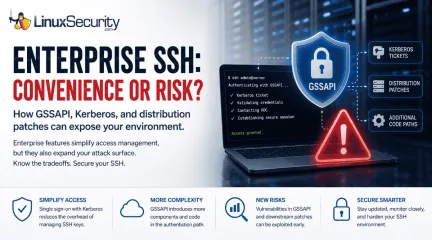
The Hidden Cost of Enterprise SSH Authentication
We often view OpenSSH security updates through the lens of standard patch management. When a new CVE hits, we scramble to update, check our versions, and return to business as usual. But recent vulnerabilities tied to distribution-added OpenSSH GSSAPI patches are a reminder that the danger doesn't always lie in the core code; it often resides in the "convenience" features we layer on top. . These recent issues shouldn't just trigger an apt upgrade or dnf update; they should trigger a configuration audit. As our infrastructure has grown more complex, we have enabled features like GSSAPI—designed to simplify enterprise management—that have quietly expanded our attack surface in ways that standard hardening guides rarely address. Why Enterprises Enable GSSAPI SSH keys work well until your environment starts growing. A handful of Linux servers is easy enough to manage, but hundreds or thousands are a different story. Keys need to be rotated, access needs to be revoked when employees leave, and every new system has to be brought into the process. That's where GSSAPI comes in. Organizations already using Kerberos can let users authenticate with their existing domain credentials instead of distributing and maintaining SSH keys on every server. For many enterprises, that's a practical decision rather than a security decision. The catch is that SSH is no longer handling a relatively simple login. It now has to work with Kerberos tickets and the software that supports them. Recent GSSAPI-related vulnerabilities are a reminder that every additional authentication feature adds more code that has to process data before a session is established. That doesn't mean GSSAPI is unsafe. It means features that make administration easier also deserve the same level of review as the rest of your SSH configuration. There's another detail that's easy to miss. Many Linux distributions ship OpenSSH with downstream patches to support enterprise environments. Those additions aren't part of the upstream OpenSSHcode maintained by the OpenBSD project, so administrators should pay attention to distribution-specific security advisories rather than assuming every OpenSSH issue affects every system the same way. Why "More Secure" Isn't "Less Risky" The core insight here is that complexity is the enemy of security. We implement GSSAPI to avoid the human-centric failure of weak passwords, but we trade that for the system-centric failure of a complex, high-privilege service boundary. If your environment doesn’t require SSO via Kerberos, you are paying a security tax for a convenience you aren't actually using. Even if you do require it, you need to treat the GSSAPI configuration with the same level of paranoia you apply to your authorized_keys files. The Audit: What Should You Be Looking For? If you are running an enterprise Linux fleet, the recent OpenSSH updates serve as a forcing function to look beyond the patch. Ask yourself the following: Is GSSAPI actually necessary? For most standalone servers or small, static clusters, the answer is usually no. If you aren't actively using Kerberos for SSH authentication, explicitly set GSSAPIAuthentication no in your sshd_config. Are your "Forwarding" features justified? Features like GSSAPIDelegateCredentials no, AllowAgentForwarding no, and AllowTcpForwarding no are often left enabled by default out of habit. These provide lateral movement pathways for attackers who compromise an initial jump host. Is your authentication boundary siloed? In a modern "Zero Trust" architecture, we aim to minimize the trust we place in the server itself. Are you relying on the server to validate complex Kerberos tokens, or are you moving toward ephemeral, centrally signed SSH certificates? The Takeaway The latest OpenSSH updates are not just another entry in your vulnerability management dashboard—they are a critique of our collective preference for "easy" enterprise configuration. When you see a GSSAPI-related vulnerability in a changelog,don't just patch. Re-evaluate. Every feature you enable in sshd_config is an intentional decision to expand the scope of what an attacker can target. Before you restart that service, ask yourself: Am I configuring this for security, or am I just configuring it for convenience? Want more Linux security news, vulnerability analysis, and software supply chain updates? Subscribe to the LinuxSecurity Newsletter and get the latest threats, advisories, and expert insights delivered directly to your inbox. Related Reading How to Harden SSH on Linux After Disabling Password Authentication How to Detect Unauthorized SSH Key Usage on Linux Systems . OpenSSH updates highlight the importance of thorough configuration audits over standard patching practices.. OpenSSH updates, enterprise SSH risk management, GSSAPI configuration issues. . MaK Ulac
 Jul 06, 2026
•
Jul 06, 2026
• Security Vulnerabilities
209
 security awarenessmachine learningai security
AI Security Risks: Navigating Vulnerabilities in Machine Learning Projects
Does your company utilize AI or ML? Artificial intelligence and machine learning bring new vulnerabilities along with their benefits. Learn how several companies have minimized their risk in this informative CSO article: . When enterprises adopt new technology, security is often on the back burner. It can seem more important to get new products or services to customers and internal users as quickly as possible and at the lowest cost. Good security can be slow and expensive. Artificial intelligence (AI) and machine learning (ML) offer all the same opportunities for vulnerabilities and misconfigurations as earlier technological advances, but they also have unique risks. As enterprises embark on major AI-powered digital transformations, those risks may become greater than what we've seen before. AI and ML require more data, and more complex data, than other technologies. The algorithms used have been developed by mathematicians and data scientists and come out of research projects. Meanwhile, the volume and processing requirements mean that the workloads are typically handled by cloud platforms, which add yet another level of complexity and vulnerability. The link for this article located at CSO Online is no longer available. . Organizations frequently emphasize swift implementation of AI and ML technologies, yet safeguarding must remain a focal point within the intricacies involved.. AI Risk Management, Secure Machine Learning, Data Protection Strategies, Cloud Security Challenges. . Brittany Day
Sep 02, 2019
•
Security Trends

74
 network securityvulnerabilityconfiguration error
Dimension Data Study: 38% Of Enterprise Devices Exposed To Attacks
Nearly 40 percent of enterprise network devices exhibit some form of security vulnerability, according to a study published today.. Dimension Data, a global IT solutions and services provider, today announced the findings from its Network Barometer Report 2010, which compiles vulnerability information from the 235 network and security ssessments it performed for enterprises in 2009. According to the study, more than 38 percent of network devices assessed by Dimension Data -- including routers, switches, and gateways -- exhibited security vulnerabilities, exposing their organizations to external and internal security attacks. There was an average of 40.7 configuration best practice errors per network device, which increases the level of vulnerability, Dimension Data says. More than 17 of those configuration errors were directly related to security. The link for this article located at Dark Reading is no longer available. . A recent analysis by Dimension Data uncovers shocking figures regarding security weaknesses within enterprise network devices.. Network Security, IT Vulnerabilities, Configuration Management. . Anthony Pell
Apr 22, 2010
•
Network Security

Get the latest News and Insights
Get the latest Linux and open source security news straight to your inbox.
Community Poll
Should Linux servers automatically install security updates?
Trending News
Search Topics
Powered By

Linux Security - Your source for Top Linux News, Advisories, HOWTOs and Feature Releases
QUICK LINKS
subscribe to newsletters!
Like staying secure? So do we.
Sign up for updates, tips, and alerts!