Overly broad permissions can turn one compromised account into a much larger security problem. Learn how to reduce unnecessary access, review privileges, and apply least privilege across modern Linux systems. Review Linux Privileges×



Desktop Security security advisory vulnerability
security advisory vulnerability GNOME is officially shortening its standard vulnerability disclosure window from 90 days to 30 days, a change that impacts upstream maintainers, downstream Linux distributions, and system administrators in how they handle software vulnerabilities. The policy shift, announced by long-time security coordinator Michael Catanzaro , addresses modern software patching realities and a growing influx of automated submissions. . Because GNOME is the default desktop environment on several major Linux...
 Jul 21, 2026

Security Vulnerabilities security advisory moderate
security advisory moderate For organizations that run a self-hosted Git platform, it’s no longer just about hosting static code repositories. Today, Git servers are responsible for deployment pipelines, API tokens, SSH keys, package repositories, and the automation scripts that push code directly. Confirm that the upgrade addresses known vulnerabilities but also provides production environments. . That makes them trusted systems within the development environment and attractive targets for attackers looking to move...
Jul 20, 2026

Server Securitydata privacy automation
data privacy automation Every system admin has lived through the same Monday morning ritual. A queue of forty tickets, half of them password resets, permission errors, or disk space warnings that any experienced technician could resolve in under two minutes. The other half require actual judgment. For years, automation promised that software would eventually sort the two apart on its own. That promise is now being tested in production Linux environments. . Early results are reshaping how IT teams think about tier-1...
Jul 17, 2026

Privacydata collection automation
data collection automation You're running a web scraping project to collect pricing data from e-commerce sites. You set up a pool of datacenter proxies, launch your scripts, and within minutes — banned . CAPTCHAs everywhere. Your data pipeline stops before it really begins. . It's a frustrating scenario that plays out daily in ad verification, market research, and multi-account management. The website doesn't know you're doing legitimate research or monitoring. It just sees traffic coming from IP ranges it recognizes as...
Jul 17, 2026

Security Trends security advisory social engineering
security advisory social engineering Business Email Compromise used to be a numbers game — mass-blasted emails, broken English, an obvious "URGENT WIRE TRANSFER" subject line. That era is over. Generative AI has turned BEC into a tailored, low-noise operation that mimics writing style, voice, and even video presence. This piece looks at what's actually changed under the hood, what defenders are testing in response, and why so many organizations are still structurally unprepared for it. . The Infrastructure Problem Nobody Wants to...
Jul 17, 2026
 Refine news
X Clear Filters
Get the latest News and Insights
Get the latest Linux and open source security news straight to your inbox.
Community Poll
Should Linux servers automatically install security updates?
Trending News
Loading...
Explore Latest Linux Security news
We found 32 articles for you...
74
 security advisorycriticalCisco
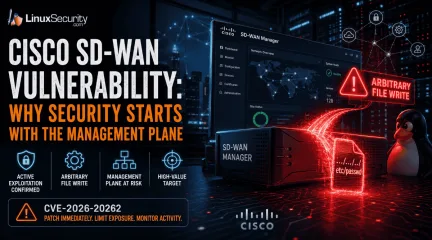
Cisco SD-WAN Vulnerability: Why Security Starts With the Management Plane
For those of us who live and breathe Linux and open-source infrastructure, the "management plane" is usually just a collection of familiar tools—SSH, APIs, and centralized orchestration. But in the world of proprietary enterprise networking, the management plane is often a black box. Cisco’s latest SD-WAN issue serves as a stark reminder that even when these proprietary systems rely on Linux components under the hood, their centralized nature makes them the ultimate high-value target. . Attackers don't need to break into every branch router when they can reach the "brain" that manages them. Cisco’s latest issue shows why SD-WAN security must start with the management plane, not just the edge device. Cisco SD-WAN Security at a Glance Metric Details Affected Product Cisco Catalyst SD-WAN Manager Vulnerability CVE-2026-20262 Type Arbitrary File Write (API Path Traversal) Risk Privilege escalation to root Status Active exploitation confirmed Recommended Action Audit exposure and patch immediately What Cisco Warned About in CVE-2026-20262 Cisco recently disclosed CVE-2026-20262 in a Cisco security advisory affecting Catalyst SD-WAN Manager. The vulnerability allows an authenticated user with write privileges to create or overwrite files through a vulnerable API. Cisco confirmed that successful exploitation can result in privilege escalation to root. This is a familiar scenario for Linux administrators: a file-handling flaw that allows an attacker to escape intended boundaries. In a standard Linux environment, we’d secure this with file system permissions, SELinux policies, or containerization. However, because SD-WAN Manager is a proprietary controller that sits at the center of your network fabric, the impact is magnified. It pushes policies, manages certificates, and provisions devices—it effectivelyacts as the root of trust for your entire WAN. Why Active Exploitation Matters Cisco confirmed active exploitation of this issue. This immediately moves the Cisco vulnerability out of the routine patch category. For those of us used to the rapid, transparent patching cycles of open-source projects, this is a call to action. Why Cisco SD-WAN Controllers Matter We build SD-WAN environments because manually managing individual Linux boxes at every branch is unsustainable. The controller centralizes that work. But centralization is a double-edged sword: Cisco SD-WAN security depends entirely on the integrity of this controller. The Linux Connection: These controllers often use vendor-hardened software stacks, and privileged access is restricted by the vendor rather than by the community. Centralized Authority: Catalyst SD-WAN Manager controls configuration, policy distribution, and device onboarding. The Operational Risk: Because the controller already knows your entire network topology, a compromise here is significantly more dangerous than a compromise of a standalone branch router. It is a fundamental part of your sd wan security checklist. Technical Breakdown: The File Write Vulnerability Cisco describes this as an arbitrary file write condition involving a vulnerable API and improper file handling logic. For anyone who has debugged an insecure Python or Go API, this is a classic path traversal vulnerability . How Path Traversal Changes the Risk While upload validation should keep user-controlled content inside expected directories, a path traversal vulnerability breaks that boundary. The Primitive: An attacker with write access can influence where the system places a file. Breaking Boundaries: Instead of staying in a controlled upload area, files can reach sensitive system paths—like /etc/ or service configuration directories. Management Implications: Because the platform runs critical services, a file written to the wrong location can change systembehavior after a restart, upgrade, or maintenance task. When these proprietary controls fail, sd wan security issues shift from simple application bugs into total control plane failures. FAQ: SD-WAN Security Concerns Is this a Cisco zero-day vulnerability? It is a critical flaw with active exploitation reported. Regardless of the label, the operational impact on management plane security remains the same. What are the primary sd wan security requirements? Beyond patching, you must restrict administrative access, remove unnecessary internet exposure, and monitor API activity. These are not just sd wan security best practices—they are the standard hardening steps we use in any Linux-based environment. Does this affect all Cisco products? No. This specifically affects the Catalyst SD-WAN Manage r. Always verify your specific version against the official Cisco security advisory before starting your maintenance window. Mitigation: Protecting the Management Plane The first priority is to patch. However, because this is an identity-dependent flaw, you must also address your sd wan security features and exposure. 1. Reduce Internet Exposure Management interfaces should never be broadly reachable. Restrict Access: Use VPNs, jump hosts, or dedicated management segments (like a hardened Linux gateway) to access the SD-WAN Manager. Firewalling: Ensure that general user networks cannot reach the administrative interface. 2. Audit Administrative Access SD-WAN security concerns often stem from overprivileged accounts. Review Privileges: Ensure only necessary users have write or netadmin-level privileges. Monitor Activity: Check logs for unexpected API activity, unauthorized file operations, or logins from unusual locations. 3. Maintain Vigilance For those tracking Cisco vulnerability news or Cisco security advisory news, the lesson is clear: management interfaces concentrate trust. If the management plane is exposed, the distinction betweenan authenticated user and a remote attacker becomes negligible. Final Takeaway This Cisco vulnerability matters because of where it lands. An arbitrary file write on a standalone system is a problem; an arbitrary file write on the platform managing your entire SD-WAN policy, certificates, and devices is a crisis. SD-WAN security and sd wan security both come back to management plane integrity. Patch the flaw, but do not stop there. Treat your controller like the critical, privileged infrastructure it is. Understanding Cisco SD-WAN Architecture This video provides a solid overview of the vManage management plane and how it sits at the heart of the SD-WAN architecture, which is critical for understanding the scope of this vulnerability. Want more Linux security analysis, vulnerability coverage, and threat intelligence? Subscribe to the LinuxSecurity Newsletter for the latest advisories, exploitation trends, and practical security guidance delivered straight to your inbox. Related Reading Securing Remote Access to Linux Servers: Best Practices for 2026 Mastering SSH for Secure Linux Remote Server Management How Secure Is Linux? Open Source, User Privilege, and Defense Tactics Explained Port Scanning Explained: Tools, Techniques, and Best Open-Source Port Scanners for Linux Exploring Linux Security Modules: SELinux vs AppArmor vs TOMOYO . Active exploitation in Cisco Catalyst SD-WAN Manager demands immediate action to mitigate the critical security risk.. Cisco SD-WAN vulnerability, management plane integrity, privilege escalation, arbitrary file write. . MaK Ulac
 Jun 16, 2026
•
Jun 16, 2026
• Network Security
210
 security advisorycriticalmemory leak
“MongoBleed” MongoDB Memory Leak Under Active Exploitation — Distros Lag on Updates
MongoBleed, tracked as CVE-2025-14847, is a high-severity flaw in MongoDB that allows unauthenticated attackers to read small pieces of a server’s memory. In simple terms, a remote client can ask MongoDB to process a malformed compressed message, and the database may respond with extra bytes it never intended to send. . Those extra bytes come from memory the process was already using. No login is required, and no unusual configuration is needed. The issue sits in a pre-authentication code path that most administrators never have reason to think about. In this article, we’ll look at what MongoBleed actually does, who is exposed, and why timing matters more than usual right now. We’ll also walk through what administrators can do while waiting for distribution-level fixes. Why This Matters Right Now MongoDB is rarely a standalone system. It usually lives behind web applications, API backends, SaaS platforms, and internal services that users rely on every day without knowing what database is underneath. When a MongoDB process leaks memory, it is not just database internals at risk. It can include credentials, tokens, query contents, or fragments of application data that happened to be in memory at the wrong moment. Researchers estimate that tens of thousands of MongoDB servers are reachable from the internet, with many more deployed on internal networks that assume a level of trust. That alone would make MongoBleed worth attention. What raises the stakes is that exploitation is already happening. Proof-of-concept code is public, scanning has been observed, and the barrier to entry is low. At the same time, upstream MongoDB patches are available while major Linux distributions such as Debian have not yet shipped fixed packages through their normal update channels. For administrators who depend on distro packages for stability and compliance , this creates a narrow window where the risk is real, the fix exists, and the official path forward is not fully in place yet. Dissecting theMongoBleed Memory Leakage Flaw This issue looks complex at first glance, but the underlying failure is easier to reason about once you slow it down. MongoBleed is not about corrupting data on disk or taking control of a system. It is about memory leakage caused by a mismatch between what MongoDB expects to receive and what it actually processes. Vulnerability Mechanics MongoDB supports compressed network traffic to reduce bandwidth and improve performance. When compression is used, each network message includes a small header that tells the server how large the message is supposed to be after it is decompressed. MongoDB uses that value to decide how much memory to allocate for the incoming request and how much data it expects to process. In vulnerable versions, MongoDB does not always verify that this declared size matches what is actually produced when the data is decompressed. An attacker can send a compressed message that advertises a larger decompressed size than the data really expands to. Internally, MongoDB allocates a response buffer based on that declared size. When the server later builds a reply, it assumes the buffer contains only valid request data. In reality, part of that buffer was never filled by the decompression step. Those unused sections can still contain whatever data happened to be in memory from earlier operations. Instead of clearing the buffer or rejecting the request, MongoDB may include those leftover bytes in its response. That is how unrelated memory ends up being sent back to the client. It is not random in the sense of being generated, but random in the sense that it reflects whatever the process was previously doing. This is why the issue is classified as memory leakage. The server is not choosing to disclose information. It is reusing memory without fully sanitizing it, and the protocol logic allows that memory to cross the network boundary before authentication ever happens. This is what actually happens when the exploit runs: The attacker opens anetwork connection to MongoDB. A specially crafted compressed message is sent. MongoDB processes it before authentication. The response includes unintended memory contents. There is no crash and often no obvious error. The database keeps running. That is part of what makes this class of bug dangerous. You often won’t get obvious symptoms. What gets exposed depends on timing and workload. It is not a clean dump of the database. It is fragments. But fragments add up. Over repeated requests, attackers can reconstruct meaningful data. Because this logic runs before authentication, no credentials are required. Any system that allows network access to MongoDB is potentially reachable. Affected Versions The issue affects multiple supported MongoDB release lines prior to patched versions. MongoDB 8.2 before 8.2.3 MongoDB 8.0 before 8.0.17 MongoDB 7.0 before 7.0.28 Default installations are vulnerable if zlib compression is enabled, which is common. Many administrators never touch compression settings, so the exposure often exists without anyone realizing it. Exploit Code and Proof of Concept Public proof-of-concept code is available and easy to adapt. It does not rely on rare conditions or fragile timing. That lowers the bar significantly. Once a PoC is public, scanning ramps up fast. Scanning increases. Opportunistic exploitation follows. Then targeted use appears, often looking for credentials or tokens rather than full database contents. MongoBleed fits that pattern closely. It is not flashy, but it is reliable enough to be useful, and that is what tends to drive real-world abuse. Understanding the Impact and Context of MongoBleed The impact of MongoBleed is less about dramatic failure and more about quiet exposure. Nothing breaks loudly. Systems stay online. Applications keep working. That is often when damage goes unnoticed the longest. Who’s Affected? The most obvious risk sits with self-hosted MongoDB deployments that are reachable over thenetwork, especially those exposed directly to the internet. But the boundary is wider than that. MongoDB is commonly embedded into: Web application backends handling user authentication and sessions API services storing tokens, keys, and request metadata Internal platforms assumed to be safe because they live “behind” other systems Managed services and SaaS products where MongoDB is one layer in a longer chain Researchers tracking exposure have identified at least 87,000 internet-accessible MongoDB servers, with some estimates placing the number much higher depending on scan methodology. That does not count internal deployments, which often reuse the same defaults and trust assumptions. Once you start to see this pattern, you realize the real audience is not just database administrators. It is anyone responsible for infrastructure that quietly depends on MongoDB behaving safely under unexpected input. Exploitability and Real-World Risk This flaw allows attackers to read sensitive data from MongoDB’s memory. It does not hand over shell access or database admin privileges. That distinction matters, but it does not make the risk small. What can leak includes: Database credentials cached in memory API keys and service tokens used by applications Query contents and partial documents Configuration values and internal logs Because the attack happens before authentication and requires little sophistication, scanning and exploitation are straightforward. Attackers do not need persistence. They can probe, extract what they can, and move on. This is the same dynamic seen in earlier memory disclosure bugs. One request might reveal nothing useful. Ten thousand requests later, patterns emerge. Secrets repeat. Context accumulates. That is how memory leakage becomes operational risk. Distribution Patching Status Upstream MongoDB has released fixed versions, and from a purely technical perspective, the problem is solved there. The friction appears atthe distribution layer. Some major distros may lag in shipping patched MongoDB builds through their standard repos. This is not unusual, but it matters. For administrators who rely on distro packages for consistency, auditing, and compliance, this creates a window where: The vulnerability is known and exploited The fix exists upstream The official distro path lags behind That gap is where risk management decisions happen. Do you wait? Do you patch manually ? Do you mitigate and monitor? There is no universal answer, but MongoBleed is a clear example of how timing, not just severity scores, shapes real-world exposure. Practical Mitigation and Response Measures for Admins Operationally, this leaves you with a decision. MongoBleed does not wait for clean patch windows or perfectly aligned advisories. If you run MongoDB today, you have to decide how much risk you are willing to carry while distributions catch up. Apply Upstream Patches The most direct fix is to upgrade to a MongoDB release that includes the patch for CVE-2025-14847. Upstream has addressed the issue in current supported branches, including 8.2.3, 8.0.17, and 7.0.28. If you are already sourcing MongoDB directly from upstream repositories, this is a straightforward upgrade path. In environments tied strictly to distro packages, it becomes a policy question rather than a technical one. This is often where compliance teams and operations teams collide. The vulnerability is real. The fix exists. The packaging lag is procedural, not technical. If Distros Haven’t Pushed Packages When official packages are not yet available, administrators typically fall into one of three camps. Manually install upstream MongoDB binaries and document the deviation. Rebuild distro packages from patched upstream sources. Delay patching and rely on mitigations and monitoring. None of these are ideal. All of them are common. If you maintain internal build pipelines, rebuilding from upstream source canpreserve most compliance guarantees. If not, documenting the rationale and timeline for a temporary upstream install is often better than pretending the risk does not exist. What matters is being explicit about the choice rather than defaulting to inaction. Temporary Mitigations If patching cannot happen immediately, there are steps that materially reduce exposure. Disable zlib compression in MongoDB’s network settings. MongoBleed relies on compressed message handling, and removing zlib from the allowed compressors cuts off the attack path. Restrict network access to MongoDB. If it does not need to be internet-facing, it should not be. Firewalls, security groups, and VPN-only access still matter. Review whether pre-auth access is broader than necessary, especially in shared or flat network segments. These are not cosmetic changes. In practice, most successful exploitation relies on easy reachability and default settings. Detection and Monitoring Detection for memory leakage is imperfect, but it is not nonexistent. Administrators should: Review MongoDB logs for unusual pre-auth connection patterns or malformed requests. Watch for repeated short-lived connections that do not follow normal client behavior. Monitoring will not prevent memory leakage, but it can tell you whether someone is knocking. In the context of an actively exploited flaw, that information changes how urgently you escalate remediation. Mitigation here is less about a single correct answer and more about reducing uncertainty until patching is complete. The Broader Takeaway: What Can We Learn from MongoBleed? MongoBleed is not unusual, and that is part of the problem. Once you have watched a few cycles like this, the shape becomes familiar. A memory leakage flaw appears in a widely deployed service. It is technically subtle but operationally simple. Exploitation starts quietly, often before most administrators have even read the advisory. Upstream fixes land quickly, whiledistribution packages follow on a slower, more careful timeline. The risk lives in that gap. This is the same pattern seen with earlier pre-auth memory disclosure vulnerabilities. Heartbleed is the obvious historical reference, but the lesson did not end there. Memory safety issues continue to surface in core infrastructure software, especially in code paths that sit below authentication and are rarely stressed in normal testing. What MongoBleed reinforces is the importance of thinking beyond patch availability alone. Defense in depth still matters. Network boundaries still matter. Defaults still matter. When a service like MongoDB is treated as internal by assumption rather than by enforcement, pre-auth flaws turn into external risks very quickly. It also highlights a recurring tension in Linux environments. Distribution packaging provides stability, auditability, and trust. It also introduces delay. For high-severity, actively exploited issues, administrators need playbooks for what happens when upstream and distro timelines diverge. You start to see it once you have lived through a few of these incidents. The vulnerability itself is only one part of the story. The rest is how quickly systems, processes, and assumptions adapt when the ground shifts underneath them. . MongoBleed exposes MongoDB's memory leak risk, allowing attackers leaked credentials under active exploitation. Patching is delayed.. MongoDB, memory leak, CVE-2025-14847, security advisory, critical threat. . Brittany Day
Jan 03, 2026
•
Security Vulnerabilities

210
 security advisorycriticalexploitation
Unity: Runtime Critical Security Flaw CVE-2025-59489 Exposes Linux Builds
A new Unity runtime vulnerability has surfaced, and Linux users are the ones left exposed. The flaw allows untrusted files to execute code inside affected applications — a confirmed Linux security vulnerability with the potential to compromise systems running unpatched builds. . Unity issued quick fixes for Windows and macOS, but Linux was left behind. Without a patcher, developers and administrators must rebuild or secure their own installations, often with little vendor guidance. Let’s look at what’s driving that exposure and how it puts Linux systems at risk. What Happened and Why It Matters to Linux Users The Unity runtime vulnerability surfaced in early October 2025 after a file-loading flaw was identified in Unity’s core runtime. The issue, tracked as Unity CVE-2025-59489 , stems from how the engine resolves local libraries and assets during startup. This process can allow untrusted files to execute code when builds remain unpatched. Unity released automated patchers for Windows and macOS, but Linux did not receive one. That omission left many Unity Linux builds exposed, forcing developers and administrators to rebuild or manually secure affected environments. The result is a Linux security vulnerability with broad implications across systems that rely on Unity for applications, games, or visualization tools. Affected versions: Unity 2017.1 through 2023.2 Platforms impacted: Windows, macOS, Linux (manual patching required) Disclosure: October 2025 This isn’t a runtime performance issue — it’s a security flaw with a clear exploitation path. Arbitrary file loads in privileged environments can escalate quickly, mainly where Unity applications run with shared permissions or elevated access. Technical Breakdown of the Unity Runtime Vulnerability Having established what happened and why Linux builds were left exposed, it helps to look under the hood: how the runtime actually makes this possible and what a real attack looks like. How thevulnerability works Unity’s problem comes from how it loads files. It checks folders in order and runs the first match, even if it’s unsafe. If users can write to those paths, attackers can plant files that Unity runs as trusted code. That’s the core of the Unity runtime vulnerability, tracked as Unity CVE-2025-59489. This is not a memory bug. It is a load path logic error. The runtime looks in the wrong order and does not validate paths. An attacker only needs to place a file locally, so systems with writable install or data folders are vulnerable. That local requirement makes detection harder and the initial access easier to attain in many real deployments. Potential exploitation flow The attacker creates a matching .so file, places it in Unity's search path, and then launches the app or loads the asset, allowing the runtime to pick it up. Once loaded, the shared object runs in-process and can establish persistence, escalate activity, or hand off to additional stages. A minimal example of how an attacker might stage this on a poorly restricted workstation: # compile a position-independent shared object with the expected exports gcc -fPIC -shared -o libpayload.so payload.c # place it in a user-writable path the runtime searches first cp libpayload.so ~/.local/share/Unity3d/GameName/libpayload.so # launching the game causes the runtime to load the local library ./Game.x86_64 Since the attack relies on file placement, priorities change. Secure writable paths and stop builds from loading files from user directories. Why Linux Users Face a Higher Risk Unity released a binary patcher to close the runtime flaw quickly on Windows and macOS. The Unity Patcher Linux build, however, was never released. Developers were left to rebuild manually or risk unverified scripts. For Linux users, that delay is nothing new. Platform Patch Method Windows / macOS Automated patcher distributed through official channels. Linux Manual rebuild or recompilation required; no automated patcher available. For developers, the impact goes beyond convenience. Without an official patch utility, they must verify Unity versions, recompile projects, and distribute new binaries manually. Maintainers have it even harder. Outdated libraries hidden in dependency chains can keep vulnerable code around for months. This extended gap increases the Linux malware risk across open repositories and modding ecosystems. Once an attacker compromises a shared asset or injects a malicious library into a cloned project, that payload can spread quietly through user-generated content. The longer Linux builds remain unpatched, the wider the window for persistence and lateral movement between systems. Real-World Exploitation Scenarios on Linux Because of the patch gap, the main risk on Linux is local. An attacker doesn’t need a remote exploit to turn a normal Unity build into a tool for execution. A single writable path or untrusted file is enough to cause a compromise. It’s a Linux security vulnerability that administrators should treat as a top priority. A single writable search path or an untrusted asset is sufficient to trigger compromise, which is why this is a clear Linux security vulnerability that administrators should treat as a high priority. Game mod packages embedding payloads. CommUnity mods are often distributed as archives or installers. A malicious or poisoned mod can drop a crafted .so into a library path the runtime searches, turning an ordinary install into a malware delivery mechanism. Shared university or lab machines running Unity builds. Multiuser workstations and classrooms commonly host student or research builds with loose permissions. Any user with write access to an application data folder may be able to plant a payload that runs under the next startup. Linux cloud workstations with misconfigured permissions. Developer or CI runners that mount workspaceswith broad write rights create ideal staging grounds for local payload placement and later execution inside test or staging builds. Flatpak / AppImage packages that bypass sandbox limits. Packaging formats that bundle runtimes can also carry unpatched Unity binaries. If the packaging or runtime configuration allows access to writable host paths or mounts user data, the packaged app can still be exploited despite containment expectations. Example Attack Chain A realistic chain begins with a poisoned mod or a compromised asset repository. The attacker crafts a shared object that matches the expected export set and drops it into a writable path that the Unity runtime prefers during resolution. When a user installs the mod or launches the game, the runtime resolves the local file ahead of the system library and loads the attacker library into the process. From there, the payload runs with the same permissions as the application. It can create persistence files, install more payloads, or move to other writable folders.. Privilege boundaries are often thin in these scenarios: mods and user assets typically run with the account of the logged-in user, and developer tooling sometimes elevates or grants broader file access for convenience. Cleanup traces are small. You might only see a dropped .so, a changed asset, or a new autostart file. Without a targeted scan, those paths are easy to miss. Viewed this way, the Unity game vulnerability becomes a practical Linux exploit: local file placement plus permissive installs equals compromise. Next, we’ll walk through detection techniques and concrete hardening steps to close these avenues before attackers can exploit them at scale. How to Detect Compromised Unity Builds Unity does not provide a built-in method to verify whether a binary has been tampered with, so Linux administrators must check manually. A few quick command-line tests can help identify versions or paths that show evidence of compromise. Understanding what to check andhow to read the output helps maintain visibility over Unity Linux builds and reduce the chance of repeat compromise. Quick Audit Commands Run the following checks from a terminal on any system hosting Unity-based applications: # locate Unity binaries and identify version strings find ~/ -name "UnityPlayer" | xargs strings | grep "2025" # list dynamically linked libraries and look for unexpected paths ldd UnityPlayer | grep -i libUnity # trace file loads during startup to see which libraries are accessed strace -f -e openat ./Game.x86_64 The first command confirms which Unity build is present and whether it falls within the affected version range. The second lists dependent libraries, allowing you to spot unrecognized or non-standard paths that could signal a replaced file. The third command traces file activity in real time and confirms that libraries load from secure system paths rather than user-writable locations. Files and Paths to Inspect Review these high-risk directories for hidden or recently modified shared objects (.so files): ~/.cache/Unity3d/ /tmp /usr/share/games/ Application-specific directories under ~/.local/share/ Any unverified file found in these locations should be compared against a known-good hash or removed until confirmed clean. Files with mismatched timestamps, suspicious ownership, or unexpected size changes deserve immediate attention. Routine auditing and disciplined cleanup form the foundation of Linux system hardening . Regular verification of Unity binaries, strict permission controls on cache and temporary directories, and version tracking across deployments keep Linux administrators ahead of compromise attempts and maintain integrity throughout Unity’s build lifecycle. Mitigation and Hardening for Linux Systems Because there’s no automatic patch for this Linux security vulnerability, manual action is required. Developers and administrators each have a role in closing the gap andpreventing further compromise. The focus is to rebuild, validate, and limit exposure before an attacker can take advantage of the untrusted file-loading flaw. For Developers Rebuilding projects with a patched Unity version is the most reliable fix. A clean rebuild eliminates vulnerable runtime behavior and ensures bundled libraries follow corrected path-resolution logic. During this process, use absolute file paths wherever possible and apply stricter resource loading validation within project scripts. Before release, verify all dependencies — including plugins, mods, and shared assets — to confirm they originate from trusted repositories and have not been repackaged. For System Administrators System administrators should concentrate on preventing tampering with deployed builds. Restrict write permissions on runtime directories and any location where Unity libraries or assets are stored. Utilize Linux sandbox security tools like Firejail or Bubblewrap to confine applications and restrict access to untrusted file paths. Regular enforcement of SELinux or AppArmor profiles and routine Linux system hardening practices should be part of maintenance cycles to reduce the attack surface. Top 3 Actions Right Now Rebuild Unity projects using patched versions. Lock down write permissions on the library and asset directories. Isolate Unity applications with sandboxing and access controls. Together, these steps restore trust in the deployment pipeline and protect environments where automated patching was never offered. Broader Security Lessons for the Linux Ecosystem The Unity patch gap isn’t just a one-time mistake. It shows a deeper problem in how vendors handle Linux security. Even now, most focus on commercial operating systems first and treat Linux as secondary. Testing pipelines, patch automation, and QA coverage are built around Windows and macOS. Linux users are left waiting for documentation or fixes that come weeks later — if at all. We’ve seen the same patternbefore with the Steam runtime and Unreal Engine, where critical patches reached Linux long after other platforms. This delay creates more than frustration. It opens quiet paths for exploitation in community builds and shared assets, where outdated components spread before anyone notices. Over time, that silence erodes trust in vendor patch management and weakens the broader Linux ecosystem. For Unity, the same issue persists through the Unity patcher Linux gap. Closed-source dependencies with limited Linux support create blind spots where security updates depend on end users rather than vendors. When those users are developers juggling multiple build environments, consistent patching becomes the exception, not the norm. Linux security depends not only on open code but also on vendor attention. Even without active exploitation, this type of neglect increases the Linux malware risk . Each missed patch expands the backlog of vulnerable runtimes and third-party components that continue running past their support window. Closing that gap takes more than open licensing. It requires equal testing, timely patch delivery, and consistent vendor accountability across every platform. The Path Forward for Linux Security and Vendor Accountability The Unity runtime vulnerability remains an active Linux security vulnerability until Linux builds are rebuilt or manually patched. Without vendor parity, exposure persists across numerous games, tools, and production applications that continue to rely on outdated runtimes. The technical details are clear, but responsibility is just as critical. Every unpatched build keeps Linux systems at risk. Addressing that gap takes shared effort. Developers must verify their versions and distribute patched releases, maintainers need to audit repositories for lingering dependencies, and end users should validate what they install. Security on Linux has always relied on collaboration, and this case is no different. To stay protected: Identify affectedUnity builds in current projects and distributions. Apply manual mitigation or rebuilds where patch automation isn’t available. Monitor LinuxSecurity advisories for future updates and confirmed fixes. Equal patch support across all platforms is a requirement. Linux security relies on timely responses and vendor accountability. Closing this gap is crucial to keeping open systems truly secure. . A critical Unity runtime flaw exposes Linux systems due to a missing patch. Manual intervention required for security.. Linux security vulnerabilities, Unity runtime issues, manual patching Unity. . MaK Ulac
Oct 15, 2025
•
Security Vulnerabilities
77
 security advisorybuffer overflowcritical
CORE Critical Stack Protection Flaws Advisory CORE-20020409
"Stack shielding" software have been developed on the promise of preventing exploitation of buffer overflow vulnerabilities that make use of the stack smashing techniques. We discovered that all of them present basic design limitations as well as some implementation flaws.. . . . "Stack shielding" software have been developed on the promise of preventing exploitation of buffer overflow vulnerabilities that make use of the stack smashing techniques. We discovered that all of them present basic design limitations as well as some implementation flaws. Date: Tue, 23 Apr 2002 19:44:51 -0300 From: "[iso-8859-1] Ivn Arce" To: BUGTRAQ@ Cc: core.lists.vulnwatch@corest.com Subject: CORE-20020409: Multiple vulnerabilities in stack smashing protection technologies CORE SECURITY TECHNOLOGIES Advisory Multiple vulnerabilities in stack smashing protection technologies Date Published: 2002-04-23 Last Update: 2002-04-23 Advisory ID: CORE-20020409 Bugtraq ID: Non-assigned yet CVE CAN: Non-assigned yet Title: Multiple vulnerabilities in stack smashing protection technologies. Class: Design limitation, Implementation flaw Remotely Exploitable: Yes Locally Exploitable: Yes Vendors contacted: 2002-04-15 - Immunix: Yes - Microsoft: Yes - Stack Smashing Protection (SSP) formerly ProPolice: Yes - StackShield: No, all attempts to notify the maintaners via email failed. No other contact information was found (the website has not been updated since January 8th, 2000). Release Mode: COORDINATED RELEASE Vulnerability Description: In the past years, several technologies (in the form of softwarepackages) have been developed to protect programs against exploitationof buffer overflow vulnerabilities. These technologies aim at detectingand preventing the execution of hostile code that takes advantage ofsoftware security vulnerabilities by overwriting a critical portionof a running program's memory known as the stack. The techniques used to exploit this type of vulnerabilities havebeendiscussed at length in the past years and, although they have been usedfor years in malicious code, notably the famous Robert T. Morris worm in1988 [1], were initially introduced to the security community at large inthepioneering articles "Smashing the stack for fun and profit" [2] writen byAleph1and "How to write buffer overflows" by Mudge.[3] Technologies to detect and prevent "stack smashing" exploit code werepresented thereafter, notably at the 1998 USENIX Security conference [4]. "Stack shielding" software have been developed on the promise of preventingexploitation of buffer overflow vulnerabilities that make use of the stacksmashing techniques. Several other techniques to exploit buffer overflows that DO NOT make useof stack overwriting or code execution on the stack have be presentedduring the past years. Techniques that exploit vulnerabilities by overwriting or otherwise abusingother memory portions of a running program are described in Solar Designer's"Getting around non-executable stack (and fix)" [5], "Advancedreturn-into-lib(c)exploits(PaX case study)" [6] and "w00w00 on Heap Overflows" [7]. However, for the purpose of this advisory we will focus on the stackprotectionmechanisms and claim the current technologies do not provide adecuateprotection: Stack shielding protections have been missunderstood, they only protect aparticular type of stack smashing exploitation, namely return addressoverwrites,NOT generic stack smashing attacks as they claim. This has been demostrated in the past, as in "Bypassing StackGuard AndStackShield" [8] and "Vulnerability in ImmuniX OS Security Alert:StackGuard1.21 Released" [9] We studied the three most visible "stack shielding" technologies: -Wirex StackGuard () and -StackShield ( (https://www.angelfire.com/sk/stackshield/download.html ) -Stack Smashing Protection (SSP, formerly ProPolice), from Hiroaki Etoh (https://www.ibm.com/us-en) As well as the recently introduced /GS stack protecting mechanismincorporated into Microsoft's Visual C++.NETas part of the Visual Studio.NETproduct family. Information about the feature and details on how it worksare availableat: https://www.bing.com/ We discovered that all of them present basic design limitations as well assome implementation flaws. Our conclusion is that although "stack shielding" technologies present avaluable mean to prevent execution of certain forms of malicious code, thosetechnologies should not be thought as a solution to the problem of bufferoverflowvulnerabilities in general and not even as a solution to some simple stacksmashingtechniques used to exploit those vulnerabilities. Stack shielding mechanims do not suffice to ameliorate the effects of badlywritten software and could give a false sense of security of devastatingeffects, if notconsidered as part of a general security strategy that includes securedesignmethodologies, secure programming practices, strict and well definedsecurity testingprocesses and the implementation of fixes and patches as well as the use ofad hoctechnologies to prevent exploitation of existing vulnerabilities, publicyknown or otherwise. Vulnerable Packages: StackShield up to, and including, v0.7-beta is vulnerable to #1, #3 and#4 StackGuard 1.2 and 2.0.1 (included in Immunix 7.0) is vulnerable to all the described methods. StackGuard 1.21 is not vulnerable to #2 Other StackGuard versions were not tested and are suspected to be vulnerable as well. Programs compiled with Microsoft Visual C++.NET /GS compiler switch are still exploitable by using techniques described in problem #1. Exploitation using #2, #3 and #4 is only possible if the attacker can guess or bruteforce the correct value of the "cookie", the existence ofheuristics for doing that are not in the scope of this advisory. SSP (ProPolice) is NOT vulnerable to any of the described exploitationmethods. Solution/Vendor Information/Workaround Wirex's Immunix StackGuard. Wirex offical response is: The upcoming next release of StackGuard,version 3.0 fixes problems #2, #3 and#4 by moving the terminator canary to a position between the frame pointer and all local variables. Problem #1 is not part of StackGuard's threat model, that is StackGuard is not designed to protect against exploitation before the vulnerable function exits. Microsoft Visual Studio.NET /GS Refer to Microsoft's white paper describing the design and implementation of the /GS switch: https://www.bing.com/ StackShield N/A ProPolice/SSP SSP is NOT vulnerable to any of the problems described. Credits: This vulnerabilities were discovered and researched by Gerardo Richartefrom CORE Security Technologies. Pionering work and ideas were introducedby Richarte and many others (see the references section) in variousinformationsecurity mailing lists and publications as far back as 1999.We wish to thank Crispin Cowan and Seth Arnold from Wirex (Immunix) fortheir quick response addressing this report. Technical Description - Exploit/Concept Code As stated previously, we have identified two basic design limitations inthe current stack smashing technologies: First, they only protect data located in memory "above" the firstsafeguarded address. Second, (and we think this is a more serious limitation) they only checkfor attacks after the called vulnerable function finishes, right beforereturning from it so exploitation is possible BEFORE exiting the vulnerable function. In addition to this, StackGuard and StackShield have an implementationflaw: They They protect the stack starting at the return address, leaving the savedframe pointer unprotected. In our study we found four different tricks to bypass stack smashingprotections, the first one is an extension of that described in thepreviously referedarticles and is a direct consecuence of design limitations. The other threeresult fromabusing frame pointer overwrites, and may be corrected introducing somechangesin the protection mechanisms. Control of function's arguments In [8] and [9] a method to exploit stack based buffer overflows onstackprotectedprograms is presented. In the example, a local pointer is used to write toarbitrarymemory locations within the program's memory space. This technique can beextendedto exploit the fact that in standard C compiled programs, function argumentsare locatedin the stack at "higher" addresses than the return address: lower addresses [ local variables ] [ saved frame pointer ] [ CANARY (0x000dff0a) ] [ return address ] [ function's arguments ] higher addresses Controlling functions arguments can effectively turn a stack protectedfunction into anexploitable program by turning the arguments into a"write-anything-anywhere" primitive.Once the attacker has the ability to "write anything, anywhere" it istrivial to bypass stack protection mechanisms. The following program will function as proof of concept code: gera@vaiolent:~src/sg/tests$ cat > sg1.c
Nov 03, 2023
•
Server Security
210
 security advisoryhigh severitysoftware update
Debian: DSA-5487-1 High: Chromium Flaws Lead to Remote Code Execution
Multiple severe, remotely exploitable security vulnerabilities have been found in Chromium, including out-of-bounds memory access in V8, CSS, and Fonts ( CVE-2023-4427 , CVE-2023-4428 , and CVE-2023-4431 ), and use after frees in Loader and Vulkan ( CVE-2023-4429 and CVE-2023-4430 ). Because of the serious threat these bugs pose to the confidentiality, integrity, and availability of impacted systems and their ease of exploitation, they have all received a National Vulnerability Database severity rating of “High”. . These issues could result in the execution of arbitrary code, denial of service, or information disclosure. A Chromium security update that mitigates these dangerous flaws has been released. We strongly recommend that all impacted users apply the updates released by Debian , Fedora and openSUSE now to protect against attacks leading to loss of access to critical systems and the compromise of sensitive data. To stay on top of essential updates released by the open-source programs and applications you use, register as a LinuxSecurity user , subscribe to our Linux Advisory Watch newsletter, and customize your advisories for your distro(s). This will enable you to stay up-to-date on the latest, most significant issues impacting the security of your systems. Follow @LS_Advisories on Twitter for real-time updates on advisories for your distro(s) . . Critical vulnerabilities in Chromium may result in code execution or service disruption. Update promptly to address these risks.. Chromium Bugs, Debian Update, Fedora Patches, OpenSUSE Security. . Brittany Day
Sep 15, 2023
•
Security Vulnerabilities
83
 network securitymalwareDDoS
Zerobot Malware Exploits 21 Flaws In Multiple Devices For DDoS
A new Go-based malware named ‘Zerobot’ has been spotted in mid-November using exploits for almost two dozen vulnerabilities in a variety of devices that include F5 BIG-IP, Zyxel firewalls, Totolink and D-Link routers, and Hikvision cameras. . The purpose of the malware is to add compromised devices to a distributed denial-of-service (DDoS) botnet to launch powerful attacks against specified targets. Zerobot can scan the network and self-propagate to adjacent devices as well as run commands on Windows (CMD) or Linux (Bash). Security researchers at Fortinet discovered Zerobot and say that since November a new version has emerged with additional modules and exploits for new flaw, indicating that the malware is under active development. . Recent findings show Zerobot, a complex malware, exploits 21 unique vulnerabilities to launch DDoS attacks on various devices, with updates in progress. Stay alert. Zerobot Malware, Network Security Threats, Device Exploits. . LinuxSecurity.com Team
Dec 11, 2022
•
Hacks/Cracks
210
 security advisoryremote executionexploitation
Joomla: Security Advisory for Remote Code Execution in Older CMS Versions
Are you a Joomla user? Details have been published online last week about a vulnerability in older versions of the Joomla content management system (CMS), a popular web-based application for building and managing websites. Learn more in a great ZDNet article: . The vulnerability was discovered by Italian security researcher Alessandro Groppo of Hacktive Security, and impacts all Joomla versions from 3.0.0 to 3.4.6, released between late September 2012 to mid-December 2015. The vulnerability is trivial to exploit, and proof-of-concept exploit code has been published online. It's a PHP object injection that can lead to remote code execution (RCE) under certain scenarios. For example, it can be exploited via the Joomla CMS' login form and can allow attackers to execute code on the site's underlying server. The link for this article located at ZDNet is no longer available. . A serious remote code execution vulnerability in Joomla CMS versions 3.0.0 to 3.4.6 has been discovered, requiring immediate attention.. joomla, details, published, online, about, vulnerability, older. . Brittany Day
Oct 08, 2019
•
Security Vulnerabilities
83
zero-daycybercrimeexploitationKen Schuchman Indicted: Satori Botnet Exploiting Huawei Router Bug
A 20 year-old man has been indicted for computer crimes by a federal court in Alaska. Evidence suggests that he could be linked to the Satori botnet that exploited a previously unknown bug in a Huawei router.. If so, one of the most virulent botnets in recent times might have been engineered not by a sophisticated organized criminal or nation state actor, but by a relatively inexperienced dabbler who happened across a zero-day vulnerability. Kenneth Currin Schuchman of Vancouver, Washington, has been indicted in an Alaskan federal court on two charges. The link for this article located at Naked Security/Sophos is no longer available. . In Alaska, a 20-year-old individual has been charged with establishing the Satori botnet, which took advantage of a vulnerability found in Huawei routers.. Satori Botnet, Cybercrime Indictment, Zero-Day Exploit, Huawei Router Bug, Malware Attacks. . LinuxSecurity.com Team
Sep 03, 2018
•
Hacks/Cracks

Get the latest News and Insights
Get the latest Linux and open source security news straight to your inbox.
Community Poll
Should Linux servers automatically install security updates?
Trending News
Search Topics
Powered By

Linux Security - Your source for Top Linux News, Advisories, HOWTOs and Feature Releases
QUICK LINKS
subscribe to newsletters!
Like staying secure? So do we.
Sign up for updates, tips, and alerts!