Overly broad permissions can turn one compromised account into a much larger security problem. Learn how to reduce unnecessary access, review privileges, and apply least privilege across modern Linux systems. Review Linux Privileges×



Desktop Security security advisory vulnerability
security advisory vulnerability GNOME is officially shortening its standard vulnerability disclosure window from 90 days to 30 days, a change that impacts upstream maintainers, downstream Linux distributions, and system administrators in how they handle software vulnerabilities. The policy shift, announced by long-time security coordinator Michael Catanzaro , addresses modern software patching realities and a growing influx of automated submissions. . Because GNOME is the default desktop environment on several major Linux...
 Jul 21, 2026

Security Vulnerabilities security advisory moderate
security advisory moderate For organizations that run a self-hosted Git platform, it’s no longer just about hosting static code repositories. Today, Git servers are responsible for deployment pipelines, API tokens, SSH keys, package repositories, and the automation scripts that push code directly. Confirm that the upgrade addresses known vulnerabilities but also provides production environments. . That makes them trusted systems within the development environment and attractive targets for attackers looking to move...
Jul 20, 2026

Server Securitydata privacy automation
data privacy automation Every system admin has lived through the same Monday morning ritual. A queue of forty tickets, half of them password resets, permission errors, or disk space warnings that any experienced technician could resolve in under two minutes. The other half require actual judgment. For years, automation promised that software would eventually sort the two apart on its own. That promise is now being tested in production Linux environments. . Early results are reshaping how IT teams think about tier-1...
Jul 17, 2026

Privacydata collection automation
data collection automation You're running a web scraping project to collect pricing data from e-commerce sites. You set up a pool of datacenter proxies, launch your scripts, and within minutes — banned . CAPTCHAs everywhere. Your data pipeline stops before it really begins. . It's a frustrating scenario that plays out daily in ad verification, market research, and multi-account management. The website doesn't know you're doing legitimate research or monitoring. It just sees traffic coming from IP ranges it recognizes as...
Jul 17, 2026

Security Trends security advisory social engineering
security advisory social engineering Business Email Compromise used to be a numbers game — mass-blasted emails, broken English, an obvious "URGENT WIRE TRANSFER" subject line. That era is over. Generative AI has turned BEC into a tailored, low-noise operation that mimics writing style, voice, and even video presence. This piece looks at what's actually changed under the hood, what defenders are testing in response, and why so many organizations are still structurally unprepared for it. . The Infrastructure Problem Nobody Wants to...
Jul 17, 2026
 Refine news
X Clear Filters
Get the latest News and Insights
Get the latest Linux and open source security news straight to your inbox.
Community Poll
Should Linux servers automatically install security updates?
Trending News
Loading...
Explore Latest Linux Security news
We found 1 articles for you...
209
 open-sourcelinux developmentcode review
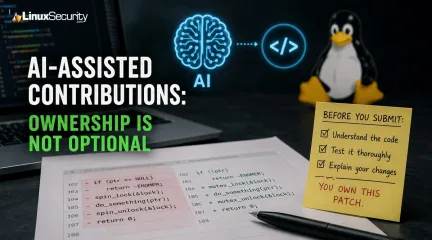
The New Rules for AI-Assisted Contributions: Ownership is Not Optional
AI-assisted patches are already showing up across open source. Small GitHub projects, package updates, kernel-adjacent tools, system libraries. It’s not a future problem anymore. . Maintainers are going to see more of this code, and most of them aren’t trying to ban it outright. They’re trying to figure out what happens when a contributor submits a patch they didn’t fully write and may not fully understand. That’s where the review process gets messy. Linux development depends on trust, but that trust only works when the person submitting the code can answer for it. The Software Freedom Conservancy (SFC) just released a set of recommendations for how to handle this. They aren't trying to ban AI. They’re trying to solve a much more basic problem: who owns the mess when AI-generated code breaks in production? Why Maintainers Are Pushing Back Nobody really cares whether you used AI. They care whether you understand the patch you're asking them to merge. Linux development has always worked on the assumption that the person submitting the code knows why every change is there. If the review turns into the maintainer trying to reverse-engineer an AI-generated implementation because the contributor can't answer basic questions, the process starts breaking down pretty quickly. The Real-World Stakes for Linux Consider how kernel maintainers handle submissions. They have zero patience for "drive-by" patches that lack documentation. Imagine you submit a scheduler tweak that passes local tests but triggers a race condition under NUMA workloads six months later. If you didn't understand the original generation, you’re stuck—and so is the maintainer. You’ve moved from being a peer contributor to a black-box operator, and that makes the maintainer's job impossible. This is even more dangerous in the supply chain. If an upstream project silently accepts an unvetted AI patch that introduces an insecure fallback path in a crypto library or a PAM module, every downstream user ofFedora, Debian, or enterprise Linux inherits that vulnerability. We haven't even begun to grapple with how to track the provenance of AI-influenced commits in our SBOMs. A helper function generated by an AI might be fine for a small utility, but that same mistake inside the networking stack or a filesystem driver can create years of maintenance work. How Code Review Is Changing Blind approvals are becoming harder to justify. Reviewers are increasingly emphasizing verification over assumptions. Don't be surprised if your next PR gets hit with questions like: "Why did you choose this specific algorithm over a simpler approach?" "Can you walk me through the logic of this loop and why it’s safe?" "What specific edge cases did you manually test, and why?" This isn't to be difficult. It’s because the reviewer needs to know if they can trust you to maintain that code long-term. If you used an AI, you’d better be prepared to defend the output as if you had typed every character yourself. Enterprise Compliance If you work in a regulated environment—banking, government, or medical—this is a legal minefield. Enterprise Linux vendors already maintain extensive records around package provenance, vulnerability management, and software bills of materials. AI-assisted contributions introduce another layer of documentation that security and compliance teams will eventually need to account for. If your team starts pumping AI-generated code into your infrastructure without a clear audit trail, you’re inviting a massive licensing and liability headache. What Happens Next? Don't expect every project to handle this the same way. Some maintainers will update their contribution guidelines. Others won't bother writing anything down and will deal with AI-assisted patches the same way they deal with every other submission: by asking questions until they're satisfied. You'll probably see more projects asking contributors to disclose AI use when it makes sense. Whether that's an Assisted-Bytag, a note in the commit message, or something else depends on the project. There isn't a standard yet, and there may never be one. The bigger change is in review. Boilerplate isn't where maintainers lose sleep. Kernel code, authentication paths, memory management, networking, package managers. That's where the questions start. If a patch touches code that could introduce a regression or create a new attack surface, reviewers are going to want more than "the AI suggested it." None of this means maintainers are declaring war on AI. Most of them already use it for something, whether that's documentation, small scripts, or chasing down an unfamiliar API. The line gets crossed when generated code lands in a pull request, and nobody can explain why it works. That's the part the SFC is trying to address. The Bottom Line The guidance doesn't really change what Linux projects have expected for years. You own the patch you submit. AI doesn't change that. If anything, it makes that expectation more obvious because reviewers can no longer assume the person who wrote the commit also wrote every line of code. The tools will keep getting better. Review probably gets harder. The Software Freedom Conservancy is hosting ongoing public Q&A sessions to help navigate these practices. If you’re a maintainer or a frequent contributor, it’s worth the time to see how the landscape is shifting. Want more Linux security news, vulnerability analysis, and software supply chain updates? Subscribe to the LinuxSecurity Newsletter and get the latest threats, advisories, and expert insights delivered directly to your inbox. Related Reading AI's Quiet Move Into the Linux Kernel Raises New Linux Kernel Security Questions Fedora AI Disruption Highlights Emerging Risks in Open Source Software Strategies to Combat Social Engineering Threats to Open Source Projects . Maintainers are expected to embrace AI assistance in patches, understanding ownership and review complexities as trustdynamics shift.. AI contributions, open source patches, Linux development, code review, Software Freedom Conservancy. . MaK Ulac
 Jun 25, 2026
•
Jun 25, 2026
• Security Trends
79
 development toolslinux developmentkernel features
How io_uring is Set to Transform the Landscape of Linux Development
A few years ago developers knew eBPF as a handy way to build firewalls yet now it's used everywhere for everything. Get ready for io_uring to do the same. . Most people don't know the first thing about Linux under the hood. Why should they? Linux, more so than most operating systems, just works. There's no need to poke inside it. But beneath the surface, there are programs such as eBPF that are transforming the infrastructure under the operating system we use every day. As revealed this week, Microsoft chose to port eBPF into Windows rather than try to duplicate its functionality with its own program. io_uring may become the next Swiss-Army tool for Linux developers. . The rise of io_uring signifies a crucial shift in Linux programming, enhancing asynchronous I/O with a streamlined, efficient interface that reduces overhead. io_uring, Linux Development, Development Tools, Programming, Kernel Features. . LinuxSecurity.com Team
Sep 30, 2022
•
Security Projects

79
 open sourcelinux developmentprogramming language
Linus Torvalds Confirms Rust Integration In Linux Kernel Upcoming
Rust , the fast-growing systems programming language, may be merged into the Linux kernel next year, or “maybe the next release,” according to Linux creator Linus Torvalds . . The creator of Linux made the statement Tuesday during an on-stage interview at the Linux Foundation ‘s Open Source Summit North America . After his announcement drew enthusiastic applause from the summit audience at downtown Austin’s J.W. Marriott hotel, he cautioned, “Don’t get too excited. We know who you are.” . Linus Torvalds announces that Rust integration into the Linux kernel may happen soon, thrilling the open source community.. Rust Integration,Linux Kernel Update,System Programming Enhancement,Open Source Development. . LinuxSecurity.com Team
Jun 23, 2022
•
Security Projects
209
open sourcelinux developmentsoftware engineeringUnderstanding Rust's Rise in Linux Development and OS Programming
To become a Linux developer, you used to need C as your passport. Now Rust can let you be an OS programmer as well. . The joke goes: "C combines the power and performance of assembly language with the flexibility and ease-of-use of assembly language." Having programmed in both C and IBM 360 Assembler – it was a long time ago, OK – there's something to that. Because of its power, performance, and portability, C became the operating system language of choice, including, of course, Linux. There's only one little problem with C. It's really easy to make blunders. Big, ugly ones. That's where Rust comes in. . Rust is gaining ground as a robust alternative to C in Linux development, focusing on safety and concurrency in high-performance environments without a garbage collector. Rust Programming, Linux Development, C Alternatives. . Brittany Day
Nov 15, 2021
•
Security Trends
78
 secure operating systemlinux developmentsystem security
Secure Linux Development Race: MandrakeSoft Versus Trusted Solutions
The race is on to deliver a version of the Linux open-source operating system that will be more secure than any of its predecessors but also manageable and affordable enough to garner widespread acceptance. . . .. The race is on to deliver a version of the Linux open-source operating system that will be more secure than any of its predecessors but also manageable and affordable enough to garner widespread acceptance. Linux developer MandrakeSoft SA and a consortium of European software makers have tossed their hat into the ring, as has Trusted Computer Solutions Inc., a maker of software used by government agencies and businesses to securely transfer sensitive data. Funded by the French Ministry of Defense via a three-year, $8.6 million (7 million euro) contract, MandrakeSoft, along with system and software developers Bertin Technologies Group, Jaluna, and Surlog, plan to develop a Linux-based operating system that meets Evaluation Assurance Level 5 of the Common Criteria, known by the designation CC-EAL5. Oppida, a service provider accredited by the French National Security Agency, will evaluate the new operating system against the international Common Criteria standard for IT security, also known as International Standards Organization 15408. Trusted Computer Solutions' time frame is a bit tighter, as the company plans to release a beta version of its Trusted Linux operating system by the end of this year. The company plans to offer a generally available version early next year. Trusted Computer Solutions began developing a more secure version of Linux to run underneath its SecureOffice data-sharing applications. The company expects TCS Trusted Linux will be certified at CC-EAL4. The link for this article located at securitypipeline.com is no longer available. . The race is fierce to develop the safest Linux distribution, bolstered by substantial investment and comprehensive resources driving these initiatives.. Secure Linux Competition, Trusted Linux, CC-EAL Certification, System Security,Linux Development. . LinuxSecurity.com Team
Sep 30, 2004
•
Vendors/Products
79
information securityopen sourcesecure computingSecure Computing's Development Plans for NSA Linux Security
This week more information was revealed on what Secure Computing is going to be doing on Linux for the National Security Agency. The following note, posted by Tom Haigh, CTO for Secure Computing, discusses how the Linux development will . . .. This week more information was revealed on what Secure Computing is going to be doing on Linux for the National Security Agency. The following note, posted by Tom Haigh, CTO for Secure Computing, discusses how the Linux development will be handled (especially with regards to the Open Source movement). The link for this article located at Linux Weekly News is no longer available. . This week more information was revealed on what Secure Computing is going to be doing on Linux for t. information, revealed, secure, computing, going, doing, linux. . LinuxSecurity.com Team
Feb 03, 2000
•
Security Projects

Get the latest News and Insights
Get the latest Linux and open source security news straight to your inbox.
Community Poll
Should Linux servers automatically install security updates?
Trending News
Search Topics
Powered By

Linux Security - Your source for Top Linux News, Advisories, HOWTOs and Feature Releases
QUICK LINKS
subscribe to newsletters!
Like staying secure? So do we.
Sign up for updates, tips, and alerts!