Overly broad permissions can turn one compromised account into a much larger security problem. Learn how to reduce unnecessary access, review privileges, and apply least privilege across modern Linux systems. Review Linux Privileges×



Desktop Security security advisory vulnerability
security advisory vulnerability GNOME is officially shortening its standard vulnerability disclosure window from 90 days to 30 days, a change that impacts upstream maintainers, downstream Linux distributions, and system administrators in how they handle software vulnerabilities. The policy shift, announced by long-time security coordinator Michael Catanzaro , addresses modern software patching realities and a growing influx of automated submissions. . Because GNOME is the default desktop environment on several major Linux...
 Jul 21, 2026

Security Vulnerabilities security advisory moderate
security advisory moderate For organizations that run a self-hosted Git platform, it’s no longer just about hosting static code repositories. Today, Git servers are responsible for deployment pipelines, API tokens, SSH keys, package repositories, and the automation scripts that push code directly. Confirm that the upgrade addresses known vulnerabilities but also provides production environments. . That makes them trusted systems within the development environment and attractive targets for attackers looking to move...
Jul 20, 2026

Server Securitydata privacy automation
data privacy automation Every system admin has lived through the same Monday morning ritual. A queue of forty tickets, half of them password resets, permission errors, or disk space warnings that any experienced technician could resolve in under two minutes. The other half require actual judgment. For years, automation promised that software would eventually sort the two apart on its own. That promise is now being tested in production Linux environments. . Early results are reshaping how IT teams think about tier-1...
Jul 17, 2026

Privacydata collection automation
data collection automation You're running a web scraping project to collect pricing data from e-commerce sites. You set up a pool of datacenter proxies, launch your scripts, and within minutes — banned . CAPTCHAs everywhere. Your data pipeline stops before it really begins. . It's a frustrating scenario that plays out daily in ad verification, market research, and multi-account management. The website doesn't know you're doing legitimate research or monitoring. It just sees traffic coming from IP ranges it recognizes as...
Jul 17, 2026

Security Trends security advisory social engineering
security advisory social engineering Business Email Compromise used to be a numbers game — mass-blasted emails, broken English, an obvious "URGENT WIRE TRANSFER" subject line. That era is over. Generative AI has turned BEC into a tailored, low-noise operation that mimics writing style, voice, and even video presence. This piece looks at what's actually changed under the hood, what defenders are testing in response, and why so many organizations are still structurally unprepared for it. . The Infrastructure Problem Nobody Wants to...
Jul 17, 2026
 Refine news
X Clear Filters
Get the latest News and Insights
Get the latest Linux and open source security news straight to your inbox.
Community Poll
Should Linux servers automatically install security updates?
Trending News
Loading...
Explore Latest Linux Security news
We found 18 articles for you...
210
 security researchopen-sourcekernel
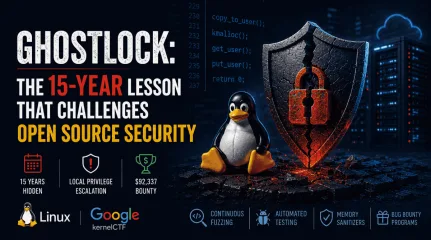
GhostLock Exposes an Uncomfortable Truth About Open Source Security
When researchers announced GhostLock, many people focused on the exploit. What stood out to me wasn't just what the vulnerability could do, but how long it had remained hidden. The flaw had lived in the Linux kernel for roughly 15 years before it was publicly identified by researchers. That means the flaw survived hundreds of kernel releases and years of upstream development before it was publicly documented. It raises an uncomfortable question about one of open source's oldest assumptions. One of the enduring arguments in favor of open source is that transparency improves security. If anyone can inspect the code, vulnerabilities should be easier to discover and fix. GhostLock doesn't disprove that idea, but it does force us to ask how well it scales when the Linux kernel contains tens of millions of lines of code. . Why the GhostLock Linux Kernel Vulnerability Is Different The Linux kernel vulnerability CVE-2026-43499 , or "GhostLock," was identified by Nebula Security Research in their ionstack analysis . Because the flaw originated in upstream code, it potentially affected numerous Linux distributions that incorporated the vulnerable kernel code until it was patched in the upstream Linux kernel in April 2026 . GhostLock stood out for several reasons: Legacy Impact: The bug existed since kernel 2.6.39, illustrating that even mature, stable code can harbor deep-seated flaws for years. High-Stakes Exploitation: Researchers demonstrated local privilege escalation to root and a container escape, making the vulnerability particularly significant for cloud and containerized environments. Professional Interest: The vulnerability was identified through Google’s kernelCTF program, earning a $92,337 bounty. The payout also reflects how difficult kernel memory-safety bugs have become to identify, even for experienced researchers. The real question isn't whether Linux is secure. It is whether the traditional "many eyes" argument still reflects how securityactually works in a codebase of this magnitude. When "Many Eyes" Meets Modern Reality One of the best-known ideas in open source security is the "many eyes" principle , often associated with Eric S. Raymond's Linus's Law : "Given enough eyeballs, all bugs are shallow." The idea is straightforward. Because the source code is publicly available, developers, researchers, and users can inspect it, increasing the likelihood that vulnerabilities will be identified and fixed more quickly than they might be in closed-source software. In practice, however, transparency makes review possible; it does not guarantee that every line of code will actually be examined by someone with the time, expertise, or reason to look at it. That distinction becomes increasingly important in a project as large and complex as the Linux kernel, where millions of lines of code are maintained by thousands of contributors across hundreds of subsystems. Several practical realities shape how security review works today: The Scale Problem: The Linux kernel receives thousands of changes during every development cycle. No single human can review the entire codebase. Subsystem Silos: Most reviewers specialize in one subsystem. If a vulnerability exists in an obscure or legacy corner of the kernel, it may sit outside the field of view of those most qualified to audit it. The "Old Code" Reality: Legacy code often changes less frequently than actively developed subsystems. That stability is valuable, but it can also mean certain execution paths receive less ongoing scrutiny than newer code undergoing active development. How Linux Kernel Security Research Has Changed GhostLock wasn't discovered because someone finally decided to manually audit that specific line of code. It was discovered because the methodology of Linux security research has fundamentally changed. Historically, kernel security depended largely on expert review and targeted testing. Today, that work is increasingly complemented bycoverage-guided fuzzing, sanitizers, and large-scale automated testing. Tools like syzkaller/syzbot and KASAN act as force multipliers, systematically probing kernel state transitions that would be impossible for a human to track mentally. Automated testing now routinely finds combinations of events that humans would never naturally think to test. Programs like kernelCTF have further professionalized this research, bringing top-tier talent to bear on the kernel’s deepest subsystems. GhostLock is a testament to the fact that modern security is no longer just about "eyes"—it’s about the sophistication of the tooling and the bounty programs that reward deep, specialized research. The Reboot Gap For administrators, GhostLock is a stark reminder of the "reboot gap." Most organizations have well-defined maintenance windows for web servers, databases, and application software. Kernel updates are different because they frequently require reboots, coordinated maintenance windows, or live-patching infrastructure that many organizations simply don't have. It's not uncommon for organizations to schedule kernel updates quarterly while patching user-space software weekly. GhostLock shows why that gap deserves another look. In a containerized world, many assume the host is "just plumbing." A container escape vulnerability proves that the host kernel is the single point of failure for everything running on top of it. Local privilege escalation vulnerabilities become especially important in these environments because the kernel remains the shared trust boundary. When a vulnerability allows for container escape, the kernel is effectively an application-level concern and must be treated with the same urgency as a critical web server flaw. Security Priorities Have Changed GhostLock also highlights how Linux kernel security priorities have shifted over the last decade. Memory safety is now one of the community's primary areas of investment. Maintainers continue to strengthen the kernel through hardeningfeatures, sanitizers, memory-safety improvements, Rust for new kernel components, and continuous automated testing. Rather than suggesting the ecosystem is stagnant, GhostLock illustrates why those investments have become increasingly important as the kernel continues to grow in size and complexity. GhostLock also demonstrates one of open source's greatest strengths. Once the vulnerability was publicly identified, researchers could independently analyze the root cause, distributions could verify the fix, and administrators had complete visibility into the patch itself. That level of transparency is difficult to match in proprietary software, where the source code and development process are generally not available for independent review. What GhostLock Says About the Future of Open Source Security If GhostLock could stay under the radar for 15 years, it makes you wonder: how many other bugs are still waiting to be found? We don't know for sure. But GhostLock also proves that the ecosystem for finding those bugs is much tougher today than it was ten years ago. Between continuous fuzzing, memory sanitizers, coordinated disclosure, and mature bug bounty programs, we are finding whole classes of vulnerabilities that would have been totally invisible in the past. GhostLock doesn't prove that open source security has failed; it proves that transparency alone isn't enough. The Linux kernel has outgrown the point where it can rely solely on volunteer code review to find every critical flaw. Today's security depends just as much on dedicated security teams, automated testing, and bounty programs that reward that deep, specialized research. This reminds us that those strengths still matter, but the scale of modern projects requires more than just visibility. Today's Linux kernel is secured not only by developers reviewing code, but also by continuous automated testing, specialized security researchers, and organizations willing to invest in uncovering vulnerabilities that traditional review alone maynever find. . GhostLock reveals the limitations of open source security, emphasizing the need for advanced tools and methodologies in Linux kernel maintenance.. Linux Kernel GhostLock, Open Source Security Flaws, Automated Security Testing. . MaK Ulac
 Jul 14, 2026
•
Jul 14, 2026
• Security Vulnerabilities
79
 security advisorybuffer overflowUbuntu
Ubuntu 25.10 Questing Quokka: Important Rust Integration for Security
Anyone following the trajectory of Ubuntu over the past few years could have seen this coming: Canonical isn’t just iterating; it’s evolving. And with its 25.10 release —aptly named Questing Quokka—Ubuntu takes a decisive step in reinforcing its reputation as the go-to Linux distribution for secure, reliable environments. If you’re an admin with a sharp eye on system security or someone deeply vested in the intersection of programming trends and operational resilience, this is the release to sit up and pay attention to. . At the heart of this evolution is Rust, a language purpose-built to address the long-standing Achilles’ heels of C and C++. Buffer overflows ? Use-after-free errors? Race conditions? These aren’t just bugs—they’re gaping holes in the fence, waiting for exploits to come knocking. Rust, with its focus on memory safety and concurrency, offers administrators and developers something closer to peace of mind. Canonical gets this, and it’s taken actionable strides to integrate Rust directly into Ubuntu’s ecosystem, especially for system-level utilities and security-sensitive components. Why Does Rust Matter for Security? First, let’s talk realities here. If you’ve been managing Linux systems for any length of time, you’ve probably had moments where a misconfigured daemon or vulnerable library turned into a potential fire drill. A significant chunk of these problems stems from unmanaged memory vulnerabilities, and the kinds that C and C++ applications seem to attract like magnets. Buffer overruns, dangling pointers, data races—these aren’t just theoretical issues; they’re the bedrock of exploitation techniques. Rust changes the equation. Its strict compiler checks and borrowing system essentially eliminate most categories of memory bugs before they ever touch production code. More importantly, Rust’s design isn’t a trade-off. Software built in Rust performs just as efficiently as its C-written counterparts, while carrying far fewer risks . ForCanonical, this isn’t about jumping on a bandwagon—it’s about future-proofing Ubuntu’s system components without compromising speed or stability. Rust-Based Tools: What Questing Quokka Brings So what does this shift look like in practice? With Questing Quokka, administrators can expect a growing presence of Rust across core system utilities. The idea isn’t to force change for its own sake but to target areas where decades of reliance on C-based codebases have carried inherent risks. While Canonical hasn’t published exhaustive documentation on every Rust-informed addition just yet, some patterns are already emerging: System-Level Utilities Take device management, for example. If you’re familiar with udev , you’ll know how critical it is for handling device event management. Questing Quokka introduces Rust-based helpers that reimagine how hardware events are processed, aiming for a cleaner, safer system to ease hardware handling headaches. Another noteworthy mention is the introduction of startup helpers—small Rust-based daemons woven into Ubuntu’s boot-up sequence. These don’t replace systemd (that’s not the goal), but they augment certain initialization tasks, reducing the likelihood of issues caused by legacy C-based implementations. Think of it as polishing the finer edges of system startup. Security Tools Canonical is clearly leaning into Rust’s strengths in security-critical applications. Questing Quokka incorporates sandboxing helpers—tools designed to isolate processes more effectively, shielding the host from potentially compromised applications while reducing memory-related vulnerabilities. This pairs beautifully with privilege separation utilities, which now benefit from Rust’s guarantees around data handling. For admins, this means less risk when executing processes with elevated permissions. Package Management While no one is rewriting apt in Rust (yet), Canonical’s experimentations in this area are no less intriguing. Dependencyresolution tools and repository metadata verifiers are taking tentative steps into Rust-based territory. These operate behind the scenes, but knowing that critical package management infrastructure is leaning into safer programming practices will come as a reassuring detail for admins dedicated to patch hygiene and repository integrity. Rust Beyond Ubuntu: An Industry Movement Ubuntu adopting Rust isn’t happening in a vacuum. The Linux community at large is showing increasing interest in Rust, for good reason. Discussions around Rust in the Linux kernel are intensifying, and smaller Rust drivers have already made their debut. Meanwhile, companies like Google are deploying Rust components in Android, validating its real-world performance and security claims. This shift signals an ecosystem-wide acknowledgment: better, safer code is possible without sacrificing efficiency. Admins should view this as a growing trend in Linux distributions. Rust isn’t replacing C outright—it’s better seen as a complementary addition to the systems programming toolkit. Tools, daemons, and modules that address specific issues (once endemic to C-based environments) are finding a natural home in Rust. It’s a gradual evolution, but one that materially impacts how systems are built and secured. So, What Should Admins Do? So, where does that leave you, as someone managing systems in the real world? First, don’t ignore this transition. Rust-based utilities will likely continue appearing across Ubuntu distributions, and staying informed is key. Regularly scanning developer notes and advisories will give you insight into what’s shifting and why. It’s also worth taking the time to understand Rust—not necessarily to become fluent overnight, but at least to know how its tooling works. Familiarize yourself with cargo, learn what makes Rust different when debugging applications, and get comfortable with basic Rust workflows. Finally, track Canonical’s security bulletins closely. Rust doesn’t maketools magically immune to all vulnerabilities, but it undeniably raises the bar, making it essential to monitor new components and rapidly address issues when they arise. Our Final Thoughts on This New Chapter for Ubuntu Users Ubuntu 25.10’s embrace of Rust is significant, not as a gimmick or trend but as a deliberate move towards greater security, stability, and resilience in Linux systems. Questing Quokka isn’t rewriting the entire operating system in Rust, but its introduction of Rust-based utilities shows a methodical commitment to tackling legacy vulnerabilities while maintaining operational excellence. Admins and infosec professionals should see this as both an opportunity and a challenge: an opportunity to depend on safer, modernized codebases and better practices, but also a call to refamiliarize themselves with new tools and methodologies shaping the Linux landscape. Rust is here—and Canonical isn’t looking back. It’s time to adapt. . Explore the ways Ubuntu 25.10 incorporates Rust-driven utilities to bolster security and improve operational reliability.. Rust Security Tools, Ubuntu 25.10, System Memory Safety, Admin Security Practices. . Brittany Day
Jul 01, 2025
•
Security Projects

79
 memory safetysystem resiliencedeveloper challenges
Linux Kernel: Rust Integration Offers Security and Resilience Challenges
Linux continues to form the backbone for various systems, ranging from cloud infrastructure to embedded devices, and Rust's integration in its kernel has become a hot topic. Rust offers many advantages when used with C, such as reduced security vulnerabilities due to memory safety features. . Rust could transform system security by making systems more resilient against memory-related exploits. However, adding Rust to 34 million lines of existing C code within the Linux kernel itself won't come easily. Even Linus Torvalds acknowledged the challenges he faced while trying this feat! We, Linux security administrators, must understand both the security enhancements and practical challenges presented by Rust's integration, along with any associated obstacles. Rust may offer improved reliability and security; however, its learning curve and rigorous review can present daunting hurdles to its adoption. Developers may react differently: some are wary about extra workload, while others see long-term benefits. Therefore, Linux admins must navigate these changes mindfully by understanding the perspectives involved and planning for the integration process to create more secure kernels across Linux environments. Let's examine the promise of Rust integration in Linux, potential integration challenges, and Linux kernel developers' perspectives on Rust integration in the LInux kernel. The Promise of Rust: Enhanced Memory Safety The most compelling reason for integrating Rust into the Linux kernel is its promise of enhanced memory safety. In traditional C programming , memory management is manual and prone to errors that can have profound security implications. Buffer overflows , use-after-free errors, and null pointer dereferences are common issues that plague C code, including in the Linux kernel. Attackers can exploit these vulnerabilities to gain unauthorized access, execute arbitrary code, or crash systems. Rust, designed with a strong emphasis on memory safety, prevents these classes of bugs at compile time. It achieves this through ownership, borrowing, and lifetime rules, ensuring that memory is managed safely and efficiently. The Rust compiler enforces these rules, making it virtually impossible for developers to introduce memory safety bugs. This means integrating Rust into the Linux kernel could substantially reduce the number of security vulnerabilities, leading to a more secure operating system. For security admins, this is a tantalizing prospect. Minimizing memory safety issues at such a fundamental layer of the system could lead to a significant decrease in security patches and emergency updates. This would enhance the overall stability and security of systems and allow security teams to focus on other critical tasks. However, while the benefits are clear, the integration process is fraught with challenges. The Hurdles of Integration Linus Torvalds, the creator of Linux, has acknowledged the difficulty in incorporating Rust into the existing kernel. As it contains about 34 million lines of C code, which has been developed over three decades, adding another language is no easy task. One key challenge in Rust development is maintaining compatibility between C and Rust modules. Linux relies heavily on C's capabilities for many core functionalities inside its kernel. To make Rust work alongside C, developers must bridge between languages using Foreign Function Interfaces (FFI) . While FFI provides some connectivity between languages, its additional complexity increases the potential for bugs. Rust's learning curve can also be steep. To become proficient, developers familiar with C need to devote both time and energy to becoming adept with Rust, including understanding its distinct memory management rules and idioms. Experienced kernel developers working for years with C may find transitioning difficult. Decades-long C code may need revamping or a complete rewrite to align with Rust safety requirements. Developers' Perspectives: Mixed Reactions Developers'responses to Rust being integrated into the Linux kernel have varied widely. While some are excited about how it could improve code quality and security, others worry about its additional workload and complexity in merging two languages into one. Prominent kernel developers such as Greg Kroah-Hartman have supported Rust, noting the long-term advantages it can bring when writing safer code. They believe the initial investment to learn Rust and refactor code will pay dividends in reduced vulnerabilities and creating an increasingly stable kernel. Kroah-Hartman believes such work is worth undertaking, given how problematic security issues have become in today's society. On the other hand, some developers express hesitation. Christoph Hellwig, in particular, has voiced his displeasure over Rust adoption. His concerns include the laborious integration process diverting resources from critical tasks and hindering focus on other key projects. These sentiments echo among other developers, as Rust can slow development efforts down while adding fresh challenges. Although Rust faces many hurdles in its adoption, the overall momentum seems positive. The kernel community recognizes its security benefits and has warmed up to Rust gradually. As more developers gain proficiency with the Rust programming language and tools and practices developed for integration processes created by its community, integration may become smoother over time. The Road Ahead: Preparing for Change Preparation and understanding are keys to successfully transitioning Rust into the Linux kernel, as these changes can be managed effectively with proper planning. First and foremost, it is important to keep abreast of developments within the Rust integration process. Being aware of patches, updates, and best practices is crucial to remaining compliant, while engaging with Linux community discussions may offer valuable insights and enable early warning of potential issues that arise. Second, investing in training and educationfor your team is critical. As Rust becomes more integrated into kernel codebases, having team members proficient with Rust will become an invaluable asset to any company. Giving developers opportunities to learn Rust in-depth can ease the transition and minimize the learning curve. Fostering an environment of collaboration and adaptability is key to successfully integrating Rust into the Linux kernel. Promoting open communication, cooperation, and willingness to adapt will help facilitate an easy transition process for everyone involved. Our Final Thoughts: Embracing the Future of Kernel Security with Rust Integration of Rust into the Linux kernel is an exciting venture that promises to strengthen its security and stability dramatically. While implementation will present its share of challenges, the long-term benefits of increased memory safety and reduced vulnerabilities make this endeavor worthwhile. We Linux security admins know the key to successfully making the transition involves understanding its security advantages and the practical barriers involved. By staying informed, investing in training, and cultivating a culture of collaboration among security teams, we can ensure a smooth integration of Rust into the Linux kernel. As Linux continues its journey of innovation and adaptation, accepting Rust will prove pivotal in building a more secure and resilient operating system for tomorrow. How do you feel about Rust integration in the kernel? We'd love to hear your opinion @lnxsec! . Go can strengthen Windows reliability and protection, yet incorporation presents notable hurdles for programmers and system operators.. Rust Integration, Linux Kernel Security, Memory Management, System Resilience. . Brittany Day
Apr 08, 2025
•
Security Projects
79
 memory safetysoftware securityChrome
Google Chrome and Rust: Elevating Security and Update Efficiency
As admins responsible for ensuring the security of critical Linux infrastructures, staying ahead of the curve means paying close attention to the technologies underlying our most crucial applications. Recently, Google made a significant shift in Chrome by switching FreeType with Skrifa (a Rust-based alternative). . Rust's built-in memory safety features offer notable security benefits, thus reducing risks from vulnerabilities due to memory bugs and providing greater protection from potential exploits on our systems. This represents a significant victory in preventing possible attacks. Transitioning to Skrifa isn't solely about security; it also facilitates faster and safer updates. Google's adoption of Rust represents an industry trend away from legacy languages toward ones that inherently promote safer code. For us Linux admins, this means better web font handling in Chrome and an indication that more Rust-based tools could make their way into our daily workflows. Embracing these changes could make our job of maintaining robust systems easier and more effective! Let's examine the significance of Google embracing Rust, how this recent shift will improve memory safety in Chrome, the broader industry-wide trend of increasing Rust adoption, and how this will impact our security and workflows as Linux admins. Why the Shift to Rust Matters The Rust programming language stands at the core of this transition, known for its strong emphasis on memory safety. FreeType was written using C, an extremely powerful yet notoriously vulnerable language susceptible to memory-related vulnerabilities such as buffer overflows and use-after-free errors. Rust is known for eschewing these vulnerabilities due to its strong emphasis on memory safety - a welcome change for security-minded users, developers, and admins! Rust was created specifically to counter these types of critical vulnerabilities. Its stringent compile-time checks and ownership system ensure memory errors are caught earlyduring development, virtually eliminating entire classes of bugs. These features make Rust an attractive choice for developers seeking secure code without compromising performance. Improved Memory Safety in Chrome Google has added the Rust font rendering library Skrifa to Chrome to improve its resilience against memory-related attacks. This provides Linux admins an added layer of protection against complex exploits of font rendering technology. By including Rust safeguards in production environments, the risk associated with Chrome vulnerabilities has been significantly decreased. This move by browser developers also underscores their broader commitment to security. Given how integral web browsers are to our online experience—from reading articles and banking online to shopping and entertainment—any steps taken to make them safer are steps toward providing us with a more secure online experience overall. Admins managing large fleets will appreciate fewer patches, lower risk profiles, and improved security hygiene. Agile and Secure Updates One of the less immediately obvious but incredibly important benefits of adopting a Rust-based library like Skrifa is the agility in development it brings. Rust’s framework allows for rapid iteration without the usual trade-offs between speed and safety. Proactive memory management reduces the need to backtrack and fix bugs that traditionally require extensive debugging. Google has emphasized that this move will allow them to roll out updates faster and with more confidence in their security posture. For Linux admins, fixes can be deployed swiftly when vulnerabilities are discovered. This is critical in an environment where zero-day vulnerabilities can lead to significant exposure if not addressed promptly. Ensuring Render Quality A common concern whenever a significant component of a widely-used application is replaced is the potential drop in quality or reliability. Google has preemptively addressed these concerns by conductingextensive pixel comparison tests to ensure that Skrifa’s output aligns with FreeType's. The goal is to maintain, if not improve, the render quality of web pages displayed in Chrome. Rendering is a fundamental aspect of the user experience. Inconsistent or poor-quality rendering can disrupt workflows and lead to user frustration. Google’s commitment to ensuring that Skrifa meets its high quality standards means that Linux admins can rest assured that this transition will not negatively impact the user experience. Continuous testing and refinement should maintain stable and reliable web browser performance. An Industry-Wide Trend of Embracing Rust Skrifa's adoption is part of a broader trend within the tech industry. Companies like Microsoft, Mozilla, and others have increasingly integrated Rust into their codebases. Its prevalence is especially apparent when security-centric projects require robust solutions. Rust's popularity stems from an increasing awareness that traditional languages like C and C++ are difficult to secure due to their growing software complexity. Memory safety issues consume significant resources for patching security vulnerabilities and ongoing maintenance and performance tuning. Rust offers an alternative option that enables high-performance, low-level code without the risks associated with its predecessors. The Future of Rust in Everyday Admin Work Understanding and adopting Rust can provide us Linux security admins with immense advantages. As more tools and components integrate Rust into their development, having a working knowledge of this language becomes increasingly indispensable. Familiarity with Rust can assist in understanding the security properties of new system components and their integration into existing infrastructures. Rust can provide an ideal language to augment or replace other essential system areas beyond web browsing, from kernel modules to user-space applications. By adopting Rust now, Linux administrators can stay ahead of the curve andbe prepared for future secure software development practices. Cost & Risk Reduction Rust's most obvious benefit lies in its potential to lower costs and risks associated with software vulnerabilities, including security breaches that are both financially costly and reputationally damaging. By selecting a language with minimal vulnerability vectors, companies can significantly decrease the likelihood of exploitative breaches occurring. Reduced frequency of security patches also translates to more stable systems. Frequent patches often require downtime and testing, which can disrupt operations, especially in environments that demand constant uptime. A more secure foundation means fewer emergency patches and a more predictable update schedule. Our Final Thoughts on Embracing Rust in Chrome for Enhanced Security and Stability Google Chrome's transition from FreeType to Skrifa marks an exciting step toward producing more secure software. As Linux security administrators, it's critical that we fully comprehend these changes and their relevance to our work. Adopting Rust for font rendering components not only strengthens security but also provides faster update cycles and consistent quality standards. Recognizing this as part of an overall industry trend can help us prepare for a future where Rust will play an increasingly central role. By staying informed and adaptable, we can ensure our systems remain resilient against new threats while providing a secure environment for users - creating a safer and more efficient digital ecosystem by applying best practices and technologies. We'd love to hear your thoughts and opinions on this exciting transition! Let's connect @lnxsec! . Network engineers can utilize Python's versatility in web servers to enhance security measures and simplify maintenance tasks.. Rust Programming, Memory Safety, Chrome Development, Software Updates, Linux Administration. . Brittany Day
Mar 24, 2025
•
Security Projects
79
 security enhancementmemory safetylinux kernel
Linux Kernel Embraces Rust: Modern Security Solutions for Legacy Code
Integration of Rust into the Linux kernel marks an enormous advancement for those committed to its security and stability. Rust's inherent memory safety features offer powerful advantages that help combat common bugs like buffer overflows and use-after-free errors. These features provide greater protection from potential exploits while streamlining development efforts, helping admins more efficiently maintain secure systems. . Linux kernel maintainers and developers Greg Kroah-Hartman and Kees Cook have expressed strong backing for Rust integration, not as an attempt at revamping existing C code but instead using Rust to develop new components, increasing overall security while decreasing critical vulnerabilities. With this hybrid approach, your existing infrastructure remains strong while subsystems constructed using Rust provide superior reliability and security from day one. Let's examine how this approach will offer admins like yourself with more stable, secure, and manageable Linux environments in the future. Understanding The Security Challenges of C The Linux kernel, the cornerstone of millions of systems worldwide, has traditionally been written using the C programming language. Although C is powerful and flexible, its usage often leads to memory management errors that compromise security. Buffer overflows, use-after-free errors, and double free errors are surprisingly frequent due to manual memory management techniques employed by C programs. These vulnerabilities have serious real-world repercussions that attackers can exploit to gain unauthorized system access or for code execution. As more interconnected systems become vulnerable due to security flaws, security administrators must patch and monitor them regularly to detect exploits and prevent future ones. Rust: A Practical Solution for Memory Safety Rust was designed with safety as the primary objective and memory security at its heart. Its stringent compiler rules prohibit null pointer dereferences and doublefree while providing proper synchronization mechanisms, significantly reducing risk and helping mitigate common bugs at compile time. Greg Kroah-Hartman, one of the longstanding Linux kernel maintainers, has long championed Rust's integration. He observes that many kernel bugs result from complex quirks or edge cases in C that require tedious manual management. "Rust removes these ambiguities," says Kroah-Hartman. "It allows us to write new components without the legacy issues that have historically plagued kernel development." This means fewer vulnerabilities to worry about from the outset. Code written in Rust is inherently safer, which translates to fewer patches and less time spent on incident responses related to memory safety issues. Enhancing Development Efficiency Integration of Rust into the Linux kernel brings many benefits beyond security. Rust's stringent compile-time checks help identify errors early, improving software quality while speeding development time and simplifying maintenance costs - ultimately leading to faster production timelines and easier maintenance needs over time. This leads to more secure code and shorter production time. Kees Cook, an active participant in Linux kernel security development, elaborates further, stating, "The goal isn't to rewrite all existing C code in Rust, but to provide an option for new drivers and subsystems. We can improve security and efficiency by introducing Rust where it makes the most sense." By catching bugs early, Rust allows developers to focus on optimizing and refining their code rather than constantly fixing avoidable errors. This means more reliable updates and reduced downtime due to bugs in newly introduced code. Balancing Legacy with Innovation One of the key challenges developers face today is balancing maintaining existing C code and adopting Rust. The Linux kernel contains an immense codebase built over decades, and completely rewriting everything with Rust would be impossible and defeat its purpose altogether. Cook emphasizes the importance of developing new components using Rust while maintaining existing C code - this hybrid approach capitalizes on both languages' strengths. "We’re not throwing away what we have," Cook says. "The existing C code has been scrutinized and hardened over the years. Rust enhances our ability to tackle new challenges without introducing the old bugs." This approach offers confidence that existing systems will remain stable while benefiting from the advantages of Rust in new developments. The goal is to create a more secure and efficient kernel without disrupting the current infrastructure. Forward-Thinking Security The integration of Rust into the Linux kernel is a forward-thinking approach to security. It prepares the kernel for future challenges and complexities, ensuring new vulnerabilities don’t enter the system. This proactive stance is critical as the threat landscape continues to evolve. Kroah-Hartman captures this sentiment well: "Security is an ongoing battle. By incorporating Rust, we’re not just addressing today's issues but positioning ourselves to handle tomorrow's threats. It’s about building a resilient foundation to adapt and withstand emerging challenges." As a security admin, I find this future proofing invaluable. It means fewer reactive measures and more strategic, proactive security management. These Rust enhancements will result in a more robust kernel you can trust to handle your security requirements. Our Final Thoughts on Embracing Rust in the Linux Kernel Rust's inclusion in the Linux kernel marks an exciting turning point in its history. Memory management vulnerabilities have long plagued kernel development efforts. With built-in memory safety features and reduced likelihood of bugs introduced during development, Rust provides an effective solution that enhances its security posture from within. Greg Kroah-Hartman and Kees Cook's backing exemplifies the advantages of integration. By emphasizing new components over rewritingexisting code, the community can strike an optimal balance between innovation and legacy maintenance, keeping systems secure against future threats. As a Linux security admin, I believe that adopting Rust's integration can mean more reliable and secure systems with reduced time spent patching or responding to incidents. Rust provides the Linux kernel with an adaptive foundation capable of facing advanced and emerging threats. What is your opinion on Rust integration in the kernel? Reach out to us @lnxsec and let's have a discussion about it! . Linux kernel maintains stability and security through Rust integration, promising a more robust coding future.. integration, linux, kernel, marks, enormous, advancement, those, committed. . Brittany Day
Mar 03, 2025
•
Security Projects
79
 security enhancementkernelsoftware management
Linux Kernel: Enhancing Security with Rust – Debate Insights
As the Linux community grapples with integrating Rust into the Linux kernel , a heated debate has unfolded, highlighting the balance between innovation and stability. At its core, the discussion examines whether Rust, a language lauded for its robust memory safety features, should coexist with the traditionally C-based Linux kernel. . Proponents, like Hector Martin, argue that Rust’s integration would significantly enhance security by preventing common vulnerabilities such as buffer overflows . Meanwhile, some veteran maintainers are skeptical, expressing concerns about increased complexity and the disruption of established development workflows. For us Linux security administrators, this debate is more than just an academic exercise; it has direct and tangible implications for the security and manageability of future kernel releases. Linus Torvalds himself has emphasized that while modernization is essential, it must be approached with technical rigor and through established processes, not social media pressure. Let's examine this recent debate and its practical implications for the future of Linux kernel security. The Promise of Rust Rust is a relatively new programming language that has quickly gained a following due to its dedication to memory safety and concurrent programming. Rust's design automatically prevents common vulnerabilities like buffer overflows and use-after-free errors that often arise in C and C++ due to manual memory management; by enforcing safety checks at compile time, Rust may help prevent whole classes of vulnerabilities that have plagued system software, including the Linux kernel. Advocates of Rust often highlight this potential increase in security as one of its primary selling points. Hector Martin, lead developer of Asahi Linux, emphasizes that integrating Rust into the kernel could form an effective defense against many security issues. By taking advantage of Rust's safety features, Martin believes the Linux kernel could substantially decreasesecurity vulnerabilities and create a more reliable operating environment - particularly beneficial when considering device drivers, which have often been sources of kernel bugs and security flaws. Concerns and Resistance Rust integration into the Linux kernel may bring significant potential benefits; however, some veteran maintainers have expressed reservations. They fear that adding another language, such as Rust, may add more complexity when maintaining it. Additionally, some prominent Linux kernel developers, such as Christoph Hellwig, have raised concerns that supporting Rust alongside C may complicate development processes , creating steeper learning curves for contributors and maintainers alike. Furthermore, this complexity has real ramifications on managing and long-term sustainability of kernel development projects. Given its complexity and global ubiquity, developers and maintainers are understandably wary when considering changes to the kernel's infrastructure. Any significant alteration could have far-reaching ramifications affecting everything from code readability and maintainability to speed and efficiency of kernel operation. Understanding Linus Torvalds’ Perspective Linus Torvalds, the creator of Linux, has made an important statement regarding this debate by stressing his emphasis on technical rigor and established processes. Torvalds is known for his no-nonsense approach to kernel development. Changes must benefit all system operation aspects before going through proper channels for approval. He criticized Hector Martin's use of social media in pushing Rust integration, believing such discussions should occur only within development communities. Despite its imperfections, Torvalds believes the current development process has proven effective. He holds that any proposal - such as Rust integration - must pass the same rigorous review and testing processes used to maintain kernel reliability and performance. His focus here lies on technical contributions and professionalcommunication to ensure changes are driven solely by merit and necessity rather than social media influence. Practical Implications for Security Administrators For Linux security administrators, this debate is immensely relevant. The potential introduction of Rust into the kernel could change how we approach securing our systems. On the one hand, Rust’s memory safety features could lead to more secure and stable kernel releases, reducing the number of vulnerabilities and the frequency of security patches . This could streamline maintaining secure systems, allowing admins to focus on more proactive security measures rather than constantly fighting emergent issues. On the other hand, the integration of Rust could introduce new challenges. Administrators would need to familiarize themselves with the intricacies of Rust and understand how it interacts with the existing C-based kernel. This knowledge would be necessary for troubleshooting and debugging, as well as assessing the security implications of new code and updates. Transition periods are often fraught with learning curves and adjustments, and the integration of Rust would likely be no different. Preparing for the Future Given the potential for Rust integration, Linux security admins should start preparing now. It is crucial to keep up-to-date with developments in this area, enabling us to anticipate changes and adapt our security strategies accordingly. We administrators should also consider investing in training for ourselves and our teams. Familiarity with Rust will be an asset, allowing us to understand and fully leverage its security benefits. Additionally, this knowledge will facilitate collaboration with developers working on integrating Rust into the kernel, ensuring that security considerations are thoroughly addressed in the process. Our Final Thoughts on This Recent Linux Security Debate Rust's integration into the Linux kernel represents an ongoing conversation about innovation, security, and stability in softwaredevelopment. While Rust's memory safety features may offer potential benefits, legitimate concerns regarding complexity and disruption must also be carefully assessed before being applied in critical systems. Linus Torvalds's emphasis on technical rigor and established processes serves as a reminder that significant changes to critical systems must be based on careful consideration and merit alone. We'd love to hear your perspective on this debate on X @lnxsec ! . Proponents, like Hector Martin, argue that Rust’s integration would significantly enhance security. linux, community, grapples, integrating, kernel, heated, debate. . Brittany Day
Feb 21, 2025
•
Security Projects
79
 security advisorykernel updatesystem performance
Linux Kernel 6.13: Arm CCA and Enhanced Security Innovations
Linux Kernel 6.13 is here, and for security-conscious Linux admins, it’s packed with updates that are set to make a big difference in how you lock down and manage enterprise systems. This latest kernel release is not just about keeping up with the times; it’s about staying ahead of potential threats with a suite of security-focused enhancements. . From the introduction of Arm Confidential Compute Architecture (CCA) realms for fortified workload isolation to performance-boosting shadow stacks for Arm processors, Linux Kernel 6.13 equips you with cutting-edge tools to boost your security posture. Extended support for secure filesystems like XFS and ext4, coupled with the ongoing integration of Rust , means you’re prepared to tackle stack manipulation and memory management vulnerabilities with finesse. Moreover, by embracing a more streamlined lazy preemption model and retiring the legacy ReiserFS, Linux Kernel 6.13 ensures your systems are secure and robustly efficient. Whether safeguarding sensitive data against rogue execution environments or mitigating performance consumption with updated architectures, this kernel version provides the flexibility and reliability that today’s enterprise-grade systems demand. So, as you embark on upgrading, these advancements are ready to empower your security measures and enhance the overall resilience of your infrastructure. Let's examine the key updates and improvements introduced in Linux Kernel 6.13 in more depth to give you a better understanding of how this release will improve the security and performance of your Linux systems. Enhanced Security with Arm Confidential Compute Architecture One of the most significant updates in Linux Kernel 6.13 is Arm Confidential Compute Architecture (CCA) support. This feature enables the operation of Linux virtual machines in protected execution environments known as realms. With the increasing complexity of cybersecurity threats, isolating workloads from potentially untrusted execution environmentshas never been more critical. Arm CCA brings hardware-level isolation, ensuring that sensitive processes and data remain safe even if other system parts are compromised. For Linux admins, this addition translates to a stronger security posture for systems that handle sensitive information. By taking advantage of Arm CCA, you can segregate critical workloads, mitigating the risk of cross-contamination and unauthorized access. This isolation level is particularly valuable in environments where high security is paramount, such as financial services, healthcare, and government sectors. The hardware-level protection provided by Arm CCA realms adds an extra layer of defense, making it more challenging for attackers to breach your systems. Better Protection with Arm Processor Shadow Stacks Alongside Arm CCA, Linux Kernel 6.13 supports shadow stacks on 64-bit Arm processors. This security feature aims to protect user-space applications against a wide range of vulnerabilities related to stack manipulation and memory safety. Shadow stacks maintain a separate, protected stack that mirrors the main stack’s control flow. This technique significantly reduces the risk of stack-based attacks, such as return-oriented programming (ROP) exploits , which have been a persistent challenge for security professionals. Including shadow stacks, you can deploy a more secure platform for your applications and services. This enhancement improves security and boosts performance by offloading some memory protection tasks to specialized hardware. As a result, your systems can run more efficiently while maintaining robust security measures. You can shield your enterprise applications from common and emerging threats by leveraging shadow stacks, providing a more stable and secure environment. Strengthened Filesystem Security Linux Kernel 6.13's improvements in filesystem security are another significant area of progress, including those to XFS, ext4, and Btrfs. Filesystem protection. This is essential to enterpriseenvironments where data loss or corruption could have severe repercussions. Linux Kernel 6.13 introduces enhancements such as Atomic Write Support in XFS and ext4 filesystems , protecting data integrity even during power outages or unexpected shutdowns. Linux administrators know that filesystem updates mean improved reliability and security for their storage solutions. Atomic writes help prevent data corruption while maintaining consistency - an essential function in applications requiring accurate data storage solutions. By adopting improvements such as these filesystem upgrades, Linux admins can mitigate data loss risks while strengthening overall infrastructure security through resilient systems that remain robust even under adverse conditions. These enhancements reinforce the value of maintaining an accessible, safe storage environment. Rust Integration for Memory Safety One of the ongoing efforts in Linux Kernel development is the incorporation of the Rust programming language . Kernel 6.13 advances this effort with more Rust modules being installed that offer improved memory safety features - known for helping prevent common vulnerabilities like buffer overflows, use-after-free errors, and null pointer dereferences. Linux Kernel developers hope to reduce memory-related bugs that can lead to exploitable security flaws through Rust integration. Sysadmins will benefit from adopting Rust modules within the kernel to reduce memory management issues that could compromise system integrity. Rust's adoption helps create a more secure codebase with fewer vulnerabilities exploitable by malicious actors. With continued integration, we expect further enhancements in the kernel's security and stability. Optimized Performance with Lazy Preemption Linux Kernel 6.13 also updates the lazy preemption model , optimizing performance across x86, RISC-V, and LoongArch architectures. Lazy preemption balances responsiveness and throughput and simplifies configuration options to improve efficiency. Whilethis update primarily focuses on performance, it also contributes to system stability, a critical security component. A stable system is less prone to crashes and interruptions, reducing the attack surface for potential exploits. This optimized lazy preemption model means you can achieve higher performance without compromising stability. This balance is critical in enterprise environments where responsiveness and reliability are paramount. By leveraging these performance enhancements, you can ensure that your systems run efficiently, maintaining a high level of service availability while mitigating security risks associated with system instability. The improved lazy preemption model is another example of how Kernel 6.13 seeks to provide a robust and reliable platform for your enterprise needs. Modernizing with the Removal of ReiserFS Linux Kernel 6.13 represents another step toward modernizing and strengthening its security by shifting resources towards supporting more secure filesystems that have seen declining usage over time. ReiserFS was once popular but has seen less use and maintenance over time. By phasing it out from the kernel development community, resources can now be dedicated to supporting more modern filesystems with increased security and reliability. Moving away from ReiserFS may require adjustments but will ultimately contribute to a more secure and resilient infrastructure. XFS, ext4, and Btrfs offer improved storage solutions and are better supported - aligning well with Linux kernel modernization efforts to increase security and performance. Our Final Thoughts on the Linux Kernel 6.13 Release Linux Kernel 6.13 marks a substantial step in improving enterprise-grade systems' security, performance, and reliability. Boasting features like Arm Confidential Compute Architecture (ACCA), shadow stacks on 64-bit Arm processors, and Rust integration, it equips administrators with the tools needed to achieve a strong security posture. Furthermore, updates to filesystems, optimized lazypreemption models, and removing ReiserFS further emphasize its focus on providing robust platforms with secure solutions. As you contemplate upgrading to Linux Kernel 6.13, take note of its practical advantages for improving the security and stability of your infrastructure. These updates will help safeguard sensitive information, boost system performance, and create an environment that can withstand current and future cybersecurity threats. With Kernel 6.13 at your side, you are keeping pace with modernity and staying ahead with the innovative tools and technologies required to safeguard enterprise systems effectively. You can download Linux Kernel 6.13 from kernel.org. . Delve into the key advancements in Linux Kernel 6.13 aimed at enhancing business cybersecurity and optimizing system efficiency.. Enterprise Linux Security, Kernel Updates, System Performance Enhancements, Secure Filesystems, Memory Safety Improvements. . Brittany Day
Jan 22, 2025
•
Security Projects
79
software developmentmemory safetycommunity feedbackC++ Community Launches Safe C++ Proposal to Enhance Memory Safety
Software development has always presented long-established programming languages with opportunities and challenges, including C++, which has long been a mainstay. However, C++ has come under scrutiny due to memory safety concerns. Because of its robust security features, developers often use Rust as an alternative language. . However, an initiative within the C++ community seeks to address these concerns with its proposal " Safe C++ ," published in the September mailing list of Working Group 21 . This initiative represents a significant movement to strengthen C++ safety features to ensure it remains an invaluable tool for future generations. To help you understand the importance of these recent efforts, I'll explain the proposal and experts' involvement in it, as well as the response of the open-source community to this monumental initiative. Understanding This Proposal At its core, the Safe C++ proposal recognizes Rust's excellent safety model, particularly its ownership and borrowing system. Rust's focus on avoiding memory management errors such as null pointer dereferencing, buffer overflows , and use-after-free vulnerabilities has established itself as an industry standard, earning praise inside and outside its community for this exceptional approach. Adopting these principles within the C++ ecosystem would significantly boost reliability and security, something highlighted in the Safe C++ proposal. Key to this proposal is the Safe Standard Library, which seeks to integrate reliable memory-safe implementations of core data structures and algorithms into the C++ Standard Library. The goal is straightforward: developers can safely reduce memory-related bugs by writing code from its inception. This library serves as the backbone of Safe C++, becoming more secure automatically rather than leaving developers to adopt best practices reactively. Stringent restrictions on unsafe operations further this transition. Safe C++ developers, for instance, are prohibited from performing tasks thatmight lead to unpredictable lifetime, type, and thread safety behaviors. Not only are such tasks discouraged, but they're actively prevented by compiler frontends, statically analyzed in compiler middle ends, or managed via runtime panic/abort mechanisms, ensuring many familiar sources of vulnerabilities are eliminated as soon as they arise. Rust's safety model goes beyond simply restricting usage and introduces novel capabilities. Safe C++ features advanced pattern matching and sophisticated borrow-checking systems that track references to prevent use-after-free bugs. Such improvements promise safer yet more expressive C++ code, leveraging Rust's groundbreaking approaches. Experts' Involvement in This Initiative This proposal showcases its considerable expertise. Founded by Sean Baxter, an accomplished developer with experience at NASA's Jet Propulsion Lab and NVIDIA, and Christian Mazakas, staff engineer for the C++ Alliance, its president, Vinnie Falco, highlighted its importance as a milestone for C++ ecosystem development. Baxter's dedication to evolving the C++ toolchain led him to develop Circle , a new C++ compiler with an integrated Rust-style borrow checker— reflecting his commitment to improving C++ through practical solutions. This historical background proves that his proposal is not an immediate reaction but part of an insightful long-term plan for improving it. Though Safe C++ may seem attractive, one may ask why not simply adopt Rust. The proposal responds by emphasizing the difficulties inherent in transitioning a vast existing codebase and community to a foreign language like Rust. Its unfamiliarity could alienate existing C++ developers, while interoperability tools needed for merging both languages would add additional layers of complexity - something evolving C++ to incorporate some aspects of Rust may help with. In such an approach, evolving C++ to include some of the best features of Rust appears more reasonable and inclusive. Safety issues surroundingprogramming languages have long been the subject of debate. Notable figures like Microsoft Azure CTO Mark Russinovich and government bodies like America's National Security Agency have issued dire warnings of memory safety vulnerabilities. Such warnings have galvanized tech industries to tackle them, making initiatives like Safe C++ timely and essential. Interesting C++ enhancement strategies don't stop with Safe C++ alone. Its creator, Bjarne Stroustrup, has proposed improving it through "profiles," sets of rules enforced by compilers to guarantee various safety properties. Critiques of this approach, like Baxter's paper "Why Safety Profiles Failed," argue that existing efforts have fallen short and that adopting Rust constructs into C++ provides more effective solutions. Examining Community Involvement in the Safe C++ Initiative Community participation is integral to this transformative process. Understanding that collaborative input is crucial, the developers of Safe C++ have sought feedback from a diverse set of stakeholders—including developers, researchers, and industry leaders—on their proposal, resolved outstanding design questions quickly, and created a stable language and standard library within 18 months for mainstream evaluation. This collaborative spirit is further demonstrated through the creation of SafeCPP.org , which serves as a central point for updates and discussions regarding this proposal. Engaging the community this way reflects a dedication to transparency and furthers communal advancement. Community reactions have ranged from enthusiastic support to cautious skepticism. Some developers are passionate about how this initiative could revitalize C++ by directly addressing its drawbacks. Yet, others question if its complexity and scope may present challenges that impede seamless integration as promised by this proposal. What are your thoughts on this proposal? Connect with us @lnxsec , and let's have a discussion! Our Final Thoughts on This Progress TowardSecuring C++ The Safe C++ proposal marks an essential moment in C++ development, seeking to protect it from memory-related bugs by drawing upon Rust's proven safety model. Integrating robust safety features directly into standard libraries and using compiler enforcement for unsafe operations are integral parts of its goal of revolutionizing the C++ safety landscape. Community collaboration will be integral to its success, marking another chapter in C++ history as we move toward modern security standards while honoring the C++ legacy. . However, an initiative within the C++ community seeks to address these concerns with its proposal 'S. software, development, always, presented, long-established, programming, languages, opportunities. . Brittany Day
Nov 04, 2024
•
Security Projects

Get the latest News and Insights
Get the latest Linux and open source security news straight to your inbox.
Community Poll
Should Linux servers automatically install security updates?
Trending News
Search Topics
Powered By

Linux Security - Your source for Top Linux News, Advisories, HOWTOs and Feature Releases
QUICK LINKS
subscribe to newsletters!
Like staying secure? So do we.
Sign up for updates, tips, and alerts!