



Security Vulnerabilities  security advisory authentication
security advisory authentication We often view OpenSSH security updates through the lens of standard patch management. When a new CVE hits, we scramble to update, check our versions, and return to business as usual. But recent vulnerabilities tied to distribution-added OpenSSH GSSAPI patches are a reminder that the danger doesn't always lie in the core code; it often resides in the "convenience" features we layer on top. . These recent issues shouldn't just trigger an apt upgrade or dnf update; they should trigger a...
 Jul 06, 2026

Security Trends privilege escalation Linux security
privilege escalation Linux security Linux security teams are drowning. Patches, kernel updates, new CVEs every week. SSH exposed here, an old web service there, and a forgotten cron job running as root. On top of that, SIEM dashboards blink all day with alerts that all claim to be “high priority.” . It’s no surprise that people stop paying attention. The real problem isn’t a lack of data. It’s the opposite. Too much noise, not enough signal. Security teams see huge lists of vulnerabilities and thousands of alerts, but very...
Jul 06, 2026

Cloud Security incident response Linux administration
incident response Linux administration Over the span of just 14 days, threat actors unleashed more than 81 million login attempts against Microsoft’s Azure command-line interface (CLI). The campaign , which security researchers at Huntress identified as an ongoing, automated password-spraying effort, successfully compromised at least 78 Microsoft accounts across 64 organizations between June 12 and June 26, 2026. . While the scale is massive, the underlying strategy is surprisingly surgical. Attackers aren't exploiting a flaw in...
Jul 01, 2026

Security Trends security update mobile security
security update mobile security Offensive Security just dropped Kali Linux 2026.2 , and at first glance, it looks like a standard quarterly refresh. You’ve got the usual kernel bumps, desktop environment updates, and a handful of new utilities. But don't write this off as just another routine version update. If you look past the changelog, this release highlights several capabilities that continue to be important in offensive security. From AI-assisted workflows to credential testing and mobile assessments, Kali Linux 2026.2...
Jun 30, 2026
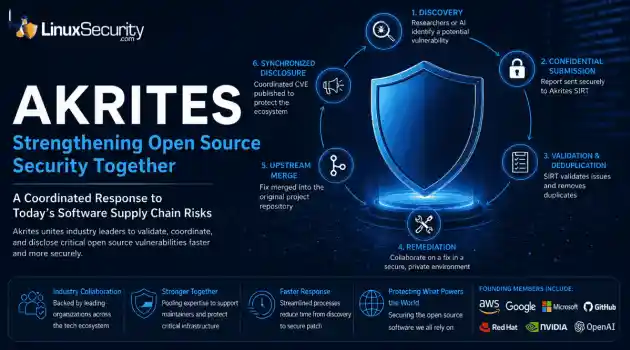
Security Projectssecurity advisory vulnerability management
security advisory vulnerability management The Linux Foundation has officially launched Akrites , a coordinated industry initiative designed to improve how critical open source vulnerabilities are validated, coordinated, and disclosed before patches reach downstream users. Backed by a diverse coalition—including AWS, Google, Microsoft/GitHub, Red Hat, NVIDIA, and OpenAI—Akrites establishes a shared Security Incident Response Team (SIRT) to streamline the validation, remediation, and disclosure of vulnerabilities in the foundational...
Jun 29, 2026
 Refine news
X Clear Filters
Get the latest News and Insights
Get the latest Linux and open source security news straight to your inbox.
Community Poll
Is application sandboxing truly safe?
Loading...
Explore Latest Linux Security news
We found 642 articles for you...
76
 security advisorysoftware designopen source
Linux Foundation and OpenSSF: CRA Compliance Impact on Security
As Linux security admins, staying abreast of evolving regulations is vital to ensuring the resilience and compliance of our systems. A recent initiative by the Linux Foundation Europe and OpenSSF to support implementation of the European Union Cyber Resilience Act (CRA) promises to transform how we manage security and compliance within the open-source software ecosystem by formalizing guidelines and tools that meet the stringent requirements set out by the CRA. . By mandating measures like secure software design, robust vulnerability reporting, and transparent Software Bills of Materials (SBOMs), our day-to-day operations will experience a noticeable shift towards more disciplined security practices. Let's examine this initiative and its implications for your Linux security administration and your systems' compliance with CRA's standards and regulations. Understanding the Cyber Resilience Act To fully appreciate this initiative, it is necessary to understand the Cyber Resilience Act (CRA) . Enforced since December 2024, this comprehensive regulation seeks to increase digital product and service security within Europe. CRA mandates that security must be integrated into software design processes from their inception, and developers must be held responsible for vulnerability reporting and management services within their products. Also, transparent software dependency lists with SBOMs are an integral element. As a Linux security admin, your job extends far beyond protecting the infrastructure within which your systems reside. It involves ensuring all software running on them also complies with these new standards. This requires reassessing how software is sourced, developed, and maintained while emphasizing proactive security measures and thorough documentation. Enhancing Security Practices The requirements set out by CRA have fundamentally transformed how we approach system security. One key implication of their requirements is to incorporate security from the onset of software design -known as "security by design." This concept ensures that security considerations do not become an afterthought but are integrated into every stage of software creation. Linux security admins must work closely with development teams to ensure security protocols are strictly followed from the outset, including regular code reviews, threat modeling, and testing of security features as part of the development process. Taking an early detection and mitigation approach to vulnerabilities reduces risks associated with potential exploits. As soon as the CRA was implemented, its significance became even clearer. The upkeep of systems cannot be underestimated. Regular software patches and updates to address known vulnerabilities are imperative to creating resilient infrastructure. Tools and guidelines developed under the Linux Foundation Europe/OpenSSF initiative will also play a significant role in supporting enhanced security practices. Management of Software Bills of Materials (SBOMs) A core requirement of the CRA is transparency in software dependencies through SBOMs . An SBOM provides a detailed listing of components and dependencies within the software, making tracking vulnerabilities easier and ensuring compliance with regulations such as the CRA. Linux security administrators responsible for managing SBOMs must implement tools that automatically generate and maintain these inventories, track open-source components, evaluate their security posture, and promptly respond to vulnerabilities in software supply chains. Becoming proficient at managing SBOMs assists compliance and strengthens overall software supply chains. Compliance Tracking and Management Ensuring compliance with CRA standards requires constant oversight of all software and devices in your infrastructure, which makes compliance tracking essential. Compliance tracking involves keeping detailed records of security measures, software updates, vulnerability management activities, etc., demonstrating adherence to thesestandards. Administrators must establish efficient methods for documenting compliance activities and being ready for audits, including clear records of patch management, vulnerability assessments, and security testing results. Tools and guidelines created through Linux Foundation Europe and the OpenSSF initiative provide invaluable resources to aid administrators in streamlining these compliance tracking processes. Collaboration and Community Involvement Collaboration is at the core of open-source communities, and this initiative puts that strength to use to its maximum. The Linux Foundation Europe and OpenSSF are working with numerous stakeholders, including companies like ARM, Ericsson, GitHub, Kusari, OpenJS Foundation, and Red Hat Rust Foundation. Through such close cooperation, tools and guidelines that are comprehensive yet broadly applicable can be created. Engaging actively with the Linux security community is vital. Subscribing to industry newsletters and tracking updates on social channels will keep you abreast of recent events and developments. Contributing open source projects supporting this initiative also offers an invaluable opportunity to collectively share knowledge and enhance security practices. Education and Adaption With cybersecurity becoming ever-more dynamic, ongoing education and adaptation are critical. The initiative by Linux Foundation Europe and OpenSSF brings new tools, frameworks, or best practices that administrators must adopt. Keeping current with these resources and learning about emerging security threats is paramount to success. Furthermore, the advent of the CRA marks a growing global trend toward tightening security regulations by adapting proactively to this shift in policies and adapting their systems as necessary to comply with current requirements while being prepared for potential security threats in the future. Our Final Thoughts on This Security & Compliance Initiative The partnership between Linux Foundation Europe and OpenSource Security Foundation to implement the Cyber Resilience Act marks a historic moment in Linux security administration. This initiative emphasizes the necessity of enhanced security practices, rigorous compliance tracking, and effective management of SBOMs, fundamentally altering how we approach system security. Linux security administrators can benefit by accepting these changes, actively engaging with the open source community's efforts, and accepting tools and guidelines being developed to meet CRA requirements - ultimately increasing supply chain security. As the cybersecurity landscape transforms, staying informed, gaining new knowledge, and adapting to evolving regulations will become increasingly critical. This initiative offers an ideal way of strengthening security practices on Linux systems in response to emerging threats - providing increased resilience against them. . Adhering to GAAP regulations is essential for system administrators to safeguard data integrity and respond to changing legislation.. Cyber Resilience Act, compliance tracking, open source security, software dependencies, secure software design. . Brittany Day
 Feb 10, 2025
•
Feb 10, 2025
• Organizations/Events
209
 open sourcecybersecurity trendsregulatory compliance
2025 Cybersecurity Challenges: AI Trends, Ransomware, IoT Security
Cybersecurity is more essential than ever as threats grow more sophisticated and defenses continue to evolve. In 2025, businesses and individuals alike face unique challenges requiring innovative strategies. This overview dives into the key cybersecurity trends shaping our current reality and provides actionable insights to bolster your defenses. . Rise of AI and Machine Learning in Cybersecurity Artificial Intelligence (AI) and Machine Learning (ML) have already made significant strides in cybersecurity, but in 2025, these technologies will become even more integral to threat detection and response. AI-powered tools are increasingly adept at analyzing vast amounts of data in real-time, identifying patterns, and predicting potential threats more accurately. AI-driven Threat Detection: Traditional security measures often struggle to keep up with sophisticated and rapidly evolving threats. AI systems, however, can analyze network traffic, detect anomalies, and respond to threats faster than human teams. In 2025, we can expect AI to become even more advanced, with improvements in natural language processing and behavioral analytics enhancing threat detection capabilities. In particular, generative AI-powered attacks, such as custom phishing emails, have added new dimensions to the threat landscape. Automated Incident Response: AI-powered automation is expected to revolutionize incident response. Automated systems can detect threats and initiate responses, such as isolating affected systems or blocking malicious traffic, without human intervention. This rapid response can significantly reduce the damage caused by cyber incidents. The Critical Role of Open Source: The rise of Artificial Intelligence (AI) and Machine Learning (ML) in cybersecurity has been significantly propelled by the open-source movement. Open-source software and tools have democratized access to advanced AI and ML technologies, allowing researchers, developers, and cybersecurity professionals tocollaborate and innovate without the constraints of proprietary systems. This collaborative environment has accelerated the development and refinement of AI algorithms and ML models that are essential for identifying, analyzing, and responding to cyber threats with unprecedented speed and accuracy. By leveraging open-source platforms, cybersecurity solutions can rapidly evolve in response to new threats, benefiting from the collective expertise and contributions of a global community. This communal approach to development not only fosters innovation but also ensures a broader, more inclusive evolution of cybersecurity technologies that can adapt to the ever-changing landscape of cyber threats. Moreover, the transparency inherent in open-source initiatives allows for the rigorous examination and validation of AI and ML models by a wide array of experts, ensuring that these technologies are robust, secure, and without hidden vulnerabilities. In parallel, organizations are exploring post-quantum cryptography to prepare for quantum computing's future impact on encryption. This aspect is particularly pertinent, given the increasing sophistication of cyberattacks and the potential for AI-driven systems to be exploited if not properly scrutinized. Open Source also facilitates a more equitable distribution of cutting-edge cybersecurity tools, enabling organizations of all sizes to defend themselves effectively against cyber threats. This has the added advantage of raising the overall security posture of the digital ecosystem, as even smaller entities can deploy advanced AI-driven defense mechanisms. Increased Focus on Zero Trust Architecture The Zero Trust model has been gaining traction in recent years, and its adoption is set to accelerate in 2025. Zero Trust operates on the principle of “never trust, always verify,” meaning that no entity, whether inside or outside the network, is trusted by default. Instead, every access request must be continuously validated. Micro-Segmentation : ZeroTrust involves segmenting networks into smaller, more manageable segments. This micro-segmentation limits the lateral movement of attackers within the network, reducing the risk of widespread breaches. In 2025, organizations will increasingly implement micro-segmentation to enhance their security posture. Continuous Monitoring and Verification : Rather than relying on perimeter defenses, Zero Trust emphasizes continuous monitoring of user behavior and device health. This approach ensures that access is granted based on up-to-date assessments of risk and trustworthiness. Expansion of Cybersecurity for IoT Devices The Internet of Things (IoT) continues to proliferate, with over 25 billion connected devices entering homes and businesses. However, many IoT devices are notoriously vulnerable to cyberattacks due to inadequate security measures. Enhanced IoT Security Standards : In response to the growing threat, 2025 will see increased efforts to establish and enforce robust security standards for IoT devices . Manufacturers and regulatory bodies will work together to ensure that IoT devices are designed with security in mind, incorporating features such as encryption and secure authentication. Network Segmentation for IoT : To mitigate the risks associated with IoT devices, organizations will adopt network segmentation techniques to isolate these devices from critical systems. This approach limits the potential impact of a compromised IoT device on the broader network. Growth of Ransomware and New Mitigation Strategies Ransomware attacks have surged in recent years, and the trend is expected to continue in 2025. Attackers are using increasingly sophisticated tactics, such as double extortion and even triple extortion, where attackers target victims' customers or partners to amplify pressure. Ransomware Preparedness : Organizations will need to bolster their ransomware preparedness by implementing comprehensive backup strategies, ensuring that backups are stored offline or in immutableformats. Regular testing of backup restoration processes will also become a standard practice. Ransomware Negotiation and Payment Policies : Companies are likely to develop clearer policies regarding ransomware negotiation and payment. Some organizations may choose to work with cybersecurity firms specializing in negotiating with attackers, while others may adopt a no-payment policy to discourage the criminal industry. Rise in Linux Ransomware: Due to its widespread deployment across servers and backend systems, Linux ransomware represents an alarming trend that threatens corporate and cloud environments alike. As hackers have realized Linux's significance to businesses, they have developed ransomware variants specifically tailored to exploit vulnerabilities in this popular OS. As such, researchers and developers from within the cybersecurity community have increased efforts to fortify Linux environments. Strategies include regularly applying updates and patches to address known vulnerabilities, employing enhanced monitoring tools that detect suspicious activities that indicate ransomware attacks, and investing in reliable backup solutions that allow rapid recovery without incurring ransomware payments. Additionally, the community supports and advocates for best practices such as least privilege principles and multi-factor authentication. Open-source initiatives play an integral role by developing tools and sharing knowledge to facilitate early detection and mitigation of threats—thus encouraging a proactive rather than reactive security posture. Increased Emphasis on Cybersecurity Skills and Training As cyber threats become more sophisticated, the demand for skilled cybersecurity professionals continues to outpace supply. In 2025, the focus will be on addressing this skills gap through enhanced training and development programs. Upskilling and Reskilling Initiatives : Organizations will invest in upskilling their existing IT staff and providing specialized training forcybersecurity roles. Partnerships with educational institutions and online training platforms will become more prevalent, aiming to build a pipeline of skilled cybersecurity professionals. A great example is the range of online IT courses that provide accessible and practical pathways into cybersecurity and other IT fields. Awareness and Training for Employees : Beyond specialized roles, all employees will need to be educated about cybersecurity best practices. Regular training on topics such as phishing awareness, password management, and safe internet usage will be critical in reducing the risk of human error. Strengthening Cybersecurity Regulations and Compliance Regulatory bodies continually update and expand cybersecurity regulations to address new threats and vulnerabilities. In 2025, we can expect a more stringent regulatory compliance environment with increased enforcement and compliance requirements. Global Data Protection Regulations: With the rise of data privacy concerns, global data protection regulations will become more comprehensive. Organizations will need to stay abreast of international regulations such as the General Data Protection Regulation (GDPR) and the California Consumer Privacy Act (CCPA) , ensuring compliance to avoid hefty fines. New regulations such as the Digital Operational Resilience Act (DORA) in Europe are shaping how organizations must approach cybersecurity resilience. Industry-Specific Standards: Besides general data protection laws, industry-specific standards will gain prominence. Finance, healthcare, and critical infrastructure sectors will face more rigorous cybersecurity requirements tailored to their unique risks. Our Final Thoughts on 2024 Cybersecurity Trends Cybersecurity will be shaped by significant technological advancements, shifting threats, and tighter regulatory oversight. Staying informed about trends and adopting proactive measures will allow organizations and individuals to strengthen their defenses against cyberthreats. Key strategies include leveraging AI and machine learning, adopting Zero Trust principles, securing IoT devices, preparing for ransomware, investing in cybersecurity skills, and adhering to regulatory standards. Collaboration and vigilance are essential for maintaining a strong and adaptable cybersecurity posture in this dynamic environment. . Examine prominent cybersecurity developments in 2025, focusing on artificial intelligence, ransomware tactics, and Internet of Things vulnerabilities, to bolster your protective strategies.. Cybersecurity Trends, AI Tools, Ransomware Preparedness, IoT Security, Open Source Innovations. . Brittany Day
Jan 22, 2025
•
Security Trends

209
security practicessocial engineeringopen sourceOpenSSF & OpenJS Warning: Social Engineering Risks Affecting OSS Security
As the backbone of much of the world's technological infrastructure, the open-source community prides itself on transparency, collaboration, and innovation . However, these strengths can also present vulnerabilities, as seen with the notorious XZ Utils backdoor. . Recently, social engineering attacks targeting open-source projects have emerged as a significant threat. The Open Source Security Foundation (OpenSSF) and OpenJS Foundation have issued alerts highlighting attempts to manipulate project maintainers into granting unauthorized access or introducing malicious code. These incidents underscore the need for heightened awareness and robust defenses among Linux admins, developers, and open-source project maintainers. Let's examine these recent warnings and actionable strategies you can implement to combat this concerning trend. Understanding The Nature of Social Engineering Attacks Social engineering attacks exploit the human element of security, relying on deceit and manipulation rather than technical exploits. Attackers typically pose as legitimate contributors or community members, using friendly and persuasive tactics to build trust over time. The ultimate goal is often to gain maintainer status or convince existing maintainers to accept harmful changes. This method can be particularly effective in open-source environments where collaboration and trust are foundational. Recognizing Suspicious Activity To combat these threats, we must be able to recognize the patterns of social engineering attacks. Persistent, friendly engagement from relatively unknown contributors aiming for high-level access should raise red flags. Additionally, endorsements from unfamiliar accounts or networks can signal coordinated deception efforts. Pay close attention to pull requests (PRs) containing obfuscated code or binaries that lack transparency. Such changes can be vehicles for introducing malicious payloads. Security admins must remain vigilant for deviations from standard build and deploymentpractices that could compromise security. If a contributor creates a false sense of urgency, pushing for expedited reviews or immediate changes, take a step back and scrutinize their motives. Strengthening Authentication and Access Controls Strong authentication methods are one of the best ways to safeguard against attacks. Two-factor or multifactor authentication (MFA) can add another layer of protection, making it much harder for attackers to gain unauthorized access. Password managers provide additional security and ensure passwords are strong, unique, and not reused across services. Administrators should store recovery codes safely offsite to regain control if their accounts become compromised. Ensuring Code Integrity The review and merging of code can be critical points of vulnerability. Enabling branch protections and insisting on signed commits can help maintain the integrity of a codebase. Code reviews are required from a second developer before merging, even for changes proposed by maintainers. This additional step can catch potentially harmful alterations before they’re integrated into the project. It’s also essential to enforce readability requirements for new code. Obfuscated code or binaries hidden within a pull request can introduce significant security risks. By ensuring all changes are human-readable, maintainers can better understand the logic and purpose behind each modification, making it easier to spot malicious intent. Periodic Reviews and Minimal Permissions Administrative practices also play a crucial role in defending against social engineering attacks. Regularly review the list of committers and maintainers to verify their ongoing involvement and legitimate status within a project. Removing inactive or unnecessary accounts can reduce the risk of hijacking dormant accounts. Limiting npm publish rights and other critical permissions to trusted individuals can further minimize risk. Ensuring that only a small, trusted group can make significant changesreduces the number of potential entry points for attackers. This principle of least privilege is a fundamental aspect of a security posture. Establishing and Following Security Policies A clear and comprehensive security policy is a cornerstone of protecting open-source projects. This policy should include protocols for coordinated disclosure, providing a transparent process for reporting and addressing vulnerabilities. By establishing these guidelines, maintainers can ensure that any discovered issues are handled systematically and securely. It's also imperative to align with industry standards for security best practices. Resources like the OpenSSF Guides provide valuable insights and frameworks to help maintainers enhance their security posture. Regularly updating and reviewing these policies ensures they remain relevant and effective in the face of evolving threats. Leveraging External Support No project is an island; the broader open-source community offers resources and support. Foundations like The Linux Foundation and OpenJS Foundation can provide valuable assistance and technical resources. These organizations can offer guidance and security reviews and help coordinate responses to security incidents. Alpha-Omega and Sovereign Tech Fund provide financial and technical support tailored explicitly toward strengthening the security of open-source projects. Participating projects gain access to funding and expertise by joining these programs, significantly boosting their defensive capacities. Fostering Vigilance To guard against social engineering attacks, open-source communities should create an atmosphere of vigilance. Communication channels must remain open between maintainers and contributors while encouraging transparency among contributors. Creating an atmosphere where maintainers and contributors feel comfortable reporting suspicious activities can help detect and mitigate threats early. Training and awareness programs also play a vital role in keepingprojects secure. Informing maintainers and contributors about social engineering attacks, their signature tactics, and how to recognize them can significantly bolster project defenses. Regular security training sessions consider these risks and prepare everyone involved if suspicious activities emerge. Our Final Thoughts on These Warnings Open-source communities' collaborative nature is their greatest strength and weakness, creating opportunities and risks. As social engineering attacks become more sophisticated, Linux security admins must take proactive measures to safeguard their projects against takeover attempts by recognizing suspicious activity, strengthening authentication and access controls , assuring code integrity, and enlisting external support to decrease takeover risk. Through vigilance, transparency, and community collaboration, the integrity and security of open-source projects can be maintained to ensure they continue to flourish and innovate over time. The joint alert from OpenSSF and OpenJS Foundation is an essential reminder that while the collaborative spirit of open-source projects is invaluable, their security must also be protected with robust measures and proactive approaches. By adopting these best practices, Linux security admins can ensure their projects remain safe from current and emerging digital threats. What measures are you taking to secure your open-source projects? Reach out to us @lnxsec and let us know! . Manipulation tactics target community-driven software; implement effective measures to strengthen defenses and resilience.. Open Source Security, Social Engineering Threats, Security Practices, Code Integrity, Community Collaboration. . Brittany Day
Jan 15, 2025
•
Security Trends
209
 open sourcenetwork reliabilitycybersecurity management
Reflecting on 2024 Trends: AI, Open Source, and ITOps for Linux Security
As we head into 2025 and reflect back on 2024, Linux security admins' roles and responsibilities are evolving rapidly with defining trends like the pervasive integration of AI technologies and their hefty storage needs and the growing prominence of open-source observability tools. . Admins must stay ahead by understanding and adapting to these shifts and trends. For instance, we admins must leverage eBPF's capabilities for advanced security and monitoring and employ sophisticated methods to measure and mitigate downtime. With increased IT spending amidst overstretched teams, the challenge is strategically investing in reliable network infrastructures and effectively balancing cybersecurity responsibilities. By embracing and learning from these trends, Linux professionals can ensure robust, efficient, and secure IT operations in 2025 and beyond. Let's examine some of the key ITOps trends of 2024 and how you can use these insights to improve your Linux security administration heading into 2025. Integration and Management of AI Systems Artificial Intelligence (AI) continues to advance, offering solutions designed to boost IT operations. However, with each opportunity comes challenges. One such challenge lies in choosing appropriate AI tools and ensuring they fit smoothly with existing systems. As Linux administrators, selecting suitable technologies requires careful evaluation for customizability and integration capabilities with current setups. Integrating AI is about finding ways to reduce complexity rather than increase it, such as with automation tools powered by AI that automate repetitive tasks, freeing IT teams' time for more pressing matters. Finding an AI tool that fits perfectly with your operational requirements and security protocols is the key to successful implementation. Managing AI Storage Needs AI workloads have brought enormous storage demands, particularly those using Machine Learning models that must store vast amounts of data. Not only must there besufficient storage capacity, but it must also comply with any relevant compliance and data management practices. Administrators must carefully plan their storage solutions to ensure data remains accessible and safe. Hybrid cloud solutions may prove helpful, providing AI workloads with scalability while still offering robust security features. Compliance with regulatory requirements is also key, protecting organizations against legal complications or data breaches. Embracing Open Source Observability Versatile, cost-effective observability tools that give valuable insight into system performance and reliability are essential for Linux systems. Open-source observability solutions are particularly appealing due to their flexibility and community support, enabling administrators to tailor monitoring and logging specifically to their needs - something proprietary tools may not allow. By employing these tools, you can gain greater insights into your system's behavior while quickly identifying issues - keeping your Linux systems running efficiently and smoothly. Utilizing eBPF for Security and Observability eBPF (Extended Berkeley Packet Filter) has become integral to increasing Linux system security and observability. By enabling custom code execution within the kernel without changing or adding modules, this technology offers both improved security and performance benefits. Understanding and integrating eBPF is key to providing more granular monitoring and security measures, including real-time system performance observability that allows Linux administrators to enhance security monitoring with advanced threat detection methods, optimize system performance, and debug issues more effectively - making it an essential tool for maintaining secure yet efficient IT environments. Measuring Downtime and Performance Downtime and performance issues were once easy to identify. However, we now face a more subtle phenomenon known as "invisible" downtime that may not immediately manifest but canhave serious ramifications over time. Advanced application monitoring techniques are crucial in detecting hidden issues with applications and systems. By employing sophisticated monitoring solutions , you can gain deeper insights into application performance while tracking any subtle anomalies or potential threats that could affect business operations and ensure they can be addressed before becoming significant problems. Reducing Network Reliability Issues Reliability is at the core of modern IT operations. Reliable network infrastructure is key for maintaining uptime and overall system performance. When selecting network providers, Linux admins should choose providers who offer robust yet dependable services. Assessing network reliability involves considering factors like uptime guarantees, service level agreements (SLAs), and provider track records. Choosing a network provider with a strong infrastructure and proven performance can decrease downtime risks while ensuring IT operations run efficiently. Regularly reviewing and testing network performance is also key in maintaining high reliability, allowing rapid responses when problems arise. Aligning IT Spending With Overstretched Teams IT spending has seen a modest rebound, offering opportunities to invest in new technologies and infrastructure. But even this doesn't negate that IT teams often work beyond regular hours to keep systems operating smoothly. As budgets increase, it's vitally important that companies use them wisely to invest in tools and technologies that add real value and efficiency. This may involve automation tools that reduce manual workload, advanced security solutions to protect IT assets, or training programs for staff to upskill in new technologies. Workload management strategies are critical to prevent burnout and keep team morale high, such as hiring additional staff, outsourcing certain functions, or investing in team-building activities that encourage healthier work-life balance. By meeting the needs ofyour team members, you can ensure they remain productive and engaged, ultimately benefitting operations as a whole. How to Manage Cybersecurity Responsibilities Cybersecurity remains an ever-increasing priority, and IT professionals often shoulder additional cybersecurity responsibilities alongside their primary roles. While this dual responsibility may seem daunting at first, navigating it successfully takes skill and dedication from IT admins who must successfully balance both tasks. Companies looking to reduce cybersecurity strain on IT professionals should invest in dedicated teams. Encouraging upskilling IT staff with cybersecurity training could prove equally effective. Awareness and preparedness are crucial in combatting cyber threats and regular training sessions, staying abreast of the latest security trends , and instituting robust security practices can go a long way toward protecting Linux systems. Our Final Thoughts on 2024 ITOps Trends Impacting Linux Security Administration For Linux security admins and IT pros navigating the changing landscape of IT operations in 2024, understanding and adapting to key trends will be very important. AI should be welcomed while its storage demands are managed, open-source observability tools like eBPF should be leveraged for enhanced monitoring, subtle performance issues must be measured for network reliability purposes, and spending must not exceed team workload. These are all areas to focus on for maximum protection into 2025 and beyond. By remaining proactive and responsive towards these changes, Linux security professionals can ensure their systems remain safe and efficient while preparing for future challenges. . Prepare for 2025 by embracing AI advancements, addressing storage needs, and utilizing monitoring solutions for Linux cybersecurity.. ITOps trends, AI technologies, eBPF integration, open source tools, network infrastructure. . Brittany Day
Jan 01, 2025
•
Security Trends
209
 open sourcecyber defensethreat detection
The Role of AI in Cyber Defense: Enhancing Security and Response
The technology is advancing at an unprecedented rate, fueling cybersecurity concerns. Experts have gone the extra mile to tackle this issue, but they will not realize AI's potential to deal with cyber threats. . Let's face it: Machine learning, data analytics, and automated response systems enable this intelligent tech to process vast amounts of information quickly and efficiently, surpassing human capabilities. They improve threat detection and response time and enable organizations to anticipate risks before they develop into serious incidents. AI technology is revolutionizing how organizations defend against threats such as phishing attacks and ransomware attacks , improving defense capabilities against all kinds of security issues. In this article, we'll outline artificial intelligence development's many roles in improving cybersecurity by exploring its capacities for proactive threat identification and effective vulnerability management. An Overview of Modern Cybersecurity Challenges Cybersecurity refers to safeguarding digital systems, networks, devices, and programs against any form of malicious attack, unauthorized access, or data breach that might threaten them in an increasingly digital world. Securing technological assets has never been more essential. These cyber-threats range from basic phishing scams to ransomware attacks, which can have devastating outcomes. Data theft, financial loss, privacy violations, and system downtime are just a few potential outcomes of system integrity breaches. Traditional security measures, such as firewalls, antivirus software, and intrusion detection systems , have traditionally provided digital protection. However, their capabilities often can't keep pace with cybercriminal innovation or sophistication—such as more stealthy attacks using advanced malware that bypass traditional detection methods—nor with all of the data and transactions going online, making monitoring and protecting everything efficiently an uphill struggle. Relying solely on traditional security measures is no longer sufficient. Organizations must adopt an all-encompassing and proactive cybersecurity strategy that includes multilayered defense strategies, cutting-edge technologies like Artificial Intelligence and Machine Learning for threat detection, and regular patching or updates for known vulnerabilities. How Does AI Impact the Cyber Security Domain? For an artificial intelligence development company, staying informed about how cybersecurity has changed since AI is necessary. AI in Open Source Security AI is reshaping open-source security by improving vulnerability detection, mitigating threats, and analyzing vast datasets. Traditional methods, like manual code reviews, often fail to address complex cyber threats. AI tools like OWASP Nettacker and the Artificial Intelligence-Driven Software Vulnerability Scanner automate vulnerability detection by continuously scanning repositories, identifying risks, and suggesting fixes. This accelerates response times and strengthens codebase security. In addition, AI excels at automating threat responses. Platforms like Snort leverage AI to identify network traffic anomalies and mitigate real-time risks. This reduces the burden on human teams while ensuring faster action against sophisticated attacks. AI also transforms data analysis. Open-source tools like ELK Stack (Elasticsearch, Logstash, Kibana) employ machine learning to sift through massive security logs, flagging critical anomalies that could otherwise go unnoticed. These capabilities make AI indispensable for organizations relying on open-source systems, especially in the context of national security. Given the widespread use of open-source technology across industries, AI integration is not just an advantage—it’s essential for fortifying systems against evolving cyber threats. AI Threat Detection Traditional security relies on predefined rules and signatures to detect threats. This approach was effective in the past butis no longer effective because it feels short-sighted when faced with new and unknown threats. Due to this concern, AI is now a valuable asset in threat detection. It possesses advanced ML algorithms that continuously analyze data in real time to spot unusual patterns or breaches immediately. AI rapidly recognizes things that humans would otherwise miss, such as suspicious user activity and unfamiliar network activity. Artificial intelligence development experts quickly flag employees logging on at unusual hours or accessing files without authorization as suspicious activity - helping prevent potential unauthorized access before it happens! It learns from past data to detect new attacks, such as zero-day exploits that otherwise might go undetected. Automating Responses AI has again shown its worth by automating responses to cyber attacks. As security alerts flood in, human teams often become overwhelmed; AI automatically assesses each threat's severity before taking necessary actions. This intelligent tech quickly responds to sophisticated ransomware attacks by isolating infected systems from networks and stopping the further spread of the infection. Those who automated cyber threat responses have a solid improvement in mitigating cyber threats quickly and minimizing loss due to them. Predictive Analytics AI does more than just react to attacks; it predicts them. By applying predictive analytics driven by AI, large volumes of data can be analyzed to identify looming vulnerabilities and emerging attack patterns ahead of time and give early warning of cyber threats in general. Predictive analytics also helps organizations prepare contingency plans, improving their ability to pre-emptively neutralize risks. AI can identify weak points within an organization's infrastructure and helps rank orders of where patches are needed first. This proactive approach helps organizations take steps to prevent the attack before it happens and avoid a costly breach. StrengthenAuthentication Systems Authentication is a cornerstone of cybersecurity, yet traditional password-based methods no longer suffice. AI technology offers more secure yet convenient authentication solutions such as biometric recognition and behavioral biometrics for added peace of mind. AI-enhanced authentication systems are constantly evolving to counter new hacking techniques, ensuring user security remains a step ahead. AI-powered authentication includes fingerprint scans, facial recognition software, and keyboard typing analysis to verify users. Adding multiple layers of verification using AI makes it much more difficult for cybercriminals to gain unauthorized entry. AI-driven authentication systems leverage continuous learning to refine their accuracy and detect unusual login patterns, further strengthening security. AI constantly adapts and learns as it recognizes patterns in how users interact with systems, making breaches even harder. If you're exploring modern authentication tools that can help secure your systems, this overview of top identity verification software is a helpful resource to compare leading solutions in the space. Fraud Detection/Prevention Where rapid detection of suspicious behavior is crucial, artificial intelligence is also making tremendous progress toward fraud prevention in sectors such as banking and e-commerce. AI-powered fraud detection systems may, therefore, progressively learn from every new transaction to identify minor trends suggesting possible hostile conduct. AI's analytical abilities enable it to rapidly examine transaction patterns for anomalies—such as abnormally high transactions or requests for user location—that would point to fraudsters working behind them. Every transaction teaches AI, and over time, it may become even more skilled at spotting fraud. Integrated with machine learning models, fraud detection technologies find dishonest behavior and adapt to new frauds. By leveraging artificial intelligence technology, businesses canquickly detect and prevent fraud, minimizing losses and safeguarding both consumers and organizations. Advanced Malware Detection Unfortunately, malware authors simply adapt and find new methods to evade their discovery while making traditional security techniques lose their effectiveness. On top of that, it becomes an answer: Intelligent systems focus not just on their known malware signatures but also on detecting specific behavior. If certain things sound suspicious- for example, actions about encrypting files- the communicational activity with unidentified outward servers- AI would characterize it as malware based upon earlier detections; it has never seen anything different. To Sum Up The promising role of artificial intelligence development in enhancing cybersecurity can’t be overstated. AI has completely changed our approach to cyber threats from detecting to predicting future risks. The future is still uncertain. We might encounter many more complex digital threats that this intelligent technology will struggle to deal with. But for now, businesses must integrate and maximize security systems. . Explore how AI is revolutionizing cyber defense by enhancing threat detection, response, and vulnerability management.. technology, advancing, unprecedented, fueling, cybersecurity, concerns, experts. . MaK Ulac
Dec 26, 2024
•
Security Trends
209
 data breachLinux securityincident response
Why ITDR is Essential for Securing Linux in Identity-Based Threats
Identity-based attacks like login attempts from unusual geographic locations or at unexpected times, as well as enforcing MFA and maintaining detailed logs of all identity-related activities, are becoming more important as attacks against these systems become more prevalent. . Integrating Identity Threat Detection and Response (ITDR) into your security arsenal helps us identify and stop attacks that target user identities, a common entry point for hackers. But what is ITDR , and why is it so critical? For organizations using Linux systems—renowned for their security and versatility—ITDR provides an extra layer of defense, making it harder for hackers to infiltrate their networks. The user identification layer is the usual entry point for most attacks, and ITDR allows us to track and contain them there. Linux systems are well-known for their security and flexibility, and ITDR adds an extra layer of protection that will make hacking much more difficult for enterprises using these systems. Let's take a closer look at ITDR and its significance in a Linux setting. What is ITDR? Identity threat detection and response (ITDR) is a cybersecurity strategy and technology framework designed to detect, analyze, and respond to threats targeting identities. This approach identifies abnormal or malicious activity involving user credentials, privileges, and access patterns. Security teams often expand this layer further with identity security platforms that monitor authentication patterns, detect compromised credentials, and provide visibility into privileged account activity across Linux environments. ITDR complements other cybersecurity technologies, such as endpoint detection and response and network security solutions, by explicitly addressing vulnerabilities and attacks targeting identity systems. Benefits of ITDR for Linux Systems HIDTR is always looking for security risks on your Linux systems. Its advanced analysis can detect suspicious behavior in real-time, allowing you to take actionbefore a catastrophic breach happens. An identification theft prevention system (IDTR) lessens the likelihood of data breaches and their possible consequences by aggressively controlling identity-based attacks, helping to Improve Security. Helps Improve Incident Response ITDR will help shorten your response time in case of a security problem. It will save you time by immediately identifying risks with real-time monitoring capabilities. Security teams can expedite recovery by analyzing system logs and user behavior to determine the cause of incidents and the extent of damage. Helps Reduce Operational Costs IDTR can automate many routine security tasks, allowing your security team to focus on more strategic initiatives. By preventing and mitigating attacks, ITDR also helps minimize system downtime and avoid costly business disruptions. Linux: A Target for Attackers As Linux systems have taken center stage in enterprise environments, especially in servers, cloud platforms, and DevOps, they've attracted the attention of malicious actors. Key vulnerabilities include: Privilege escalation: Attackers exploit vulnerabilities to gain administrative access to Linux systems. Weak SSH keys: Compromised or mismanaged Secure Shell keys can allow unauthorized access. Insider threats: Malicious insiders or human error can lead to identity misuse or data breaches. Configuration flaws: Misconfigured Linux servers are prime targets for exploitation. Integration with Open Source Monitoring Tools When integrated with popular open-source monitoring tools such as Prometheus, Grafana, and the ELK Stack, ITDR solutions benefit from an extended range of visibility, analytics, and incident response capabilities. Here's how these integrations can be implemented and the benefits they offer: Prometheus Integration Prometheus , a leading monitoring and alerting tool, is ideal for real-time collecting and analyzing metrics. ITDR solutions can leverage Prometheus by: Exportingmetrics: Import critical identity and access metrics into IT disaster recovery systems, as Prometheus-compatible metrics should include login abnormalities, privilege escalations, and failed authentication attempts. Custom rules and alerts: Defining custom alerting rules in Prometheus based on ITDR data, such as detecting unusual activity patterns or spikes in login failures. Centralized visualization: Integrating Prometheus with Grafana (discussed below) to visualize ITDR metrics in dashboards makes detecting identity-based threats easier. Grafana Integration Grafana ’s powerful visualization capabilities complement ITDR solutions by providing intuitive dashboards for monitoring identity-related metrics and trends: Data aggregation: By combining ITDR indicators with other system metrics in Grafana, we can get the whole picture of the Linux environment's security and health. Interactive dashboards: Building interactive dashboards to display ITDR data, such as authentication trends, geolocation heatmaps for logins, and role-based activity monitoring. Cross-domain insights: Combining ITDR data with infrastructure metrics like CPU or memory usage to correlate identity-based threats with system anomalies for deeper insights. ELK Stack Integration The ELK Stack offers robust log aggregation, processing, and visualization capabilities, making it an excellent choice for ITDR solutions: Log enrichment: Using Logstash to ingest and enrich identity-related logs from ITDR tools, such as audit logs, access attempts, and policy violations, with contextual data. Centralized log storage: Storing enriched ITDR logs in Elasticsearch for fast querying and correlation with other security data. Threat detection dashboards: Building Kibana dashboards to visualize identity-based threat data, such as anomalous login attempts, unauthorized privilege escalations, and suspicious lateral movement. Proactive querying: Crafting Elasticsearch queries to identifypatterns indicative of identity-based threats, triggering alerts, or automated responses. Role of Container Security in ITDR Kubernetes , a powerful container orchestration platform, introduces unique security challenges due to its dynamic and multi-layered nature. Serious security breaches can occur due to misconfigurations involving service accounts, nodes, pods, and container workloads, all requiring certain access privileges. Attackers can take advantage of exposed API endpoints, permissions that have been over-provisioned, and compromised credentials that are kept in configuration files. One way to make Kubernetes environments far more secure is to use an Identity Threat Detection and Response framework. Integrating with Kubernetes Role-Based Access Control, Threat Detection and Response (ITDR) aids in enforcing least-privilege access, guaranteeing that workload identities and service accounts possess only the essential authorizations. Additionally, ITDR can monitor identity-related telemetry to spot suspicious activity, such as unexpected privilege escalations or attempts at unauthorized access. To further strengthen security, ITDR can integrate with external tools like HashiCorp Vault or AWS Secrets Manager for secure secret management. Organizations can significantly minimize the attack surface by reducing the risk of hardcoding sensitive information. Impact of ITDR on Compliance and Regulatory Requirements That is to say, recording access and activity logs, essential compliance features, are precisely what Information ITDR does to Linux systems. The concept of least privilege protects sensitive data and systems from unauthorized access with granular access controls. ITDR's real-time threat detection capability helps decrease the risk of non-compliance fines by letting them recognize and mitigate possible security incidents much quicker. Also, automated reporting translates to ease of compliance documentation that furnishes clear evidence of following laws. ITDR supports thedata breach notification requirements by delivering rapid incident reports on breaches under GDPR ; under HIPAA and PCI DSS, ITDR protects protected health information and payment card information through multi-factor access controls. Integrating the functionality of ITDR on your Linux infrastructure will proactively let you stay compliant, ease up auditing, and reduce or even eliminate the risks of breach of any regulations in nature. How ITDR Boosts Linux Security ITDR is a powerful tool that strengthens Linux security by focusing on a crucial area: identity and access management. This layer is often overlooked, but it's a major target for cyberattacks. Let's see how ITDR helps safeguard your Linux systems: Proactive Threat Detection ITDR is like a vigilant guard, constantly monitoring your system for suspicious activity. It spots anomalies like: Login attempts from unfamiliar locations Unusual privilege escalations Tampering with critical system files By catching these red flags early, ITDR helps you to react swiftly before a breach can take hold. Enhanced Credential Protection One of the most common ways hackers infiltrate Linux systems is by stealing credentials. ITDR protects your credentials by: Keeping a close eye on SSH key usage and flagging unauthorized access Detecting phishing attacks designed to trick users into revealing their passwords Automatically locking out compromised accounts to prevent further damage Securing Privileges Linux systems often have users with varying levels of access. ITDR ensures that these privileges are used responsibly by: Stopping privilege escalation attempts in their tracks Providing a clear view of all privileged user activities Implementing strict least-privilege policies to limit access to only what's needed A 360-Degree View of Identity ITDR offers a comprehensive overview of identity-related activities across your Linux systems. This bird's-eye view helps you understand howidentities interact with system resources and identify potential vulnerabilities. Compliance Made Easier With ITDR, compliance efforts are made easier for firms in regulated industries. You may meet legal obligations and demonstrate accountability with the help of ITDR, which enforces secure identity management procedures and generates extensive audit records. By protecting Linux systems from intrusion, ITDR goes above and beyond the call of duty by fixing an often-overlooked but critically important security hole: identity management. ITDR protects your Linux infrastructure from constantly changing cyber threats by actively identifying them, safeguarding credentials, and maintaining least-privilege policies. Take immediate action to safeguard your systems and safeguard your organization's future—don't wait for a breach to reveal the weaknesses in your defenses. . Implementing ITDR within your Linux environment strengthens protection against identity-centric attacks and boosts the efficiency of incident management.. Identity Threat Detection, Linux Systems, Incident Management, Security Framework, Identity Protection. . MaK Ulac
Nov 29, 2024
•
Security Trends
74
 data protectionopen sourcemalware analysis
Harnessing Proxies for Threat Intelligence Using Open Source Tools
Sensitive corporate data can be stolen at this very second; unfortunately, breaches can be invisible. As cyber threats multiply at an exponential rate, reacting to them like before no longer works. The answer lies in more innovative threat intelligence that enables preemptive action. The stakes are high: the 2024 IBM Cost of a Data Breach report shows that the average breach costs $4.45 million, and 82% of organizations suffer multiple breaches. However, many incidents never get reported, sometimes because of inadequate monitoring that leaves them undetected. Take, for example, a security analyst tracking suspicious traffic to an unfamiliar domain. Using a proxy, they uncover a phishing attack targeting sensitive company credentials. Without the right tools, that threat might have gone unnoticed. This guide will walk you through exactly how proxies can be combined with advanced, open-source tooling to revolutionize threat intelligence and posture you to anticipate and neutralize cyber threats before they strike. The Role of Proxies in Threat Intelligence Proxies are essential in threat intelligence, as they always enable researchers to analyze traffic without direct exposure to malicious traffic. For example, ISP proxies , which come directly from internet service providers, mimic real user traffic, making the threat investigation more authentic and less likely to raise suspicion. Key Functions of Proxies We all know how critical it is to stay ahead with regard to threats. Proxies are the trump card in this persistent fight. They can act like an additional pair of eyes when investigating network traffic without revealing our presence to any adversary. If you can tap proxies within the security framework, early warnings of malicious intent, if any, could be noticed, anomalies unmasked, and vulnerabilities pointed out with third-party compliance. Traffic Analysis Analyzing the incoming and outgoing data , proxies assist the researchers in identifying howmalicious actors behave and where the threats are located. They can also identify anomalies or suspicious data transfers that can help in Infrastructure protection to avoid breaches. Anonymity and Deception A proxy allows people to conceal their IPs and locations for research or investigations. It also helps security teams replicate users' behavior and collect intelligence about suspected threat actors’ activity, which helps researchers better study threats. Malware Analysis Proxies can be used to safely handle the links or files, probably required for research work, which could be harmful because the researcher is protected from the direct implications of the proxies. It also captures other important information related to malware activity and interaction, such as with CnC servers, which can be helpful when conducting investigations. Traffic Analysis with Proxies Threat identification and mitigation are essential parts of traffic monitoring and analysis. Proxies add an extra layer of security to prevent the researcher's system from being compromised. Importance of Monitoring Incoming and Outgoing Traffic Staying vigilant with network traffic is crucial to our roles as Linux and IT admins. Monitoring incoming and outgoing traffic lets you catch early signs of malicious activity, safeguarding our systems before threats escalate. Analyzing traffic patterns will enable you to spot anomalies such as data exfiltration , phishing attempts, or malware communications, giving you valuable insights into potential security breaches. Effective traffic surveillance helps identify the weaknesses in a network that an attacker can use to their advantage and ensure that practices are aligned with industry standards and government regulations to avoid fines for non-compliance. You can further enhance your monitoring using proxies for an added layer of security so the threat intelligence stays strong and our systems are better protected. Traffic analysis, with the help of tools like squid andMITM proxy, helps keep your network infrastructure secure and, as such, makes it more effective. If you know the complete concepts of overall traffic monitoring, that can definitely help you in the proactive defense of our networks by keeping our organizational data intact. Early Threat Detection : It is effective in traffic surveillance as it can detect noticeable signs of malicious attacks and control them before they become serious risks. Anomaly Identification : When both inbound and outbound traffic are monitored, information exfiltration, data theft, phishing, or malware traffic can be spotted. Vulnerability Identification : Traffic analysis provides insight into the network organization, discovering potential risks attackers may otherwise exploit. Compliance Monitoring : Traffic standards, best practices, and government regulations can help an organization avoid penalties arising from non-compliance. Open Source Tools for Traffic Analysis As fellow Linux admins, we have learned how to have the proper tools on one's side for any occasion. In the case of traffic analysis, it is barely possible to do without open-source solutions from Squid or Mitmproxy. Squid does its job well in monitoring web traffic, thus helping you efficiently notice unusual patterns. Mitmproxy is probably better for deep analyses of encrypted HTTPS traffic. These utilities continue to enable you to locate and reroute threats and provide community-driven support upon which we depend to protect our systems. Let's dive into how these open-source solutions can amplify our threat intelligence efforts. Squid Squid is a powerful HTTP server and cache that is ideal for web traffic analysis. It empowers security specialists to track and analyze web requests to distinguish irregularities. Mitmproxy Short for Man-in-the-Middle Proxy, Mitmproxy is an ingenious interactive HTTPS proxy that allows the researcher to monitor, alter, and analyze web traffic in real-time. One of the tool's most significantstrengths is its ability to evaluate encrypted traffic, which cyber criminals frequently employ to hide their activities. Ensuring Anonymity and Deception The identity of the parties involved in threat intelligence investigations should be protected. This safety is done by masking an IP address and location, thereby bringing the advantages of proxies and assisting a researcher in gaining access to dangerous sites or tracking a suspect without revealing the individual’s identity. Importance of Anonymity for Security Researchers Protection from Retaliation : This keeps the persons involved in research unknown to the attackers, thereby minimizing attacks or harm. Safe Exploration of Malicious Domains : Researchers can access and work with potentially malicious sites, threads, or files without endangering their authentic selves or systems to cybercriminals. Unbiased Data Collection : This allows researchers to capture data without influencing or changing attacker behavior, developing better threat intelligence. Open-Source Tools for Anonymity Tor (The Onion Router) Tor is perhaps the most famous network for anonymizing connections to the Internet using multiple volunteer-operated servers located globally. Another advantage of Tor is its extensive coverage, which is useful for blending in and avoiding detection during investigations. Malware Analysis with Proxies Analyzing malware is an integral part of threat intelligence, and using proxies is a good practice when working with potentially harmful content. They help researchers analyze traffic between the hosting of malicious websites and infected hosts, allowing the discovery of Command and Control (C&C) servers or other IoCs. Proxies offer a controlled environment required to investigate malware and its behaviors, including its transmission and communication. This is critical when identifying the best strategies to contain a practically unobservable threat. Safely Analyzing Malicious Websitesand Downloads Proxies are beneficial in safely researching and studying potentially risky websites and files. They are a barrier between the researcher and threats. With such websites, proxies capture and forward the traffic and keep the researcher’s system from malicious activity. Likewise, proxies assist in tracking downloads. Although they allow the researcher to examine malicious files, they do not permit their running on the researcher’s network. This isolation is crucial in malware analysis and threat intelligence, as the operative space is restricted and controlled. Open-Source Tools for Malware Analysis For us Linux and IT admins, having the right tools to dissect and understand malware is crucial. ClamAV and Av matching, combined with the Cuckoo Sandbox, are game-changers as open-source solutions in this arena. ClamAV brings robustness in terms of scanning and detecting malicious software at an antivirus level, whereas Cuckoo Sandbox maintains the environment for runtime dynamic analysis, observing malware behavior. Such tools allow you to save yourself from threats, share your findings with the community, and fortify your systems. Let's see how the usage of these open-source tools can increase our capability for malware analysis and defense. Cuckoo Sandbox Cuckoo Sandbox is an automated malware analysis system that emulates an environment for running files/URLs suspected of being malicious in nature. By integrating proxies like Squid or Mitmproxy, Cuckoo Sandbox can intercept the network traffic arising out of malware execution and produce a detailed report on the malware's activities. Integrating Proxies with Threat Intelligence Platforms Incorporating proxies with threat intelligence platforms adds value and efficiency to cybersecurity security. A proxy is a highly valued collection point for monitoring web traffic, malicious behavior, and indicators of compromise. When incorporated with systems like MISP (Malware Information Sharing Platform) or OTX (OpenThreat eXchange), proxy information enhances threat intelligence by mapping these internet traffic and domain-specific peculiarities with collective threat information. Enriching Threat Data with Proxy Logs Proxy logs contain helpful information that can help make threat intelligence more effective. When used with threat intelligence platforms, these logs can be run through the databases of known threats, and new threats and correlated patterns can be run against the previous attacks. Furthermore, proxy logs provide archival information, which is crucial for trace investigations conducted after an attack; this way, the teams learn threat tactics and improve their protection measures. Examples of Open Source Threat Intelligence Platforms Leverage threat intelligence platforms for active defense. MISP or OpenCTI are open-source and must be part of our toolkit. MISP allows organizations to share information about threats and correlate events, while OpenCTI is a sophisticated framework used for representing, managing, and analyzing knowledge about cyber threats. These platforms amplify our capabilities for threat detection while creating a collaborative environment where we share community-sourced intelligence to which we can contribute. Let's dive into how open-source platforms amplify our threat intelligence efforts. MISP (Malware Information Sharing Platform) MISP is one of the largest sources for sharing and correlating IoCs related to targeted attacks. Adding proxy logs into the mix will help other members add more context to the indicators shared via MISP by making them more accurate. For example, such proxy data can validate the fact that, yes, indeed, an IP address flagged as malicious is indeed pulling off malicious activities or is part of a botnet. Open Threat Exchange (OTX) OTX is a centralized threat-sharing platform that allows multiple organizations to exchange threat information. Proxy logs can be fed into OTX to give near real-time updates on active threats suchas new phishing campaigns or new strains of malware. Using Honeypots with Proxies When used with proxies, honeypots may also assist in detecting and analyzing malicious activities while guaranteeing that they do not impact the researcher’s natural systems. This setup is accompanied by proxies that log traffic between the attackers and the honeypot, which translates to possible attack methodologies, malware characteristics, and potential vulnerabilities in the system. Open-Source Honeypot Tools Honeypots are strategic methods of luring cyber threats for analysis. Cowrie and Dionaea are excellent open-sourced honeypot tools. Cowrie emulates a vulnerable SSH and Telnet environment that traps an attacker, while Dionaea catches malware by emulating vulnerable services. These will give an excellent insight into the methodology and pattern of the attack and enable you to control our security posture further. This helps you turn the tables against attackers and enhance our defenses through open-source honeypot tools. Let us now turn to how these help dig up and test threat intelligence effectively. Cowrie Cowrie is a medium-interaction honeypot that mimics SSH and Telnet servers. It can record all connections and the commands the attackers execute, which can shed light on the standard brute force attack strategies and methods for malware distribution. Dionaea Dionaea is another honeypot used to capture malware that targets system vulnerabilities. With the help of the proxy, Dionaea can safely forward the malicious traffic to the honeypot while the actual system remains unharmed. The proxy logs can also show trends in malware distribution—consecutive tries to scan certain software vulnerabilities, for example. Keep Learning about How to Harness Proxies for Threat Intelligence When it comes to threat intelligence, proxies are a completely irreplaceable tool. They allow the researcher to investigate and analyze traffic, remain anonymous, communicate with adversarial parties,and obtain valuable data, all while minimizing personal and system vulnerabilities. Coupled with open-source tools, proxies raise the bar of this service by offering cost-effective, adaptable, and community-supported solutions to multiple threat intelligence operations. Integrating proxies into your threat intelligence framework enhances your organization's security and helps combat increasingly advanced cyber threats. . . Utilize virtual private networks to amplify security insights through sophisticated publicly available software and proactive safeguarding methodologies.. threat Intelligence tools, proxies for analysis, open source security, malware investigation, traffic analysis tools. . MaK Ulac
Nov 24, 2024
•
Network Security
81
 open sourcesecurity updatesuser experience
Explore Tor Browser 14.0: Key Privacy Improvements and Linux Setup Guide
Tor Browser has long been recognized for providing anonymity online and is considered essential by privacy-minded users instead of conventional methods like VPNs (Virtual Private Networks) . Now, with its latest release of 14.0 , there is much to celebrate regarding privacy, security, and usability enhancements! . To help you understand the significance of this release and how downloading and testing out Tor 14.0 will improve your digital security, privacy, and anonymity, I'll explain the notable updates and improvements introduced in this monumental release and then walk you through how to download Tor 14.0 on your Linux systems. Let's begin by understanding Tor Browser and how it differs from a VPN. Understanding Tor Browser & How It Differs From a VPN Tor is built upon onion routing technology for anonymous communication across computer networks. Tor uses over seven thousand relays as its encryption layer of choice. Each relay adds additional encryption layers that protect users and obscure their source and identity. While both provide users with anonymity online, their methods vary considerably. VPN providers create tunnels through which you access internet traffic masked with IP addresses belonging to them, but providers can still see your traffic. However, due to its multilayer encryption approach, Tor prevents anyone from learning your location or browsing habits - including relays. Tor Browser 14.0: What's New? The Tor Browser 14.0 release contains numerous changes designed to empower users with enhanced privacy, security, performance, and usability. The most notable updates and improvements include: Upgraded Foundations Tor Browser 14.0 has upgraded its foundation by migrating to Firefox Extended Support Release 128 (ESR 128) . This is an important milestone, as it ensures the browser has integrated one year's worth of Firefox updates into its architecture and becomes even stronger against online threats while offering a more user-friendly experience. EnhancedSecurity Tor has improved security by addressing over 200 vulnerabilities found in Firefox code that could threaten user security. Furthermore, new typography aims to enhance both readability and accessibility to make Tor more secure and easier on the eyes. One of the update's core features is Encrypted Client Hello (ECH) . As its successor to Server Name Indication encryption, ECH seals gaps that allow network observers to monitor which websites users are accessing despite using HTTPS encryption . Tor's developers have also enhanced its user agent spoofing capabilities, which obscure a user's browser and operating system. This makes it harder for websites or individuals to track them across various websites (cross-site tracking) or identify them through browser fingerprinting, a technique in which websites collect data about your device for identification purposes. Usability Improvements Tor Browser 14.0 introduces a new circuit feature for Android, increasing flexibility and control. Suppose users experience connectivity issues with a website. In that case, they can now request a relay circuit directly within the app without needing new identification, improving both accessibility and usability of the browser on the go for all. Known Issues and Transparency Tor Project's commitment to transparency extends to their disclosure of known issues with each release. Users running their browser in compatibility mode on Windows may experience discrepancies in OS reporting that make Windows 10 and 11 appear as Windows 7. Therefore, switch off compatibility mode before updating to ensure a smooth transition during any updates. Tor 14.0 offers excellent support for legacy systems, providing critical updates for older versions of Windows and macOS. Installing Tor Browser 14.0 on Linux Linux users, known for their dedication to open-source software and privacy, tend to take the lead when adopting security-focused updates such as Tor Browser 14.0 on Linux machines. Installing it shouldbe relatively straightforward: just follow the steps below. Navigate to Tor Project's official website and locate its download section for Linux systems. Install the Tor Browser package compatible with your Linux distribution. Extract the archive. Ensure that LANG corresponds with your preferred language abbreviation and that x64 becomes x32 if running a 32-bit Linux system. Access the newly extracted Tor Browser folder and initiate its setup by double-clicking on its icon or running start-tor-browser.desktop from within a terminal session. This setup will guide you through a quick configuration process to help ensure optimal privacy settings based on your requirements. Once completed, you can browse privately and securely using Tor Browser 14.0. Have you given Tor Browser 14.0 a try? How has your experience been so far? We'd love to hear what you think of these updates and improvements! Reach out to us on X @lnxsec and let us know. Our Final Thoughts on the Tor Browser 14.0 Release Tor Browser 14.0 marks an impressive step forward in the browser's evolution, strengthening privacy, security, and user experience for every platform user. This latest iteration further illustrates Tor's dedication to online anonymity while assuring users' digital footprints remain secure across devices. Linux users can use Tor's straightforward installation process to stay ahead of privacy and security threats. With Tor 14.0, users gain a comprehensive toolset to navigate online while confidently keeping their identities hidden. . Discover key improvements in Tor Browser 14.0 for privacy and security, plus installation guidance for Linux users!. Tor Browser, Privacy Features, Security Improvements, Linux Installation, Open Source Browser. . Anthony Pell
Oct 28, 2024
•
Privacy

Get the latest News and Insights
Get the latest Linux and open source security news straight to your inbox.
Community Poll
Is application sandboxing truly safe?
Search Topics
Powered By

Linux Security - Your source for Top Linux News, Advisories, HOWTOs and Feature Releases
QUICK LINKS
subscribe to newsletters!
Like staying secure? So do we.
Sign up for updates, tips, and alerts!
Discover faster search, smarter navigation, and deeper Linux security insights. Read More