



Security Vulnerabilities  security advisory authentication
security advisory authentication We often view OpenSSH security updates through the lens of standard patch management. When a new CVE hits, we scramble to update, check our versions, and return to business as usual. But recent vulnerabilities tied to distribution-added OpenSSH GSSAPI patches are a reminder that the danger doesn't always lie in the core code; it often resides in the "convenience" features we layer on top. . These recent issues shouldn't just trigger an apt upgrade or dnf update; they should trigger a...
 Jul 06, 2026

Security Trends privilege escalation Linux security
privilege escalation Linux security Linux security teams are drowning. Patches, kernel updates, new CVEs every week. SSH exposed here, an old web service there, and a forgotten cron job running as root. On top of that, SIEM dashboards blink all day with alerts that all claim to be “high priority.” . It’s no surprise that people stop paying attention. The real problem isn’t a lack of data. It’s the opposite. Too much noise, not enough signal. Security teams see huge lists of vulnerabilities and thousands of alerts, but very...
Jul 06, 2026

Cloud Security incident response Linux administration
incident response Linux administration Over the span of just 14 days, threat actors unleashed more than 81 million login attempts against Microsoft’s Azure command-line interface (CLI). The campaign , which security researchers at Huntress identified as an ongoing, automated password-spraying effort, successfully compromised at least 78 Microsoft accounts across 64 organizations between June 12 and June 26, 2026. . While the scale is massive, the underlying strategy is surprisingly surgical. Attackers aren't exploiting a flaw in...
Jul 01, 2026

Security Trends security update mobile security
security update mobile security Offensive Security just dropped Kali Linux 2026.2 , and at first glance, it looks like a standard quarterly refresh. You’ve got the usual kernel bumps, desktop environment updates, and a handful of new utilities. But don't write this off as just another routine version update. If you look past the changelog, this release highlights several capabilities that continue to be important in offensive security. From AI-assisted workflows to credential testing and mobile assessments, Kali Linux 2026.2...
Jun 30, 2026
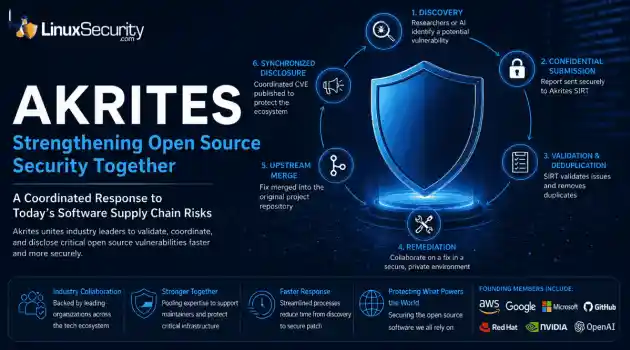
Security Projectssecurity advisory vulnerability management
security advisory vulnerability management The Linux Foundation has officially launched Akrites , a coordinated industry initiative designed to improve how critical open source vulnerabilities are validated, coordinated, and disclosed before patches reach downstream users. Backed by a diverse coalition—including AWS, Google, Microsoft/GitHub, Red Hat, NVIDIA, and OpenAI—Akrites establishes a shared Security Incident Response Team (SIRT) to streamline the validation, remediation, and disclosure of vulnerabilities in the foundational...
Jun 29, 2026
 Refine news
X Clear Filters
Get the latest News and Insights
Get the latest Linux and open source security news straight to your inbox.
Community Poll
Is application sandboxing truly safe?
Loading...
Explore Latest Linux Security news
We found 6 articles for you...
209
 security implicationslinux distributionslinux software
Exploring Linux Software Packages for Quantum Computing Technologies
The intersection of Linux and quantum computing has become increasingly apparent, emphasizing the importance of Linux-based operating systems in developing and deploying quantum computing technologies. As quantum computing technology advances, there is a growing need for operating systems that can support quantum computing frameworks. . Linux has emerged as an ideal OS for quantum computing thanks to its robust security, customization, and compatibility. Let's explore Linux's central role in quantum computing advancements and notable Linux software packages for quantum computing. We'll begin by discussing quantum computing basics. What Is Quantum Computing? How Does it Differ from Regular Computing? Quantum computers are fundamentally different from classic computers. The classic computer chip relies on millions of transistors, either on or off. Quantum computers, however, use qubits in place of transistors. These qubits can be in several states simultaneously thanks to quantum mechanical principles such as superposition and entanglement. A qubit can be either in an on or off state or a combination. This allows for a wide range of processing possibilities. Quantum computers are excellent at solving some problems, but they won't replace classic computers. The Increasingly Vital Role of Linux in Quantum Computing Quantum computing is rapidly evolving, showcasing its potential to solve complex problems that are practically impossible for classical computers, thus sparking curiosity about the practical applications of quantum computing in various fields. For instance, major tech companies like Google and IBM have substantially invested in quantum computing. IBM makes their quantum computers available online, allowing anyone to learn about quantum computing and run workloads through quantum logic gates. Linux's increasing role in quantum computing has become increasingly apparent. Linux's open-source nature has enabled the development of operating systems that are both flexible and robust,making them inherently compatible with most quantum computing software and tools. As quantum computing technology becomes more affordable and accessible, Linux distributions must ensure integration with quantum computing processing units and peripherals, raising questions about the security implications of integrating quantum computing systems with Linux infrastructure. Linux's customizability, compatibility, open-source community, and security attributes suit quantum computing applications well. However, this raises questions about how Linux will adapt to the evolving security concerns and specialized drivers needed for quantum computing hardware. What Linux Software Packages Exist for Quantum Computing? Various software packages for Linux have been engineered specifically for quantum computing. Some of the most notable include: Qiskit: Qiskit , IBM's Python-based framework for quantum computing development, is a toolkit for circuit simulation and design. It is well-known and widely used because it is compatible with multiple Linux distributions. QuTiP: The Python software package " QuTiP " is short for "Quantum Toolbox Python." It allows simulations of quantum computing. QuTiP uses the NumPy NumPy library to simulate quantum computing systems. It works with Linux distributions and is often used in quantum optics and quantum information science. ProjectQ: ProjectQ is a Python-based quantum computing framework that simplifies the development of quantum algorithms and applications using APIs and abstractions. It is compatible with the majority of Linux distributions and supports a variety of quantum backends. Our Final Thoughts on Linux's Role in Quantum Computing It is increasingly critical to understand Linux's evolving role in quantum computing and its potential impact on Linux admins and infosec professionals globally. Thanks to its open-source roots, Linux is an ideal quantum computing OS due to its robust security, customization, and compatibility. Weexpect Linux to become an increasingly central part of Quantum computing advancements in the coming years. . Unix-based systems play a crucial role in machine learning, providing robust reliability and integrative capabilities for cutting-edge applications.. Linux Quantum Computing, Open Source Frameworks, Quantum Software Packages. . Brittany Day
 May 26, 2024
•
May 26, 2024
• Security Trends
67
 security advisorynetwork securitycryptographic solutions
Linux Foundation and PQCA Collaborate for Robust Post-Quantum Security
The Linux Foundation recently launched its partnership with the Post-Quantum Cryptography Alliance (PQCA). This open and collaborative initiative aims to address the data and network security challenges that quantum computing presents by developing and adopting quantum-resistant cryptography.. It is paramount that organizations implement robust cryptographic solutions that can withstand attacks in network security through advancements in quantum computing. The PQCA brings together industry leaders, researchers, and developers to support sensitive data security and improved communications in the post-quantum era. This article will discuss quantum computing, PQCA, and the possible implications of the launch. What is Quantum Computing? Who Supports PQCA? Quantum computing combines various scientific fields to solve network security issues more efficiently and effectively. Computer science, physics, and math contribute to a successful cloud security framework, and quantum computing uses each aspect in its comprehensive solutions. PQCA has support from founding members such as Amazon Web Services (AWS), Cisco, Google, IBM, and NVIDIA. These industry giants understand the value of post-quantum cryptography cybersecurity and how correspondence can enhance secure cryptographic solutions during development. Matthew Campagna, Senior Principal Engineer at AWS, states, "Post-quantum cryptography is an emerging area of cryptographic security that AWS has already started to invest in… By joining the PQCA, we will be able to promote better the development of the open standards and software that will be essential to help advance the state of the industry and keep customer data secure." PQCA is a worthwhile organization that can help improve the security posture of any online company. What Security Implications Does PQCA Have? Our PQCA launch has a few setbacks that could shortly lead to certain network security risks. Here are the concerns and tactics we must keep in mind while working with PQCA: As quantum computing evolves and develops, current cryptographic algorithms may harbor cybersecurity vulnerabilities that can lead to challenges if an attack occurs. Security practitioners must stay on top of potential network security threats and improve security posture by implementing cryptographic solutions to prevent issues from harming quantum computers. Linux admins, infosec professionals, and sysadmins must keep up with the latest information security news to update their servers with the most recent quantum-resistant cryptography. PQCA has various technical cybersecurity projects that involve developing, evaluating, prototyping, and deploying new post-quantum algorithms so that every industry can benefit from their services. These secure solutions can help organizations increase their credibility and boost their reputation. Security practitioners must evaluate the issues organizations may encounter when transitioning to post-quantum cryptography and devise strategies to ensure their business has a smooth, secure migration. PQCA supports cryptographic agility and aligns with the U.S. National Security Agency's Cybersecurity Advisory concerning the Commercial National Security Algorithm Suite 2.0. Therefore, companies collaborating with PQCA must understand the impact of cryptographic standards on new post-quantum algorithms. Understanding the possible setbacks and the necessary reminders to utilize post-quantum computing is vital to improving security posture and helping your business thrive. Our Final Thoughts on the PQCA Launch The Linux Foundation Post-Quantum Cryptography Alliance enhances how valuable robust cryptographic solutions can improve data and network security in the face of quantum computing advancements. PQCA aims to develop and adopt post-quantum cryptography by collaborating with security practitioners. These professionals, including Linux admins, infosec users, internet security enthusiasts, and sysadmins, must actively participate in and follow PQCA's work toensure the newest cryptographic solutions are secure, beneficial, and robust. Before transitioning to post-quantum cryptography cybersecurity, businesses must evaluate the cryptographic agility of the software to ensure they have long-term data and network security and communications in the post-quantum era. . Strong encryption mechanisms are essential for mitigating the risks associated with the rapid evolution of quantum technologies.. Post-Quantum Cryptography, Network Security Solutions, Data Protection. . Brittany Day
Feb 07, 2024
•
Cryptography

79
 open sourcesoftware developmentmachine learning
Google Introduces TensorFlow Quantum: Bridging Classical And Quantum AI
Google today launched TensorFlow Quantum (TFQ), an open-source library for prototyping quantum machine learning models. . Quantum computers aren’t quite mainstream yet, but when they arrive they’ll need algorithms. TFQ fills that Gap by making it possible for developers to create hybrid AI algorithms that use both classical computing techniques and quantum computer circuit simulations. According to a blog post from Google AI: TFQ provides the tools necessary for bringing the quantum computing and machine learning research communities together to control and model natural or artificial quantum systems; e.g. Noisy Intermediate Scale Quantum (NISQ) processors with ~50 – 100 qubits. The link for this article located at The Next Web is no longer available. . Quantum advancements require innovative methodologies, and TensorFlow Quantum facilitates the fusion of classical AI with quantum technologies. Learn more!. TensorFlow Quantum, Quantum Machine Learning, Hybrid AI, Open Source Library, AI Development. . LinuxSecurity.com Team
Mar 10, 2020
•
Security Projects
78
 IBMquantum computingcloud technology
IBM’s 53-Qubit Quantum Computer Now Available In The Cloud
IBM has boosted its growing stable of quantum computers with a new 53-quantum bit (qubit) device, the most powerful ever offered for commercial use. Learn more in a great Naked Security article: . Google announced a more powerful 72-qubit ‘Bristlecone’ model last year, but that was for its internal techies only. IBM’s, by contrast, feels significant because it can be used by absolutely anyone who can find a use for such a computer. The new and still-to-be-named computer will sit in the company’s Quantum Computation Center in Poughkeepsie, New York State, which has recently turned into a hotbed for commercial development. The link for this article located at NakedSecurity is no longer available. . IBM's new 53-qubit quantum computer is now available in the cloud for anyone to use, enhancing quantum capabilities.. boosted, growing, stable, quantum, computers, 53-quantum, (qubit), device. . LinuxSecurity.com Team
Sep 20, 2019
•
Vendors/Products
79
 quantum computingcloud servicesprocessor design
IBM Launching 53-Qubit Quantum Computer At NY Data Center
IBMcontinues to push its quantum computing efforts forward and today announced that it will soon make a 53-qubit quantum computer available to clients of itsIBM Q Network. The new system, which is scheduled to go online in the middle of next month, will be the largest universal quantum computer available for external use yet. . The new machine will be part of IBM’s new Quantum Computation Center in New York State, which the company also announced today. The new center, which is essentially a data center for IBM’s quantum machines, will also feature five 20-qubit machines, but that number will grow to 14 within the next month. IBM promises a 95 percent service availability for its quantum machines. IBM notes that the new 53-qubit system introduces a number of new techniques that enable the company to launch larger, more reliable systems for cloud deployments. It features more compact custom electronics for improves scaling and lower error rates, as well as a new processor design. The link for this article located at TechCrunch is no longer available. . Google is preparing to unveil a 72-qubit quantum processor at its advanced Quantum Research Facility in California later this month.. Quantum Computing, IBM, Qubit Technology, Cloud Services. . LinuxSecurity.com Team
Sep 18, 2019
•
Security Projects
209
 cybercrimelaw enforcementemerging technology
Emerging Tech Threats: AI, Quantum Computing, and 5G's Impact on Cybercrime
Like all thinks, there are both benefits and risks associated with AI, quantum computing and 5G. Law enforcement needs to be innovative and act now in order to keep face with near future criminal threats, warns 'Do criminals dream of electric sheep' paper. . Artificial intelligence, quantum computing, 5G and the rise of the Internet of Things are just some of the emerging technologies that could aid cybercriminals in ways that could make them more dangerous than ever – and law enforcement must innovate quickly in order to help keep citizens safe, a new report has warned. Published by Europol, the 'Do criminals dream of electric sheep: how technology shapes the future of crime and law enforcement' report – the title of which references the work of science fiction writer Philip K. Dick – explores the consequences that emerging technology could have for cybercrime. The link for this article located at ZDNet is no longer available. . Artificial intelligence, quantum mechanics, and 5G networks could empower malicious activities; it's essential for authorities to safeguard the public.. Artificial Intelligence, Quantum Computing, Cybercrime Threats, Law Enforcement Innovations, Emerging Technologies. . Brittany Day
Jul 19, 2019
•
Security Trends
67
 data securitycryptographyencryption impact
Quantum Computing Threatens 2048-Bit RSA Encryption Security
Many people worry that quantum computers will be able to crack certain codes used to send secure messages. The codes in question encrypt data using “trapdoor” mathematical functions that work easily in one direction but not in the other. That makes encrypting data easy but decoding it hugely difficult without the help of a special key. . These encryption systems have never been unbreakable. Instead, their security is based on the huge amount of time it would take for a classical computer to do the job. Modern encryption methods are specifically designed so that decoding them would take so long they are practically unbreakable. The link for this article located at MIT Technology Review is no longer available. . These encryption systems have never been unbreakable. Instead, their security is based on the huge a. people, worry, quantum, computers, crack, certain, codes, secure. . LinuxSecurity.com Team
Jun 03, 2019
•
Cryptography
67
 cybersecuritycryptographyencryption technology
NSA's $80 Million Quantum Computing Project: A New Encryption Threat Ahead
The U.S. National Security Agency is attempting to build a new breed of supercomputer that theoretically could make short work of cracking most keys used for encrypted communications. . The project to build "a cryptographically useful quantum computer" is part of an $80 million research project called "Penetrating Hard Targets" that is taking place at a campus in College Park, Maryland, according to The Washington Post. The newspaper quoted documents it said were provided by former NSA contractor Edward Snowden. The link for this article located at Network World is no longer available. . The endeavor to construct 'a practically applicable quantum device for encryption' is part of a $100 million research program launched by the CIA.. Quantum Computing, Encryption Security, Cybersecurity Innovations. . LinuxSecurity.com Team
Jan 03, 2014
•
Cryptography

Get the latest News and Insights
Get the latest Linux and open source security news straight to your inbox.
Community Poll
Is application sandboxing truly safe?
Search Topics
Powered By

Linux Security - Your source for Top Linux News, Advisories, HOWTOs and Feature Releases
QUICK LINKS
subscribe to newsletters!
Like staying secure? So do we.
Sign up for updates, tips, and alerts!
Discover faster search, smarter navigation, and deeper Linux security insights. Read More