Overly broad permissions can turn one compromised account into a much larger security problem. Learn how to reduce unnecessary access, review privileges, and apply least privilege across modern Linux systems. Review Linux Privileges×



Security Vulnerabilities  security advisory moderate
security advisory moderate For organizations that run a self-hosted Git platform, it’s no longer just about hosting static code repositories. Today, Git servers are responsible for deployment pipelines, API tokens, SSH keys, package repositories, and the automation scripts that push code directly. Confirm that the upgrade addresses known vulnerabilities but also provides production environments. . That makes them trusted systems within the development environment and attractive targets for attackers looking to move...
 Jul 20, 2026

Server Securitydata privacy automation
data privacy automation Every system admin has lived through the same Monday morning ritual. A queue of forty tickets, half of them password resets, permission errors, or disk space warnings that any experienced technician could resolve in under two minutes. The other half require actual judgment. For years, automation promised that software would eventually sort the two apart on its own. That promise is now being tested in production Linux environments. . Early results are reshaping how IT teams think about tier-1...
Jul 17, 2026

Privacydata collection automation
data collection automation You're running a web scraping project to collect pricing data from e-commerce sites. You set up a pool of datacenter proxies, launch your scripts, and within minutes — banned . CAPTCHAs everywhere. Your data pipeline stops before it really begins. . It's a frustrating scenario that plays out daily in ad verification, market research, and multi-account management. The website doesn't know you're doing legitimate research or monitoring. It just sees traffic coming from IP ranges it recognizes as...
Jul 17, 2026

Security Trends security advisory social engineering
security advisory social engineering Business Email Compromise used to be a numbers game — mass-blasted emails, broken English, an obvious "URGENT WIRE TRANSFER" subject line. That era is over. Generative AI has turned BEC into a tailored, low-noise operation that mimics writing style, voice, and even video presence. This piece looks at what's actually changed under the hood, what defenders are testing in response, and why so many organizations are still structurally unprepared for it. . The Infrastructure Problem Nobody Wants to...
Jul 17, 2026

Security Trends cybersecurity Linux documentation
cybersecurity Linux documentation Linux operating systems have gained prominence due to their stability, adaptability, and excellent security options. In the case of developing documentation, designing cybersecurity dashboards, or educational material, visuals are of vital importance when it comes to making things clear. The use of icons allows one to understand the message regarding alerts, authorization, encryption, authentication, or the state of the system just by looking at the visual cue without having to read long...
Jul 17, 2026
 Refine news
X Clear Filters
Get the latest News and Insights
Get the latest Linux and open source security news straight to your inbox.
Community Poll
Should Linux servers automatically install security updates?
Trending News
Loading...
Explore Latest Linux Security news
We found 77 articles for you...
74
 open-sourcepythonlinux
How Supply Chain Attacks Continue to Threaten Open-Source Software
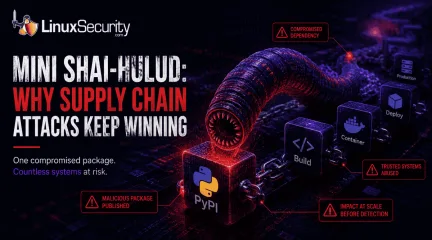
Researchers recently identified another wave of malicious packages on PyPI linked to the broader Mini Shai-Hulud campaign, a worm-like supply chain attack that spread through trusted software packages. On the surface, the packages looked no different from thousands of others published to the repository each week. . Instead of trying to break into a target network directly, the attackers hid malicious code inside software that developers were already using. A few downloads are all it takes. Once a package enters a development workflow, it can end up in places far beyond the original system. That's what makes supply chain attacks difficult to ignore. A compromised package can end up in dozens of environments without the attacker ever interacting with the victim directly . The repository handles distribution. Dependency chains handle the rest. By the time someone figures out a package has been tampered with, the code may already be sitting in build systems, test environments, containers, or production workloads. What Happened? Researchers recently uncovered a new wave of malicious packages on PyPI linked to the broader Mini Shai-Hulud campaign. According to Socket's investigation , the attackers weren't relying on phishing emails or fake downloads. They were using software developers already trusted. A malicious Python package may initially compromise a developer workstation, but the impact rarely stops there. If the package becomes part of an automated build process, it can be incorporated into Linux containers, deployed through Kubernetes, or distributed across production servers without anyone noticing. The Approach : Instead of convincing users to download suspicious files, attackers insert malicious code into software people already trust. The repository remains legitimate, the package name remains familiar, and installation happens through normal workflows. The Targets : Research into the related Miasma and Mini Shai-Hulud activity found attackers targeting packagesused by developers, researchers, and technical users. Several affected projects were tied to scientific computing and development workflows, granting access to environments where source code, credentials, and deployment infrastructure are often concentrated. Trusted repositories have become a preferred target because they offer attackers a scale that traditional intrusion methods rarely achieve. Why Are Supply Chain Attacks So Effective? Supply chain attacks succeed because they abuse the trust already existing inside development environments. Developers trust official repositories, and organizations trust approved package managers. Build systems routinely download and install dependencies without requiring anyone to inspect every line of code. That trust creates an opportunity. Modern software development relies heavily on automation. Modern development pipelines are built around automation. Packages get pulled automatically, builds run automatically, and updates move through environments faster than most teams can review them. That works well until something malicious gets mixed in. A compromised package does not need a special path into the environment. It follows the same route as every legitimate dependency. Most organizations could not tell you everything sitting inside their dependency tree. There is simply too much of it. One package depends on another, which depends on five more, and somewhere down that chain, a bad update can end up in places nobody expected. Nobody installs malware on purpose. They install software they believe is safe. Why Linux Users Should Pay Attention Although the recent campaign involved Python packages on PyPI, the risk extends well beyond Python development. Many Linux environments depend heavily on open-source software. Developers install packages from trusted repositories every day. Build systems pull dependencies automatically. Containers often include software from dozens of different projects maintained by people spread across theworld. That creates a lot of trust points. A compromised dependency can end up in build systems, containers, development environments, and production workloads long before anyone realizes something is wrong. That is part of what makes supply chain attacks so effective. The attacker never has to touch the target directly. The repository handles distribution. The dependency chain handles the rest. A Systemic Trend: Beyond a Single Incident The malicious PyPI packages linked to Mini Shai-Hulud are only the latest example of a much larger problem. Over the past several years, attackers have repeatedly targeted the software supply chain instead of attacking organizations directly. The compromise of Codecov's software distribution process exposed customer credentials. The 3CX incident showed how a trusted software update could be turned into a delivery mechanism for malware. More recently, the attempted backdoor in the widely used XZ Utils project demonstrated how deeply attackers are willing to embed themselves in open-source ecosystems before making a move. The techniques vary, but the objective rarely changes. Sometimes the target is a package repository. Sometimes it is a developer account, a source code repository, or a CI/CD environment. In every case, the goal is the same: gain access to software before it reaches users. That shift matters. Attackers are spending less time looking for individual victims and more time looking for distribution points. Compromise something trusted, and the reach comes with it. The Mechanics of Modern Supply Chain Attacks Most supply chain attacks begin with access. Attackers obtain developer credentials, compromise maintainer accounts, abuse publishing infrastructure, or gain a foothold inside environments responsible for software distribution. Once inside, the process is streamlined: Insertion : Malicious code is injected into legitimate package updates. Trusted Workflow : Attackers use existing development processes to movemalicious code toward end users. Automated Distribution : A compromised package is pulled into development environments, incorporated into automated builds, packaged into containers, and eventually pushed into production. Each step appears routine because the software originates from a source users already trust. The speed is what makes these incidents difficult to contain; by the time malicious activity is detected, affected packages may already exist across multiple environments and organizations. Key Takeaways for Linux Administrators and Developers The lessons from these incidents are not limited to Python developers. Anyone responsible for Linux systems, cloud workloads, or software delivery pipelines should view package repositories as part of their attack surface: Perform Regular Reviews : Dependency reviews should be routine. Unused packages should be removed rather than left sitting inside production environments. Secure Developer Accounts : Developer accounts deserve the same protection as administrative accounts. Multi-factor authentication (MFA) should be enabled, especially for maintainers responsible for publishing software. Increase Visibility : Organizations should monitor package publishing activity and software entering their environments. Software composition analysis (SCA) tools can help identify risky dependencies before deployment. Monitor for Anomalies : Tracking package updates can provide early warning when trusted projects suddenly introduce unexpected behavior. The larger lesson is simple: Trust should not be automatic simply because software comes from an official repository. Conclusion The malicious PyPI packages linked to Mini Shai-Hulud will eventually disappear. The bigger issue will not. Open-source software is woven into modern infrastructure. Most teams could not realistically operate without it. That is why these incidents matter. The code arrives through a source everyone trusts, gets pulled into a workflow that looksnormal, and often spreads before anyone has a reason to question it. But incidents like this start much earlier in the process. The code arrives through a source that looks legitimate, gets pulled into a workflow that looks normal, and spreads before anyone has a reason to question it. That is what makes supply chain attacks difficult to defend against. The trust is already there. Related Reading Why Linux Supply Chain Attacks Are Becoming a Nightmare for DevOps Teams Why Software Supply Chain Security Matters in Linux Systems Debian 14 Requires Reproducible Builds for Package Integrity Enforcement Targeted Attacks on Open Source Maintainers Highlight Security Risks If you like this kind of Linux security coverage, subscribe to our newsletter for more updates, analysis, and practical tips. . Exploring the rise of supply chain attacks in open-source software, focusing on recent malicious Python packages on PyPI.. Supply Chain Attack, Open Source Risk, Python Software Security, Dependency Management, Security Best Practices. . MaK Ulac
 Jun 09, 2026
•
Jun 09, 2026
• Network Security
79
 memory safetysoftware securityChrome
Google Chrome and Rust: Elevating Security and Update Efficiency
As admins responsible for ensuring the security of critical Linux infrastructures, staying ahead of the curve means paying close attention to the technologies underlying our most crucial applications. Recently, Google made a significant shift in Chrome by switching FreeType with Skrifa (a Rust-based alternative). . Rust's built-in memory safety features offer notable security benefits, thus reducing risks from vulnerabilities due to memory bugs and providing greater protection from potential exploits on our systems. This represents a significant victory in preventing possible attacks. Transitioning to Skrifa isn't solely about security; it also facilitates faster and safer updates. Google's adoption of Rust represents an industry trend away from legacy languages toward ones that inherently promote safer code. For us Linux admins, this means better web font handling in Chrome and an indication that more Rust-based tools could make their way into our daily workflows. Embracing these changes could make our job of maintaining robust systems easier and more effective! Let's examine the significance of Google embracing Rust, how this recent shift will improve memory safety in Chrome, the broader industry-wide trend of increasing Rust adoption, and how this will impact our security and workflows as Linux admins. Why the Shift to Rust Matters The Rust programming language stands at the core of this transition, known for its strong emphasis on memory safety. FreeType was written using C, an extremely powerful yet notoriously vulnerable language susceptible to memory-related vulnerabilities such as buffer overflows and use-after-free errors. Rust is known for eschewing these vulnerabilities due to its strong emphasis on memory safety - a welcome change for security-minded users, developers, and admins! Rust was created specifically to counter these types of critical vulnerabilities. Its stringent compile-time checks and ownership system ensure memory errors are caught earlyduring development, virtually eliminating entire classes of bugs. These features make Rust an attractive choice for developers seeking secure code without compromising performance. Improved Memory Safety in Chrome Google has added the Rust font rendering library Skrifa to Chrome to improve its resilience against memory-related attacks. This provides Linux admins an added layer of protection against complex exploits of font rendering technology. By including Rust safeguards in production environments, the risk associated with Chrome vulnerabilities has been significantly decreased. This move by browser developers also underscores their broader commitment to security. Given how integral web browsers are to our online experience—from reading articles and banking online to shopping and entertainment—any steps taken to make them safer are steps toward providing us with a more secure online experience overall. Admins managing large fleets will appreciate fewer patches, lower risk profiles, and improved security hygiene. Agile and Secure Updates One of the less immediately obvious but incredibly important benefits of adopting a Rust-based library like Skrifa is the agility in development it brings. Rust’s framework allows for rapid iteration without the usual trade-offs between speed and safety. Proactive memory management reduces the need to backtrack and fix bugs that traditionally require extensive debugging. Google has emphasized that this move will allow them to roll out updates faster and with more confidence in their security posture. For Linux admins, fixes can be deployed swiftly when vulnerabilities are discovered. This is critical in an environment where zero-day vulnerabilities can lead to significant exposure if not addressed promptly. Ensuring Render Quality A common concern whenever a significant component of a widely-used application is replaced is the potential drop in quality or reliability. Google has preemptively addressed these concerns by conductingextensive pixel comparison tests to ensure that Skrifa’s output aligns with FreeType's. The goal is to maintain, if not improve, the render quality of web pages displayed in Chrome. Rendering is a fundamental aspect of the user experience. Inconsistent or poor-quality rendering can disrupt workflows and lead to user frustration. Google’s commitment to ensuring that Skrifa meets its high quality standards means that Linux admins can rest assured that this transition will not negatively impact the user experience. Continuous testing and refinement should maintain stable and reliable web browser performance. An Industry-Wide Trend of Embracing Rust Skrifa's adoption is part of a broader trend within the tech industry. Companies like Microsoft, Mozilla, and others have increasingly integrated Rust into their codebases. Its prevalence is especially apparent when security-centric projects require robust solutions. Rust's popularity stems from an increasing awareness that traditional languages like C and C++ are difficult to secure due to their growing software complexity. Memory safety issues consume significant resources for patching security vulnerabilities and ongoing maintenance and performance tuning. Rust offers an alternative option that enables high-performance, low-level code without the risks associated with its predecessors. The Future of Rust in Everyday Admin Work Understanding and adopting Rust can provide us Linux security admins with immense advantages. As more tools and components integrate Rust into their development, having a working knowledge of this language becomes increasingly indispensable. Familiarity with Rust can assist in understanding the security properties of new system components and their integration into existing infrastructures. Rust can provide an ideal language to augment or replace other essential system areas beyond web browsing, from kernel modules to user-space applications. By adopting Rust now, Linux administrators can stay ahead of the curve andbe prepared for future secure software development practices. Cost & Risk Reduction Rust's most obvious benefit lies in its potential to lower costs and risks associated with software vulnerabilities, including security breaches that are both financially costly and reputationally damaging. By selecting a language with minimal vulnerability vectors, companies can significantly decrease the likelihood of exploitative breaches occurring. Reduced frequency of security patches also translates to more stable systems. Frequent patches often require downtime and testing, which can disrupt operations, especially in environments that demand constant uptime. A more secure foundation means fewer emergency patches and a more predictable update schedule. Our Final Thoughts on Embracing Rust in Chrome for Enhanced Security and Stability Google Chrome's transition from FreeType to Skrifa marks an exciting step toward producing more secure software. As Linux security administrators, it's critical that we fully comprehend these changes and their relevance to our work. Adopting Rust for font rendering components not only strengthens security but also provides faster update cycles and consistent quality standards. Recognizing this as part of an overall industry trend can help us prepare for a future where Rust will play an increasingly central role. By staying informed and adaptable, we can ensure our systems remain resilient against new threats while providing a secure environment for users - creating a safer and more efficient digital ecosystem by applying best practices and technologies. We'd love to hear your thoughts and opinions on this exciting transition! Let's connect @lnxsec! . Network engineers can utilize Python's versatility in web servers to enhance security measures and simplify maintenance tasks.. Rust Programming, Memory Safety, Chrome Development, Software Updates, Linux Administration. . Brittany Day
Mar 24, 2025
•
Security Projects

76
 Linux administrationsoftware securityindustry report
Secure Software Development Education Report: Key Findings for Linux Admins
The Linux Foundation and Open Source Security Foundation recently published a report entitled "Secure Software Development Education 2024 Survey—Understanding Current Needs." This report highlights the urgent need for formalized training and education in secure software development. It was derived from an industry survey of nearly 400 software developers, which revealed significant knowledge gaps. . To help you understand what this report's findings mean for your Linux security administration, I'll walk you through the findings, their implications for Linux security, and practical recommendations for closing the secure software development knowledge gap. Breaking Down This Report's Key Findings Nearly one-third of all professionals involved in software development and deployment, whether software developers, committers, or maintainers, report feeling uninformed about secure software development. This statistic is alarming because these individuals are responsible for maintaining and creating the critical code that underpins organizations' applications and systems. David A. Wheeler, the Linux Foundation's director of open-source supply chain security , highlights the importance of this issue: "We've seen software vulnerabilities exploited with catastrophic results, which highlights the need for developers to have the necessary knowledge and skills to write secure code." The report highlights several barriers to learning about secure software development: Lack of time: Many professionals 58%) struggle to find the time to learn more due to their busy schedules. Lack of Training and Awareness: There is a large gap between the available resources and where to find quality training for 50% of respondents. Self-Directed Learning: Most (74%) respondents use self-directed methods, such as videos, books, and online tutorials. However, these can lack depth and structure compared to formal courses. Emerging Security Issues: As new challenges such as AI andsupply chain security become more critical, staying updated and continuing education is necessary. What Are the Implications of These Findings for Linux Admins? The findings of this report are particularly relevant for Linux admins and IT teams managing Linux systems. Linux environments are the foundation of many enterprise infrastructures, and these systems' secure development and maintenance are paramount. Linux administrators who do not have a solid understanding of secure software can expose their systems to vulnerabilities, which could lead to data breaches, system failures, and other disastrous events. Admins must stay up-to-date with the latest developments in the field. Anyone in the field should have a professional development plan with robust training and learning. Practical Recommendations for Addressing The Secure Software Development Knowledge Gap The report suggests several strategies to bridge the knowledge gap identified: Formal Training Programs: Industry-wide efforts must prioritize secure development education. OpenSSF and the Linux Foundation offer courses that cover secure software development. For example, OpenSSF provides a free course called "Developing Secure Software" (LFD121). These programs provide structured and in-depth information essential for building secure software. As Christopher "CRob," co-chair of OpenSSF Education Special Interest Group and chair of OpenSSF Technical Advisory Council, highlights: "The first step to addressing the problem of secure software development is to identify areas where additional training should be provided. It is important to make an effort to increase awareness of the available resources and the importance of secure software practices." Incentivize Training: Organizations should encourage their employees to participate in secure software development training by making it a component of their career development plans. This can be done through certifications or professional developmentcredits. Open Source Resources: OpenSSF, the Linux Foundation, and other organizations like LinuxSecurity.com provide valuable guides and learning materials . These resources are available to industry professionals to help them improve their knowledge and understanding of secure software practices. Collaborative Learning: Promote a culture that encourages knowledge sharing in teams and within the industry. Peer learning, mentorship, and collaborative projects are all ways to spread the word and embed secure practices into everyday workflows. Our Final Thoughts: What Are the Main Takeaways of This Report? The "Secure Software Development Education 2024 survey" is an important wake-up call to the industry. The report highlights a knowledge gap that, if left unaddressed, could have severe implications for software security worldwide. This is particularly important for Linux administrators, as they are usually at the forefront of maintaining the secure infrastructure within enterprises. The industry can overcome challenges by focusing on secure software development education. This will also increase awareness about available resources, encourage training and the use of open-source security tools , and cultivate a culture that promotes collaborative learning. The Linux Foundation's and OpenSSF’s commitment to providing high-quality, accessible training materials is an excellent example of the leadership required to close this knowledge gap. "Our research revealed that a lack of education is a critical challenge in secure software development. Practitioners don't know where to begin and learn as they go," says David A. Wheeler, emphasizing that the industry must make a concerted effort to promote secure development education as a top priority. By addressing the shortcomings of traditional education approaches, the software industry can better prepare itself to face ever-evolving security threats. This will ensure a safer future for all technology applications. .Recent studies reveal significant deficiencies in understanding secure coding techniques, which are impacting the management of security protocols within Linux environments.. Secure Software Development, Training Gap, Linux Administration, Software Security, Knowledge Sharing. . Brittany Day
Jul 18, 2024
•
Organizations/Events
76
 open sourcesecurity awarenesssoftware security
Linus Torvalds Discusses Hardware Errors and Community Trust at Summit
At The Linux Foundation's Open Source Summit North America , Linus Torvalds, the creator of Linux, discussed various topics related to Linux development and the challenges the open-source community faces. Torvalds addressed hardware errors, malicious developers, and the hype surrounding Artificial Intelligence (AI). . This analysis explores the implications of Torvalds' statements and their impact on Linux administrators, infosec professionals, internet security enthusiasts, and sysadmins. What Critical Points Did Linus Torvalds Address at the Open Source Summit? One of the intriguing points raised by Torvalds is the issue of hardware errors and the slow response from hardware manufacturers. He expressed frustration about the time it takes for hardware fixes to be implemented, stating, "We have five generations of hardware that we can't fix after the fact, and it will take another couple of years before the actual new hardware [arrives] that can help you work around the problem." This raises questions about the long-term consequences of relying on hardware solutions that cannot be easily updated or patched . It also highlights the importance of proactive hardware design and development to prevent security vulnerabilities. Another notable discussion revolved around the threat of malicious developers infiltrating open-source projects. Torvalds recounted an incident in which attempts were made to insert bad patches into the Linux kernel . While the open-source nature of Linux allowed these attempts to be identified and thwarted, Torvalds emphasized the importance of community vigilance, stating, "A healthy community is the best defense." This brings attention to the need for trust in the open-source community and the potential impact on the overall security of open-source projects. It is also ironic that Torvalds and Dirk Hohndel, Verizon's Head of the Open Source Program Office, expressed skepticism towards AI hype. Torvalds dismissed AI as "autocorrect on steroids," highlighting the needfor caution when embracing AI technologies. This raises questions about the vulnerabilities that may arise from overreliance on AI solutions in security and administration. Additionally, Torvalds acknowledged the potential benefits of AI in bug detection and tool development but emphasized the importance of waiting for the technology to mature and prove its worth. Our Final Thoughts on Torvalds' Statements This article's critical analysis of Torvalds' perspectives reminds Linux administrators, infosec professionals, and sysadmins that no technology or community is immune to challenges and potential threats. We aim to spark curiosity and encourage readers to question the long-term consequences of hardware limitations, the trustworthiness of open-source projects, and the possible risks associated with emerging technologies like AI. As technical practitioners, it is vital to stay updated on these issues , engage in community support, and approach new technologies with a critical eye, ensuring the security and stability of the systems we manage. . At the recent Open Source Summit, Linus Torvalds voiced critical concerns about hardware reliability and trust in the open source community, stressing transparency and collaboration.. Open Source Summit, Hardware Errors, Linux Development, Community Trust, AI Security. . Anthony Pell
Apr 18, 2024
•
Organizations/Events
209
 security practicesLinux distributionsoftware security
Linux Distros Must Prioritize Security in Open Source Supply Chains
Open source is everywhere ; a Synopsys study found that 96% of all software code bases analyzed included open-source software. That’s the good news. Ironically, it’s also the bad news, as the very pervasiveness of open source introduces risk. . Decades ago, proprietary players used to spew disingenuous fear, uncertainty, and doubt around open source security, but they may finally have a point. Not at the individual project level where critics once wrongly focused their case, but rather in supply chains, as massive vulnerabilities like SolarWinds and Log4j remind us that we still have essential open source security work to do. Most enterprises have gotten very mature at network and perimeter security, but are still juvenile in their understanding and workflow around open source provenance and software supply chain security. Hackers have shifted their attention towards not only the security of individual open source projects themselves, but the gaps between software artifacts: their transitive dependencies and the build systems they touch. We need to fix this, and the way to do so is arguably not at the individual project level but rather at the level of the distribution . . Organizations must improve their strategies for safeguarding open source components within software supply chains and managing associated risks.. Open Source Governance, Supply Chain Vulnerabilities, Software Risks, Security Enhancement. . Brittany Day
Oct 03, 2023
•
Security Trends
82
 cyber defensenational securitysoftware security
US Cyber Contest: AI Enhancing National Security And Software Safeguards
The White House launched a multimillion-dollar cyber contest to use artificial intelligence (AI) to detect and fix security vulnerabilities in the U.S. government's digital infrastructure in response to hackers' growing use of AI. . This strategic endeavor serves as a crucial step in improving national cybersecurity defenses and is a reaction to the rising worry about the harmful use of AI in cyberattacks. "The Linux Foundation's Open Source Security Foundation (OpenSSF), a project under its wing, will play a crucial role in ensuring that the winning software code immediately helps to strengthen the country's most crucial software systems. " . This calculated initiative stands as a vital move towards enhancing the country’s cybersecurity measures and leveraging artificial intelligence.. National Security, AI Cybersecurity, Software Protection, Open Source Solutions. . Brittany Day
Aug 14, 2023
•
Government
82
software securityfederal compliancecybersecurity policyFederal Agencies: Extended Deadline for Software Security Attestation
The Biden Administration has extended the deadline for federal agencies to submit documentation proving that the software they use was developed with appropriate security practices, because the form for reporting on such matters isn't complete. . Since coming into office in 2021, the Administration has focused on cybersecurity for the both the government and private sectors, with an emphasis on hardening the software supply chain in the wake of such incidents as the SolarWinds attack. One of the Administration's tactics was requiring software vendors to attest to their use of federal software development standards defined by the National Institute of Standards and Technology's (NIST's) Secure Software Development Framework [PDF]. The deadline for government agencies to collect attestation certificates from their vendors was September 14. But that dog ain't going to hunt just yet. . The Biden Administration's extension of software security compliance highlights the ongoing hurdles in vendor preparedness.. Software Security, Cybersecurity Compliance, Vendor Attestation, NIST Standards. . Brittany Day
Jun 18, 2023
•
Government
79
 security managementsoftware securitysoftware innovation
OpenSSF Develops Dynamic SBOMs to Enhance Software Security
Since 41% of organizations are still not confident about their open-source software security, more innovations are needed to change this narrative. Even though software bill of materials offer more visibility, the Open Source Security Foundation seeks to alter SBOMs from just being a mechanism to be organism-based so that they address issues such as changes in metadata and compiler flags, according to Omkhar Arasaratnam , general manager of OpenSSF at The Linux Foundation. . “If we look back to the SANS Top 20 — or I guess this is now known the CIS Top 20 — number one has been asset management for the last three decades,” Arasaratnam said. “If we extend that thinking to our assets no longer being servers, laptops and network kit, but also software assets, that is what the SBOM seeks to address. Talking about how that evolves and how the data structures are supported through operational process, now I know I have Log4j.” Arasaratnam and Brian Behlendorf (right), chief technology officer of OpenSSF at The Linux Foundation, spoke with theCUBE industry analyst John Furrier and guest analyst Rob Strechay at Open Source Summit NA , during an exclusive broadcast on theCUBE, SiliconANGLE Media’s livestreaming studio. They discussed the importance of SBOMs in the open-source software security landscape and how OpenSSF fits in the picture. . Explore the advancements made by OpenSSF in the realm of SBOMs, aimed at boosting software security and mitigating threats within open-source ecosystems.. Dynamic SBOM, OpenSSF Innovations, Software Security Management. . LinuxSecurity.com Team
May 15, 2023
•
Security Projects

Get the latest News and Insights
Get the latest Linux and open source security news straight to your inbox.
Community Poll
Should Linux servers automatically install security updates?
Trending News
Search Topics
Powered By

Linux Security - Your source for Top Linux News, Advisories, HOWTOs and Feature Releases
QUICK LINKS
subscribe to newsletters!
Like staying secure? So do we.
Sign up for updates, tips, and alerts!