



Government European Commission public sector
European Commission public sector Some of the software the world depends on most is maintained by people most users will never know by name. The project might be sitting inside Linux distributions, enterprise software, cloud platforms, and government systems without most users ever realizing it is there. . The problem is not difficult to find. Critical software components can end up supporting thousands of products and services while being maintained by small teams with limited resources. By the time a vulnerability,...
 Jun 19, 2026
Server Securitysecurity advisory privilege escalation
security advisory privilege escalation The recent Keystone advisory is unusual because the vulnerabilities are scattered across several features but keep affecting the same class of security controls. Application credentials, trusts, RBAC enforcement, project ownership validation, token expiration. Different code paths. Similar failures. . Most require authentication already. The concern is what happens after access exists. Several of the disclosed vulnerabilities affect how Keystone validates identity, ownership, delegation, and...
Jun 19, 2026 Security Vulnerabilities security advisory authentication bypass
security advisory authentication bypass Fortinet has confirmed active exploitation of three FortiSandbox vulnerabilities . One allows attackers to bypass login controls, while the other two enable command execution directly on the appliance. Combined, they create a path from unauthenticated access to direct interaction with a system many organizations trust to analyze suspicious content. . In many environments, FortiSandbox sits between incoming content and the systems responsible for making security decisions about it. Before a...
Jun 18, 2026 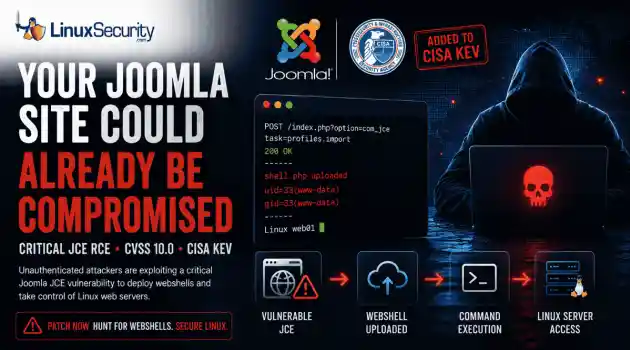
Security Vulnerabilities security advisory critical
security advisory critical The Joomla Content Editor (JCE), one of the most widely deployed editor extensions for Joomla websites, is currently under active attack due to a critical vulnerability. . The issue, tracked as CVE-2026-48907 , affects JCE versions earlier than 2.9.99.5 and carries a CVSS score of 10.0. Because JCE is installed on a large number of public-facing Joomla sites, the vulnerability has quickly become a high-priority target for attackers and automated scanning campaigns. CISA has added the flaw to...
Jun 17, 2026 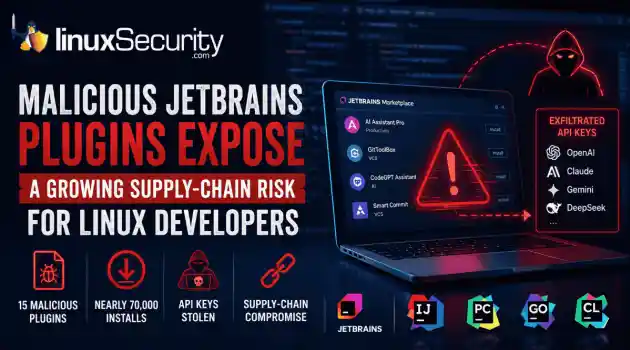
Security Trends security advisory open-source
security advisory open-source At least 15 malicious plugins and nearly 70,000 installs later, developers are being reminded that trusted marketplaces can become supply-chain attack vectors overnight. . How Malicious Plugins Steal API Credentials It’s simple. The user installs a plugin. It asks for API credentials. The developer clicks "Apply." A short time later, those keys could be sent to a third-party server. Think of an API key like a valet key to your house. It doesn't give them the deed to the property, but it lets...
Jun 17, 2026  Refine news
X Clear Filters Get the latest News and Insights
Get the latest Linux and open source security news straight to your inbox.
Community Poll
What got you started with Linux?
Loading...
Explore Latest Linux Security news
We found -3 articles for you...
81
 security advisorycryptographyanonymity
Tails 6.4 Security Advisory: Enhanced Privacy and Cryptographic Features
As digital privacy and security evolves, anonymity cannot be overemphasized. Tails is a live operating system designed to keep its focus on privacy and anonymity. Its unique focus allows you to boot it on almost any computer using a USB stick or DVD drive and use state-of-the-art cryptographic tools for protecting files, emails, and instant messaging conversations without leaving a trace behind on your machine. With its focus on anonymity and its use of state-of-the-art cryptographic tools to encrypt files and instant messaging conversations from being kept under lock and key. TAILS (an acronym for The Amnesic Incognito Live System) leverages the Tor network to protect online privacy and evade censorship. Each Tails session acts like a clean slate when shutting down; no data remains from session to session unless saved into an encrypted Persistent Storage space. New Features in Tails 6.4 Tails version 6.4 brings many notable updates that will appeal to Linux administrators and privacy-minded users alike. Cryptography Strength Reinforced with Random Seed One of the key enhancements for Tails is including a random seed on USB flash drives as part of our cryptographic strength enhancement. This feature is invaluable in strengthening cryptography across our system—such as Tor, HTTPS connections, and the Persistent Storage feature—by strengthening cryptography across them. By keeping this random seed outside Persistent Storage itself, all users benefit from increased cryptographic protections regardless of configuration differences. Tails 6.4 Switches to HTTPS over Onion Services for APT Repositories In an unconventional move from past versions, Tails 6.4 has transitioned away from using onion services for Debian and Tails APT repositories in favor of HTTPS addresses to improve reliability for the Additional Software feature and streamline software management for users. Software Updates and Bug Fixes One compelling factor in adopting Tails 6.4 is its current software stack andarray of fixed problems. Tails 6.4 offers an updated Tor Browser (13.0.16) and Tor client (0.4.8.12) to give users access to the latest developments in secure browsing; email communication has also been improved thanks to an upgraded Thunderbird (115.12.0). Numerous bugs have been addressed to enhance user experience significantly. Problem resolution includes fixing and unlocking Persistent Storage issues, connecting to mobile broadband networks on particular hardware, and reenabling Thunderbird's previously disabled PDF reader due to security. Furthermore, user experience refinements such as more informative error messages in Tails Cloner and smooth interactions when using the Unlock VeraCrypt Volumes utility demonstrate developers' attentiveness towards user feedback. Upgrading and New Installations For existing users, upgrading to Tails 6.4 should be straightforward, with automatic upgrades from as early as version 6.0 being available for automatic upgrading. Newcomers or those wishing for manual upgrades can follow detailed installation instructions provided by the Tails project, which are explicitly tailored for various platforms. Why Linux Administrators Should Take Note Linux administrators who prioritize security and seek to safeguard their systems against surveillance and censorship will find Tails 6.4 indispensable. With its enhanced cryptographic measures, commitment to updating core components like the Tor Browser and client, and quick bug resolution, Tails exudes an environment designed specifically to secure its systems. Administrators will appreciate Tor's operational transparency--all network traffic is automatically routed through it, eliminating risks related to network surveillance. Furthermore, its persistent storage feature enables safekeeping of essential files, configurations and software across sessions without jeopardizing its security posture. Alternatives to Tails for Privacy and Security Tails stands out for its anonymity and security features, but it isn'talone in this respect. Linux distributions such as Whonix and Qubes OS also provide similar functionality; Whonix operates by isolating user internet connections within an isolated virtual machine that routes all traffic via Tor. Meanwhile, Qubes takes an alternative approach by compartmentalizing various aspects of its OS into isolated VMs to prevent malware from crossing boundaries. Open Source choices ftw! Learn More about Tails and Privacy Tails 6.4 is evidence of this project's ongoing dedication to privacy, security, and user experience. With every update, Tails equips the global community with toolsets designed to increase online anonymity while guarding against surveillance intrusions. Linux administrators who place great value in security measures will find this release compelling enough to upgrade existing systems or implement this OS into their operations in an increasingly monitored digital world. Best distro for privacy and security in 2024 Which distros are most focused on privacy ? How to Encrypt Files on Linux Enhanced Privacy with Predator-OS . . Tails 6.4 boosts security and confidentiality with advanced encryption techniques, intuitive interface upgrades, and protected boot features.. Anonymity Tools, Privacy Enhancements, Cryptographic Solutions, Linux Security, Secure Browsing. . Dave Wreski
 Jun 18, 2024 •
 Privacy
 79
 security updatesystem managementperformance enhancement
Linux Kernel 6.9: Upgrades In Security And Performance For Linux Systems
The recently released Linux Kernel 6.9 brings forth a blend of crucial upgrades and enhancements, catering to the ever-evolving needs of the Linux ecosystem. Linus Torvalds, the creator of Linux, underscores this by stating, "a more powerful arm64 machine (thanks to Ampere)," signaling promising optimizations for ARM64 architecture in this new release. . Let's delve deeper into the key highlights that make this update noteworthy for Linux admins and security practitioners. What's New in the Linux Kernel 6.9 Release? The release packs various features that add significant value to the Linux community. One striking addition is the support for AMD Preferred Core, prioritizing high-performance cores for demanding tasks. This shift aims to enhance overall system efficiency by leveraging the full potential of AMD processors. On the Intel front, notable refinements include support for the Fastboot feature on old platforms and the introduction of Intel's FRED architecture, promising improved performance for Meteor Lake chips. Furthermore, the enhancements in ARM support stand out, including Rust support for ARM64 architecture, which opens the door for Rust-based kernel codes in the future. Alongside this, the extended hardware support for various devices like MediaTek MT7981B and NXP i.MX8DXP showcases the kernel's adaptability to newer technologies. Long-Term Consequences & Considerations As we look toward the future, the broader implications of these updates on Linux security and system management are worth considering. The introduction of Rust support for ARM64 architecture might pave the way for a more secure and robust kernel structure. However, will introducing Rust-based code potentially introduce new vulnerabilities or complexities in the long run? The extended hardware support raises questions about how these diverse devices will interact with the unified kernel framework and the security implications that come with it. Linux Kernel 6.9: Our Final Thoughts The Linux Kernel 6.9release is a significant milestone that brings about essential upgrades and hints at the future direction of Linux development. With a strong focus on performance optimization, security enhancements , and extended hardware support, this release promises to catapult Linux systems to new heights. As security practitioners and sysadmins, we must stay informed , delve deeper into these changes, anticipate their impact on system security, and adapt our strategies to ensure a seamless and secure user experience. You can download Linux Kernel 6.9 here. . This release highlights essential tools for network administrators and cybersecurity professionals, enhancing efficiency and compatibility among various systems.. Linux Kernel Updates, ARM64 Improvements, Security Features, Software Enhancements. . Brittany Day
Jun 03, 2024 • Security Projects 

Get the latest News and Insights
Get the latest Linux and open source security news straight to your inbox.
Community Poll
What got you started with Linux?
Search Topics
Powered By

Linux Security - Your source for Top Linux News, Advisories, HOWTOs and Feature Releases
QUICK LINKS
subscribe to newsletters!
Like staying secure? So do we.
Sign up for updates, tips, and alerts!
Discover faster search, smarter navigation, and deeper Linux security insights. Read More