Audit Linux privileges now to limit compromise, escalation, and system-wide damage. Review Linux Privileges×


Security Vulnerabilities  cisa kev vulnerability prioritization
cisa kev vulnerability prioritization Most Linux teams don't struggle to find vulnerabilities anymore. They struggle to decide which ones deserve attention first. Between daily scanner results, vendor advisories, and hundreds of new CVEs each month, the challenge isn't visibility—it's prioritization. . To solve this, organizations typically lean on the National Vulnerability Database (NVD) and CISA’s Known Exploited Vulnerabilities Catalog. But these aren’t competing lists. They answer two entirely different questions. While the...
 Jul 22, 2026

Desktop Securitysecurity advisory vulnerability
security advisory vulnerability GNOME is officially shortening its standard vulnerability disclosure window from 90 days to 30 days, a change that impacts upstream maintainers, downstream Linux distributions, and system administrators in how they handle software vulnerabilities. The policy shift, announced by long-time security coordinator Michael Catanzaro , addresses modern software patching realities and a growing influx of automated submissions. . Because GNOME is the default desktop environment on several major Linux...
Jul 21, 2026

Security Vulnerabilities security advisory moderate
security advisory moderate For organizations that run a self-hosted Git platform, it’s no longer just about hosting static code repositories. Today, Git servers are responsible for deployment pipelines, API tokens, SSH keys, package repositories, and the automation scripts that push code directly. Confirm that the upgrade addresses known vulnerabilities but also provides production environments. . That makes them trusted systems within the development environment and attractive targets for attackers looking to move...
Jul 20, 2026

Server Securitydata privacy automation
data privacy automation Every system admin has lived through the same Monday morning ritual. A queue of forty tickets, half of them password resets, permission errors, or disk space warnings that any experienced technician could resolve in under two minutes. The other half require actual judgment. For years, automation promised that software would eventually sort the two apart on its own. That promise is now being tested in production Linux environments. . Early results are reshaping how IT teams think about tier-1...
Jul 17, 2026

Privacydata collection automation
data collection automation You're running a web scraping project to collect pricing data from e-commerce sites. You set up a pool of datacenter proxies, launch your scripts, and within minutes — banned . CAPTCHAs everywhere. Your data pipeline stops before it really begins. . It's a frustrating scenario that plays out daily in ad verification, market research, and multi-account management. The website doesn't know you're doing legitimate research or monitoring. It just sees traffic coming from IP ranges it recognizes as...
Jul 17, 2026
 Refine news
X Clear Filters
Get the latest News and Insights
Get the latest Linux and open source security news straight to your inbox.
Community Poll
Should Linux servers automatically install security updates?
Trending News
Loading...
Explore Latest Linux Security news
We found 48 articles for you...
79
 security advisoryvulnerability managementopen source initiative
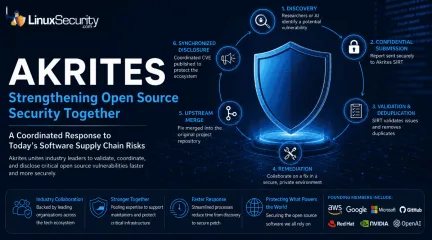
Linux Foundation Launches Akrites to Strengthen Software Supply Chain Security
The Linux Foundation has officially launched Akrites , a coordinated industry initiative designed to improve how critical open source vulnerabilities are validated, coordinated, and disclosed before patches reach downstream users. Backed by a diverse coalition—including AWS, Google, Microsoft/GitHub, Red Hat, NVIDIA, and OpenAI—Akrites establishes a shared Security Incident Response Team (SIRT) to streamline the validation, remediation, and disclosure of vulnerabilities in the foundational code that underpins the modern digital economy. . AI Is Changing Software Supply Chain Security One detail in the Linux Foundation announcement stands out more than the launch itself. The organization isn't suggesting that open source projects suddenly need more vulnerability reports. They already receive plenty. The problem is volume. AI-assisted analysis has made it possible to review large codebases much faster than before. Researchers can identify suspicious patterns, compare projects, and generate vulnerability reports in a fraction of the time that manual analysis once required. That is good news for open-source security, but it has also exposed a weakness in the current response model. Every report still has to be reviewed by a person. Someone has to reproduce the issue, determine whether it affects supported releases, understand its severity, decide whether a CVE is appropriate, develop a patch, and move that fix through coordinated vulnerability disclosure before technical details become public. None of those tasks has become significantly easier simply because AI can produce findings more quickly. According to Endor Labs, one of Akrites' founding members, fewer than 5% of recently validated open source vulnerabilities have been patched . Whether that percentage changes over time, it illustrates the same trend. Discovery is accelerating faster than remediation. Why Existing Open Source Security Processes Are Under Pressure The reality for many maintainers looks verydifferent from how people imagine open-source security working. A widely used library isn't necessarily maintained by a large engineering team. In many cases, it's a handful of contributors or even a single developer balancing maintenance with a full-time job. Now imagine that the project suddenly receives dozens of reports describing the same underlying issue. One submission comes from a commercial scanner. Another is generated by an AI coding assistant. A third arrives through a bug bounty program. None are identical, but all require investigation. The difficult part isn't opening the email. It's figuring out whether the report is accurate, whether the vulnerability can actually be reproduced, whether downstream users are affected, and how the issue should move through vulnerability disclosure without exposing organizations before a fix is available. Akrites is intended to reduce that burden by acting as a shared Security Incident Response Team. Instead of every organization independently contacting maintainers, the initiative provides a coordinated process for validating reports, removing duplicates, and helping projects prepare fixes before disclosure begins. Recent Incidents Showed Why Coordination Matters Recent security incidents have demonstrated that identifying a vulnerability is often only the beginning. Log4Shell became a global response effort almost overnight. The challenge wasn't limited to understanding the vulnerability itself. Linux distributions, software vendors, cloud providers, security teams, and enterprise administrators all had to coordinate patches, advisories, testing, and deployment under intense time pressure. The XZ Utils backdoor exposed a different weakness. It showed how much critical infrastructure still depends on software maintained by very small teams. When one upstream project experiences a security problem, the consequences spread through Linux distributions, enterprise products, containers, cloud platforms, and countless applications built ontop of that code. Akrites would not have prevented either incident. The Linux Foundation isn't making that claim. Instead, the initiative attempts to strengthen the coordination that happens after a vulnerability is discovered and before it reaches the wider ecosystem. What Akrites Means for Open-Source Security Akrites represents a clear realization: open source security can no longer rely solely on the efforts of individual maintainers. Every critical project eventually hits the same wall: the software becomes indispensable long before the maintenance team has the resources to manage it. One interesting aspect of this initiative isn't just the technology—it's the list of founding members. Organizations like Citi, JPMorgan Chase, Ericsson, and Cisco rarely launch joint initiatives unless they share a massive, systemic problem. In this case, they do. Modern infrastructure shares an enormous amount of upstream code, which means one overwhelmed maintainer is now a systemic risk for banks, power grids, and cloud providers alike. What This Means for Linux Administrators Linux administrators rarely work directly with upstream maintainers, yet they depend on them every day. Enterprise distributions such as Red Hat Enterprise Linux, Ubuntu, Debian, SUSE, AlmaLinux, and Rocky Linux package software only after upstream projects have investigated reports, developed patches, and coordinated disclosure. Improvements at the upstream level can ripple through the entire software supply chain, ultimately affecting how quickly organizations receive trusted updates. : Faster upstream patch coordination: Verified fixes land in your distribution’s repositories sooner because the "middle work" of validation and deduplication is handled upstream. More consistent security advisories: Standardized reports make it easier to track and prioritize updates across your fleet. Better support for widely used components: Akrites says it can serve as a "maintainer of last resort" for certain criticalprojects by helping coordinate remediation when active maintenance is no longer sufficient. How Akrites Coordinates Vulnerability Response The initiative formalizes the vulnerability disclosure lifecycle to ensure confidentiality and speed. Instead of maintainers fielding reports from hundreds of sources, they have one predictable partner. Discovery: A researcher or AI surfaces a potential flaw. Confidential Submission: The report is sent to the Akrites SIRT, not a public bug tracker. Validation & Deduplication: The SIRT verifies the issue and removes duplicates. Remediation: Maintainers and industry engineers collaborate on a fix in a secure environment. Upstream Merge: The fix is merged into the original project's repository. Synchronized Disclosure: A coordinated CVE is published to alert the ecosystem. Akrites Won't Replace Vulnerability Management It is vital to note that Akrites is an upstream coordination body, not an enterprise security product. Organizations still need robust internal programs, including vulnerability management processes, asset inventories, and monitoring tools to detect threats within their specific environments. Akrites improves the upstream coordination of security, but the responsibility for securing the downstream enterprise environment remains with the organization. Akrites complements existing vulnerability management programs rather than replacing them. Organizations will still need scanners, patch management workflows, asset inventories, and software bills of materials (SBOMs) to identify affected systems and deploy updates. Akrites focuses on the upstream coordination that happens before those updates reach enterprise environments. Conclusion For years, the industry invested heavily in tools designed to identify software vulnerabilities faster. Akrites reflects a strategic recognition that discovery is no longer the limiting factor. As AI continues to accelerate vulnerability research, the challenge hasbecome how quickly maintainers can validate reports, coordinate fixes, and deliver patches before attackers exploit them. Whether Akrites succeeds will ultimately be measured not by the number of vulnerabilities it processes, but by whether it successfully shortens the time between discovery and remediation across the open source ecosystem. By professionalizing the "messy middle" of the response process, Akrites is attempting to build the operational infrastructure needed to keep our most critical software secure in an age of AI-accelerated threats. Want more Linux security news, open source security analysis, and software supply chain insights? Subscribe to the LinuxSecurity Newsletter for the latest vulnerability disclosures, security advisories, threat analysis, and expert coverage of the technologies shaping the Linux ecosystem. Related Reading Why Linux Supply Chain Attacks Are Becoming a Nightmare for DevOps Teams Targeted Attacks on Open Source Maintainers Highlight Security Risks . The Linux Foundation's Akrites aims to improve the response and management of open source vulnerabilities through collaborative efforts.. Linux Foundation, Akrites, Open Source Security, Vulnerability Coordination, Software Supply Chain. . MaK Ulac
 Jun 29, 2026
•
Jun 29, 2026
• Security Projects
209
 security advisorycommunity collaborationvulnerability management
Navigating CVE Management in Linux Security: Embracing Community Control
As Linux security administrators, we're witnessing a pivotal shift in how open-source projects manage vulnerabilities. This transition is a result of new regulatory landscapes, such as the European Union Cyber Resilience Act, which mandates a more hands-on approach for open-source projects. These projects must now become their own CVE Naming Authorities (CNAs). . Gone are the days of relying solely on third-party vendors to assign and manage Common Vulnerabilities and Exposures (CVEs) . Instead, open-source communities must take the reins, ensuring a more accurate and direct handling of security vulnerabilities. Though introducing additional tasks, this change promises to reduce the issuance of unnecessary or erroneous CVEs, which have historically led to resource drain and, at times, complacency among security teams. For you, this shift brings a few key changes. Firstly, there will be increased administrative tasks related to security management, offering better accuracy and control over how vulnerabilities are handled. Projects will need efficient tools to automate the CVE process, just as the Linux kernel team has done with their public repository. Automation will help manage the high volume of vulnerabilities, allowing you to focus on resolution rather than tracking. Let's examine how this new approach not only aligns with regulatory requirements but also enhances the overall security framework of your open-source projects. Embracing the Responsibility of Managing CVEs Transitioning to managing CVEs internally means open-source projects are taking on a significant amount of responsibility. This can initially seem daunting, especially for smaller projects with limited resources. However, the outcome of this increased responsibility guarantees more precise vulnerability tracking. When projects manage their CVEs, they can tailor vulnerability identification to their specific needs and environments, reducing the noise from irrelevant or inaccurately assigned CVEs. Open-source projectsare inherently collaborative, a strength they can leverage in this new framework. By involving contributors in the CVE management process, teams can draw from a broader pool of expertise. This is not just about administrators or project leaders taking charge; it's about harnessing the collective power of the entire community. When everyone involved in a project understands their role in the new CVE management process, it leads to a more robust and dynamic approach to security. Enhancing Precision and Control The move to self-manage CVEs allows projects to exercise greater control over how vulnerabilities are reported and addressed. This addresses one of the major pain points of the previous system—misclassified or "bogus" CVEs issued by external parties. These issues often arise from a lack of understanding of a project's specific nuances. By becoming CNAs, projects can ensure that CVEs reflect actual security concerns and are not padded out with irrelevant issues. More accurate CVE management means vulnerabilities are handled more efficiently, from identification to resolution. This can significantly enhance a project’s security posture, reducing risk and building trust with users who rely on these open-source solutions. For us administrators, this means less time wasted sorting through irrelevant CVEs and more focus on resolving genuine vulnerabilities. Automation: A Necessary Tool With the increase in responsibility comes the need for tools to handle the workload. Automation is set to become indispensable in managing the CVE process. Take a cue from the Linux kernel team, which has implemented a public repository to disclose vulnerabilities. This approach streamlines vulnerability tracking and makes it easier for stakeholders to access, understand, and react to potential security issues. Automation tools can quickly generate CVE reports, reducing the manual effort required. They ensure that reports are consistent, timely, and accurate, allowing administrators to focus on criticalproblem-solving tasks rather than administrative overhead. Embracing automation also aids in compliance with new regulations , providing a clear audit trail of how vulnerabilities are identified and addressed. Building an Effective Reporting Infrastructure Establishing a standardized process for reporting and disclosing vulnerabilities is a crucial part of this transition. This involves setting up systems that can quickly disseminate information about CVEs to everyone who needs it, whether internal developers, external partners, or end-users. The process should be as transparent and accessible as possible, enabling a swift and effective response to security issues. Security teams can ensure no vulnerability slips through the cracks by developing a clear reporting infrastructure. This can involve creating detailed documentation and using universally understood formats, like JSON , for security vulnerability disclosures. It's also important to consider how feedback will be received and processed, ensuring that all parties agree and work towards a common goal. Projects that communicate their CVE handling processes effectively will stand out in the open-source community. When users and developers know how vulnerabilities are managed, their confidence in the project's security grows, leading to broader adoption and contribution. Leveraging Community Collaboration Open-source projects thrive on collaboration, which should be harnessed to manage security vulnerabilities effectively. Projects can benefit from varied expertise and creative problem-solving skills by involving a diverse group of contributors. This collective effort can lead to innovative approaches to vulnerability management that might not be possible in more siloed environments. Encouraging community involvement can be as simple as making vulnerability tracking tools and processes accessible and easy to use. Regular updates and clear guidelines on how contributors can help can also foster a sense of ownership and responsibilityamong community members. This collaborative approach enhances security and energizes the community, driving more contributions and improvements to the project. Our Final Thoughts: Moving Forward with Confidence Transitioning to a model where open-source projects manage their CVEs is a big change, but it has significant benefits. By taking control of vulnerability management, projects gain more accuracy, transparency, and efficiency. While the initial setup may require additional effort, the long-term advantages include a more robust security framework and increased trust from users and contributors. We, Linux security administrators, are at the forefront of this change, equipped to lead our projects toward a future where vulnerabilities are not just another checkbox but a focal point of innovation and collaboration. By embracing responsibility, implementing effective tools, fostering community engagement, and setting up streamlined processes, the challenge of CVE management becomes an opportunity to redefine and enhance security within open-source projects. This proactive approach ensures that open-source ecosystems remain secure, reliable, and ready to tackle the vulnerabilities of tomorrow. What are your thoughts on this shift? Let us know @lnxsec! . Community-driven initiatives implement CVE oversight to enhance precision and governance regarding security flaws, reinforcing defense and reliability.. Linux CVE Management, Open Source Security, Vulnerability Control, Community Collaboration, Automation Tools. . Brittany Day
Apr 02, 2025
•
Security Trends

79
 security advisoryopen-sourceLinux
OSV-Scanner V2 Enhancements: Container and Dependency Security for Linux
Google recently unveiled OSV-Scanner V2 , with significant upgrades benefiting open-source developers and Linux security admins tasked with securing open-source projects. This new version of the popular vulnerability scanner boasts features such as enhanced dependency extraction through OSV-SCALIBR , which now supports more formats and ecosystems, including .NET, Python, and JavaScript. Thus, it is easier to detect vulnerabilities in source manifests and lock files, and ensure no weak link goes overlooked. . OSV-Scanner V2 also supports layer and base image-aware scanning for container images on Debian, Ubuntu, and Alpine operating systems. This enables administrators to accurately pinpoint vulnerabilities that impact specific environments while filtering out those unlikely to affect them. Furthermore, interactive HTML output makes analyzing vulnerability data simpler. In addition, improved guided remediation for Maven's pom.xml files makes fixing security issues much faster, making OSV-Scanner an essential tool for Linux security admins and developers committed to keeping their open-source projects and applications secure and their systems running safely. Let's take a closer look at the key features of this update and how OSV-Scanner V2 will benefit your secure software development and administration efforts. Enhanced Dependency Extraction OSV-Scanner V2 stands out with its enhanced dependency extraction capability through OSV-SCALIBR . It offers Linux security administrators a more thorough identification of vulnerabilities across various formats and ecosystems. Whether you're working in .NET, Python, or JavaScript environments, every dependency is carefully examined using OSV-SCALIBR's enhanced extraction feature, ensuring all dependencies are fully covered for open-source security. Furthermore, this enhanced scanning function can quickly identify source manifests and lock file vulnerabilities. This dual approach helps detect weaknesses in declared libraries and their specificversions—essential when working within complex ecosystems of interdependent projects requiring robust security measures. Layer and Base Image-Aware Scanning OSV-Scanner V2 brings another important addition: layer and base image scanning support, particularly for container images on widely used Linux distributions such as Debian, Ubuntu, and Alpine. Containers have become an essential part of modern application development and deployment, yet securing containers presents considerable difficulties due to the multiple layers and base images they contain. OSV-Scanner V2 now tackles this complexity head-on by offering layer-aware scanning. Security admins can use this feature to trace vulnerabilities back to their source, allowing for more targeted remediation strategies and fewer blanket updates that may lead to other complications. Furthermore, filtering out vulnerabilities irrelevant to your container setup ensures security efforts remain focused and effective instead of spending time addressing threats that do not pose a real risk to your environment. Interactive HTML Output OSV-Scanner V2 significantly simplifies security management thanks to its interactive HTML output feature. This feature is designed to provide an engaging and user-friendly way of visualizing scan results that may otherwise be overwhelming in traditional formats. For Linux security administrators, this means clearer insights and actionable data at their fingertips. When the interactive HTML output presents vulnerability data in an easily filterable format, there is no need to wade through long text files or CSVs. This makes it easier to identify critical issues and communicate them to team members, stakeholders, or security auditors. Plus, enhanced readability and usability of scan results streamline the vulnerability management process into an actionable plan! Guided Remediation for Maven OSV-Scanner V2 also expands its guided remediation capabilities to support Maven pom.xml files, a particularly helpfulfeature to Java developers. Managing dependencies in large Java projects can be challenging, and vulnerabilities in their dependencies often remain undetected until it's too late. OSV-Scanner's guided remediation feature simplifies this task by offering intelligent, prioritized upgrade recommendations for dependencies listed in pom.xml files. Linux security administrators responsible for Java environments can benefit from automating security assessments by spending less time manually sorting through dependencies and more time providing reliable suggestions to resolve security issues. Prioritization helps focus efforts on the most critical vulnerabilities, helping ensure security measures are both efficient and effective. Automating not only saves time; it also reduces human error in manual processes. By including guided upgrades in the development cycle, administrators can maintain a safe environment while minimizing disruptions to ongoing projects. Proactive Vulnerability Management OSV-Scanner V2 provides Linux security admins with features designed to aid them in taking an aggressive stance toward vulnerability management. Less critical vulnerabilities escape detection through improved dependency extraction and layer and base image-aware scanning. Layer—and base image-aware scanning offers deep container security insights, making modern DevOps practices possible. Interactive HTML output makes vulnerability analysis much less time-consuming, while guided remediation for Maven makes dealing with Java vulnerabilities faster and more effective. Proactive cybersecurity approaches are increasingly essential in today's fast-paced tech landscape. Security shouldn't be seen as a one-time task. Rather, it must be an ongoing priority. Organizations can significantly lower their risk profile by continuously monitoring , identifying, and fixing vulnerabilities with tools like OSV-Scanner V2. At the same time, admins gain more time for strategic initiatives rather than being bogged down with manuallyscanning vulnerabilities—keeping high security standards without impacting efficiency or productivity. Our Final Thoughts on the Recent OSV-Scanner V2 Update OSV-Scanner V2 represents an important advancement in open-source security management, particularly for Linux administrators and open-source developers. It features enhanced dependency extraction, layer and base image-aware scanning, interactive HTML output, and guided remediation for Maven projects, making OSV-Scanner V2 an indispensable security tool for secure software development. These features increase the efficiency and effectiveness of vulnerability management and foster more proactive approaches towards protecting open-source projects - ideal for Linux admins looking to maintain top-tier security standards. OSV-Scanner V2 is available for free on GitHub. Have you given it a try? We's love to hear your thoughts and feedback @lnxsec ! . The updated OSV-Scanner V2 boosts security measures for Linux administrators by refining container vulnerability assessment and management.. OSV-Scanner V2, open-source security, Linux administration, vulnerability management, container scanning. . Brittany Day
Mar 20, 2025
•
Security Projects
77
 antivirusintrusion preventionsecurity strategies
Comprehensive Guide to Securing Linux Servers Against Threats
Linux servers form a vital backbone of today's Internet, with approximately 81% of all hosted websites running on them. With Windows' complete dominance in the personal computing space, Linux's resilience to minute threats has made it a staple among server admins. However, this doesn't prevent a ttackers from actively targeting Linux servers and pentest distros . . Learning to safeguard and future-proof your servers and utilize pentest distros to boost security is crucial to network integrity as a Linux administrator. Let’s explore practical measures you can take to secure your networks and servers against vulnerabilities and attacks. Understanding Linux Server Vulnerabilities While Linux is dominant in resilience against malware and viruses, servers are still a vector for attack, especially in mixed-OS environments. An infected Linux server in such networks weakens barriers against malware propagation to other devices. It is indeed a vivid scenario pointing out the need for proactive security. According to CISA, corporate servers are among the favorite targets of cyberattacks. In this respect, implementing an effective antivirus solution for Linux servers is considered one of the critical steps toward assuring sensitive data protection and compliance with regulations. The Key Role of Antivirus in Linux Server Protection Antivirus has become an indispensable component in the security of Linux servers. It has changed how such servers are set up and ensures they are protected against threats. An effective antivirus strategy is instrumental, as Linux servers present a broad attack surface. First and foremost, antivirus software protects against user mistakes. Even the most conscientious user may commit errors by accidentally downloading or misconfiguring. In this respect, antivirus software serves as an added layer of protection, guaranteeing that such mistakes do not lead to a breach in the integrity of the server. Servers usually contain sensitive data, whichautomatically makes them targets for attackers. Deploying antivirus solutions is necessary to protect and comply with data protection regulations. By deploying antivirus defense mechanisms, an organization can reduce the risk of a data breach, loss of sensitive data, and damage to one's brand reputation. Ultimately, the prevalence of Linux servers on the Internet is increasingly making them an easy target for focused attacks. That means the entry points through which bad guys can get in are widening, which calls for a capable antivirus solution. Cyber threats keep evolving, making an effective antivirus strategy critical to every comprehensive security posture. Beyond Antivirus: All-Encompassing Security Strategies for Linux While antivirus software is foundational , there needs to be multiple layers to complete any Linux-based server security strategy. Following are several strategies that can add value to a server's security profile: Implementing Host-Based Intrusion Prevention Systems (HIPS) HIPS stands for Host Intrusion Prevention System , or advanced protection for Linux servers. It is designed to monitor system activities for malicious behaviors. HIPS detects unauthorized changes in system files and configuration, blocking real-time attacks. By monitoring endpoint devices continuously, HIPS gives administrators the capability for real-time threat response, drastically reducing the risk of any successful intrusion. Fail2ban for Extra Security Fail2ban is an efficient way to prevent brute-force login attempts. It reads the log file, searches for failed login attempts, and immediately blocks suspect IP addresses. Advanced users will want to configure Fail2ban because it offers advanced options for handling debug messages, among other features. This tool significantly improves your server's security posture against unauthorized access, helping to lock down the server from brute-force attacks and other potential threats that could leverage weak login credentials. Integrationof Behavioral Analysis Tools for Threat Detection Behavioral analysis tools can aid in identifying anomalies indicative of security breaches. In such systems, machine learning algorithms establish regular baselines for server operations. Because these systems flag deviations from established norms, administrators are warned of a potential threat before it escalates. By implementing behavioral analytics, proactive threat detection enables teams to quickly respond to suspicious activity and protect the integrity of servers and sensitive data. The Importance of Regular System Updates Regular updates are essential because they keep the server environment secure. Any outdated software opens up vulnerabilities if exploited by cybercriminals. Regular updates reduce these risks since all known vulnerabilities get patched. However, managing how such updates are announced or made known to others is vital in avoiding the unintentional disclosure of one's system weaknesses. Setting up regular, systematic updates will enable an organization to strengthen its security further and provide protection against newly arising threats. Proactive Measures to Mitigate Future Threats Cybersecurity threats are continuously changing; hence, new perils are coming. In such a scenario, frequent security audits become essential for the administrator to adapt. Various vulnerabilities like Injection flaws, Broken Authentication, and XSS attacks can be identified or picked out with the help of advanced tools like Burp Suite and SQLmap . These can comprehensively analyze server security assessments that could enable one organization to deal with vulnerabilities before they can be exploited proactively. Developing an Effective Audit Schedule Regular auditing is crucial to a sound security posture. It includes determining critical assets that need protection, such as sensitive data and essential applications that house them. Frequent vulnerability assessments involve organizations implementing automated tools thatfind vulnerabilities by rapidly scanning and providing actionable remediation steps. Moreover, your team must be fully aware of the response procedures tested. This will ensure that once potential vulnerabilities within an organization have been identified, there is a proper, workable plan to handle them efficiently and as quickly as possible. Our Final Thoughts on Improving Linux Server Security Administrators should consider integrating antivirus solutions with general security and, more importantly, proactive measures to offer increased protection for an organization's critical infrastructures from an ever-growing array of threats. Check out this LinuxSecurity article on the best forensic and pentesting distros to learn more about pentesting for admins and ethical hackers. Remember that security is not one activity to reach a destination but an ongoing process of safeguarding your server environment. . Learning to safeguard and future-proof your servers and utilize pentest distros to boost security is. linux, servers, vital, backbone, today's, internet, approximately, hosted, websit. . Dave Wreski
Oct 02, 2024
•
Server Security
78
 Linux administrationvulnerability managementopen-source security
Navigating Cyber Threats: Professional Cybersecurity for Linux Systems
> In modern business, Linux and open-source software form the backbone of countless enterprises, driving the engine behind essential applications and infrastructures globally. Renowned for their unparalleled openness and adaptability, these systems empower organizations with customization and control seldom found in proprietary counterparts. . Despite these advantages, the open nature of Linux and open-source ecosystems also exposes them to a complex landscape of cyber threats that put every organization at risk, from agile startups to established multinational giants. A fortified defense strategy that guards sensitive data and ensures uninterrupted business operations is imperative to navigate this terrain. While beneficial, the inherent characteristics of Linux and open-source platforms—such as their transparency, broad community engagement, and rapid development cycles—also attract sophisticated and targeted cyberattacks. These threats exploit the openness and collaborative development model that make Linux and open-source solutions valuable, requiring a departure from conventional cybersecurity approaches. Acknowledging this reality, integrating professional cybersecurity services tailored to address the distinctive challenges faced by Linux and open-source software is pivotal for organizations. This strategic decision extends beyond a mere choice to a vital safeguard for protecting a critical digital platform. Opting for external cybersecurity expertise presents a compelling advantage. It opens the door to an extensive arsenal of specialized skills, insights, and technological solutions that might be unfeasible to cultivate in-house due to constraints in budget, time, or manpower. Professional cybersecurity providers bring a fresh perspective, armed with the most current threat intelligence and cutting-edge strategies to protect Linux and open-source environments. This article explores the benefits and transformative potential of such professionalcybersecurity services for Linux and open-source systems, illumining the unique considerations for administrators and IT teams spearheading enterprise-level Linux deployments. Linux Lockdown: Unpacking the Security Challenges Unique to Linux Administrators Linux administrators and IT departments responsible for enterprise Linux deployments face unique cybersecurity and information security challenges. Here are some of the considerations and challenges that Linux administrators face. Kernel security: The Linux kernel can be customized and is accessible. This flexibility is a plus, but administrators must ensure that any custom configurations don't introduce vulnerabilities. Patch management: Linux distributions often have different patch release schedules. Administrators must stay up-to-date on patches for the kernel and the wide range of software running on these systems. Hardening and Configuration: It is critical to configure and harden Linux servers correctly. Linux systems require more manual configuration than other operating systems with pre-configured settings. Access control: Managing robust access controls, such as SELinux and AppArmor on Linux, is more complicated but essential to managing permissions and minimizing privilege escalation risks. Open-Source Software Management: Due to the widespread use of open-source components, administrators must diligently monitor these components to identify vulnerabilities and stay up-to-date with security patches. Diverse Environment: The Linux ecosystem has many distributions and environments. Due to this diversity, more than a one-size-fits-all approach to security is needed. Instead, more tailored security strategies are required. Auditing and Compliance: Ensuring compliance with industry standards, regulations, and tools in Linux environments can be complex due to the need for specialized tools. Mastering the Complexities of Linux Enterprise System Defense As Linux continues to gainprominence in enterprise environments, Linux administrators grapple with a unique set of challenges inherent to this versatile and powerful operating system. In the following section, we'll delve into some of the core challenges that Linux administrators routinely navigate to keep enterprise systems secure and efficient in the face of ever-evolving cybersecurity threats. Community-Driven Security: The community is often the first to identify vulnerabilities in Linux or open-source software. It is important to stay up-to-date with community forums, mailing lists, and databases such as CVE (Common Vulnerabilities and Exposures). Multi-purpose Attack Surface: Linux servers are often used for multiple purposes, which can increase the attack surface. Admins must secure multiple systems, including web servers, databases, and files. Automation and Scripting: If not properly managed, the reliance on automation and custom scripts for system tasks could lead to security flaws. This is especially true when it comes to managing secret management and privileges. Tool Compatibility: Not all security software is compatible with Linux distributions. Administrators may need help finding the correct tools for their distro or need to customize tools for their environment. Containerization Security: With the advent of Docker, Kubernetes, and other orchestration platforms, Linux administrators must learn new skills to secure these applications. Linux administrators must proactively leverage community resources and remain vigilant against potential security threats. Dynamic All-Round Security As your business expands, there are more security threats you should anticipate. Due to the size, hackers can exploit multiple attack points and loopholes. For instance, moving from on-premise to cloud increases the threats you must handle. The migration is sometimes incomplete since you retain certain aspects, mainly critical data on premier air gap systems. With all this, your securityand cyber prevention bills will rise since you have more systems to protect. Therefore, more than one security system will be required. You need the most diverse and extensive security architecture and framework on such occasions. Instead of deploying measures for every system, consider expert cybersecurity services to create an attack-proof architecture. The services will include cloud, application, DevOps, and infrastructure security services within these frameworks. Only then can you be sure that your business is secure and that no threat will penetrate. These services are necessary, as cybersecurity is much more than protection alone. Experts can help you enforce risk compliance practices and governance within the cyber framework and architecture to ensure that every system, including hybrid, virtual, and on-premise, is secure. Access To Experts Even if you run a small company or business, you still need the best experts to help secure your company. You can hire security experts to work full-time; however, you must pay them wages. Therefore, outsourcing experts is much more effective than hiring one full-time. A security team is beneficial since you must conduct an ongoing security assessment and enforce compliance measures. However, not all of them will be at par with the current threats and trends. Work with an expert who interacts with more companies and understands the aggressive nature of the current threats. A perfect expert for your business should understand security practices beyond compliance, the basics, and even cloud computing. Ideally, the hired experts will help you predict future threats and set measures to anticipate and prevent them before they occur. Due to their critical roles, assess their competence, experience, and skills before hiring them. You may have to pay more for some of these services, but you will be guaranteed an attack-proof system. Remember, cybersecurity is fast becoming a competitive edge for businesses; hence, you should not mind outsourcingcosts. If your systems are tightly secure and impenetrable, customers can trust you with their data. Open Source Software Vulnerabilities Management Although open-source platforms play a vital role in business, they also carry security risks. A robust vulnerability management process is essential to identify and correct security gaps quickly. This process involves regularly scanning software, continuously monitoring for newly disclosed vulnerabilities, and applying patches promptly. Professional cybersecurity services offer expertise on automated tools and practices essential to maintaining Open-Source systems' integrity. Integrating automated security scanning into your CI/CD process will ensure that your security assessments are as agile and responsive as your development processes. This allows you to address vulnerabilities proactively before they are exploited. Support for the Community and Contributions The collective wisdom of the community and its support are key advantages of using open-source tools. Cybersecurity professionals should use this resource to find the latest security advisories and threat intelligence. Professionals can also contribute by sharing their solutions and experiences with security challenges. Engaging with the open-source community enhances your security and also benefits the ecosystem. Professional cybersecurity services can facilitate this engagement, help your business adopt best practices, and contribute to the strengthening of open-source tools. Compliance and Legal Implications It is important to do thorough due diligence when incorporating open-source software to comply with regulatory and legal standards. Each open-source license has restrictions that may affect how the software is used or distributed. Data protection laws also require strict security measures for data stored or transmitted on open-source platforms. Professional cybersecurity services offer legal guidance and compliance audits to ensure open-source software is aligned with industryregulations. This minimizes legal risks and builds trust with stakeholders. With the help of professional cyber security services, you can incorporate these aspects into your Linux and open-source security strategy to provide a more comprehensive framework for protecting your enterprise's systems and data. Focus On the Main Goal Your business's growth depends on how much time you devote to core business services and activities. Ideally, if you're in manufacturing, your main goal should be product quality. At no point should that attention shift to something else. If it does, you will likely compromise on quality and everything people love about your brand. While focusing on key goals, you must understand how inadequate cybersecurity can threaten your business. Hence, you can never ignore such threats; you must take them seriously. With that, you will likely have divided attention since you have two critical matters to resolve. Instead of a divided focus, allow experts to handle cybersecurity matters while you maintain your core business focus. This strategy helps you secure your systems and impress your customers. Compliance Benefits The number of companies facing complaint penalties is currently on the rise. These penalties can be crippling, especially for smaller businesses. Besides that, customers will begin losing trust in your brand, especially if you offer services or collect more customer data. Big brands can survive these fines and penalties due to their cashflows; however, for medium or small businesses, the penalties can be crippling. So, you do not have to wait until it is too late to hire an expert. You can make them an essential part of your operations. While you go about your other mission, cyber experts can focus on evaluating your business functions and enforcing compliance practices for every activity. Secondly, experts are adept at the latest and changing regulations. Nothing passes their attention, so you do not have to worry about failing regulatory securityaudits . Ensure you hire diverse services and understand the industry's cyber and regulatory practices. These practices vary and are sometimes industry-specific. You can always take advantage of all, leaving yourself vulnerable to other penalties. Whether you operate regionally or internationally, enforce globally acceptable cyber practices for your industry. Your in-house team may only know some of these practices since most work and are trained within the region. Consider outsourcing your cybersecurity services to globally accredited experts. With their help, you can travel to countries and trade online without worrying about fines from other countries. Our Final Thoughts on the Importance of Professional Cybersecurity Services Whether you are a small or large business, you must have an ongoing partnership and contracts with cybersecurity experts. They can provide you with security insights and strategies that your team may need to learn. Regardless of your organization, experts can help you build a security architecture that offers the ultimate cybersecurity protection and ensures compliance with all regulatory measures. . Utilize cutting-edge security measures to safeguard your Unix and free software platforms, all the while maintaining adherence to regulatory standards.. Linux Administration, Open Source Risks, Cybersecurity Threats, Vulnerability Management, Compliance Regulations. . Dave Wreski
Aug 18, 2024
•
Vendors/Products
210
 security advisorydenial of serviceUbuntu
Ubuntu: Security Advisory on Apache2 Issues - Code Injection & DoS
The Ubuntu security team has recently discovered and addressed multiple vulnerabilities in the Apache HTTP Server (apache2) impacting versions through 2.4.59. These vulnerabilities could potentially disrupt the server and inject malicious code. . Let's explore the implications of these vulnerabilities, their impact on admins and security practitioners, and measures you can take to secure your systems against them. What Vulnerabilities Have Been Discovered in the Apache HTTP Server? Recent vulnerabilities in apache2 include CVE-2023-38709 and CVE-2024-24795 , which involve the mishandling of inputs and the potential to inject malicious code. Another vulnerability, CVE-2024-27316 , affects the Apache HTTP Server's HTTP/2 module and could lead to denial-of-service attacks by overwhelming the server with endless data streams. CVE-2023-31122 , a flaw in the mod_macro module's memory management, also allows remote attackers to crash the server, resulting in a denial-of-service attack. It is essential to promptly update systems with the latest Apache2 versions to mitigate these vulnerabilities. In a broader sense, these issues raise questions about software vendors' responsibilities in addressing vulnerabilities in older software versions and potential financial barriers that users may face when accessing critical security updates. These bugs may disproportionately impact budget-conscious organizations and those relying on EOL systems for extended periods. While patching and staying updated with the latest security fixes is essential, organizations must balance the need for timely updates with potential disruptions caused by patching. Admins must constantly navigate maintaining a secure infrastructure while minimizing downtime for critical services. The implications of these vulnerabilities extend beyond Ubuntu systems, as Apache HTTP Server is widely used across different platforms. These flaws serve as a reminder of the importance of ongoing monitoring and vulnerability management, as new vulnerabilities can arise even in well-established and widely used software like apache2. Our Final Thoughts on These Apache2 Bugs The significant vulnerabilities recently identified in the Apache HTTP Server underscore the need for prompt updates and patching. Balancing the need for security updates with potential disruptions caused by patching is crucial. As Linux vulnerabilities continue to become increasingly prevalent , these apache2 flaws serve as a reminder to admins that continuously assessing and mitigating risks in their Linux and open-source environments has never been more critical. . The Apache HTTP Server has critical vulnerabilities in its recent versions, mainly affecting Ubuntu, which can lead to severe security issues and unauthorized access. Apache HTTP Server, Ubuntu Security Update, Server Flaws, Vulnerability Management. . Brittany Day
Jun 13, 2024
•
Security Vulnerabilities
210
 security practicesLinux securitysystem protection
Effective Techniques to Reduce Kernel Bugs in Linux Operating Systems
Linux admins and security practitioners face significant challenges in keeping their Linux systems secure amidst the constant threat of kernel bugs. Understanding and mitigating the vulnerabilities in the Linux kernel is essential in safeguarding your systems against exploits leading to compromise. Let's examine why kernel vulnerabilities are such a severe threat and mitigation strategies for protecting against them. . Why Are Linux Kernel Bugs Such A Severe Threat? How Can I Secure My System Against Them? The kernel is in a unique spot in the system, where even ordinary bugs can be transformed into vulnerabilities if exploited cleverly. Linux kernel developer Jonathan Corbet states, "In the kernel, just about any bug, if you're clever enough, can be exploitable to compromise the system." This statement raises important questions about the level of security that can be achieved in Linux systems and the measures required to protect them effectively. To address these concerns, Corbet suggests using long-term stable (LTS) kernel releases, which receive regular patches and fixes for identified vulnerabilities. He advises Linux admins and infosec professionals to ensure that their distributions run LTS kernel releases, as they provide a certain level of assurance against known threats. However, this approach has a caveat, as Corbet warns that LTS releases will no longer be supported for as long as they used to be. This change has long-term consequences, as it accelerates the phasing out of older kernel versions and emphasizes the need for regular updates to current versions. It is critical to highlight the Linux kernel developer community's immense efforts to maintain the kernel's security and stability . Corbet mentions the increase in first-time contributors, which indicates a vibrant and forward-moving community. However, he points out the critical issue of burnout among maintainers and long-time developers. Without adequate support, the risk of frustrated developers, deteriorating codequality, and increased security problems becomes a looming concern. Given these implications, companies must treat Linux work as a top priority and provide the necessary resources to support the community. Nearly all businesses depend on Linux. Ignoring this fact would be detrimental, as it could lead to compromised systems, data breaches , and financial losses. Regularly updating to the latest LTS kernel release and actively supporting the Linux developer community can go a long way toward maintaining system security. Our Final Thoughts on Protecting Against Linux Kernel Bugs This article aims to provide valuable insights into the challenges of keeping Linux systems safe from kernel bugs. The importance of proactive measures such as using LTS releases, supporting the developer community, and staying updated with the latest security patches must be emphasized. By critically analyzing the implications presented in this article, security practitioners can better understand the impact on their practices and make informed decisions to safeguard their Linux environments. . Protect your Linux system from kernel vulnerabilities with regular updates, minimal installations, security modules, and active monitoring for potential threats. Kernel Bug Management, System Protection Strategies, Linux Kernel Security. . Dave Wreski
May 18, 2024
•
Security Vulnerabilities
212
 security advisoryvulnerability managementoperational security
Enhancing Container Image Security: Key Scanning Techniques
Scanning for vulnerabilities in the right places is critically important in securing your Linux environment. While vulnerability scanning initially involved scanning Linux hosts, it has since shifted to scrutinizing container images . However, in the world of vulnerability management, we often focus on scanning images in registries and CI/CD processes but forget to monitor vulnerabilities where it really matters: container images that are actually running. . This approach is becoming increasingly essential to ensure that the systems we operate and the software we deploy remain secure. Our current paradigm for vulnerability management involves looking for vulnerabilities under the lamppost. It is crucial to remember why vulnerability scanning is essential, which is to identify and bolster potential weak points in our systems before they can be exploited. Why Is Scanning Container Images Important & What Challenges Do Admins Face? By scanning images in registries, organizations can ensure that only approved and secure images are deployed. Additionally, modern vulnerability scanners can easily integrate with popular image registries, automating the scanning process. One significant challenge, however, is the fact that the scan results will only contain the vulnerabilities that are known at that point in time. Any vulnerabilities that surface later will be missed. Therefore, it's vital to focus scans where it matters - on container images actually running in an operational environment. An excellent way to accomplish this is through the Software Bill of Materials (SBOM), which is an exhaustive list of components in a software version. By regularly comparing your SBOMs against known vulnerabilities, it’s possible to gauge your exposure level and act promptly. But how do we ensure that our registry scan results stay up-to-date and relevant for our running systems? While scanning container images in registries and CI/CD processes is useful, it should not distract us from monitoringvulnerabilities where it genuinely matters: our running container images. Our Final Thoughts on Linux Vulnerability Scanning In conclusion, vulnerability scanning is critical, and scanning for vulnerabilities in container images that are actually running in our production environment is crucial to robust security. As a security practitioner, I will take this advice to heart and focus my vulnerability management efforts on scanning images that matter most in the operational environment. Have a question or comment on this topic? Connect with us on X @lnxsec , and let's have a discussion! . Focus on analyzing container images to enhance Linux security measures and improve the methods for handling vulnerabilities.. Container Security, Linux Scanning, Vulnerability Management. . Dave Wreski
Jan 21, 2024
•
Cloud Security

Get the latest News and Insights
Get the latest Linux and open source security news straight to your inbox.
Community Poll
Should Linux servers automatically install security updates?
Trending News
Search Topics
Powered By

Linux Security - Your source for Top Linux News, Advisories, HOWTOs and Feature Releases
QUICK LINKS
subscribe to newsletters!
Like staying secure? So do we.
Sign up for updates, tips, and alerts!