


Why Runtime Monitoring Is Replacing Traditional Linux Logging
 May 12, 2026
•
May 12, 2026
•
 MaK Ulac
4 - 8 min read
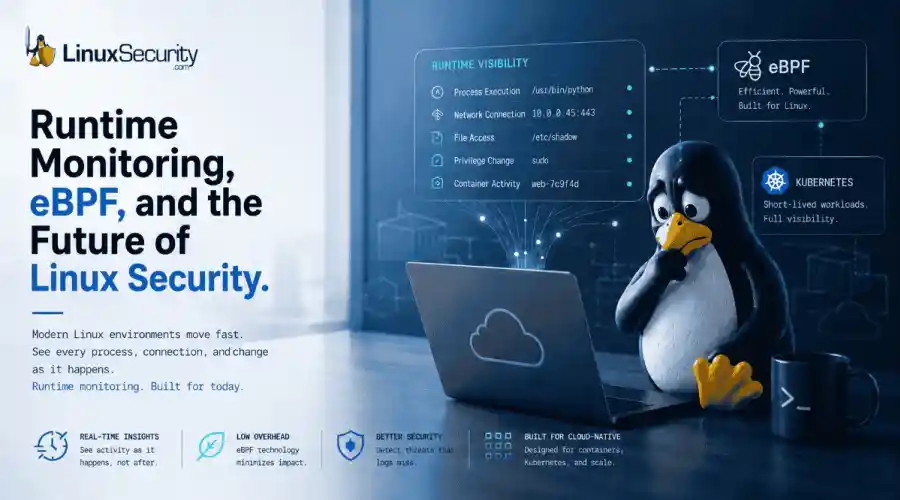

The problem is not necessarily a lack of security tools. Modern Linux infrastructure changes so quickly that maintaining consistent visibility has become one of the hardest operational problems in cloud security.
From Kubernetes clusters to CI/CD pipelines, production environments now depend heavily on Linux systems that are distributed, containerized, and constantly changing. Many workloads may only exist for a few seconds before disappearing entirely. Traditional logging systems were designed for stable, long-running servers, not ephemeral workloads that scale dynamically across cloud infrastructure.
That shift is forcing organizations to rethink how Linux activity is monitored in real time. Traditional logfile logging still provides useful historical records, but many Linux security teams are increasingly looking for more modern monitoring approaches that can capture runtime activity as it happens instead of reconstructing events afterward.
Runtime monitoring technologies, particularly eBPF (Extended Berkeley Packet Filter), are becoming more important because they allow defenders to observe process execution, network activity, file access, and process lineage in real time across highly dynamic Linux environments.
Why Traditional Monitoring Fails
Linux environments are rarely standardized. A single organization may run Ubuntu in the cloud, Red Hat on production servers, Alpine inside containers, and custom kernels for specialized workloads, all at the same time. Security tools that work well in one environment may collect incomplete activity in another.
That inconsistency creates operational blind spots long before an attacker appears. A monitoring platform may capture process activity correctly on one host but lose file visibility after a kernel update on another. Container workloads may terminate before alerts are fully processed. Security teams often assume they are collecting the same activity everywhere when, in reality, visibility varies heavily across systems.
The issue is not always tooling quality. Linux infrastructure itself changes too quickly to guarantee perfectly uniform monitoring.
That is one reason many Linux security teams are adopting runtime monitoring platforms and eBPF to improve visibility across distributed infrastructure, where traditional log file logging often struggles.
Why Traditional Logs Fail to Detect Modern Attacks
Many organizations still rely heavily on logs to investigate Linux activity. While logs remain useful for troubleshooting and historical investigations, modern attackers increasingly avoid techniques that generate obvious alerts.
Instead of deploying traditional malware, attackers often rely on legitimate Linux utilities already present on the system. A compromised account may:
- connect through SSH,
- pull payloads with curl or wget,
- execute scripts directly in memory,
- or move laterally using valid credentials.
To a logging platform, much of this can look identical to normal administrative work.
For example, a developer running:
curl internal-script.sh | bash
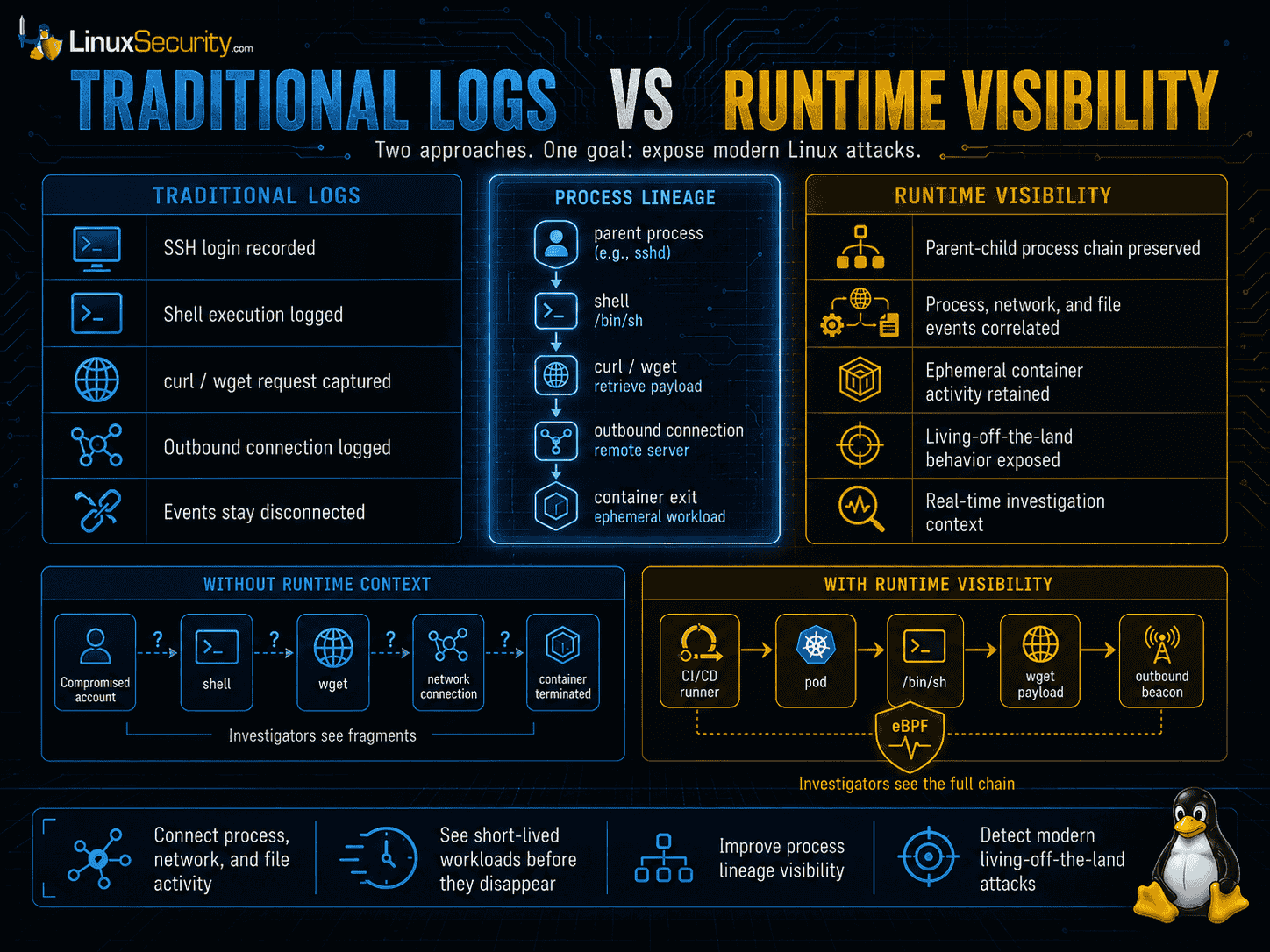
may generate activity that looks nearly identical to an attacker downloading and executing a malicious payload in the same way. Both actions involve a shell process, a network request, and script execution. Without additional runtime context around the process itself, security teams may not immediately know the difference.
This becomes especially dangerous in cloud environments where attackers intentionally blend into routine operational activity using legitimate Linux utilities already trusted inside production environments. Many organizations still struggle to correlate process activity, network connections, and file access together in real time, which is why runtime monitoring and technologies like eBPF are becoming increasingly important for improving process lineage visibility and identifying living off the land attacks.
Consider a Kubernetes workload launched through a compromised CI/CD pipeline that briefly executes a shell, downloads a binary with wget, opens an outbound connection, and terminates less than 30 seconds later.
Traditional logs may capture fragments of the activity separately:
- a shell execution,
- a network connection,
- and a terminated container.
What often disappears is the runtime relationship between those events.
eBPF helps preserve that process lineage in real time, allowing investigators to see which parent process launched the shell, which workload initiated the network activity, and whether privilege escalation or additional child processes followed before the container disappeared.
These visibility challenges become even harder once workloads become highly ephemeral.
The Security Challenges of Containerized Workloads
Containers changed the way Linux infrastructure operates, but many security strategies still assume systems are stable and long-running.
In Kubernetes environments, workloads may exist for only seconds before disappearing entirely. By the time an alert appears, the container involved may no longer exist. This creates several practical problems for defenders:
- process histories become incomplete,
- evidence disappears quickly,
- and investigators may struggle to identify which workload originally triggered suspicious activity.
Imagine a container briefly launching, connecting to an unfamiliar external IP address, downloading a file, and terminating 20 seconds later. If monitoring systems are not collecting activity in real time, much of the evidence disappears alongside the workload itself.
Traditional host-based monitoring was designed for persistent servers, not constantly changing infrastructure. The faster environments scale and rotate, the harder traditional monitoring becomes.
How eBPF Is Improving Linux Runtime Monitoring
To close these gaps, many organizations are shifting away from simple post-event logging and toward runtime monitoring.
One of the most important developments driving this shift is eBPF, which allows security tools to observe low-level Linux activity with far less performance impact than older monitoring methods. Instead of relying entirely on logs written after activity occurs, runtime monitoring can observe:
- process execution,
- network connections,
- privilege changes,
- and file access
while activity is actually happening.
This is especially valuable in container environments where workloads may disappear before investigators can manually review them. Runtime monitoring also improves process lineage, meaning security teams can better understand what launched a process, what happened afterward, and whether related network or file activity followed nearby. That context is often what determines whether the activity is a benign administration or an active intrusion attempt.
Practical Steps to Reduce Linux Visibility Gaps
No organization will achieve perfect visibility across every Linux workload, but several practical steps can reduce monitoring blind spots significantly.
Standardize monitoring wherever possible
The more Linux distributions, kernel versions, and custom environments an organization maintains, the harder visibility becomes. Standardizing production environments reduces inconsistency between systems and improves monitoring reliability.
Prioritize runtime monitoring for internet-facing systems
Traditional logs alone are often insufficient for cloud workloads and exposed infrastructure. Runtime monitoring helps security teams observe activity while it is happening instead of reconstructing events afterward.
Validate visibility after infrastructure changes
Kernel updates, container platform updates, and agent upgrades can quietly reduce monitoring coverage. Security teams should routinely validate that expected process, file, and network activity is still being collected correctly after major changes.
Correlate activity instead of relying on isolated alerts
Single events rarely tell the full story on Linux systems. Correlating process activity, file changes, authentication events, and network connections together provides a much stronger detection context.
Focus on short-lived workloads
Container environments require real-time monitoring strategies. If activity is only reviewed after an alert triggers, important evidence may already be gone.
The Tradeoff Between Visibility and System Performance
One of the hardest operational problems in Linux security is balancing visibility against performance.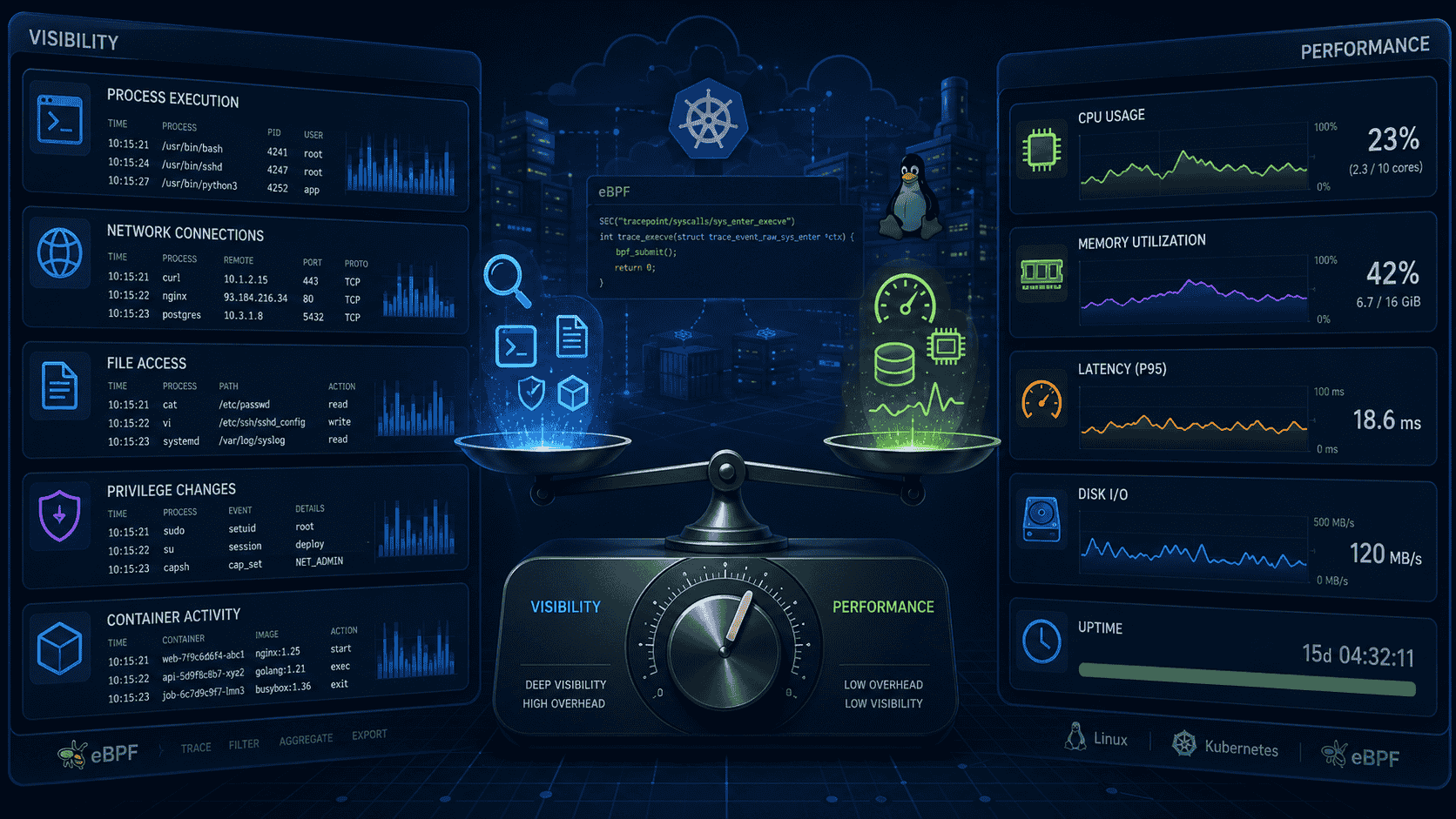
Security teams want detailed information about process execution, network activity, file access, and privilege changes. The problem is that collecting all of that activity consumes CPU, memory, and storage resources.
Production systems are usually optimized aggressively for uptime and application performance. If a monitoring agent introduces latency, increases resource usage, or causes instability, operations teams may disable it entirely. That forces organizations into difficult tradeoffs.
Lightweight monitoring agents reduce performance impact but often provide incomplete visibility. More aggressive monitoring platforms collect deeper runtime activity but may increase operational overhead or strain production workloads. There is rarely a perfect balance, especially in cloud-native environments where workloads scale constantly, and resource usage is tightly controlled.
eBPF-based runtime monitoring has become increasingly important partly because it allows organizations to collect deeper runtime telemetry with significantly lower overhead than many traditional kernel instrumentation approaches.
Conclusion: Runtime Visibility Is Becoming Essential
Traditional logfile logging still plays an important role in Linux security operations, but modern cloud infrastructure increasingly requires runtime visibility that can capture process activity, workload relationships, and low-level system behavior as it happens.
Modern Linux environments are distributed, performance-sensitive, heavily containerized, and constantly changing. Attackers increasingly rely on legitimate Linux utilities and living off the land attacks that blend directly into normal operational activity.
That is why runtime monitoring and eBPF-based telemetry collection are becoming central to modern Linux security strategies, particularly inside Kubernetes and other highly dynamic environments where traditional logging alone often arrives too late.
Stay Ahead of Linux Runtime Security & Infrastructure Trends
Interested in more in-depth coverage of Linux runtime monitoring, cloud-native security, Kubernetes visibility, eBPF, and modern infrastructure defense strategies? Subscribe to the LinuxSecurity newsletter for weekly analysis, threat updates, and technical insights from across the Linux ecosystem.
Related Reading
- Linux Supply Chain Attacks Threaten DevOps Teams and Security
- Why Software Supply Chain Security Matters in Linux Systems
- GitHub Actions Critical Misconfigurations Expose Open Source Risks
- Securing the Software Supply Chain with In-Toto
- Targeted Threats Against Open Source Maintainers: Key Insights
- Linux Supply Chain Attack Update: Protecting Against Threats
 PREVIOUS

 NEXT
NEXT

Powered By

Linux Security - Your source for Top Linux News, Advisories, HOWTOs and Feature Releases
QUICK LINKS
subscribe to newsletters!
Like staying secure? So do we.
Sign up for updates, tips, and alerts!