Audit Linux privileges now to limit compromise, escalation, and system-wide damage. Review Linux Privileges×


Stay Ahead With Linux Security Features
 security advisory path traversal
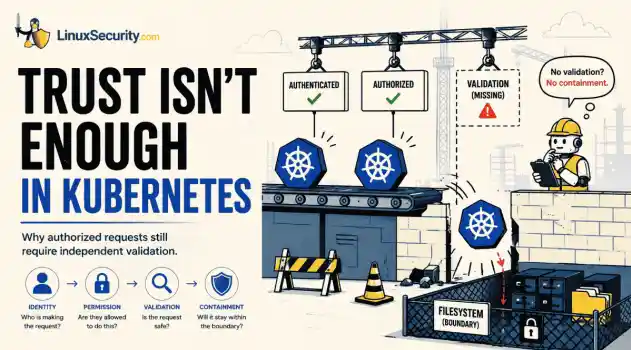
 Two newly fixed storage bugs in Kubernetes showed more than just a problem with path traversal. They found a common security flaw in the cloud: powerful parts often think that requests accepted by a higher system are safe to run. This is a simple lesson for the platform and security teams: RBAC can accept a request without showing that its parameters will stay within a certain filesystem boundary. This is clear from a new study from SentinelLabs into flaws in the Kubernetes CSI drivers for NFS...
 Jul 24, 2026
 security advisory update
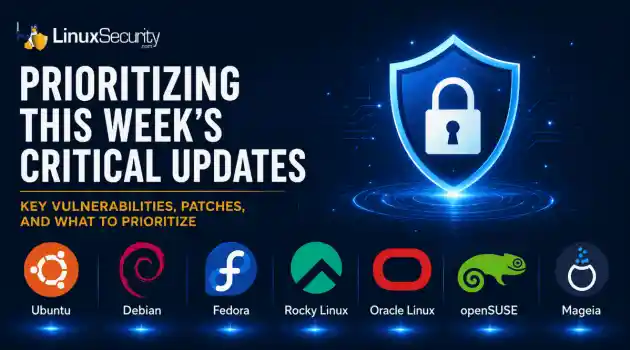
 A large volume of Linux security updates and advisories this week across major distributions once again, but it wasn't just the volume that was the story. Where maintainers and security teams focused their attention was evident in the concentration of fixes targeting Linux kernel updates, identity services, DNS infrastructure, and internet-facing software. . Instead of looking at each advisory in isolation, administrators gain more value from the general trends they reveal about Linux security...
Jul 23, 2026
 identity management security tactics
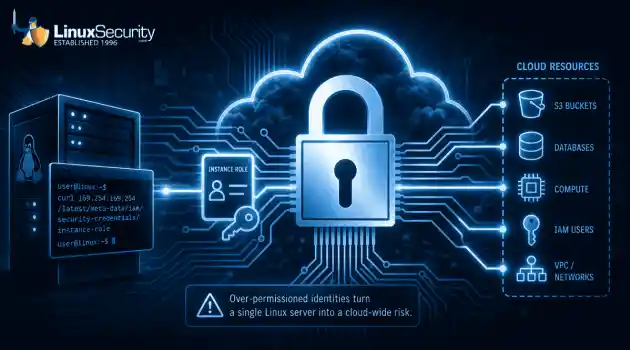
 For years, we secured our Linux infrastructure by building walls: VPCs, security groups, and hardened SSH configurations. We treated the cloud like a virtual data center, assuming that if we kept the "bad guys" out of the network, our workloads were safe. . That model is no longer sufficient. Today, one of the most common paths from an initial compromise to a major cloud breach is the identity assigned to your Linux workload. When an attacker gains code execution on a Linux instance—through a...
Jul 17, 2026
 security practices patch management
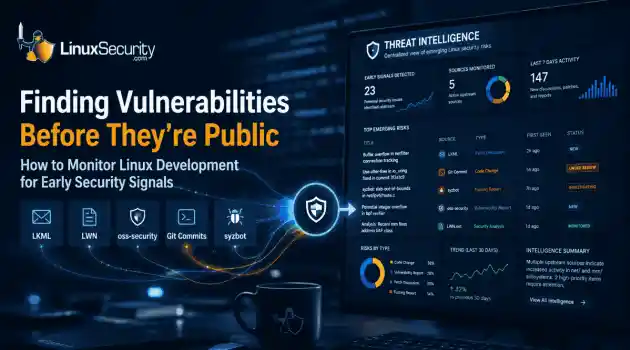
 Most of us don't hear about a kernel vulnerability until a CVE lands in our inbox or the vulnerability scanner starts complaining. By then, the patch isn't new anymore. Kernel developers may have been passing it around for review, arguing over the implementation, or revising it for days before anyone outside that community noticed it. None of those discussions are secret. They're sitting in mailing list archives, Git commits, and patch reviews where they've been the whole time. The strange...
Jul 14, 2026
 Linux security cyber attacks
 Every Linux server in your fleet produces thousands of events every minute. From journald logs and auditd records to kernel-level eBPF hooks, your systems are constantly talking. Most of that noise is just the mundane churn of system services, CI/CD runners, or routine administrative automation. But among that noise, an attacker might be establishing a foothold, moving laterally, or setting up persistence. The challenge for any security team is: how do you separate the routine from the...
Jul 13, 2026
 Refine features
X Clear Filters
Get the latest News and Insights
Get the latest Linux and open source security news straight to your inbox.
Community Poll
Should Linux servers automatically install security updates?
Loading...
Explore Latest Linux Security features
We found -3 articles for you...
102
 data protectioncybersecurity strategylinux security
Strengthening Linux Endpoint Security: Embracing Zero Trust and Encryption
With the rise of cloud computing and mobility and the remote work environment brought on by the pandemic, securing Linux endpoint devices has never been more challenging for the organization and its IT department. Endpoint encryption designed to protect data stored on endpoints such as devices, hardware and files has always been an essential component of a strong Linux endpoint security strategy; however, perimeter security is no longer effective in protecting against sophisticated threats in this modern, mobile era. . Instead, organizations need a model that provides multiple fail-safes to strengthen their defenses against today’s advanced cyberattacks. To understand what is required to fortify a modern Linux infosec architecture with a robust endpoint security strategy, we spoke with industry-leading Linux endpoint encryption provider WinMagic about the challenges of securing today’s Linux endpoints, the importance of defense-in-depth and full disk encryption to support a Zero Trust strategy, and how endpoint encryption with WinMagic SecureDoc for Linux delivers multi-layered, full disk encryption to improve Linux endpoint security. Linux Endpoint Encryption Is More Critical than Ever for a Robust Cybersecurity Posture in 2022 & Beyond Cyber risk has never been greater, and is a reality that organizations can no longer afford to ignore - malware incidents rose 358% in 2020, and 1 in 5 Americans experienced a ransomware attack that year. Linux endpoints are often seen as more secure than their Windows counterparts, but the belief that Linux is safe from malware and other cyberattacks is a dangerous misconception . While Linux is generally regarded as a highly secure OS , it has become an increasingly popular attack target in recent years due to its growing user base and the high-value systems and devices it powers worldwide. As a result, organizations need to protect Linux endpoints with identical robust security mechanisms they use for other device types. In this modern, mobile era ofheightened digital risk, organizations must find new ways to protect their systems and information. The Importance of a Zero Trust Strategy & Defense-in-Depth in Securing a Linux Infosec Architecture Relying on a single technology to secure your organization and its data does not provide the protection needed in our modern mobile world. Today, information security architectures require a layered defensive strategy. By creating a security architecture with layers of defense around your critical infrastructure and information, you can reduce the risk posed by modern cyber threats. As technology has advanced and attackers have honed their skills and increased the complexity of their attacks, new approaches and solutions are needed to provide effective defense-in-depth protection for a Linux information security architecture. Zero Trust, which deems all network traffic as untrusted, is one of the more popular security models organizations adopt to deal with emerging threats, but most enterprises are not implementing it to its fullest extent, resulting in unnecessary information security risk. The U.S. Government recognizes the importance of encryption as part of an effective Zero Trust cybersecurity strategy, and a recent memorandum directs agencies to use encryption to protect data at rest. Be Aware of Zero Trust Challenges Implementing Zero Trust recommendations could potentially lead to a decrease in work productivity during encryption and increased costs associated with ongoing administration. Implementing Zero Trust recommendations can be challenging, and could potentially lead to a decrease in work productivity during encryption and increased costs associated with ongoing administration. Luckily there are solutions organizations can leverage to easily meet Zero Trust requirements without sacrificing productivity or cost-efficiency. For instance, WinMagic offers a comprehensive encryption solution, SecureDoc for Linux, that integrates and protects data across an entire IT ecosystem withdefense-in-depth full disk encryption. The solution tackles the challenges associated with implementing Zero Trust recommendations head on by allowing initial live conversion of disk permitting admins and users to log in and work on the machine while encryption occurs. SecureDoc also reduces IT management costs by enabling a pre-boot network-based authentication as an additional security measure to ensure data on drives is never left unprotected during boot-up. In addition, SecureDoc provides damage control for lost or stolen devices by removing keys to ensure data cannot be accessed even with the right credentials. WinMagic SecureDoc for Linux: Enterprise-Class Encryption for Linux Endpoints SecureDoc for Linux offers enterprise-class full drive encryption for Linux endpoints. SecureDoc separates encryption into two components - encryption and key management. Because the expertise to deliver these two components is different, SecureDoc for Linux works seamlessly with Linux native encryption, layering on top of dm-crypt to better manage and unify encryption efforts across the enterprise and device platforms. SecureDoc also supports Smart Card based MFA at pre-boot (e.g., PIV cards). For many agency systems, PIV (including Derived PIV10) will be the simplest way to support phish ing-resistant MFA requirements, and OMB Memorandum M- 19-17 requires agencies to use PIV credentials as the “primary” means of authentication to Federal information systems. Garry McCracken, WinMagic VP of Technology and CISO, elaborates, “Linux has had built-in encryption for endpoints for several years now. Yet, many enterprises struggle with encryption on Linux endpoints such as reinstallation of the operating system before commencing on encryption, and some solutions only providing encryption for Windows devices. Our SecureDoc for Linux solution builds on the capabilities available in Linux (such as dm-crypt), providing an overarching layer of manageability, visibility, and automation that scales at an enterprise leveland facilitates compliance.” Some of the core features of SecureDoc for Linux include: Live disk conversion allows admins and users to log in and work on the machine while encryption occurs. Removes the need to clear the disk and reinstall the operating system before commencing encryption Encryption statuses are monitored and available centrally in a single pane of glass admin portal. SecureDoc enables pre-boot network-based authentication as an additional security measure to ensure data on drives is never left unprotected during boot-up. Supports Smart Card based MFA at pre-boot (e.g., PIV cards) SD Linux makes it easy for AD and Azure AD users to log into encrypted devices. Login to encrypted devices without having to be pre-provisioned for access on the device. SecureDoc Enterprise Server provides a simple central management for all OS endpoints, including Linux, Windows, and Mac. With the features included in the defense-in-depth protection of WinMagic’s SecureDoc for Linux, organizations can support an integrated Zero Trust strategy that fortifies their information security architecture for Linux endpoints. Key Takeaways In 2022, securing Linux endpoints in an information security architecture has never been more critical - and more challenging - for organizations. Defense-in-depth protection and a Zero Trust strategy are essential components of an effective modern Linux endpoint encryption solution. SecureDoc for Linux is a solution we love for organizations looking to meet Zero Trust requirements and fortify Linux infosec architectures with multi-layered endpoint encryption. . Companies need to embrace a systematic method to improve Linux endpoint protection and establish robust zero trust frameworks.. Linux Endpoint Security, Zero Trust, Encryption Solutions, Cyber Defense, Defense-in-Depth. . Brittany Day
 May 02, 2022
•
May 02, 2022
•
102
 network monitoringsecurity technologythreat management
Exploring Network Intrusion Prevention Systems: Benefits And Challenges
Anyone keeping track of the security vendor/technology hype knows that IPS has quickly replaced IDS as the “next big thing. What NIPS Isn’t First and foremost, NIPS is not a tool for stopping elite crackers. That may be how it’s being marketed, but it’s crap. If you’re the type to fall for that sort of hype then you’re probably in a lot more danger than any given technology can help you with. A Simple Question Whether or not IPS is worthless or a godsend to your organization hinges on a single question – “How good is your organization at staying patched?. What NIPS Isn’t First and foremost, NIPS is not a tool for stopping elite crackers. That may be ho. anyone, keeping, track, security, vendor/technology, knows, quickly, replaced. . Anthony Pell
Feb 11, 2010
•

Get the latest News and Insights
Get the latest Linux and open source security news straight to your inbox.
Community Poll
Should Linux servers automatically install security updates?
Search Topics
Powered By

Linux Security - Your source for Top Linux News, Advisories, HOWTOs and Feature Releases
QUICK LINKS
subscribe to newsletters!
Like staying secure? So do we.
Sign up for updates, tips, and alerts!