Audit Linux privileges now to limit compromise, escalation, and system-wide damage. Review Linux Privileges×


Stay Ahead With Linux Security Features
 security advisory path traversal
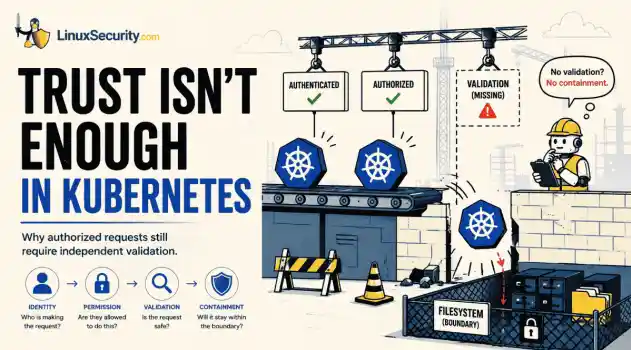
 Two newly fixed storage bugs in Kubernetes showed more than just a problem with path traversal. They found a common security flaw in the cloud: powerful parts often think that requests accepted by a higher system are safe to run. This is a simple lesson for the platform and security teams: RBAC can accept a request without showing that its parameters will stay within a certain filesystem boundary. This is clear from a new study from SentinelLabs into flaws in the Kubernetes CSI drivers for NFS...
 Jul 24, 2026
 security advisory update
 A large volume of Linux security updates and advisories this week across major distributions once again, but it wasn't just the volume that was the story. Where maintainers and security teams focused their attention was evident in the concentration of fixes targeting Linux kernel updates, identity services, DNS infrastructure, and internet-facing software. . Instead of looking at each advisory in isolation, administrators gain more value from the general trends they reveal about Linux security...
Jul 23, 2026
 identity management security tactics
 For years, we secured our Linux infrastructure by building walls: VPCs, security groups, and hardened SSH configurations. We treated the cloud like a virtual data center, assuming that if we kept the "bad guys" out of the network, our workloads were safe. . That model is no longer sufficient. Today, one of the most common paths from an initial compromise to a major cloud breach is the identity assigned to your Linux workload. When an attacker gains code execution on a Linux instance—through a...
Jul 17, 2026
 security practices patch management
 Most of us don't hear about a kernel vulnerability until a CVE lands in our inbox or the vulnerability scanner starts complaining. By then, the patch isn't new anymore. Kernel developers may have been passing it around for review, arguing over the implementation, or revising it for days before anyone outside that community noticed it. None of those discussions are secret. They're sitting in mailing list archives, Git commits, and patch reviews where they've been the whole time. The strange...
Jul 14, 2026
 Linux security cyber attacks
 Every Linux server in your fleet produces thousands of events every minute. From journald logs and auditd records to kernel-level eBPF hooks, your systems are constantly talking. Most of that noise is just the mundane churn of system services, CI/CD runners, or routine administrative automation. But among that noise, an attacker might be establishing a foothold, moving laterally, or setting up persistence. The challenge for any security team is: how do you separate the routine from the...
Jul 13, 2026
 Refine features
X Clear Filters
Get the latest News and Insights
Get the latest Linux and open source security news straight to your inbox.
Community Poll
Should Linux servers automatically install security updates?
Loading...

Explore Latest Linux Security features
We found -4 articles for you...
102
 buffer overflowmemory safetysecure coding
Understanding Buffer Overflow Risks and Solutions for Linux Programming
A buffer overflow occurs when a program or process tries to store more data in a temporary data storage area than it was intended to hold. Since buffers are created to contain a finite amount of data, the extra information can overflow into adjacent buffers, corrupting or overwriting the valid data held in them. . By: Suhas Desai Buffer overflows are a fertile source of bugs and malicious attacks. They occur when a program attempts to write data past the end of a buffer. A buffer is a contiguous allocated chunk of memory, such as an array or pointer in C. Limitation of C and C++ is there are no automatic bounds checking on the buffer where user can write past a buffer as given in example. Note: All examples are compiled on Linux platform having x86 configuration. int main () { int buffer [10]; buffer[20]=10; } After execution of this program it won’t give errors but program attempts to write beyond the allocated memory for the buffer which results for unexpected output. Example: void function (char *str) { char buffer[16]; strcpy(buffer,str); } int main() { char *str=”I am greater than 16 bytes”; function(str); } This program is guaranteed to cause unexpected behavior, because a string (str) of 27 bytes has been copied to a location (buffer) that has been allocated for only 16 bytes. The extra bytes run past the buffer and overwrite the space allocated for the FP, return address and so on. This corrupts the process stack. The function used to copy the string is strcpy, which completes no checking of bounds. Using strncpy would have prevented this corruption of the stack. Example: int main() { char buff[15]={0}; printf(“Enter your name:”); scanf(buff,”%s”); } In this example, program reads a string from the standard input but does not check strings length. If the string has more than 14 characters, then it causes a buffer overflow as scanf() tries to write the remaining characterpast buff’s end. Note: One character is always reserved for a null terminator. The result is most likely a segmentation fault that crashes the program .In certain conditions, the users will receive a shell’s prompt after the crash. Even if the shell has restricted privileges, they can examine the values of environment variables; list the current directory files to detect the network with the pig command. Writing Buffer Overflow exploits: 1. Example of an exploitable program - Lets assume that we exploit a function like this: void lame (void) { char small[30]; gets (small); printf("%sn", small); } main() { lame (); return 0; } Compile and disassemble it: # cc -ggdb program.c -o program /tmp/cca017401.o: In function `lame': /root/program.c:1: the `gets' function is dangerous and should not be used. # gdb program /* short explanation: gdb, the GNU debugger is used here to read the binary file and disassemble it (translate bytes to assembler code) */ (gdb) disas main Dump of assembler code for function main: 0x80484c8 : pushl %ebp 0x80484c9 : movl %esp,%ebp 0x80484cb : call 0x80484a0 0x80484d0 : leave 0x80484d1 : ret (gdb) disas lame Dump of assembler code for function lame: /* saving the frame pointer onto the stack right before the ret address */ 0x80484a0 : pushl %ebp 0x80484a1 : movl %esp,%ebp /* enlarge the stack by 0x20 or 32. our buffer is 30 characters, but the memory is allocated 4byte-wise (because the processor uses 32bit words) this is the equivalent to: char small[30]; */ 0x80484a3 : subl $0x20,%esp /* load a pointer to small[30] (the space on the stack, which is located at virtual address 0xffffffe0(%ebp)) on the stack, and call the gets function: gets(small); */ 0x80484a6 : leal 0xffffffe0(%ebp),%eax 0x80484a9 : pushl %eax 0x80484aa : call 0x80483ec 0x80484af : addl $0x4,%esp /* load the address of small and the address of "%sn" string on stack and call the print function: printf("%sn", small); */ 0x80484b2 : leal 0xffffffe0(%ebp),%eax 0x80484b5 : pushl %eax 0x80484b6 : pushl $0x804852c 0x80484bb : call 0x80483dc 0x80484c0 : addl $0x8,%esp /* get the return address, 0x80484d0, from stack and return to that address. you don't see that explicitly here because it is done by the CPU as 'ret' */ 0x80484c3 : leave 0x80484c4 : ret End of assembler dump. 1.a. Overflowing the program # ./program xxxxxxxxx
 Feb 12, 2010
•
Feb 12, 2010
•

Get the latest News and Insights
Get the latest Linux and open source security news straight to your inbox.
Community Poll
Should Linux servers automatically install security updates?
Search Topics
Powered By

Linux Security - Your source for Top Linux News, Advisories, HOWTOs and Feature Releases
QUICK LINKS
subscribe to newsletters!
Like staying secure? So do we.
Sign up for updates, tips, and alerts!