


Stay Ahead With Linux Security Features
 threat detection scalability
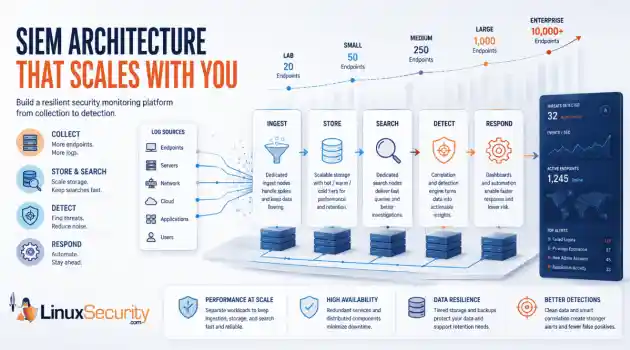
 Building a SIEM is easier than scaling one. Most open-source deployments start as a simple "all-in-one" server. It is easy to set up, but that design rarely survives the transition from a lab to a production workload. . A SIEM watching 20 endpoints is not doing the same job as one watching 500. More endpoints mean more logs; more logs require more storage; more storage makes search heavier. Eventually, the very architecture that made your lab easy to deploy becomes the reason your production...
 Jun 04, 2026
 security advisory apache
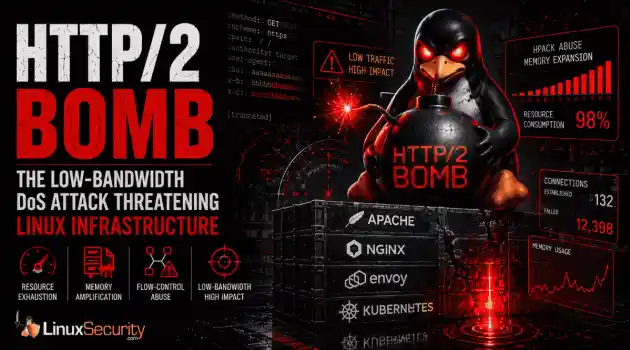
 A newly disclosed attack technique called HTTP/2 Bomb is drawing attention because it targets the software that sits at the front of much of the Linux internet. Apache HTTP Server, NGINX, Envoy, and the ingress layers that many Kubernetes environments depend on can be forced into consuming disproportionate amounts of memory using relatively small amounts of attacker traffic. . For Linux administrators, the concern is not the HTTP/2 protocol itself. It is the possibility that a single...
Jun 04, 2026
 security advisory important
 The compromise of Nx Console shows how much infrastructure now sits behind a single developer account. GitHub repositories, CI/CD pipelines, container build systems, Terraform projects, Kubernetes deployments. None of those systems was the initial target. The workstation was. . Attackers did not need a Linux privilege escalation bug or a remote code execution chain. They needed developers to trust a tool they were already using. For many organizations, that was enough. What Happened? Federal...
Jun 03, 2026
 security advisory open-source
 You remove the malware. You rotate the compromised credentials. You patch the original vulnerability and close the ticket. Two weeks later, the attacker is back. . What happened? You didn't lose the battle at the exploit; you lost it at the cleanup. In many modern Linux intrusions, the malware you found wasn't the main problem—it was the fallback mechanisms left behind. These hooks quietly restore attacker access the moment you look away. If you clean a host but miss these persistence layers,...
Jun 02, 2026
 security advisory Red Hat
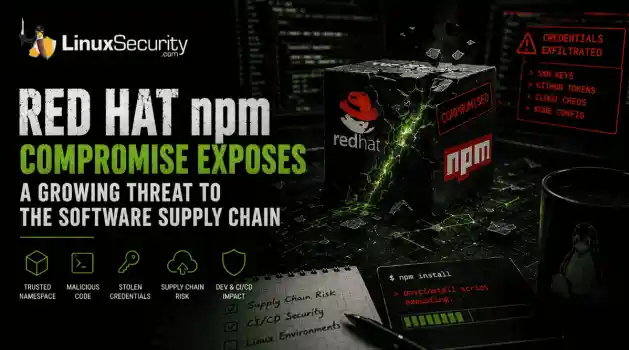
 Researchers investigating a campaign now tracked as Miasma found that more than 30 packages in Red Hat's @redhat-cloud-services npm namespace had been altered to deliver credential-stealing malware. . The packages weren't being used to deploy ransomware or sabotage systems. From what has been reported so far, the objective appears to have been much simpler: collect credentials from developer environments and use that access elsewhere. GitHub tokens, cloud credentials, SSH keys, and other...
Jun 02, 2026
 Refine features
X Clear Filters
Get the latest News and Insights
Get the latest Linux and open source security news straight to your inbox.
Community Poll
What got you started with Linux?
Loading...

Explore Latest Linux Security features
We found -4 articles for you...
102
 security advisorycriticalprivilege escalation
Linux Kernel Fragnesia Critical Privilege Escalation CVE-2026-46300
Linux administrators are once again dealing with a familiar problem: a local Linux foothold that can potentially become full root access. . A newly disclosed kernel vulnerability called Fragnesia ( CVE-2026-46300 ) affects the Linux kernel’s XFRM ESP-in-TCP subsystem and could allow unprivileged attackers to escalate privileges to root on vulnerable systems. The issue matters because modern Linux attacks rarely begin with root access. Attackers typically compromise a lower-privileged process first, then use local privilege escalation vulnerabilities to take over the underlying host. At first glance, the vulnerability may sound similar to Dirty Frag . But Fragnesia is being tracked separately and has received its own patch. That distinction matters because it highlights an ongoing issue inside Linux environments: kernel networking and page-cache attack surfaces are still producing serious privilege escalation risks. And for administrators, local privilege escalation bugs are rarely “minor.” What You Need To Know Fragnesia is tracked as CVE-2026-46300 The flaw affects the Linux kernel’s XFRM ESP-in-TCP subsystem Researchers say it may allow arbitrary byte writes into the kernel page cache of read-only files Successful exploitation could allow local attackers to gain root privileges Systems using ESP/XFRM-related functionality may require special mitigation considerations Administrators should prioritize official kernel patches from Linux vendors Why Local Privilege Escalation Still Matters Modern Linux attacks usually do not start with root access. An attacker gains a small foothold first. Maybe through a vulnerable application, exposed service, stolen credentials, container breakout, or compromised developer account. From there, the goal is escalation. That is where vulnerabilities like Fragnesia become dangerous. Once an attacker reaches root, the entire system changes hands. Security tools can be disabled Persistence can beestablished quietly Credentials, containers, workloads, and neighboring systems all become easier targets This matters even more in environments like cloud infrastructure, container hosts , CI/CD runners, shared Linux systems, developer workstations, and Kubernetes environments. In those environments, attackers do not necessarily need remote kernel exploitation. They only need a local foothold that can be turned into something bigger. What Makes Fragnesia Important One of the more significant details in the disclosure is that Fragnesia reportedly does not require a race condition to corrupt the page cache. That lowers complexity. Race-condition exploits are often harder to execute reliably because timing matters. Remove the race condition, and exploitation becomes more predictable under the right circumstances. The vulnerability also affects a subsystem many administrators may not actively monitor day to day: ESP/XFRM networking functionality tied to IPsec behavior. That creates a practical problem. Vulnerable components can sit quietly inside production systems without drawing much attention until a disclosure like this appears. In large Linux environments, especially cloud-heavy ones, many teams may not immediately know whether affected functionality is enabled, exposed, or actively being used. That delay matters during patch cycles. What Admins Should Check Right Now Administrators should begin by identifying whether affected networking modules are loaded on exposed systems. lsmod | grep esp lsmod | grep xfrm Teams should also verify currently running kernel versions: uname -r Additional priorities should include: Reviewing Linux vendor advisories for patched kernels Validating updates for cloud images and managed infrastructure Prioritizing shared Linux systems and container hosts Reviewing Kubernetes worker nodes and CI/CD infrastructure Confirming whether IPsec VPN dependencies could be impacted by temporary mitigations Patching Is the Priority Fragnesia has received its own patch, and administrators should rely on official kernel updates from their Linux distribution rather than attempting manual kernel changes. Organizations should closely monitor advisories and updated packages from vendors including: Red Hat Ubuntu Debian Fedora SUSE AlmaLinux Rocky Linux Cloud image providers and managed infrastructure platforms should also be monitored closely as updated kernels become available. As with most kernel vulnerabilities, delayed patching expands the window for attackers. Local privilege escalation flaws become significantly more dangerous once attackers already have access somewhere inside the environment. Temporary Mitigations May Affect VPNs For organizations unable to patch immediately, temporary mitigations reportedly follow the same general approach associated with recent ESP/XFRM-related issues. That may involve blocking or unloading affected modules such as esp4 or esp6. Administrators should be careful here. Disabling ESP/XFRM-related modules can interfere with IPsec VPN functionality , encrypted tunnels, and secure network communications that rely on those components. In production environments, aggressive mitigation steps can create operational problems if applied broadly without testing. That tradeoff is one of the more difficult realities of kernel vulnerability response. Security fixes are not always operationally clean, especially when networking infrastructure is involved. Why This Matters for Kubernetes and Cloud Environments Consider a Kubernetes worker node running multiple workloads. If an attacker compromises a vulnerable containerized application and gains limited local access to the underlying host namespace, a privilege escalation vulnerability like Fragnesia could potentially allow escalation to root on the node itself. From there, attackers may gain access to credentials, neighboring workloads, orchestration tooling, or cluster secrets. That is one reason local privilege escalation vulnerabilities continue to matter heavily in modern Linux infrastructure. Why Linux Kernel Bugs Continue To Matter Linux systems now sit underneath nearly every modern environment. They power containers, cloud workloads, CI/CD infrastructure, virtualization platforms, enterprise applications, and internet-facing services. Attackers know that, and increasingly, Linux attacks do not rely on noisy malware or obvious system crashes. Many operate quietly inside normal administrative activity until privilege escalation opens the door to full control. That is why vulnerabilities like Fragnesia deserve attention even when they require local access first. Because in modern infrastructure, attackers rarely need to start with root. They just need a reliable path to get there. Immediate Actions for Linux Admins Patch affected kernels immediately Verify whether ESP/XFRM modules are loaded Review IPsec VPN dependencies before mitigation Prioritize shared systems and container hosts Monitor vendor advisories for updated kernels Want more Linux security breakdowns and kernel vulnerability analysis? Subscribe to our newsletter for weekly infrastructure and security updates. Related Reading: Dirty Frag Linux Privilege Escalation Explained How To Secure the Linux Kernel Against Exploits Container Escape Vulnerabilities Explained for Linux Admins Linux Security Hardening Tips for Keeping Servers Safe Dirty Pipe: One of Linux’s Most Serious Recent Vulnerabilities . A newly disclosed kernel vulnerability called Fragnesia (CVE-2026-46300) affects the Linux kernel’. linux, administrators, again, dealing, familiar, problem, local, foothold. . MaK Ulac
 May 14, 2026
•
May 14, 2026
•

Get the latest News and Insights
Get the latest Linux and open source security news straight to your inbox.
Community Poll
What got you started with Linux?
Search Topics
Powered By

Linux Security - Your source for Top Linux News, Advisories, HOWTOs and Feature Releases
QUICK LINKS
subscribe to newsletters!
Like staying secure? So do we.
Sign up for updates, tips, and alerts!
Discover faster search, smarter navigation, and deeper Linux security insights. Read More