Audit Linux privileges now to limit compromise, escalation, and system-wide damage. Review Linux Privileges×


Stay Ahead With Linux Security Features

 security advisory update
 A large volume of Linux security updates and advisories this week across major distributions once again, but it wasn't just the volume that was the story. Where maintainers and security teams focused their attention was evident in the concentration of fixes targeting Linux kernel updates, identity services, DNS infrastructure, and internet-facing software. . Instead of looking at each advisory in isolation, administrators gain more value from the general trends they reveal about Linux security...
 Jul 23, 2026
 identity management security tactics
 For years, we secured our Linux infrastructure by building walls: VPCs, security groups, and hardened SSH configurations. We treated the cloud like a virtual data center, assuming that if we kept the "bad guys" out of the network, our workloads were safe. . That model is no longer sufficient. Today, one of the most common paths from an initial compromise to a major cloud breach is the identity assigned to your Linux workload. When an attacker gains code execution on a Linux instance—through a...
Jul 17, 2026
 security practices patch management
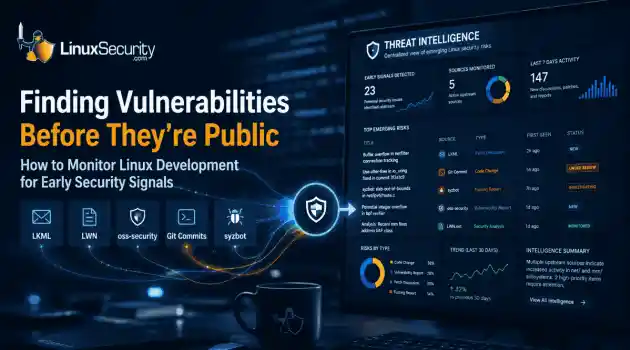
 Most of us don't hear about a kernel vulnerability until a CVE lands in our inbox or the vulnerability scanner starts complaining. By then, the patch isn't new anymore. Kernel developers may have been passing it around for review, arguing over the implementation, or revising it for days before anyone outside that community noticed it. None of those discussions are secret. They're sitting in mailing list archives, Git commits, and patch reviews where they've been the whole time. The strange...
Jul 14, 2026
 Linux security cyber attacks
 Every Linux server in your fleet produces thousands of events every minute. From journald logs and auditd records to kernel-level eBPF hooks, your systems are constantly talking. Most of that noise is just the mundane churn of system services, CI/CD runners, or routine administrative automation. But among that noise, an attacker might be establishing a foothold, moving laterally, or setting up persistence. The challenge for any security team is: how do you separate the routine from the...
Jul 13, 2026
 open-source infrastructure risk
 Security scanners flag exposed API keys in public repositories every day. The initial response is usually predictable: delete the commit, revoke the credential, and move on. That’s a mistake. . In a real Linux environment, an API key never stays in one place. By the time it hits a public repo, it’s already everywhere. It’s in the CI/CD pipeline. It’s in your container registry. It’s in the build logs. It’s in the backups. Git makes this worse because the history never dies. Deleting a file in...
Jul 11, 2026
 Refine features
X Clear Filters
Get the latest News and Insights
Get the latest Linux and open source security news straight to your inbox.
Community Poll
Should Linux servers automatically install security updates?
Loading...
Explore Latest Linux Security features
We found -2 articles for you...
102
 security advisoryhigh severitylocal privilege escalation
Ubuntu Copy Fail High Local Privilege Escalation Threat Advisory 2026-31431
Most Linux hardening focuses on access. This vulnerability bypasses that entirely. . Think about Linux security like the structural integrity of a building. We spend a lot of time on the front door—locks, cameras, and ID badges. Those are just policy layers. They’re great for keeping people out, but they don't tell you what happens to the foundation if a core system component is bypassed in plain sight. The reality is that upstream kernel security moves a lot faster than enterprise adoption. Defenses are being built quietly through patch discussions and mailing lists, not through big announcements. By the time a vulnerability like this becomes a standard operational concern, the risk has already been sitting in the gap between what is "available" and what is actually "active" in your environment. Copy Fail (CVE-2026-31431 ) sits right in that gap. It’s a high-severity local privilege escalation flaw in the Linux kernel’s cryptographic subsystem ( authencesn ), and it’s easy to miss if you’re only tracking what’s been announced instead of what’s actually running. This isn't about just listing what exists; it’s about verifying what is actually working on your systems and knowing where the risk actually lives. Why This Matters in Production Environments If you're trying to figure out how to secure a server, the structural boundaries are where things usually break down. Copy Fail is not remotely exploitable on its own, but chained with a web Remote Code Execution (RCE), a compromised CI runner, or an SSH breach, it gives an external attacker an immediate express lane to host-level root. The real danger of this local privilege escalation Linux flaw isn't on a single, isolated desktop. The risk lies in the shared infrastructure that powers modern enterprise tech: Container Escape Vulnerabilities: The vulnerability represents a dangerous container escape primitive . Because the page cache is shared at the host level, an attacker doesn’t stay contained. Frominside a compromised container, this turns into a path straight to the underlying Kubernetes node. Shared Kernels: Containers aren’t isolated in the way most people assume; they all rely on the same kernel and memory. Once that boundary breaks, it doesn’t stop at one workload. How 4 Bytes Can Give You Root To understand what’s happening, you don't need to be a kernel developer. Most server security conversations stay at the surface—firewalls, access controls, patching. But this vulnerability stems from an in-place processing optimization introduced to the Linux kernel back in August 2017 (commit 72548b093ee3). The kernel uses a mechanism called the page cache to keep frequently accessed files in RAM, so the system doesn't have to keep reading the slower disk drive. When you make an AEAD (Authenticated Encryption with Associated Data) request through an AF_ALG socket to the authencesn cryptographic template, the kernel processes the data. Due to this optimization, a page from the page cache ends up in the writable destination scatterlist: The Overwrite: If an attacker binds a socket to authencesn and sends a recvmsg call with the exact offset, the kernel treats the request as an in-place operation. It writes four controlled bytes into the page cache of a target setuid binary (such as /usr/bin/su ). The Hijack: The exploit doesn't alter the file on disk. File integrity monitoring tools will see nothing. Instead, it alters the binary as it is executed . When that setuid binary is run by the system or another user, it reads the modified cache, executes the corrupted memory instead of the original code, and hands over root privileges to the unprivileged user. The Simplicity: Unlike older, complex LPEs like Dirty Pipe, there are no race conditions or tricky timing windows to worry about. With a 732-byte Python script, it works reliably on the first try across almost all enterprise Linux builds (Ubuntu, Debian, RHEL, SUSE) released since 2017. The AI Factor: Why This Problem Is About to Get Worse This isn't an isolated discovery pattern, nor is it just a theoretical milestone. Copy Fail wasn't found by a researcher spending months hunting through assembly code by hand. It was identified by Theori researcher Taeyang Lee using their Xint Code AI scanning software in about an hour. Think about the economics of vulnerability research: for years, finding a reliable, high-severity local privilege escalation flaw in the Linux kernel required deep domain expertise, patience, and manual fuzzing with tools like syzbot . The barrier to entry was high, and the turnaround time was measured in weeks or months. That barrier has completely collapsed. When an AI-driven tool can scan, identify, and trace a deep logic flaw in the kernel's cryptographic subsystem in sixty minutes, the friction of discovery drops to zero. We are looking at an exponential increase in automated vulnerability discovery. The industry is already feeling the downstream pressure of this shift—security programs and maintainers are being inundated with automated bug reports, struggling to triage deep logic vulnerabilities at scale. What does this mean for your infrastructure? It forces a change in your fundamental threat model. You can no longer treat kernel-level LPEs as rare anomalies that only affect high-value targets. If vulnerabilities are found in minutes, threat actors and automated agents can weaponize and chain them into container escapes much faster than enterprise release cycles can accommodate. When the foundation can be breached this quickly, infrastructure security stops being about patching known bugs one by one. It becomes a requirement to harden the environment against entire classes of vulnerabilities and validate those protections at the host layer before an attacker even gets a foot in the door. The System Looked Clean, but Wasn’t In internal testing, this exploit worked on fully patched enterprise Linux builds from the last several years,with no alerts triggered and no file changes on disk. What to Check and Where Mitigations Fail The gap between what’s possible and what’s deployed is where risk lives. Standard patching doesn't always validate these internal controls, and many teams assume a patch was applied without auditing the running state of the host. For instance, simply updating the base image of a container does nothing if the underlying host kernel remains vulnerable. Furthermore, disabling modules requires active host reboots or unloads that often get delayed in production. Here is a quick check for your endpoint security: Patch Your Kernels: Major Linux distributions have already rolled out updates. Debian, Ubuntu, and SUSE are pushing patches. Red Hat shifted its guidance to issue patches promptly. Check your distribution's security repository and apply the latest kernel packages. On production Kubernetes clusters, plan a rolling drain-and-reinstate procedure. Apply Temporary Mitigations: If you can't reboot or patch your kernels immediately, you can disable the vulnerable algif_aead module. Harden Container Pipelines: Restrict the creation of AF_ALG sockets using seccomp profiles to stop the exploit from being executed within containers. # Disable the vulnerable algif_aead module echo "install algif_aead /bin/false" > /etc/modprobe.d/disable-algif.conf rmmod algif_aead 2> /dev/null || true (Note: This mitigation doesn't affect standard encryption like IPsec or OpenSSL, but you should always test it in a non-production environment first). True infrastructure security is about the foundation. Validation matters more than assumptions. The best defenses aren't the ones you read about in a memo—they’re the ones you’ve actually turned on and validated within your container workloads. Where Security Assumptions Break Nothing here throws obvious signals. The system runs, policies stay loaded, logs look routine, and the control still doesn’t behave the wayanyone expects once it’s actually exercised. The problem shows up at the boundary. A container reaches past its limits, a syscall path resolves when it shouldn’t, a restriction exists but doesn’t apply in the exact context an attacker lands in, and that’s enough. It doesn’t take much. One weak spot in a shared layer, one enforcement gap that never got tested under real conditions, and isolation starts to blur in ways that don’t show up in configs or dashboards. This isn’t about adding more controls. It’s about knowing which ones you’ve pushed hard enough to trust, and which ones are still sitting there unverified. Subscribe to the newsletter if you want direct insight into where these breaks actually happen, especially around kernel behavior and container boundaries. . Think about Linux security like the structural integrity of a building. We spend a lot of time on th. linux, hardening, focuses, vulnerability, bypasses, entirely, think, about. . MaK Ulac
 May 01, 2026
•
May 01, 2026
•
102
 security advisorydenial of servicenetwork security
Chromium: High-Risk DoS and Info Disclosure Security Advisory
Several high-impact, remotely exploitable cybersecurity vulnerabilities were recently discovered in the popular Chromium free and open-source web browser. These network security issues could lead to the execution of arbitrary code, Denial of Service (DoS) attacks resulting in potentially exploitable crashes, or the disclosure of sensitive information. . Luckily, important Chromium security updates can fix these bugs and are now available. This article will cover these dangerous exploits in cybersecurity recently identified in Chromium and how users can update their systems to protect against these risks. The Discovery & The Impact The most severe data and network security threats recently discovered and patched in Chromium include: CVE-2023-1810: Heap buffer overflow in Visuals in Google Chrome prior to 112.0.5615.49 allowed a remote attacker who had compromised the renderer process to potentially exploit heap corruption via a crafted HTML page. (Chromium security severity: High) CVE-2023-1811: Use after free in Frames in Google Chrome prior to 112.0.5615.49 allowed a remote attacker who convinced a user to engage in specific UI interaction to potentially exploit heap corruption via a crafted HTML page. (Chromium security severity: High) CVE-2023-1812: Out-of-bounds memory access in DOM Bindings in Google Chrome prior to 112.0.5615.49 allowed a remote attacker to perform out-of-bounds memory access via a crafted HTML page. (Chromium security severity: Medium) CVE-2023-1813: Inappropriate implementation of Extensions in Google Chrome prior to 112.0.5615.49 allowed an attacker who convinced a user to install a malicious extension to bypass file access restrictions via a crafted HTML page. (Chromium security severity: Medium) CVE-2023-1814: Insufficient validation of untrusted input in Safe Browsing in Google Chrome prior to 112.0.5615.49 allowed a remote attacker to bypass download checking via a crafted HTML page. (Chromium security severity: Medium) CVE-2023-1815: Use after free in Networking APIs in Google Chrome prior to 112.0.5615.49 allowed a remote attacker who convinced a user to engage in specific UI interaction to potentially exploit heap corruption via a crafted HTML page. (Chromium security severity: Medium) CVE-2023-1816: Incorrect security UI in Picture In Picture in Google Chrome prior to 112.0.5615.49 allowed a remote attacker to potentially perform navigation spoofing via a crafted HTML page. (Chromium security severity: Medium) CVE-2023-1817: Insufficient policy enforcement in Intents in Google Chrome on Android prior to 1 12.0.5615.49 allowed a remote attacker to bypass navigation restrictions via a crafted HTML page. (Chromium security severity: Medium) CVE-2023-1818: Use after free in Vulkan in Google Chrome prior to 112.0.5615.49 allowed a remote attacker to potentially exploit heap corruption via a crafted HTML page. (Chromium security severity: Medium) CVE-2023-1819: Out-of-bounds read in Accessibility in Google Chrome prior to 112.0.5615.49 allowed a remote attacker to perform an out-of-bounds memory read via a crafted HTML page. (Chromium security severity: Medium) CVE-2023-1820: Heap buffer overflow in Browser History in Google Chrome prior to 112.0.5615.49 allowed a remote attacker who convinced a user to engage in specific UI interaction to potentially exploit heap corruption via a crafted HTML page. (Chromium security severity: Medium) CVE-2023-2033: Type confusion in V8 in Google Chrome prior to 112.0.5615.121 allowed a remote attacker to potentially exploit heap corruption via a crafted HTML page. (Chromium security severity: High) Many of the cybersecurity vulnerabilities have been rated by the National Vulnerability Database as having a critical or high severity. These network security issues have a high impact on confidentiality, integrity, and availability. How Can I Secure My System Against These Critical Bugs? Chromium has released an important security update mitigatingthese network security issues. We strongly recommend that all impacted users apply the Chromium updates issued by their distro(s) as soon as possible to protect against exploits in network security leading to downtime, system compromise, and sensitive data loss. To see if your distro has issued an advisory for these Chromium cybersecurity vulnerabilities and to stay on top of important updates released by the open-source programs and applications you use, be sure to register as a LinuxSecurity user , then subscribe to our Linux Advisory Watch newsletter and customize your advisories for the distro(s) you use. This will enable you to stay up-to-date on the latest, most significant network security threats impacting your systems. We also encourage you to follow @LS_Advisories on Twitter for real-time updates on advisories for your distro(s) . Linux security expert and LinuxSecurity.com Founder Dave Wreski concludes, “It is crucial that all admins and organizations track security advisories diligently and apply patches as soon as they are released in order to stay ahead of attackers looking to exploit vulnerabilities to gain access to critical systems and confidential information.” . Important Chromium security updates can fix high-impact vulnerabilities. Apply patches to secure your systems promptly.. high-impact, remotely, exploitable, cybersecurity, vulnerabilities, recently. . Brittany Day
Apr 21, 2023
•

102
security advisorynetwork securityhigh severityOpenSSL: High-Severity Advisory for CVE-2023-0286 DoS Threat
On February 7, 2023, OpenSSL released a security advisory regarding the discovery and security patching of several cybersecurity vulnerabilities. This advisory included a high-severity address type confusion bug that hackers could use in exploits in cybersecurity to read memory contents or enact Denial-of-Service (DoS) attacks in network security. . OpenSSL is a software applications library that contains the open-source implementation of the SSL and TLS protocols and provides secure communications over computer networks. So many Internet servers utilize OpenSSL in some shape or form, so users must know of all the data and network security issues they could face. This article will discuss all the details you need regarding the latest network security news about this vulnerability and how to mitigate it. The Discovery & The Impact The most notable network security threat plaguing OpenSSl systems is a high-severity type confusion vulnerability related to X.400 address processing within X.509 GeneralName (CVE-2023-0286). bX.400 addresses received the label ASN1_STRING following analysis. Still, the public structure definition for GENERAL_NAME incorrectly specified the type of x400 Address field as ASN1_TYPE. The OpenSSL function GENERAL_NAME_cmp interprets the coding as an ASN1_TYPE rather than an ASN1_STRING. When CRL checking is enabled, these network security issues may allow attackers to pass arbitrary pointers to a memcmp call, enabling threat actors to read memory contents or carry out a Denial of Service attack. Fortunately, this vulnerability does not impact an entire system; however, applications implementing CRLs into their network functionality are most susceptible to this risk. What Should I Do to Secure My Systems Against This Bug? Here are the outdated, at-risk systems that clients utilize. If you use one of these servers, we have personalized recommendations for you about how to reduce or remove risk from your cybersecurity platforms: OpenSSL 3.0 users should upgrade to OpenSSL3.0.8. OpenSSL 1.1.1 clients must download OpenSSL 1.1.1t. OpenSSL 1.0.2 organizations must employ OpenSSL 1.0.2zg, which is premium customer support only. What Other Issues Did We Find on OpenSSL? Here are a few other cybersecurity vulnerabilities and flaws we discovered in OpenSSL this past week, on top of the address type confusion issue: A timing-based side channel exists in the OpenSSL RSA Decryption implementation, which could be sufficient to recover plaintext across a network in a Bleichenbacher-style attack (CVE-2022-4304). OpenSSL 3.0, 1.1.1, and 1.0.2 are vulnerable to this issue. OpenSSL 3.0 users should upgrade to OpenSSL 3.0.8. OpenSSL 1.1.1 users should upgrade to OpenSSL 1.1.1t. OpenSSL 1.0.2 users should upgrade to OpenSSL 1.0.2zg (premium support customers only). A read buffer overrun can result from X.509 certificate verification, specifically in name constraint checking (CVE-2022-4203). This flaw might result in a denial of service attack, and, in theory, it could also result in the disclosure of private memory contents. OpenSSL versions 3.0.0 to 3.0.7 are vulnerable to this issue. OpenSSL 3.0 users should upgrade to OpenSSL 3.0.8. OpenSSL 1.1.1 and 1.0.2 are not affected by this issue. A use-after-free following BIO_new_NDEF (CVE-2023-0215) could result in a crash. OpenSSL 3.0, 1.1.1, and 1.0.2 are vulnerable to this issue. OpenSSL 3.0 users should upgrade to OpenSSL 3.0.8. OpenSSL 1.1.1 users should upgrade to OpenSSL 1.1.1t. OpenSSL 1.0.2 users should upgrade to OpenSSL 1.0.2zg (premium support customers only). Double free after calling PEM_read_bio_ex (CVE-2022-4450) could lead to a crash. OpenSSL 3.0 and 1.1.1 are vulnerable to this issue. OpenSSL 3.0 users should upgrade to OpenSSL 3.0.8. OpenSSL 1.1.1 users should upgrade to OpenSSL 1.1.1t. OpenSSL 1.0.2 is not affected by this issue. An invalid pointer dereference in the d2i_PKCS7 functions (CVE-2023-0216) could lead to a denial of service attack. OpenSSL versions 3.0.0 to 3.0.7 are vulnerable to this issue.OpenSSL 3.0 users should upgrade to OpenSSL 3.0.8. OpenSSL 1.1.1 and 1.0.2 are not affected by this issue. An invalid pointer dereference on read can be triggered when an application tries to check a malformed DSA public key by the EVP_PKEY_public_check() function (CVE-2023-0217). Such operations will most likely lead to a crash. OpenSSL versions 3.0.0 to 3.0.7 are vulnerable to this issue. OpenSSL 3.0 users should upgrade to OpenSSL 3.0.8. OpenSSL 1.1.1 and 1.0.2 are not affected by this issue. A NULL dereference during PKCS7 data verification (CVE-2023-0401) could lead to a crash. OpenSSL versions 3.0.0 to 3.0.7 are vulnerable to this issue. OpenSSL 3.0 users should upgrade to OpenSSL 3.0.8. OpenSSL 1.1.1 and 1.0.2 are not affected by this issue. Final Thoughts on the February 7th OpenSSL Advisory Open-source software and applications are not immune to facing detrimental cybersecurity vulnerabilities . OpenSSL cybersecurity platforms are no different, and we can acknowledge how many network security issues are present on OpenSSL as of just this past week. Fortunately, there are ways to stay up-to-date on the latest security advisories so you can employ security patching before attacks in network security threaten your server. Your Linux distribution offers a security newsletter to look at and prepare for threats. Consider subscribing to the Linux Advisory Watch security newsletter to get generalized updates and customize your LinuxSecurity advisories to see advisories specific to your distributions. Be sure to upgrade OpenSSL frequently to avoid network security issues that could lead to significant downtime, data loss, and reputational harm. . OpenSSL has issued a critical notification regarding a severe vulnerability that leaves systems vulnerable to denial-of-service attacks and potential compromises.. OpenSSL Advisory, Address Type Confusion Bug, High Severity Flaw. . Brittany Day
Feb 10, 2023
•

Get the latest News and Insights
Get the latest Linux and open source security news straight to your inbox.
Community Poll
Should Linux servers automatically install security updates?
Search Topics
Powered By

Linux Security - Your source for Top Linux News, Advisories, HOWTOs and Feature Releases
QUICK LINKS
subscribe to newsletters!
Like staying secure? So do we.
Sign up for updates, tips, and alerts!