Explore top 10 tips to secure your open-source projects now. Read More
×


Stay Ahead With Linux Security Features

 identity management security tactics
 For years, we secured our Linux infrastructure by building walls: VPCs, security groups, and hardened SSH configurations. We treated the cloud like a virtual data center, assuming that if we kept the "bad guys" out of the network, our workloads were safe. . That model is no longer sufficient. Today, one of the most common paths from an initial compromise to a major cloud breach is the identity assigned to your Linux workload. When an attacker gains code execution on a Linux instance—through a...
 Jul 17, 2026
 security practices patch management
 Most of us don't hear about a kernel vulnerability until a CVE lands in our inbox or the vulnerability scanner starts complaining. By then, the patch isn't new anymore. Kernel developers may have been passing it around for review, arguing over the implementation, or revising it for days before anyone outside that community noticed it. None of those discussions are secret. They're sitting in mailing list archives, Git commits, and patch reviews where they've been the whole time. The strange...
Jul 14, 2026
 Linux security cyber attacks
 Every Linux server in your fleet produces thousands of events every minute. From journald logs and auditd records to kernel-level eBPF hooks, your systems are constantly talking. Most of that noise is just the mundane churn of system services, CI/CD runners, or routine administrative automation. But among that noise, an attacker might be establishing a foothold, moving laterally, or setting up persistence. The challenge for any security team is: how do you separate the routine from the...
Jul 13, 2026
 open-source infrastructure risk
 Security scanners flag exposed API keys in public repositories every day. The initial response is usually predictable: delete the commit, revoke the credential, and move on. That’s a mistake. . In a real Linux environment, an API key never stays in one place. By the time it hits a public repo, it’s already everywhere. It’s in the CI/CD pipeline. It’s in your container registry. It’s in the build logs. It’s in the backups. Git makes this worse because the history never dies. Deleting a file in...
Jul 11, 2026
 open-source rootkit
 Most of us think of Linux rootkits as ancient history—the stuff of 90s hacking forums and clunky malware that would crash your system if you looked at it the wrong way. But if you think they’ve gone away, you’re mistaken. They’ve just gotten smarter. . Modern attackers aren't using the noisy tools of the past. Today’s threats are surgical. Many of today’s most advanced Linux rootkits operate at the kernel level or abuse legitimate system features to blend in with normal traffic. They’re...
Jul 09, 2026
 Refine features
X Clear Filters
Get the latest News and Insights
Get the latest Linux and open source security news straight to your inbox.
Community Poll
Should Linux servers automatically install security updates?
Loading...
Explore Latest Linux Security features
We found -3 articles for you...
102
 privilege escalationopen-sourcesystem access
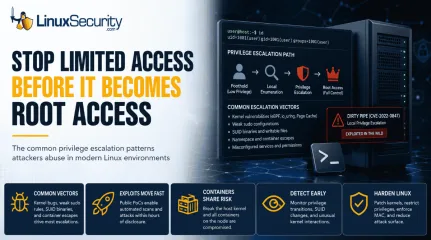
Linux Privilege Escalation Patterns and Mitigation Strategies
Linux privilege escalation starts once an attacker gets a foothold on a machine. Maybe it is a regular user account. Maybe it is an exposed application that nobody patched, or a reused password from another breach. Root access is usually the next objective. Attackers typically keep digging once inside, looking for a way to gain root privileges and remove the restrictions around them. . That matters because most Linux breaches do not begin with full control. They grow into it. Recent threat intelligence continues to show the same patterns across different environments. Old kernel bugs still get reused, weak sudo rules still get abused, and misconfigured services still open the door for local privilege escalation long after patches are available. Different exploit chains, same general mistakes underneath. This article is not a hacking tutorial or a deep breakdown of exploit development. The goal is simpler than that. We are looking at the common patterns behind modern Linux privilege escalation activity, why these attacks continue to succeed, and what defenders should recognize before a limited compromise turns into full system access. Why Linux Privilege Escalation Still Matters Privilege escalation is rarely the first move in an attack chain. Most compromises begin with restricted access: a web shell, exposed API token, stolen SSH key, or vulnerable CI runner. Attackers use that foothold to map the environment and look for a path toward root. A standard user account still runs into operational barriers. Security tooling continues running. Sensitive files stay restricted. Service credentials remain partially isolated. Root access removes those constraints. Once attackers gain elevated privileges, they can tamper with logs, disable monitoring, harvest credentials from memory, and move laterally through infrastructure that trusted the compromised system. Modern Linux environments amplify the impact. Kubernetes nodes, CI/CD pipelines, cloud workloads, and container hosts all depend heavilyon shared Linux infrastructure. A privilege escalation vulnerability inside one containerized workload may expose the underlying host kernel. From there, the attacker is no longer confined to a single application. Microsoft’s analysis of the Copy Fail vulnerability demonstrated this problem clearly. A local privilege escalation flaw on a shared host is no longer isolated to one machine. In multi-tenant environments, the trust boundary itself starts collapsing. The attack path usually looks familiar: initial foothold local enumeration privilege escalation persistence credential access lateral movement Security teams spend a lot of time defending the perimeter while attackers focus on the transitions happening after access already exists. That gap matters. Common Patterns Behind Modern Kernel Exploit Activity Kernel exploitation trends are not random. The same subsystems keep appearing because they expose complicated functionality directly to unprivileged userspace processes. eBPF is one example. Designed for observability and high-performance packet filtering, it allows user-controlled programs to interact with kernel logic under tightly enforced validation rules. When flaws appear inside the eBPF verifier, attackers sometimes bypass those protections and gain arbitrary kernel-level execution. That combination makes these features attractive: high complexity broad accessibility deep kernel interaction io_uring follows a similar pattern. It was built for performance. Fast asynchronous I/O. Reduced overhead. Better scalability. It also introduced another large attack surface into the kernel. Several recent exploit chains abused memory handling mistakes inside io_uring operations to escalate privileges after gaining a low-level foothold. Complexity keeps winning against isolation boundaries. Attackers also continue targeting netfilter, user namespaces, and page cache handling. The technical details differ between vulnerabilities, but theoperational pattern stays consistent: accessible kernel functionality combined with flawed memory handling. Memory Corruption and Page Cache Abuse Many Linux privilege escalation exploits still revolve around memory corruption. Dirty COW , Dirty Pip e, and newer page cache vulnerabilities all share the same underlying theme: attackers manipulating how the kernel handles protected file operations. Dirty Pipe is a good example because the exploitation chain became operationally trivial once Proof-of-Concept code appeared publicly. The vulnerability affected the Linux pipe implementation and allowed unprivileged users to overwrite read-only files through improper page cache behavior. In practical terms, attackers could modify files they were never supposed to control: /etc/passwd SSH authorized_keys SUID binaries configuration files A low-privileged shell on a vulnerable system was often enough to reach root access within seconds. The bigger lesson was not the bug itself. It was the speed of weaponization. Once public exploit code landed on GitHub, attackers immediately started scanning for vulnerable kernels. Organizations delaying patch cycles by even a few days suddenly had internet-exposed systems vulnerable to fully automated privilege escalation attempts. The technical details changed from Dirty COW years earlier. The operational reality did not. Public Exploit Releases Compress the Timeline The gap between disclosure and exploitation keeps shrinking. Researchers publish advisories. A CVE gets assigned. Patch notes appear. Then, the exploit code lands online, and the environment changes immediately. Threat actors scrape GitHub, Exploit-DB, and Packet Storm, constantly looking for reusable privilege escalation chains. The workflow is brutally efficient: vulnerability disclosed public PoC released scanners updated vulnerable kernels identified exploit deployed automatically Security teams often think about privilege escalation as apost-exploitation problem requiring manual operator skill. That assumption stopped being reliable years ago. Many modern exploit chains are fully automated now. Delayed patching turns operational debt into exposure. Attackers do not need persistence if organizations leave vulnerable kernels online long enough for mass exploitation to work at scale. Containers Changed the Risk Model Containers provide the illusion of isolation. They share the underlying host kernel. That is a massive architectural dependency. If an attacker cracks that shared kernel, the container boundaries vanish. In Kubernetes or multi-tenant clouds, one container escape leads to total cluster compromise. The kernel is the ultimate referee. If the referee is compromised, the isolation rules fall apart. This analysis on defense-in-depth confirms why hardening the kernel is more effective than focusing solely on application-level security. When the foundation is shaky, the walls don't matter. Defenders should pay close attention to: unexpected unshare activity abnormal namespace creation containers spawning host-level processes unusual access to /proc or host-mounted filesystems The isolation model only works if the underlying kernel stays trustworthy. Once that assumption breaks, container boundaries stop helping. How Linux Privilege Escalation Becomes a Real-World Threat Privilege escalation is rarely the entire attack. It is usually the midpoint. Attackers tend to start with exposed services: vulnerable web applications, leaked SSH credentials, weak API authentication, forgotten admin panels, or CI runners that nobody has properly hardened. The initial foothold is often limited, but it gives them enough access to begin mapping the environment. The workflow usually follows a predictable sequence: Enumerate the local environment Kernel versions get checked against public exploit databases. Sudo permissions get reviewed for weak rules or unrestricted shell access. Attackers look forwritable scripts, exposed Docker sockets, SUID binaries, and namespace configurations that make container escape easier. Identify escalation paths Most of this process is heavily automated now. Tools like LinPEAS and resources like HackTricks help attackers quickly identify weak sudo configurations, vulnerable kernels, writable cron jobs, weak filesystem permissions, and exposed container runtimes. Escalate privileges and stabilize access Once root access is gained, the objective changes immediately. Persistence gets installed. Credentials get harvested. Logging pipelines disappear. Security agents stop reporting. SSH keys start appearing in places they should never exist, and service accounts begin authenticating against internal systems they never touched before. That sequence appears constantly during real intrusions. Different malware families. Different operators. Same escalation logic underneath. Practical Linux Security Monitoring for Privilege Escalation Detection Patching matters, but it does not solve everything. Production systems lag behind. Legacy workloads stay pinned to older kernels. Zero-days exist whether defenders like it or not. Detection becomes the fallback layer. Most privilege escalation attempts leave operational traces before attackers fully stabilize access. The goal is catching those transitions early enough to respond before persistence spreads through the environment. Watch for unusual privilege transitions Unexpected sudo execution deserves attention immediately, especially from service accounts or web-facing processes. A web server spawning sudo, pkexec, bash, or sh should never blend into normal activity. Parent-child process relationships matter here. So do timing anomalies. Monitor SUID changes aggressively SUID binaries remain one of the most common privilege escalation and persistence mechanisms on Linux systems. Attackers frequently modify existing binaries or introduce new SUID-enabled files after escalating privileges. Baseline scans help identify suspicious additions: find / -perm -4000 -type f 2> /dev/null Auditd can monitor sensitive binaries directly: auditctl -w /usr/bin/passwd -p wa -k suid-monitor Useful SIEM detections include: new SUID files outside standard system paths unexpected chmod +s service accounts spawning root-owned shells execution chains involving pkexec, sudo, or su Watch kernel interaction patterns Unexpected interaction with eBPF, namespaces, or kernel modules often appears during local escalation attempts. Good detection targets include: non-root execution of bpf() syscalls unexpected unshare or nsenter module loading outside maintenance windows web-facing processes spawning shell interpreters container workloads touching host-mounted paths Modern EDR platforms increasingly detect these patterns behaviorally because static signatures fail against rapidly changing exploit chains. Centralized logging still matters Attackers with root access frequently wipe or tamper with local logs. If logs never leave the host, incident responders lose visibility fast. At minimum: forward audit logs externally centralize authentication events preserve sudo history Monitor kernel logs for crashes or module anomalies Local visibility disappears quickly once root access is gained. Kernel Hardening Strategies That Reduce Linux Privilege Escalation Risk No single configuration stops every exploit. Security relies on layering. You shrink the attack surface to force the adversary into harder, noisier paths. If you rely on one wall, you’ve already lost. Defense-in-depth is the only realistic posture. Use this as your baseline for system configuration. It isn’t exhaustive, but it is operational. Keep kernels updated: This is the baseline. If your kernel is six months old, you are hosting known exploits. Automate the patch pipeline where possible. Restrict unnecessary kernel modules: If you don't need amodule, unload it. Disable kernel module loading entirely on production systems after boot. Disable unused services: Every active service is a potential point of entry. Audit your listening ports. Close anything that doesn't serve a clear business function. Limit user namespace exposure: Attackers frequently abuse unprivileged_userns_clone. Restrict this capability. It prevents many container-based escape attempts. Use SELinux or AppArmor: Mandatory Access Control provides the final layer. Even if an attacker hits a kernel vulnerability, these tools can block them from accessing sensitive files or executing unauthorized binaries. Apply least privilege: Audit your sudoers file. Do not grant broad shell access to service accounts. Every permission granted is a potential escalation path. Segment workloads: Do not mix critical services on the same host. If a container breakout occurs, it should land the attacker in an isolated network segment, not the heart of your data center. Monitor exploit disclosures: Track kernel vulnerability advisories closely. Knowledge is an operational advantage. Harden container environments: Run containers as non-root users. Use seccomp profiles to filter system calls. Treat the container runtime as a high-risk surface. Reality is harsh. A high-impact zero-day will eventually bypass these controls. You cannot eliminate the risk of a kernel vulnerability entirely. You can only make the exploit process costlier and more visible for the attacker. Layered security forces the adversary to chain multiple vulnerabilities together. Each step adds noise. Each step increases the chance of detection. When you combine strict access control with proactive patching and kernel-level hardening, you aren't just making the system "safer"—you are making the cost of exploitation higher than the value of the target. Do not hunt for perfect security. It doesn't exist. Hunt for better operational visibility. Patch the critical gaps. Harden the interfaces thatface the most risk. Defending Against the Privilege Escalation Lifecycle Privilege escalation isn’t an isolated event. It’s the logical progression of an exploit chain. Attackers lean on recurring weaknesses—stale kernels, loose sudo rules, and exposed subsystems—to turn a minor foothold into full system control. Architecture is complex. Exploits remain predictable. Security teams lose ground by chasing individual alerts instead of identifying patterns. Public Proof of Concepts turn academic vulnerabilities into automated threats overnight. If your strategy relies on scrambling to patch after weaponized code hits GitHub, you’ve already ceded the initiative. Threat intelligence must dictate your patching cadence. Prioritize the flaws attackers are actually weaponizing. Resilience requires more than reactive patching. You need visibility into system behavior to spot attackers moving toward root access. Combine kernel hardening with strict access controls to close gaps before they are discovered. Organizations that master these exploit patterns don't wait for the next vulnerability; they build environments that make exploitation noisy and difficult. Recognize the move. Block the path. Stop the escalation. Linux privilege escalation trends keep evolving because Linux environments keep evolving. New kernel features, container runtimes, and orchestration layers introduce new attack surfaces faster than most organizations can harden them. Our newsletter tracks the exploit chains, hardening strategies, and detection patterns defenders actually need to pay attention to. Related Reading Seccomp, AppArmor, SELinux: Where Linux Security Controls Fall Short Securing Linux with SELinux (or AppArmor) SELinux vs AppArmor: The Hard Truth About Linux Security Container Security Fundamentals: AppArmor and SELinux . Preventing Linux privilege escalation requires understanding exploit patterns and implementing effective security measures.. Linux Privilege Escalation,Security Monitoring, Kernel Hardening, Attack Patterns, Exploitation Mitigation. . MaK Ulac
 May 22, 2026
•
May 22, 2026
•
102
 security techniquessystem securitykernel hardening
A Master's Guide to Kernel Hardening with GrSecurity and RBAC
Our resident Master's student Gian Spicuzza chimes in this month with a great feature HowTo on Kernel Hardening! There are a number of ways to lock down a system, and RBAC (role based access control) is one of them. Read on to learn more about what makes RBAC so useful, and to read one of the best overviews on Low/Medium/High Security... The combination of the Linux kernel and GNU packages has always been regarded as a secure operating system, but can it be more secure? Kernel hardening is the answer to tightening up the Linux backbone. GrSecurity, a kernel patch for Linux, is one of the more popular approaches... One of the most significant feature is the addition of a role-based access control system (RBAC) that monitors what each user can execute based on their role and denies execution if they overstep their pre-defined rules. . A Quick and Dirty Guide To Kernel Hardening with GrSecurity By: Gian G. Spicuzza ; The combination of the Linux kernel and GNU packages has always been regarded as a secure operating system, but can it be more secure? Kernel hardening is the answer to tightening up the Linux backbone. GrSecurity, a kernel patch for Linux, is one of the more popular approaches. After applying this patch and compiling a fresh kernel, your system will have a plethora of new security features. The most significant feature is the addition of a role-based access control system (RBAC) that monitors what each user can execute based on their role and denies execution if they overstep their pre-defined rules. Other useful features include ip-based rules, extensive chroot restrictions, address space modification restrictions (PaX), auditing/logging features and /proc and dmesg anti-leak features. A full feature list can be found at the Grsecurity homepage. Installing Grsecurity: First we need to download the Linux kernel and Grsec patch. $ wget $ wget For your convenience, the PGP keys are located at: https://grsecurity.net/spender-gpg-key.asc .sign Move the kernel and patch into the /usr/src directory. $ su -c The link for this article located at is no longer available. . A Quick and Dirty Guide To Kernel Hardening with GrSecurity By: Gian G. Spicuzza ; The combination o. resident, master's, student, spicuzza, chimes, month, great, feature, howto, kerne. . Brittany Day
Dec 20, 2007
•


Get the latest News and Insights
Get the latest Linux and open source security news straight to your inbox.
Community Poll
Should Linux servers automatically install security updates?
Search Topics
Powered By

Linux Security - Your source for Top Linux News, Advisories, HOWTOs and Feature Releases
QUICK LINKS
subscribe to newsletters!
Like staying secure? So do we.
Sign up for updates, tips, and alerts!