


Stay Ahead With Linux Security Features
 security advisory attack
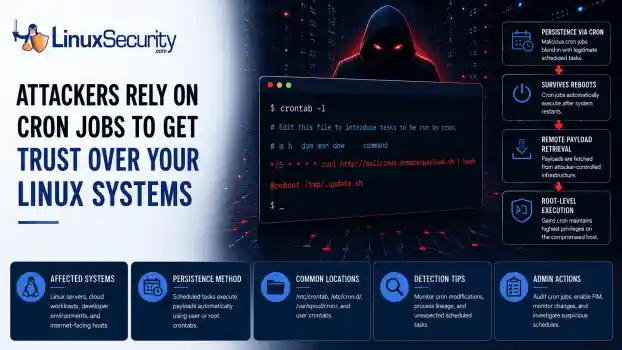
 A Linux server gets cleaned up after an intrusion. The suspicious process is terminated, credentials are rotated, and the system is rebooted during maintenance. Everything seems secure. A few hours later, the same outbound connection appears again. . Situations like that point to persistence . The attacker no longer needs the original exploit because something on the host continues restoring access behind the scenes. Finding that mechanism is often more important than understanding how the...
 Jun 08, 2026
 threat detection scalability
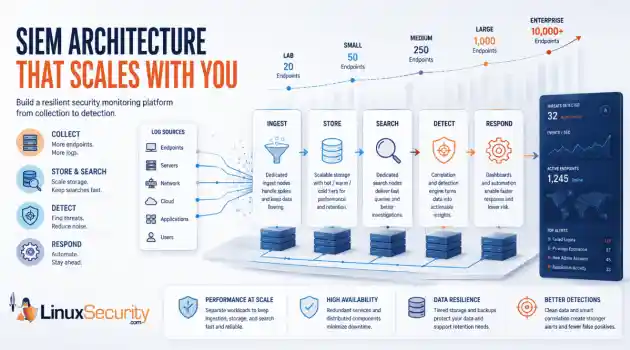
 Building a SIEM is easier than scaling one. Most open-source deployments start as a simple "all-in-one" server. It is easy to set up, but that design rarely survives the transition from a lab to a production workload. . A SIEM watching 20 endpoints is not doing the same job as one watching 500. More endpoints mean more logs; more logs require more storage; more storage makes search heavier. Eventually, the very architecture that made your lab easy to deploy becomes the reason your production...
Jun 04, 2026
 security advisory apache
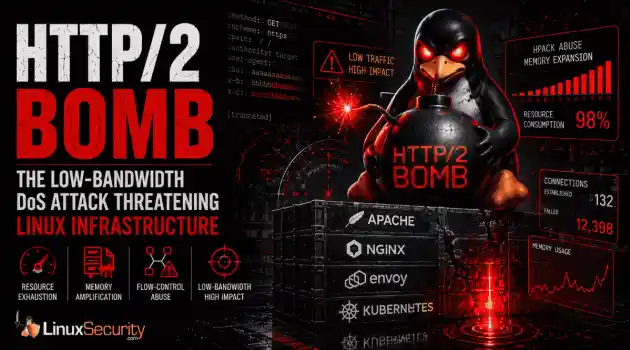
 A newly disclosed attack technique called HTTP/2 Bomb is drawing attention because it targets the software that sits at the front of much of the Linux internet. Apache HTTP Server, NGINX, Envoy, and the ingress layers that many Kubernetes environments depend on can be forced into consuming disproportionate amounts of memory using relatively small amounts of attacker traffic. . For Linux administrators, the concern is not the HTTP/2 protocol itself. It is the possibility that a single...
Jun 04, 2026
 security advisory important
 The compromise of Nx Console shows how much infrastructure now sits behind a single developer account. GitHub repositories, CI/CD pipelines, container build systems, Terraform projects, Kubernetes deployments. None of those systems was the initial target. The workstation was. . Attackers did not need a Linux privilege escalation bug or a remote code execution chain. They needed developers to trust a tool they were already using. For many organizations, that was enough. What Happened? Federal...
Jun 03, 2026
 security advisory open-source
 You remove the malware. You rotate the compromised credentials. You patch the original vulnerability and close the ticket. Two weeks later, the attacker is back. . What happened? You didn't lose the battle at the exploit; you lost it at the cleanup. In many modern Linux intrusions, the malware you found wasn't the main problem—it was the fallback mechanisms left behind. These hooks quietly restore attacker access the moment you look away. If you clean a host but miss these persistence layers,...
Jun 02, 2026
 Refine features
X Clear Filters
Get the latest News and Insights
Get the latest Linux and open source security news straight to your inbox.
Community Poll
What got you started with Linux?
Loading...
Explore Latest Linux Security features
We found -2 articles for you...
102
 security advisorylocal privilege escalationexploit
Ubuntu Dirty Frag Important Local Privilege Escalation Exploit
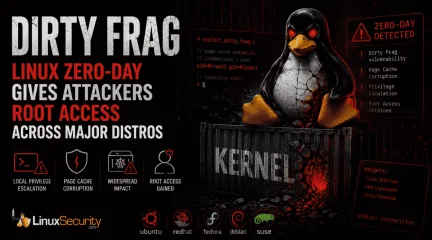
Just weeks after Linux defenders began responding to Copy Fail , researchers have disclosed another serious privilege escalation vulnerability that can deliver reliable root access on major distributions. . Known as Dirty Frag, the exploit abuses Linux page cache corruption to modify protected files directly in memory without relying on unstable race conditions or crash-prone exploitation methods. Unlike race-condition exploits that rely on timing or unstable behavior, Dirty Frag succeeds consistently. No kernel panic is required. No memory corruption crash window needs to line up perfectly. According to researcher Hyunwoo Kim, the exploit chain works reliably enough to provide immediate root access across a wide range of environments. At the time of disclosure, no CVE had been assigned, and no official patches were broadly available. How the Dirty Frag Exploit Works Dirty Frag is not a single vulnerability. It is a chained local privilege escalation attack built from two separate Linux kernel flaws: xfrm-ESP Page-Cache Write RxRPC Page-Cache Write Both vulnerabilities abuse the Linux kernel’s handling of fragmented socket buffer structures ( sk_buff ) during in-place cryptographic operations. At a high level, the exploit abuses Linux zero-copy networking behavior. Using splice() and related kernel interfaces, attackers can place references to page-cache-backed memory into fragmented socket buffers. Vulnerable cryptographic code paths then perform in-place operations directly against those fragments. That allows protected memory pages to be modified even when the attacker only has read access to the underlying file. In practice, attackers can: patch /usr/bin/su with shellcode alter /etc/passwd bypass authentication launch a root shell All from an otherwise unprivileged local context. What makes Dirty Frag especially dangerous is that the exploit modifies files through the Linux page cache in memory rather than writingdirectly to disk. That breaks long-standing security assumptions around read-only file access and protected cached pages. Why Security Researchers Are Comparing It to Dirty Pipe Dirty Frag belongs to the same vulnerability class as: Dirty Pipe Dirty COW Copy Fail All of them abuse unintended write behavior against cached pages in memory. Dirty Pipe targeted pipe_buffer structures. Dirty Frag instead abuses the frag field inside Linux socket buffers. That difference matters because it opens another path to modifying supposedly protected memory pages during network and cryptographic processing. The exploit effectively turns internal kernel crypto operations into arbitrary write primitives. Two Exploit Paths Cover Each Other’s Weaknesses One reason Dirty Frag is especially concerning is that the two exploit variants compensate for each other. The ESP variant The xfrm-ESP attack path provides a strong arbitrary write primitive, but typically requires: user namespaces CAP_NET_ADMIN within a namespace Some hardened environments restrict unprivileged namespace creation, which can block this path. The RxRPC variant The RxRPC attack path does not require namespace creation and can work entirely from unprivileged APIs. Instead of patching binaries directly, it manipulates /etc/passwd entries to bypass authentication. Its limitation is module availability. Some distributions do not ship rxrpc.ko by default. Together, they broaden exploitability If one path is blocked by policy or configuration, the other may still succeed. That flexibility is exactly why researchers are treating Dirty Frag as more than another isolated Linux kernel bug. Why You Need To Take Dirty Frag Vuln Seriously Several characteristics make Dirty Frag more dangerous than a typical Linux local privilege escalation vulnerability. Reliable Exploitation Changes the Threat Model Many Linux kernel privilege escalation exploits rely on raceconditions, unstable timing windows, or behaviors that frequently crash systems during exploitation attempts. Dirty Frag is different. According to researcher Hyunwoo Kim, the exploit chain works reliably without requiring race conditions or precise timing. The attack also avoids the kernel instability commonly associated with memory corruption exploits, making successful privilege escalation far more practical for real-world attackers. That reliability significantly lowers the barrier to weaponization. Broad Linux Distribution Exposure Increases Risk Researchers confirmed successful exploitation against multiple major Linux distributions, including: Ubuntu Red Hat Enterprise Linux CentOS Stream AlmaLinux Fedora openSUSE Tumbleweed Because the affected functionality exists deep inside common Linux kernel networking and cryptographic subsystems, organizations may find it difficult to quickly determine exposure across large environments. Shared infrastructure, CI/CD systems, developer platforms, and container-heavy deployments may face elevated risk. Public Exploit Code Is Already Available The coordinated disclosure process reportedly broke down after a third party publicly released exploit details ahead of schedule. Once the embargo collapsed, researchers and maintainers released technical writeups and proof-of-concept exploit chains publicly. As a result, attackers already have access to: detailed exploit documentation weaponized proof-of-concept code mitigation bypass techniques practical exploitation examples before many organizations have production-ready patches available. Temporary Mitigation Available Until vendors release patches, researchers recommend disabling the affected modules where possible. sh -c "printf 'install esp4 /bin/false\ninstall esp6 /bin/false\ninstall rxrpc /bin/false\n' > /etc/modprobe.d/dirtyfrag.conf; rmmod esp4 esp6 rxrpc 2> /dev/null; true" Be aware that this mitigation has anoperational impact. Disabling these modules may break: IPsec VPN functionality AFS distributed file systems services relying on RxRPC Some administrators have also noted that if the vulnerable modules are already loaded, a reboot may be necessary after unloading them to fully clear the affected page cache state. SELinux May Reduce Exposure Some early testing suggests that strict SELinux policies can interfere with exploitation. Researchers discussing the flaw noted that SELinux Strict Policy configurations using user_t contexts appeared capable of blocking exploit execution paths associated with Dirty Frag and Copy Fail. Kernel Hardening Still Matters Dirty Frag is another reminder that SELinux , AppArmor , and other hardening layers can still help reduce zero-day impact even before patches arrive. The Bigger Problem Facing Linux Security Dirty Frag arrives only weeks after the Linux ecosystem began responding to Copy Fail, another actively exploited privilege escalation vulnerability. CISA recently added Copy Fail to its Known Exploited Vulnerabilities catalog , warning federal agencies to patch affected systems quickly due to the risk of real-world exploitation. Now, another exploit chain in the same vulnerability family has appeared before many defenders fully addressed the previous one. The trend is difficult to ignore. Researchers are increasingly finding ways to abuse: page cache interactions splice behavior zero-copy networking in-place cryptographic operations inside the Linux kernel. The result is a growing class of high-impact privilege escalation vulnerabilities that can bypass traditional assumptions about file protections and memory isolation. What Linux Administrators Should Do Right Now Organizations running Linux servers should immediately: Determine whether affected modules are loaded Restrict unprivileged user namespace creation where feasible Apply temporary mitigations ifoperationally possible Monitor vendor advisories closely Watch for unusual privilege escalation activity Harden SELinux or AppArmor policies where applicable Prioritize patch deployment once fixes become available Systems with shared-user access, developer workloads, CI/CD infrastructure, or container-heavy environments may face elevated risk. Final Thoughts Dirty Frag does not feel like an isolated kernel mistake. It looks more like another sign that attackers and researchers are getting better at abusing the same weak points inside Linux memory handling and page-cache behavior. Dirty COW exposed it years ago. Dirty Pipe reinforced it. Copy Fail pushed it further. Now Dirty Frag arrives with reliable exploitation, public proof-of-concept code, and multiple paths to root access before many defenders have even finished patching the last round of issues. What stands out here is the consistency. No unstable race conditions. No complicated crash timing. Just predictable abuse of trusted kernel operations that were never expected to become write primitives. That changes the risk calculation for shared systems, developer infrastructure, container hosts, and anywhere unprivileged local access already exists. The bigger problem is that these bugs keep surfacing in different forms while targeting the same underlying assumptions around memory isolation and protected file access. Defenders can patch this specific flaw once updates land, but the pattern itself is becoming harder to dismiss. Stay Ahead of Linux Security Threats Sign up for our newsletter for weekly analysis covering Linux kernel vulnerabilities, privilege escalation exploits, container security risks, and hardening strategies. Dirty Pipe: High Severity Linux Vulnerability Explained DirtyCred: Another Linux Privilege Escalation Threat What Is an RCE Vulnerability in Linux? Linux Risk Management and Exploitation Trends The Evolution of Linux Security Threats . Known as Dirty Frag,the exploit abuses Linux page cache corruption to modify protected files direct. weeks, linux, defenders, began, responding, researchers, disclosed, another. . MaK Ulac
 May 08, 2026
•
May 08, 2026
•
102
 security advisoryhigh severitylocal privilege escalation
Ubuntu Copy Fail High Local Privilege Escalation Threat Advisory 2026-31431
Most Linux hardening focuses on access. This vulnerability bypasses that entirely. . Think about Linux security like the structural integrity of a building. We spend a lot of time on the front door—locks, cameras, and ID badges. Those are just policy layers. They’re great for keeping people out, but they don't tell you what happens to the foundation if a core system component is bypassed in plain sight. The reality is that upstream kernel security moves a lot faster than enterprise adoption. Defenses are being built quietly through patch discussions and mailing lists, not through big announcements. By the time a vulnerability like this becomes a standard operational concern, the risk has already been sitting in the gap between what is "available" and what is actually "active" in your environment. Copy Fail (CVE-2026-31431 ) sits right in that gap. It’s a high-severity local privilege escalation flaw in the Linux kernel’s cryptographic subsystem ( authencesn ), and it’s easy to miss if you’re only tracking what’s been announced instead of what’s actually running. This isn't about just listing what exists; it’s about verifying what is actually working on your systems and knowing where the risk actually lives. Why This Matters in Production Environments If you're trying to figure out how to secure a server, the structural boundaries are where things usually break down. Copy Fail is not remotely exploitable on its own, but chained with a web Remote Code Execution (RCE), a compromised CI runner, or an SSH breach, it gives an external attacker an immediate express lane to host-level root. The real danger of this local privilege escalation Linux flaw isn't on a single, isolated desktop. The risk lies in the shared infrastructure that powers modern enterprise tech: Container Escape Vulnerabilities: The vulnerability represents a dangerous container escape primitive . Because the page cache is shared at the host level, an attacker doesn’t stay contained. Frominside a compromised container, this turns into a path straight to the underlying Kubernetes node. Shared Kernels: Containers aren’t isolated in the way most people assume; they all rely on the same kernel and memory. Once that boundary breaks, it doesn’t stop at one workload. How 4 Bytes Can Give You Root To understand what’s happening, you don't need to be a kernel developer. Most server security conversations stay at the surface—firewalls, access controls, patching. But this vulnerability stems from an in-place processing optimization introduced to the Linux kernel back in August 2017 (commit 72548b093ee3). The kernel uses a mechanism called the page cache to keep frequently accessed files in RAM, so the system doesn't have to keep reading the slower disk drive. When you make an AEAD (Authenticated Encryption with Associated Data) request through an AF_ALG socket to the authencesn cryptographic template, the kernel processes the data. Due to this optimization, a page from the page cache ends up in the writable destination scatterlist: The Overwrite: If an attacker binds a socket to authencesn and sends a recvmsg call with the exact offset, the kernel treats the request as an in-place operation. It writes four controlled bytes into the page cache of a target setuid binary (such as /usr/bin/su ). The Hijack: The exploit doesn't alter the file on disk. File integrity monitoring tools will see nothing. Instead, it alters the binary as it is executed . When that setuid binary is run by the system or another user, it reads the modified cache, executes the corrupted memory instead of the original code, and hands over root privileges to the unprivileged user. The Simplicity: Unlike older, complex LPEs like Dirty Pipe, there are no race conditions or tricky timing windows to worry about. With a 732-byte Python script, it works reliably on the first try across almost all enterprise Linux builds (Ubuntu, Debian, RHEL, SUSE) released since 2017. The AI Factor: Why This Problem Is About to Get Worse This isn't an isolated discovery pattern, nor is it just a theoretical milestone. Copy Fail wasn't found by a researcher spending months hunting through assembly code by hand. It was identified by Theori researcher Taeyang Lee using their Xint Code AI scanning software in about an hour. Think about the economics of vulnerability research: for years, finding a reliable, high-severity local privilege escalation flaw in the Linux kernel required deep domain expertise, patience, and manual fuzzing with tools like syzbot . The barrier to entry was high, and the turnaround time was measured in weeks or months. That barrier has completely collapsed. When an AI-driven tool can scan, identify, and trace a deep logic flaw in the kernel's cryptographic subsystem in sixty minutes, the friction of discovery drops to zero. We are looking at an exponential increase in automated vulnerability discovery. The industry is already feeling the downstream pressure of this shift—security programs and maintainers are being inundated with automated bug reports, struggling to triage deep logic vulnerabilities at scale. What does this mean for your infrastructure? It forces a change in your fundamental threat model. You can no longer treat kernel-level LPEs as rare anomalies that only affect high-value targets. If vulnerabilities are found in minutes, threat actors and automated agents can weaponize and chain them into container escapes much faster than enterprise release cycles can accommodate. When the foundation can be breached this quickly, infrastructure security stops being about patching known bugs one by one. It becomes a requirement to harden the environment against entire classes of vulnerabilities and validate those protections at the host layer before an attacker even gets a foot in the door. The System Looked Clean, but Wasn’t In internal testing, this exploit worked on fully patched enterprise Linux builds from the last several years,with no alerts triggered and no file changes on disk. What to Check and Where Mitigations Fail The gap between what’s possible and what’s deployed is where risk lives. Standard patching doesn't always validate these internal controls, and many teams assume a patch was applied without auditing the running state of the host. For instance, simply updating the base image of a container does nothing if the underlying host kernel remains vulnerable. Furthermore, disabling modules requires active host reboots or unloads that often get delayed in production. Here is a quick check for your endpoint security: Patch Your Kernels: Major Linux distributions have already rolled out updates. Debian, Ubuntu, and SUSE are pushing patches. Red Hat shifted its guidance to issue patches promptly. Check your distribution's security repository and apply the latest kernel packages. On production Kubernetes clusters, plan a rolling drain-and-reinstate procedure. Apply Temporary Mitigations: If you can't reboot or patch your kernels immediately, you can disable the vulnerable algif_aead module. Harden Container Pipelines: Restrict the creation of AF_ALG sockets using seccomp profiles to stop the exploit from being executed within containers. # Disable the vulnerable algif_aead module echo "install algif_aead /bin/false" > /etc/modprobe.d/disable-algif.conf rmmod algif_aead 2> /dev/null || true (Note: This mitigation doesn't affect standard encryption like IPsec or OpenSSL, but you should always test it in a non-production environment first). True infrastructure security is about the foundation. Validation matters more than assumptions. The best defenses aren't the ones you read about in a memo—they’re the ones you’ve actually turned on and validated within your container workloads. Where Security Assumptions Break Nothing here throws obvious signals. The system runs, policies stay loaded, logs look routine, and the control still doesn’t behave the wayanyone expects once it’s actually exercised. The problem shows up at the boundary. A container reaches past its limits, a syscall path resolves when it shouldn’t, a restriction exists but doesn’t apply in the exact context an attacker lands in, and that’s enough. It doesn’t take much. One weak spot in a shared layer, one enforcement gap that never got tested under real conditions, and isolation starts to blur in ways that don’t show up in configs or dashboards. This isn’t about adding more controls. It’s about knowing which ones you’ve pushed hard enough to trust, and which ones are still sitting there unverified. Subscribe to the newsletter if you want direct insight into where these breaks actually happen, especially around kernel behavior and container boundaries. . Think about Linux security like the structural integrity of a building. We spend a lot of time on th. linux, hardening, focuses, vulnerability, bypasses, entirely, think, about. . MaK Ulac
May 01, 2026
•

102
 security advisorycriticallocal privilege escalation
Ubuntu PackageKit Critical Local Privilege Escalation CVE-2026-41651
Most information security best practices are built on a single, comfortable assumption: that the "root" gate is locked and only the administrator holds the key. We assume that unless we explicitly hand over credentials, the core of the system is off-limits. . But the recent discovery of Pack2TheRoot (CVE-2026-41651) just blew that theory apart. For over 12 years, a local privilege escalation flaw has lived in the default install of almost every major Linux distribution. It didn't require a complex network exploit or a social engineering scheme. It sat in PackageKit—a background service designed for "convenience", and it allowed any unprivileged user to walk through the front door and claim root privileges in seconds. This isn't just a bug write-up. It’s a case study in how trust is enforced (and how it fails) in modern system security. The Hidden Layer of Server Security Everyone Ignores When we talk about how to secure a server, we usually focus on the perimeter: hardening SSH, configuring firewalls, and managing user identities. But there is an invisible layer of "helper" services running in the background that most admins never touch. PackageKit is the poster child for this hidden attack surface. It’s a D-Bus abstraction layer designed to make software updates "seamless" for desktop users and web-based management tools like Cockpit. Because it’s meant to be user-friendly, it’s often installed and activated by default. The problem? You can harden your network security all day, but if PackageKit is sitting there waiting to be triggered by a local D-Bus call, you’ve left a root-level power tool sitting on the counter for anyone to pick up. True server security isn't just about who can get into the box; it's about what the box is allowed to do once they're there. How the PackageKit Trust Model Breaks System Security The technical failure here is a classic Time-of-Check to Time-of-Use (TOCTOU) race condition , but the design failure is much deeper In a healthysystem security model, trust should be "atomic, it either exists or it doesn't. PackageKit breaks this by splitting trust across layers. It checks if a user is authorized to start an update (via polkit), but then it relies on "transaction flags" to decide how that update happens. Attackers found they could initiate a legitimate request and then, in the millisecond before the system executed the command, overwrite those flags. By the time the system actually acts, it’s no longer running the authorized update; it’s running the attacker’s malicious code with full root authority. This is what happens when trust is split: the gap between the "check" and the "action" becomes a playground for exploits. Why Endpoint Security Doesn’t Catch This This is where the reality of endpoint security gets uncomfortable. Most security tools are designed to look for "bad" things: known malware signatures, suspicious network traffic, or unauthorized binary execution. The process is a legitimate system daemon ( packagekitd ). The action is a legitimate system function (installing a package). The authorization was technically "passed" at the start. Security tools trust the same system components that attackers abuse. If your endpoint security strategy is purely reactive, it will stay silent while the system's own "trusted" tools are used to dismantle it from the inside. The Cross-Distro Problem: An Infrastructure Security Failure When a vulnerability is this widespread, it stops being a 'Linux bug' and becomes a massive failure in infrastructure security, as detailed on the OSS-Security mailing list . This wasn't a misconfiguration or an edge case; it was the default behavior shipped to millions of users. Distribution Default Status Risk Profile Ubuntu Enabled by default Critical (Widely used in Cloud/Desktop) Fedora Enabled by default High (bleeding-edge defaults) Debian Standard Install High (The backbone of many servers) Rocky/RHEL Active if using Cockpit Medium-High (Enterprise standard) When the "standard" image is vulnerable out of the box, scale becomes your biggest risk. If you are managing a fleet of a thousand servers based on these defaults, you aren't just managing servers—you're managing a thousand open windows. Breaking the Data and Information Security Models We need to be clear about the stakes: Root access is total access. All your information security best practices assume that you have control over what software is running on your hardware. Once an attacker can install arbitrary packages via PackageKit, that control is gone. They can install kernel modules, sniff network traffic, or bypass every data security best practice you’ve implemented. If they have root, they don't need to crack your database encryption; they can just pull the keys directly from memory. Your entire policy model is built on the assumption that software installation is a privileged, controlled act. Pack2TheRoot turns that act into a free-for-all. How to Secure a Server Right Now (Without Waiting) Most environments should not be running PackageKit at all. If you are running a server, you likely use apt , dnf , or an automation tool like Ansible to manage packages. You don't need a middleman. Here is how to secure a server against this class of "default" vulnerabilities: Check: See if the service is lurking on your system. systemctl status packagekit Disable: If you don't need a GUI or Cockpit-based updates, kill the service and mask it so it can't be "woken up" by other processes. sudo systemctl stop packagekit sudo systemctl mask packagekit Patch: If you absolutely must use it, verify you are on PackageKit version 1.3.5 or higher Investigate: Look for the "crash" signal in your logs. The exploit often causes the daemon tocrash immediately after it grants root access. journalctl -u packagekit | grep "status=6/ABRT" The Real Lesson: Stop Trusting Default System Behavior If there is one thing that cybersecurity best practices consistently get wrong, it’s the idea that "default" equals "safe." Defaults prioritize usability. They want the system to "just work" for the broadest number of people. But security assumes correct behavior, and reality breaks both. If a 12-year-old flaw can sit in default installs across every major distro, the problem isn’t a lack of patching—it’s a lack of skepticism. The most dangerous systems are the ones that look normal. Security isn't about the tools you've installed; it's about the trust you've refused to give. Stop trusting that the "standard" install has your back. Start validating the foundation. . A critical flaw in PackageKit exposes root access on various Linux distros. Discover how to protect your systems now.. PackageKit security, linux privilege escalation, Ubuntu critical risk, system security best practices. . MaK Ulac
Apr 27, 2026
•

Get the latest News and Insights
Get the latest Linux and open source security news straight to your inbox.
Community Poll
What got you started with Linux?
Search Topics
Powered By

Linux Security - Your source for Top Linux News, Advisories, HOWTOs and Feature Releases
QUICK LINKS
subscribe to newsletters!
Like staying secure? So do we.
Sign up for updates, tips, and alerts!
Discover faster search, smarter navigation, and deeper Linux security insights. Read More