Explore top 10 tips to secure your open-source projects now. Read More
×


Stay Ahead With Linux Security Features
 identity management security tactics
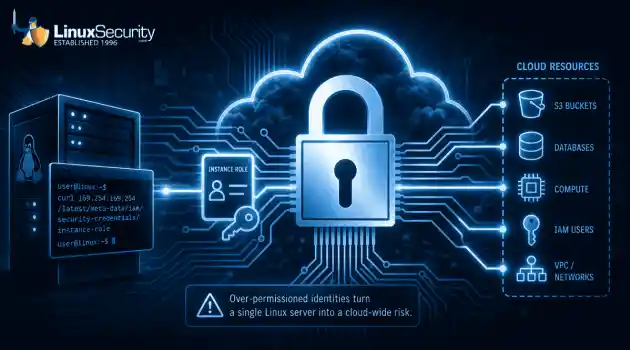
 For years, we secured our Linux infrastructure by building walls: VPCs, security groups, and hardened SSH configurations. We treated the cloud like a virtual data center, assuming that if we kept the "bad guys" out of the network, our workloads were safe. . That model is no longer sufficient. Today, one of the most common paths from an initial compromise to a major cloud breach is the identity assigned to your Linux workload. When an attacker gains code execution on a Linux instance—through a...
 Jul 17, 2026
 security practices patch management
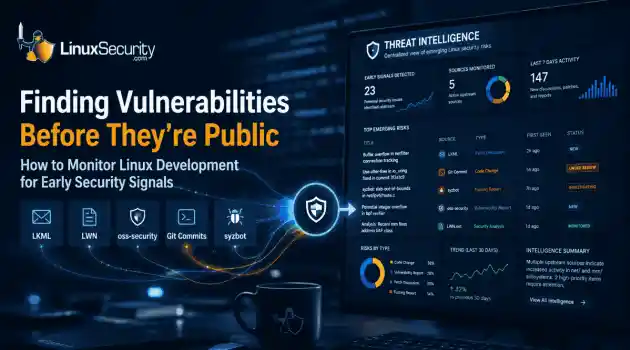
 Most of us don't hear about a kernel vulnerability until a CVE lands in our inbox or the vulnerability scanner starts complaining. By then, the patch isn't new anymore. Kernel developers may have been passing it around for review, arguing over the implementation, or revising it for days before anyone outside that community noticed it. None of those discussions are secret. They're sitting in mailing list archives, Git commits, and patch reviews where they've been the whole time. The strange...
Jul 14, 2026
 Linux security cyber attacks
 Every Linux server in your fleet produces thousands of events every minute. From journald logs and auditd records to kernel-level eBPF hooks, your systems are constantly talking. Most of that noise is just the mundane churn of system services, CI/CD runners, or routine administrative automation. But among that noise, an attacker might be establishing a foothold, moving laterally, or setting up persistence. The challenge for any security team is: how do you separate the routine from the...
Jul 13, 2026
 open-source infrastructure risk
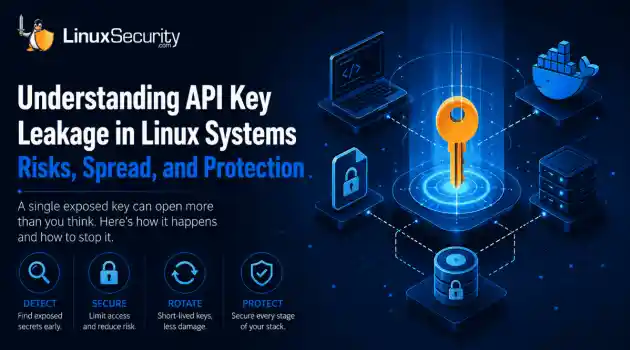
 Security scanners flag exposed API keys in public repositories every day. The initial response is usually predictable: delete the commit, revoke the credential, and move on. That’s a mistake. . In a real Linux environment, an API key never stays in one place. By the time it hits a public repo, it’s already everywhere. It’s in the CI/CD pipeline. It’s in your container registry. It’s in the build logs. It’s in the backups. Git makes this worse because the history never dies. Deleting a file in...
Jul 11, 2026
 open-source rootkit
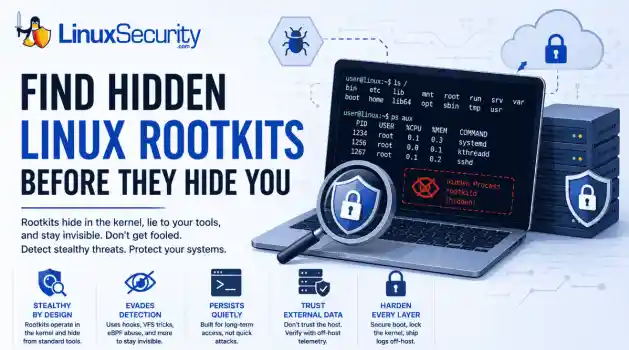
 Most of us think of Linux rootkits as ancient history—the stuff of 90s hacking forums and clunky malware that would crash your system if you looked at it the wrong way. But if you think they’ve gone away, you’re mistaken. They’ve just gotten smarter. . Modern attackers aren't using the noisy tools of the past. Today’s threats are surgical. Many of today’s most advanced Linux rootkits operate at the kernel level or abuse legitimate system features to blend in with normal traffic. They’re...
Jul 09, 2026
 Refine features
X Clear Filters
Get the latest News and Insights
Get the latest Linux and open source security news straight to your inbox.
Community Poll
Should Linux servers automatically install security updates?
Loading...
Explore Latest Linux Security features
We found -3 articles for you...
102
 security researchmalware analysislinux techniques
Advanced Anti-Debugging Techniques: Detecting Breakpoints in Linux
In the previous part of our Hacker's Corner series, we covered anti-debugging using a trivial self-modifying code. Here, instead of blocking debugging completely, we will detect various debugger-induced activities.. Breakpoints A breakpoint is intentional "pause" in normal execution of a program, generally used to inspect the internals of said process in more detail. This is the *most* used feature of any debugger. On x86 CPUs, there are two types of breakpoints: hardware breakpoints and software breakpoints. While they overlap to a certain degree they are not exactly the same. In most of debugging cases, you will be using software breakpoints, which do not need any special hardware support. These are implemented using same interrupt mechanism which is used by pretty much everything else. On x86, 3rd interrupt is used to implement a breakpoint. When you set a breakpoint, your debugger overwrites target address (where you want to put the breakpoint) with INT 3 (0xCC in hex). When this instruction gets executed, debugger gets the control back from target process, and can inspect its state (registers, memory etc). To resume the execution, debugger will silently remove breakpoint, execute the instruction, and set the breakpoint again before letting the process resume (until it terminates, or breaks). Features like step over, step out are also implemented using "transparent" software breakpoints, which are set and removed automatically by debugger. Generally, you can set any number of software breakpoints; however these cannot be set on non-code address (i.e. these can break the program only when target address content is executed; but not if the address is read from or write to). Hardware breakpoints, on the other hand, are much more powerful and flexible than software breakpoints. These can be set to break not only on execution, but also on memory access (read and write both), I/O port access etc. These debuggers are set by writing into special "debug registers" which are largelyplatform specific (and not all platforms will have support for hardware breakpoints). On x86, registers DR0-3 and DR6-7 are used to set these breakpoints (DR4-5 are reserved as of now). If you have ever used "watchpoints" which let you break when certain memory address is accessed, you have used hardware breakpoints. Here, one can try looking this inside a debugger, and then claim that this is not how software breakpoints work: (gdb) break main Breakpoint 1 at 0x116d (gdb) disassemble main Dump of assembler code for function main: 0x0000000000001169 : push rbp 0x000000000000116a : mov rbp,rsp 0x000000000000116d : lea rsi,[rip+0xe91] # 0x2005 0x0000000000001174 : lea rdi,[rip+0x2f05] # 0x4080 0x000000000000117b : call 0x1040 0x0000000000001180 : mov rdx,rax 0x0000000000001183 : mov rax,QWORD PTR [rip+0x2e46] # 0x3fd0 0x000000000000118a : mov rsi,rax 0x000000000000118d : mov rdi,rdx 0x0000000000001190 : call 0x1050 0x0000000000001195 : mov eax,0x0 0x000000000000119a : pop rbp 0x000000000000119b : ret End of assembler dump. (gdb) Here, we cannot see any interrupt instruction; not because there is none; but because our debugger is lying here. It will show you disassembly as it looked before setting any breakpoints so that it matches with what compiler generated from source. Detecting Software Breakpoint Since we know that software breakpoints are set by overwriting 0xCC at first byte of instruction, we can easily check for such breakpoints in our code: - Find where our target function (or any chunk of code) is located in memory - Read 1 byte from address - If byte is 0xCC, a breakpoint has been set A trivial implementation looks something like this: #include bool isBreakpointPresent(unsigned char *func) { bool result = *func == 0xCC; return result; } void secret() { for (int i = 0; i <10; ++i) { std::cout
 Jul 18, 2022
•
Jul 18, 2022
•
102
 malware analysisthreat intelligenceopen source intelligence
Exploring Open Source Intelligence Insights Provided by Dancho Danchev
Open Source Intelligence (OSINT) is a tactic used to learn about information relevant to protecting an organization from external and internal threats using publically accessible data. Identifying information that could be used against an organization provides actionable insight that could reduce the risk that an organization may face. It’s an early warning system used to forecast and signal a potential threat. . LinuxSecurity editors thought it would be interesting to discuss the topic of open source intelligence, threat intelligence, and how to get started with OSINT with our audience, as well as to speak with Dancho Danchev, an acclaimed ex-hacker and security intelligence researcher from Bulgaria. Dancho is a leader in the field of current and emerging cybercrime research and threat intelligence and a prolific blogger on the subject. Dancho Danchev, Bulgarian Hacker, Security Researcher We thought it would be interesting to ask Dancho a few questions about his background, open source intelligence, current trends in the cybersecurity community, the Dark Web, government security, zero-day threats, and his efforts that resulted in the take-down Koobface, the world’s largest botnet at the time. Formerly a ZDNet Zero Day blogger for more than four years, Dancho also worked as a security blogger for Webroot. In 2011, he was selected by SCMagazine for their Social Media award as a finalist for his twitter account at the time. Dancho also presented at UKs GCHQ including Canadian Intelligence Service’s HQ, and a Keynote presentation on “Exposing Koobface - The World’s Largest Botnet” . In 2016, Dancho presented at CyberCamp RSA Europe and InfoSec Europe on current cybercrime trends and cyber jihad. Prior to this, he also was one of the primary developers of the underground network known as Astalavisita . Dancho is often cited and frequently referenced cybercrime researcher, security blogger and threat intelligence analyst with over a decade in fightingcybercrime and actively responding to current and emerging cybercrime threats. Dancho also worked as a Technical Collector for the infamous LockDown2000 anti-trojan software solution, including working as a Trojan Database Manager for the market-leading Trojan Defense Suite anti-trojan vendor. His research blog, Mind Streams of Information Security Knowledge , reportedly has over 5.6M active pageviews and visitors since it was started in 2005. Dancho got started with computer security in the 90s, researching trojans and hacking tools and writing about them for a software company that developed anti-trojan solutions. Threat Intelligence and Why It’s Important Threat intelligence is the study and research of who may be attacking you, what their motivation and capabilities are, and what indicators of compromise in your systems to look for to help make informed decisions about your security. The skilled threat intelligence researcher should be able to strip out the extraneous information and false alarms and only focus on the actionable intelligence that directly affects her interests. Dancho told us that “threat Intelligence has been an inseparable part of my career and it’s something that I do and practice on a daily basis. My earliest experience with Threat Intelligence is as a Technical Collector of trojan horses/viruses/worms and VBS scripts for LockDownCorp throughout the 90’s which in combination with my experience in OSINT let me to produce some of the industry’s most recognized research articles. I’m also researching Eastern European cybercriminals as well as international and global spam phishing and malware campaigns and information on the actors behind them.” Threat intelligence and OSINT is the research and analysis of only public data. LinuxSecurity was curious if Dancho had ever been a blackhat hacker. “In my entire teenage ex-hacker enthusiast experience I've only compromised one Website which was my town's official Website,” writes Dancho. Hemanaged to obtain the accounting data for the site by socially engineering tripod.com at the time into going through the System Administrator's ICQ profile to gain access to the site for the purpose of changing the homepage to spread a message and actually say "hi" and greet local friends. What is Open Source Intelligence (OSINT)? Open-source Intelligence, or OSINT, is data collected from publicly available sources to be used in an intelligence context. While it doesn’t necessarily refer to open-source software, OSINT instead refers more to information that is open and available to everyone, such as that which is available publically on the Internet. An OSINT researcher is a skilled technician, capable of analyzing large amounts of data quickly, using sophisticated tools and knowledge of how the underground networks on the Internet work in order to understand the cyber criminals and how they operate. OSINT can also be used to track a potential attacker prior to that attack occurring, as well as to analyze raw data to determine who may be impacted by an attack. In the US Government, the CIA is responsible for collecting, producing, and promoting open source intelligence through its management of the DNI Open Source Center (OSC). In the intelligence community, the term "open" refers to freely available information, usually in its raw form, such as in a database. OSINT data is useful for gaining intelligence as part of an investigation - using OSINT doesn’t necessarily mean that data is also easily accessible. It doesn’t necessarily refer to information that can be found using regular search engines - a huge portion of the Internet cannot be found using major search engines. Instead, the “deep web” refers to a mass of pages or paywalls that cannot be indexed by Google, but is publically available nevertheless. For example, tools like Shodan and Censys can be used to find IP addresses, networks, open ports, webcams, printers, and pretty much anything elsethat’s connected to the internet. These individual pieces of information can be combined with other publically-accessible bits of information to develop a profile about a particular topic of interest by the skilled analyst. There’s also a dark side to OSINT - anything which can be found by security researchers can also be found by threat actors. In fact, late last year Dancho identified hundreds of gigabytes of raw OSINT information in underground cybercrime forum communities from more than a million websites and scoured them for fraudulent activity in an effort to shut down the community. Getting Started with OSINT LinuxSecurity asked Danchev how he got started with OSINT. Writes Danchev, “In 2008 I earned the privilege of getting invited to an invite-only conference event at the GCHQ which I attended with the Honeynet Project. Since that time, I’ve made numerous valuable contributions to the U.S Intelligence Community as an independent contractor and through the research which I've been publishing at my personal blog in terms of high-quality and never-published before OSINT analysis as an independent contractor.” Dancho tells us of a time when he was going through FOIA requests and in particular publicly released and classified information, visiting and browsing the CIA's official Website, and came across the following quote courtesy of President Nixon at the time - “What use are they? They’ve got over 40,000 people over there reading newspapers.” He says this got him interested in OSINT and helped him shape the future of his career as an Intelligence Analyst and OSINT analyst working under NDA as an independent contractor. For this project, Dancho attempted to collect as much personal information as possible, including IoCs (Indicators of Compromise) websites including personal account information and email addresses. His research resulted in publishing a list of thousands of email addresses and ICQ numbers of cybercriminals responsible for stealing creditcard and CVV numbers, among other personally identifiable information (PII). Danchev said he learned early on in my career that the best way to learn in the security intelligence world is to join a local hacking and security community. The security community rewards hard work and diligence. Prove that you can speak authoritatively on a security topic, manage a project, and build a community around it, and you will be recognized for your efforts. Anonymous Communication Using Tor One of the most useful tools in the arsenal of the security intelligence hacker is Tor, the free and open-source software for enabling anonymous communication. The name is derived from the acronym for the original software project name, " The Onion Router ". Tor was initially a worldwide network of servers built for the US Navy that enabled people to browse the Internet anonymously. Tor disguises your identity by transferring your traffic between different Tor servers, encrypting that traffic so it isn’t tracked back to you. Accessing the Tor network requires using the Tor browser . It’s typically used in environments where you’re concerned about being tracked, such as if you live under a dictatorship or a hacker looking to stay hidden from the government. “I believe it was around 2006 when I was busy researching several U.S Government programs including SPAWAR. I then decided to use it including several other covert communication tools for the purpose of preventing my local ISP from intercepting what I was doing online,” writes Dancho. He continues, “At the time in particular the 90’s many Eastern European countries part of the Soviet Union at the time were under technology embargo which was known as COCOM with personal computers at the time being something in the lines of a luxury and only organizations and companies could really afford them.” Dancho also talks about the Space and Naval Warfare Systems Command, known as SPAWAR, and the research they produced for foreignintelligence and other US Government programs as a valuable resource. Zero-day Threats and Security Blogging Dancho used to be a security blogger at ZDNet’s Zero-Day blog for four years, covering topics including the latest cyber threats, cybercrime, malware and botnets, as well as operating system vulnerabilities and exploits. Danchev writes, “During this period I covered hundreds of high-profile security events, including vulnerabilities affecting Adobe, Apple, Google, and Facebook, as well as botnets and malware affecting hundreds of millions of users. I also was awarded the prestigious Jesse H. Neal award for best blog quite some time ago. In one post, Dancho discussed how the process of developing and managing such a botnet is entirely automated, efficient, and most importantly - available as a service through a malicious underground Cybercrime-as-a-Service provider. I’m sure we’ll learn more about how that works in a future report. Astalavisita, Baby Throughout 2003-2006 Dancho was the site operator for astalavista.box.sk - the underground hacking website while acting as a Managing Director where he was responsible for managing the portal’s content and the production of a security newsletter where he interviewed people from the security industry. Back in the early 2000s, the Astalavista portal was one of the world’s most widely known and visited Websites used to search for hacking and security resources with thousands of users visiting it on a daily basis. Although it originally was created as a resource for security researchers, it also became a popular search engine for security exploits, software for hacking, cracking and different keygenerators and software cracks. In present day - he currently runs a high-profile project on the original Astalavista.box.sk domain, still one of the world’s most highly-visited websites for hackers and security experts including a popular security forum. Koobface Botnet and Compromising SocialNetworking Sites The Koobface botnet (an anagram for Facebook) propagated exclusively across Facebook and managed to infect hundreds of thousands of users globally using social engineering campaigns to trick them into revealing personal details about themselves and their friends. “Over a period of two and a half years I actively monitored the botnet’s activities and published the details on my personal blog. Eventually I learned of a single mistake made by one of the botnet masters behind the campaign, which eventually led me to actually find personally identifiable information on him, ultimately leading to the shutdown of the entire Koobface botnet at the time,” writes Dancho on his botnet takedown assist with the US government. Dancho worked full days to provide actionable intelligence on the way the Koobface botnet worked including actual information on some of the current and latest campaigns launched by the Koobface operators at that time. He then made this information available to the broader security industry, including law enforcement, so they would be able to actually track down and prosecute some of the botnet masters behind it. Bill Brenner from CSO Online reported in his article, “ Dancho Danchev unmasks man behind the Koobface Botnet ” at the time that Koobface “prompted friends to download an update to their Flash player in order to view a video. The update is a copy of the virus.” Pretty amazing stuff. Launching an actual take-down effort against the botnet’s infrastructure, including the primary Command and Control (C&C) servers led to a personal message being distributed to all the infected hosts internationally which greeted me personally and included a reference to my personal blog followed by another message during the Christmas season including an actual point-by-point answers to my “ Top 10 Things You Didn’t Know About the Koobface Botnet ” which I published at ZDNet’s Zero Day blog at the time embedded on every malware-infected hostpart of the botnet. It was an incredible success, and extremely rewarding for the intelligence community. The Evolution of Intelligence Gathering The US military first coined the term OSINT in the late 1980s as a way of providing timely, objective intelligence, free of bias, based upon all sources available to the US Intelligence Community, public and non-public. When 9/11 occurred, government agencies were formed to ensure OSINT was a major source in merging and consolidating relevant intelligence into actionable products. The government learned to collaborate with academia - universities are the perfect place for capturing the expertise needed to do the analysis. OSINT analysts are now processing immense amounts of public data, such as that on social networks, to discover emerging trends and identify valuable information. The tools being used for OSINT have also evolved greatly. On the evolution of the tools used, Danchev writes that the “majority of tools that I'm aware of rely on APIs including the active use of public sources. Users who use these tools should definitely take basic precautions to protect their own privacy, such as through the use of VPNs and secure tunnels.” “I'd rather say people should look for what information they publicly provide including social media as people including spies and bad guys often tend to do their homework before and prior to launching cyber attacks that also includes espionage campaigns.” Sage advice from an experienced OSINT researcher. Are you a security blogger or researcher and would like to be profiled here? Share your story with us and we’d be happy to discuss it with you. Connect with Dancho on social media: Twitter - https://twitter.com/dancho_danchev LinkedIn - Medium - https://medium.com/@danchodanchev . LinuxSecurity editors thought it would be interesting to discuss the topic of open source intelligen. source, intelligence, (osint), tactic, learn, about,information, relevant, protecting. . Brittany Day
Apr 27, 2020
•


Get the latest News and Insights
Get the latest Linux and open source security news straight to your inbox.
Community Poll
Should Linux servers automatically install security updates?
Search Topics
Powered By

Linux Security - Your source for Top Linux News, Advisories, HOWTOs and Feature Releases
QUICK LINKS
subscribe to newsletters!
Like staying secure? So do we.
Sign up for updates, tips, and alerts!