Explore top 10 tips to secure your open-source projects now. Read More
×


Stay Ahead With Linux Security Features

 open-source rootkit
 Most of us think of Linux rootkits as ancient history—the stuff of 90s hacking forums and clunky malware that would crash your system if you looked at it the wrong way. But if you think they’ve gone away, you’re mistaken. They’ve just gotten smarter. . Modern attackers aren't using the noisy tools of the past. Today’s threats are surgical. Many of today’s most advanced Linux rootkits operate at the kernel level or abuse legitimate system features to blend in with normal traffic. They’re...
 Jul 09, 2026
 security advisory hardening
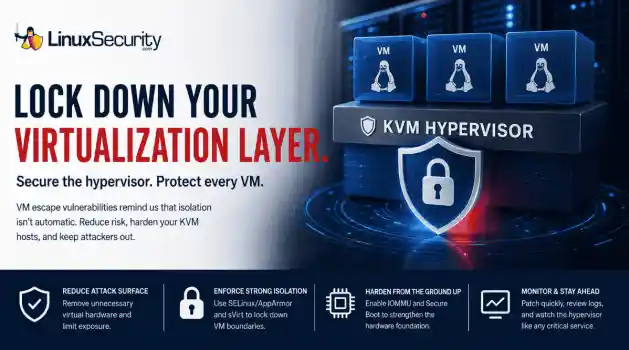
 A 16-year-old KVM vulnerability recently hit the news, and honestly? It’s a healthy dose of reality. We like to think of our hypervisors as these impenetrable walls, but this is a reminder that VM isolation isn't a permanent guarantee. Even in the most mature Linux virtualization stacks, you’ve got code paths that haven't been touched in over a decade, just waiting for the right researcher to pull on the wrong thread. For those of us running KVM hosts, this isn't just about grabbing the latest...
Jul 07, 2026
 security advisory linux
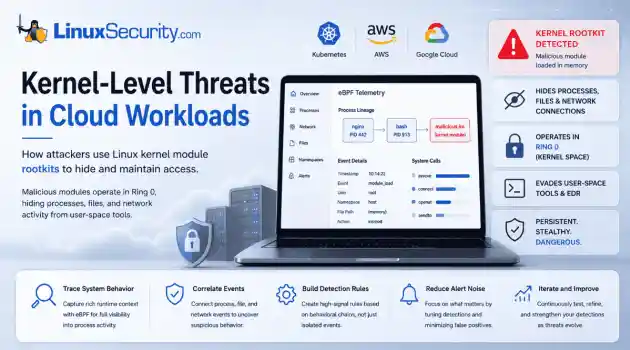
 If you think you know what’s running on your Linux host, you’re probably wrong. Not because you’re bad at your job—but because the kernel is lying to you. . I remember the first time I saw a kernel-level rootkit in the wild. We were debugging a performance spike on a cluster of web servers. Everything looked fine. top showed nominal CPU usage, ps listed the expected worker processes, and our security agent—a standard EDR tool—reported that the system integrity was "Green." But the network...
Jul 02, 2026
 network security threat detection
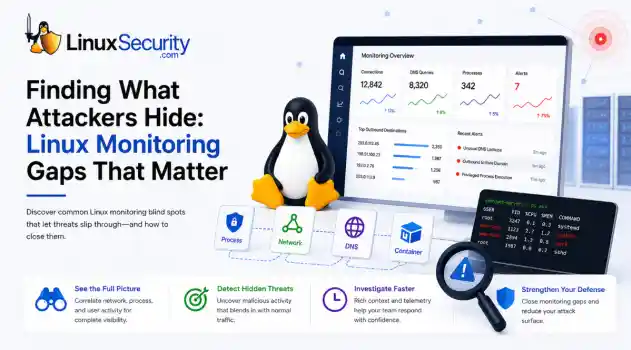
 If you’re relying on standard network logs to protect your Linux infrastructure, you’re flying blind. Most organizations believe they have network security monitoring because they’re capturing traffic, but they’re actually just collecting noise. Real security—the kind that stops an attacker—happens in the gaps between the network, the process, and the host. When an attacker breaches a Linux server, they rarely reach for a custom zero-day. They use what’s already there: curl, bash, python, or...
Jun 30, 2026
 unauthorized access security practices
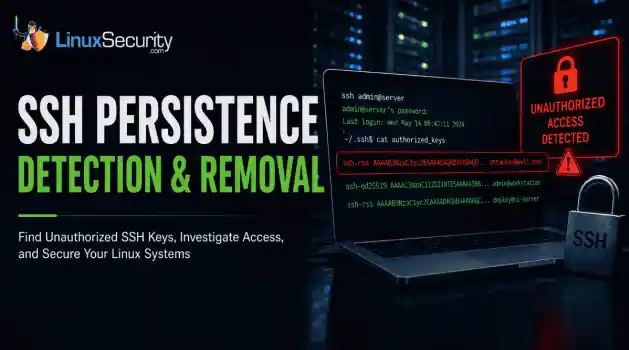
 SSH persistence usually does not look malicious at first. The login succeeds normally, the session opens cleanly, and the account already exists on the server, which is exactly why attackers continue using SSH keys after gaining a foothold on Linux systems. . Once a public key is added to authorized_keys , the server treats future access as trusted authentication. Attackers no longer need password resets or repeated exploit chains every time they reconnect because the server now accepts the...
Jun 26, 2026
 Refine features
X Clear Filters
Get the latest News and Insights
Get the latest Linux and open source security news straight to your inbox.
Community Poll
Is application sandboxing truly safe?
Loading...

Explore Latest Linux Security features
We found -4 articles for you...
102
 security advisorycriticalauthentication
CISA Alerts on Critical CVEs 2025-49151, 49152, 49153 in MICROSENS NMP Web+
If you’re managing industrial networks, critical manufacturing systems, or infrastructure that demands tight security, you’ll want to sit down for this one. MICROSENS NMP Web+, a popular network management platform, is in the spotlight after researchers discovered several critical vulnerabilities that essentially gift-wrap your systems for attackers. This isn’t just a fix-it-whenever-you-can scenario. We’re staring at vulnerabilities with CVSS v4 scores as high as 9.3—serious problems that require immediate attention. . These aren’t obscure bugs tucked away behind a labyrinth of layered defenses. Instead, CISA has warned they’re the kind of issues attackers can exploit with relative ease, targeting vulnerabilities in authentication and file management. If you’re running MICROSENS NMP Web+ version 3.2.5 (or earlier), it’s time to prioritize. Let’s dive into what’s at stake, how to mitigate it, and what your Linux and IT teams need to focus on today, not tomorrow, not next week. The Vulnerabilities — Breaking Down the Risks Here’s the quick rundown: three major vulnerabilities have been identified in MICROSENS NMP Web+, and they’re as bad as they sound. CVE-2025-49151 — Hardcoded Security Constants (CWE-547) This one’s a jaw-dropper. An attacker can reverse-engineer hardcoded constants to forge JSON Web Tokens (JWTs), bypassing authentication entirely. Think about that for a second: no credentials, no access control—just walk right in. The CVSS score is 9.3, and for good reason. CVE-2025-49152 — Insufficient Session Expiration (CWE-613) A less flashy but still dangerous issue: JWTs in these versions don’t expire. Once someone gains access, they can hold onto it indefinitely, effectively creating a golden ticket into your system. The CVSS score here is 8.7—still high but slightly less terrifying compared to the first one. CVE-2025-49153 — Path Traversal (CWE-22) If overwriting files and executing arbitrary code sounds like yourworst nightmare, pay attention to this one. It’s a path traversal vulnerability, allowing attackers to manipulate file paths and execute commands, even without authentication. Again, this lands at a 9.3 CVSS score—another critical severity issue. For context, these issues don’t just put a single system at risk. When exploited, the vulnerabilities could allow attackers to compromise an entire network, particularly in tightly integrated industrial control environments. The potential damage is magnified in critical infrastructure deployments—power plants, manufacturing lines, transportation systems—all key targets in the cybersecurity landscape lately. Why Does This Matter Right Now? These vulnerabilities don’t just open doors—they blow holes into the walls of systems that were already under constant threat from motivated attackers. The industrial and manufacturing spaces lean heavily on MICROSENS’ tools. These environments typically operate under tight uptime restrictions—patching isn’t fast or easy, but these CVEs aren’t the kind you let sit in your queue. Affecting industries around the globe, the vulnerabilities specifically target systems deployed in critical operational frameworks, where even slight disruptions could mean enormous downtime costs, safety implications, or worse. Attackers know this, and with the disclosed details public, there’s no reason to assume they won’t exploit it. What Should You Do — Immediately? Hands-on Linux admins, IT security pros, and network engineers—this is your checklist, plain and simple. Upgrade to MICROSENS NMP Web+ v3.3.0. MICROSENS has already released a fix in version 3.3.0. Regardless of the complexity of your patching workflow, deploying this update must be your top priority. Sticking to version 3.2.5 or earlier will only leave you exposed. Delays are not an option. Download the patched version, run your standard test environments (if you absolutely must), and roll it out. While you’re at it, triple-checkthat post-upgrade processes clear out any potential access granted to old JWT tokens, since these vulnerabilities leveraged persistent security issues. Harden Your Networks. If your systems are directly exposed to the internet, you've got a much bigger problem. Move quickly to isolate NMP Web+ servers and devices behind firewalls. Not doing so is practically handing attackers the keys. Segment these systems away from your general enterprise network, ideally with strict traffic rules governing cross-communication. Secure Remote Access. If remote management is required—and let’s face it, it often is—don’t rely on default configurations. Layer in a robust VPN (that you’ve recently updated), enforce multi-factor authentication (MFA) , and closely monitor all access attempts. It’s basic hygiene but effective. Implement Defense-in-Depth Strategies. No single tool is perfect. Combine intrusion detection systems, endpoint protection, and well-tuned logging mechanisms to catch suspicious activity quickly. If something smells fishy—a strange configuration change, odd traffic spikes—investigate it immediately. Educate Your Teams. This isn’t just a sysadmin problem—it’s systemic. Make sure your entire IT and security staff understand the nature of these vulnerabilities and how they might be weaponized. A well-trained team can often act as an initial line of defense against exploit attempts. Understanding The Bigger Picture When it comes to vulnerabilities like these, patches are the lifeline, but they’re only part of a larger puzzle. An effective response requires changes to the entire security model—reducing the attack surface, limiting trust relationships, and being constantly vigilant. MICROSENS’ latest release helps close the gaps, but exploits targeting software like NMP Web+ are a reminder of the ongoing challenges in managing critical infrastructure systems. The stakes are high because the environments where this software is deployed depend on uptime,and attackers know it. But that doesn’t mean we have to stand helplessly. Proper segmentation, tight controls, and timely patches will go a long way toward keeping your systems out of harm’s way. Don’t waste time on this one. Coordinate with your teams, upgrade to MICROSENS NMP Web+ v3.3.0, and build in the kinds of layered defenses that can blunt future threats. The risks are real, but with swift action and a strong strategy, you can avoid becoming the next headline. . Critical vulnerabilities in MICROSENS NMP Web+ demand immediate action and patching to protect industrial systems.. you’re, managing, industrial, networks, critical, manufacturing, systems, infrastructure. . Brittany Day
 Jul 02, 2025
•
Jul 02, 2025
•

Get the latest News and Insights
Get the latest Linux and open source security news straight to your inbox.
Community Poll
Is application sandboxing truly safe?
Search Topics
Powered By

Linux Security - Your source for Top Linux News, Advisories, HOWTOs and Feature Releases
QUICK LINKS
subscribe to newsletters!
Like staying secure? So do we.
Sign up for updates, tips, and alerts!