


Stay Ahead With Linux Security Features
 threat detection scalability
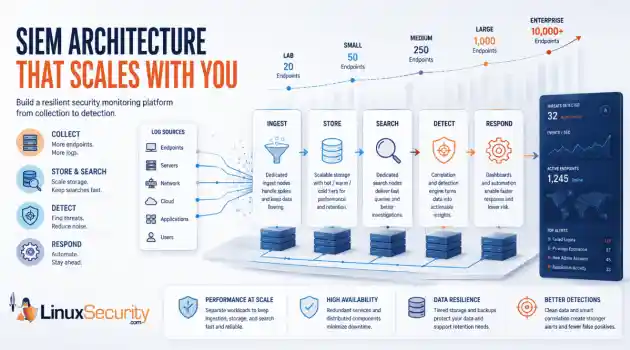
 Building a SIEM is easier than scaling one. Most open-source deployments start as a simple "all-in-one" server. It is easy to set up, but that design rarely survives the transition from a lab to a production workload. . A SIEM watching 20 endpoints is not doing the same job as one watching 500. More endpoints mean more logs; more logs require more storage; more storage makes search heavier. Eventually, the very architecture that made your lab easy to deploy becomes the reason your production...
 Jun 04, 2026
 security advisory apache
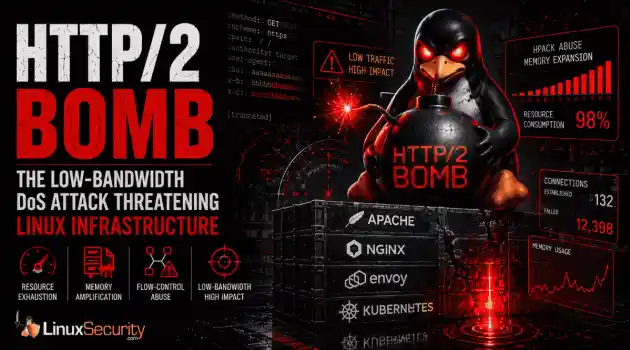
 A newly disclosed attack technique called HTTP/2 Bomb is drawing attention because it targets the software that sits at the front of much of the Linux internet. Apache HTTP Server, NGINX, Envoy, and the ingress layers that many Kubernetes environments depend on can be forced into consuming disproportionate amounts of memory using relatively small amounts of attacker traffic. . For Linux administrators, the concern is not the HTTP/2 protocol itself. It is the possibility that a single...
Jun 04, 2026
 security advisory important
 The compromise of Nx Console shows how much infrastructure now sits behind a single developer account. GitHub repositories, CI/CD pipelines, container build systems, Terraform projects, Kubernetes deployments. None of those systems was the initial target. The workstation was. . Attackers did not need a Linux privilege escalation bug or a remote code execution chain. They needed developers to trust a tool they were already using. For many organizations, that was enough. What Happened? Federal...
Jun 03, 2026
 security advisory open-source
 You remove the malware. You rotate the compromised credentials. You patch the original vulnerability and close the ticket. Two weeks later, the attacker is back. . What happened? You didn't lose the battle at the exploit; you lost it at the cleanup. In many modern Linux intrusions, the malware you found wasn't the main problem—it was the fallback mechanisms left behind. These hooks quietly restore attacker access the moment you look away. If you clean a host but miss these persistence layers,...
Jun 02, 2026
 security advisory Red Hat
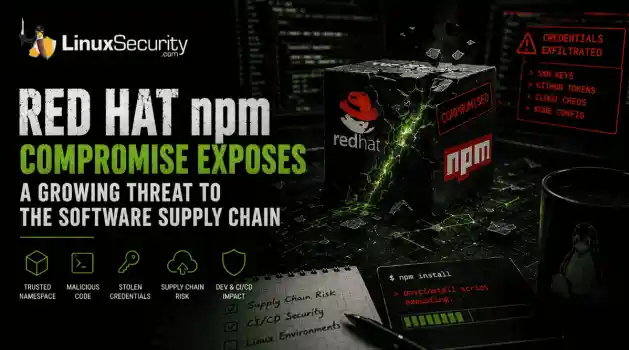
 Researchers investigating a campaign now tracked as Miasma found that more than 30 packages in Red Hat's @redhat-cloud-services npm namespace had been altered to deliver credential-stealing malware. . The packages weren't being used to deploy ransomware or sabotage systems. From what has been reported so far, the objective appears to have been much simpler: collect credentials from developer environments and use that access elsewhere. GitHub tokens, cloud credentials, SSH keys, and other...
Jun 02, 2026
 Refine features
X Clear Filters
Get the latest News and Insights
Get the latest Linux and open source security news straight to your inbox.
Community Poll
What got you started with Linux?
Loading...

Explore Latest Linux Security features
We found -4 articles for you...
102
 security advisoryaccess controlmisconfiguration
Kubernetes Container Security Misconfigurations Leading to Threats
Container security failures rarely come from zero-days. They come from the configuration. Misconfigurations don’t trigger alerts. They don456’t crash systems. Most of the time, they sit quietly in production until something starts probing from the outside or moving laterally from the inside. . Kubernetes environments are especially prone to this. The flexibility that makes them powerful also creates space for subtle mistakes. Some are obvious once you see them. Others blend into normal operations and get missed during audits. This is where most real-world container risk lives, not in the exploit, but in the setup that makes exploitation trivial. Where Container Security Actually Breaks Down Most environments aren’t “unsecured.” They’re partially secured. You’ll see: Namespaces in place, but overly permissive RBAC is configured, but not enforced consistently Network policies are defined, but not applied cluster-wide Each layer looks correct in isolation. The gaps show up between them. Security controls in Kubernetes are composable. That’s the problem. Missing one piece doesn’t break the system; it just lowers the barrier for an attacker. In practice, teams that do this well benchmark their environment against the Kubernetes Security Checklist to ensure their layered controls are actually creating a cohesive defense. Overly Permissive RBAC Role-Based Access Control is one of the most common weak points. You often find broad roles assigned to service accounts, wildcard permissions (*) used for convenience, or long-lived tokens tied to workloads. Once an attacker gains access to a pod, these permissions define what happens next. In many cases, escalation doesn’t require an exploit—it just requires using what’s already allowed. In practice, teams that do this well use rbac-lookup to visualize current permissions and move toward granular, namespaced roles that only permit the exact actions required by the application. Containers Running withExcessive Privileges Privileged containers are still common in production clusters. This includes: privileged: true containers Access to host namespaces Mounting sensitive host paths like /var/run/docker.sock These configurations blur the boundary between container and host. At that point, the container is no longer isolated in any meaningful way, turning a single container foothold into full node access. In most cases, this isn’t intentional; it’s a shortcut added to get a workload running, then never revisited. Over time, it becomes part of the baseline. In practice, teams that do this well use Admission Controllers like Kyverno or OPA Gatekeeper to automatically reject pods attempting to run with elevated privileges. They treat these configurations as temporary exceptions that are removed once no longer needed, pushing workloads back toward the minimum level of access required to function, as outlined in the CIS Kubernetes Benchmark . Missing or Ineffective Network Policies Flat networking is still the default in many Kubernetes deployments. Without strict network policies, pods communicate freely across namespaces, and internal services are exposed to lateral movement. Even when policies exist, they’re often incomplete, applied inconsistently, or not tested under real conditions. That creates segmentation on paper, but not in practice. The difference shows up when you look at how traffic actually flows. In tighter environments, communication paths are defined intentionally. In practice, teams that do this well implement a "Default Deny All" policy for every namespace, following the official Kubernetes Network Policy documentation . This forces an explicit mapping of traffic: workloads don't get broad internal access by default—they only talk to exactly what they need to function. Unrestricted Use of Kernel Features Containers don’t remove kernel risk—they share it. Misconfigurations here include: Lack of seccomp profiles No AppArmor orSELinux enforcement Broad syscall access If a container can access powerful kernel interfaces without restriction, it becomes much easier to trigger or chain vulnerabilities. The kernel is constantly adapting, but configurations often lag behind. In practice, teams that do this well use Inspektor Gadget to observe the actual system calls their applications make, allowing them to generate and enforce minimal, secure profiles for each workload. Image and Supply Chain Weaknesses Not all misconfigurations are runtime. Common issues include using outdated base images, pulling from untrusted registries, or embedding secrets directly into image layers. These issues won't show up in a standard cluster scan. In practice, teams that do this well implement image signing with Sigstore/Cosign to ensure code integrity and offload secret management to tools like HashiCorp Vault , keeping sensitive credentials out of the image entirely. Why These Issues Go Unnoticed These misconfigurations persist for a few reasons: They don’t break functionality They often exist in “working” systems Security reviews focus on compliance, not behavior Tooling reports issues, but prioritization is inconsistent Most teams fix what blocks deployment. These issues don’t. What to Focus on Going Forward Enforce least privilege in RBAC, not just define it Treat privileged containers as exceptions, not defaults Apply and test network segmentation policies Restrict kernel-level access with seccomp and LSMs Continuously validate configurations, not just at deployment The Path Forward: Moving from Compliance to Behavior Container security isn’t failing because controls don’t exist. It’s failing because those controls are applied unevenly. The gaps aren’t always obvious. They’re small, layered, and easy to justify in isolation. But in practice, they create predictable paths for attackers. Fixing them doesn’t require new technology. It requires tighteningwhat’s already in place and understanding where those controls stop short. . Kubernetes environments are especially prone to subtle misconfigurations that can expose them to severe security threats.. container misconfigurations, Kubernetes security, least privilege RBAC. . MaK Ulac
 Apr 15, 2026
•
Apr 15, 2026
•

Get the latest News and Insights
Get the latest Linux and open source security news straight to your inbox.
Community Poll
What got you started with Linux?
Search Topics
Powered By

Linux Security - Your source for Top Linux News, Advisories, HOWTOs and Feature Releases
QUICK LINKS
subscribe to newsletters!
Like staying secure? So do we.
Sign up for updates, tips, and alerts!
Discover faster search, smarter navigation, and deeper Linux security insights. Read More