Audit Linux privileges now to limit compromise, escalation, and system-wide damage. Review Linux Privileges×


Stay Ahead With Linux Security Features

 security advisory path traversal
 Two newly fixed storage bugs in Kubernetes showed more than just a problem with path traversal. They found a common security flaw in the cloud: powerful parts often think that requests accepted by a higher system are safe to run. This is a simple lesson for the platform and security teams: RBAC can accept a request without showing that its parameters will stay within a certain filesystem boundary. This is clear from a new study from SentinelLabs into flaws in the Kubernetes CSI drivers for NFS...
 Jul 24, 2026
 security advisory update
 A large volume of Linux security updates and advisories this week across major distributions once again, but it wasn't just the volume that was the story. Where maintainers and security teams focused their attention was evident in the concentration of fixes targeting Linux kernel updates, identity services, DNS infrastructure, and internet-facing software. . Instead of looking at each advisory in isolation, administrators gain more value from the general trends they reveal about Linux security...
Jul 23, 2026
 identity management security tactics
 For years, we secured our Linux infrastructure by building walls: VPCs, security groups, and hardened SSH configurations. We treated the cloud like a virtual data center, assuming that if we kept the "bad guys" out of the network, our workloads were safe. . That model is no longer sufficient. Today, one of the most common paths from an initial compromise to a major cloud breach is the identity assigned to your Linux workload. When an attacker gains code execution on a Linux instance—through a...
Jul 17, 2026
 security practices patch management
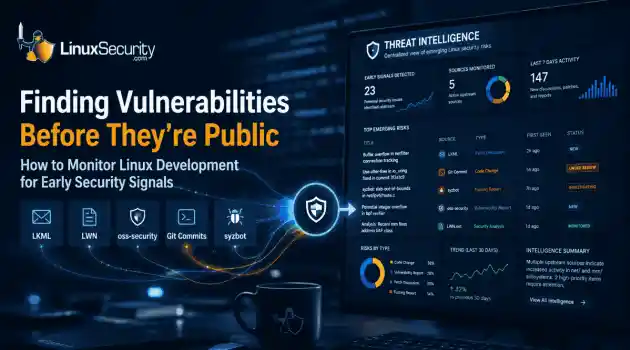
 Most of us don't hear about a kernel vulnerability until a CVE lands in our inbox or the vulnerability scanner starts complaining. By then, the patch isn't new anymore. Kernel developers may have been passing it around for review, arguing over the implementation, or revising it for days before anyone outside that community noticed it. None of those discussions are secret. They're sitting in mailing list archives, Git commits, and patch reviews where they've been the whole time. The strange...
Jul 14, 2026
 Linux security cyber attacks
 Every Linux server in your fleet produces thousands of events every minute. From journald logs and auditd records to kernel-level eBPF hooks, your systems are constantly talking. Most of that noise is just the mundane churn of system services, CI/CD runners, or routine administrative automation. But among that noise, an attacker might be establishing a foothold, moving laterally, or setting up persistence. The challenge for any security team is: how do you separate the routine from the...
Jul 13, 2026
 Refine features
X Clear Filters
Get the latest News and Insights
Get the latest Linux and open source security news straight to your inbox.
Community Poll
Should Linux servers automatically install security updates?
Loading...
Explore Latest Linux Security features
We found 0 articles for you...
102
 mandatory access controlLinux administrationrisk mitigation
What Is AppArmor? A Practical Look for Linux Admins
Most of us don’t decide to deploy AppArmor. We inherit it. It’s already enabled on the system, already loaded at boot, and already assumed to be doing something useful. Over time, it fades into the background. That’s usually when it starts to matter. . AppArmor sits inside the kernel and quietly decides whether a process can touch a file, open a socket, or use a capability. It does this whether you are paying attention or not. In many environments, that means AppArmor is part of your Linux security posture by default, not by design. You may not know which services are confined, which profiles are permissive, or whether anything is actually being enforced. The problem is not that AppArmor exists. The problem is that it’s easy to trust it without verifying what it’s doing. Profiles can load cleanly and still fail to reflect how your services actually run. Denials can pile up in logs no one watches. Or nothing shows up at all, which feels reassuring until you realize you don’t know why. AppArmor is not a hardening switch you flip to make risk go away. It is a profile-driven control that narrows what a process can do after it has already started running. When it works, it limits how far a compromised service can reach. When it’s misunderstood, it either breaks workloads or provides a false sense of coverage. This article is about understanding what AppArmor really changes for you as an admin. How it fits into Linux security, where it meaningfully reduces risk, and where it does not. By the end, you should be able to look at AppArmor on your systems and decide whether it should be enforced, audited, tuned, or deliberately left alone. Where Does AppArmor Fit in Linux Security? When AppArmor shows up in conversations, it’s often treated as a feature instead of a control. That framing causes confusion. AppArmor is part of Linux security in the same way file permissions and sudo are. It limits behavior. It does not make decisions for you. At a basic level, AppArmor is amandatory access control system enforced by the kernel. Once a process starts, the kernel checks its AppArmor profile before allowing access to files, network resources, signals, or capabilities. Those checks happen after traditional Unix permissions are evaluated. If DAC says yes, but the AppArmor profile says no, the answer is still no. Here’s the important part to internalize early. AppArmor assumes the process is already running. It does not care how the process got there. If a service is exploited through a bug or misconfiguration, AppArmor does not stop that initial compromise. What it can do is limit what the attacker can touch next. That distinction matters when you’re reasoning about risk. Unlike label-based systems, AppArmor policies are path-based. The profile applies to a binary at a specific path and to the files it is allowed to access by path. That design choice makes AppArmor easier to reason about for many admins, especially early on, but it also introduces blind spots when paths change or when access happens in unexpected ways. Most admins first encounter AppArmor passively. It’s enabled by default on common distributions, profiles ship with packages, and nothing appears broken. Over time, you start to see it surface during incidents or upgrades, usually as a denial tied to a service that used to work. That’s often the moment people realize AppArmor has been part of their Linux security model all along. The practical shift here is how you think about damage, not intrusion. AppArmor is about constraining the blast area after something goes wrong. If you’re evaluating it as a preventive control, you’ll be disappointed. If you evaluate it as a way to keep a bad day from becoming a worse one, it starts to make more sense. What AppArmor Actually Controls (And What It Doesn’t) Once you accept where AppArmor sits, the next step is understanding its reach. This is where expectations tend to drift. People assume it covers more ground than it really does, or they dismissit entirely because it doesn’t solve the wrong problem. In practice, AppArmor focuses on a narrow but important slice of process behavior. It controls what a confined process is allowed to touch, not what logic it executes or what data it chooses to mishandle. AppArmor can restrict, per profile: Reading, writing, and executing files by path Access to specific directories or device files Network operations, depending on profile and kernel support Use of Linux capabilities, such as mounting or raw sockets ptrace and signal interactions with other processes This is effective when a service has a predictable footprint. A web server that should only read its config, write logs, and talk to the network is a good candidate. Once you’ve seen a compromised service try to read SSH keys or crawl through home directories, you start to see the value of narrowing those paths. There are clear limits. AppArmor does not understand application intent. It does not stop SQL injection , command injection, or logic flaws inside the process. If an application is allowed to read a file, AppArmor does not care why it’s reading it or how that data is used. Path-based enforcement also means that symlinks, bind mounts, and dynamic paths can complicate the picture in ways that are not always obvious. This is the point where assumptions usually break. AppArmor does not prevent lateral movement in the way people sometimes expect, and it does not compensate for weak authentication or exposed management interfaces. It reduces the set of things a process can reach, nothing more. Once you see those boundaries clearly, AppArmor becomes easier to reason about. You stop expecting it to solve application-layer problems, and you stop assuming it has visibility it simply doesn’t have. That shift alone prevents a lot of misplaced trust. Profiles, Modes, and Enforcement Reality On paper, AppArmor profiles look straightforward. A profile exists, it applies to a binary, and the kernel enforces it. Inproduction, it’s rarely that clean. Every profile runs in one of two modes. Enforce mode blocks actions that are not allowed by the policy. Complain mode allows the action but logs what would have been denied. Complain exists for a reason. Most real services do things you don’t fully understand until you watch them run under constraint. Skipping that learning phase is how profiles end up disabled instead of fixed. Profiles are loaded at boot or when the AppArmor service starts, and they’re matched by binary path. That detail shows up in incidents more often than people expect. If a package update moves or replaces a binary, or if a service is launched through a wrapper or symlink, the profile you think is active may not apply at all. The service still starts. Nothing crashes. Enforcement just quietly disappears. Includes and abstractions add another layer. Many shipped profiles rely on shared snippets for common permissions. That keeps policies manageable, but it also makes it harder to tell at a glance what a profile really allows. You start to see this when a denial doesn’t make sense until you trace it back through multiple includes. The most common mistake is assuming that a loaded profile is an effective profile. A profile can exist, be syntactically valid, and still fail to match how the service actually behaves. Over time, workloads change. Paths move. Features get added. Profiles do not update themselves. Once you’ve been bitten by this, your posture changes. You stop trusting the presence of profiles as evidence of enforcement. You start checking which mode they’re in, what paths they actually match, and whether the profile still describes the service you’re running today, not the one that shipped with the package years ago. What Breaks When AppArmor Is Turned On Most AppArmor problems don’t show up as clean failures. Services start, then behave oddly. Errors surface in places that don’t obviously point back to access control. That’s why AppArmor has a reputationfor being “random” when it isn’t. Common breakage patterns tend to repeat: Services failing with generic permission errors that don’t mention AppArmor Background tasks or helpers failing while the main process appears healthy Denials appearing only after package upgrades or configuration changes Custom install paths and non-standard directory layouts being blocked Containerized workloads hitting paths the profile never anticipated Teams disabling enforcement instead of adjusting the profile Test environments rarely expose this. They’re smaller, cleaner, and closer to defaults. Production systems accumulate history. Old paths linger. Debug flags get enabled. Temporary files move into places nobody documented. AppArmor enforces what the profile says, not what the service “usually” does. Developers often work around these failures by changing how the service runs rather than fixing the policy. That solves the immediate problem but leaves you with a control that’s technically enabled and functionally irrelevant. Over time, that’s how AppArmor becomes shelfware. The real cost here is time. If you don’t recognize AppArmor as the source, you chase file permissions, ownership, and SELinux flags that aren’t in play. Once you’ve seen a few of these incidents, you start checking AppArmor early. It saves hours. Operationally, this shifts how you plan changes. Turning AppArmor on, or moving profiles from complain to enforce, is not a toggle you flip casually. It’s something you stage, observe, and revisit, especially on systems that have grown organically over years. Logging, Alerts, and What “Good” Looks Like AppArmor’s visibility is uneven, and that’s part of why it’s easy to ignore. It logs denials, not intent. If nothing is being denied, you may see nothing at all. On most systems, AppArmor events end up in the audit stream or kernel logs, depending on how auditing is configured. A real denial is usually explicit once you know thepattern. You’ll see the profile name, the operation, the path that was blocked, and whether enforcement was active. Until you recognize that structure, it blends into the noise of other kernel messages. The harder part is interpretation. Some denials are expected and harmless. Others indicate that the profile no longer matches reality. The difference shows up over time. Repeated denials on the same path usually point to missing permissions. One-off denials tied to strange paths are often worth a closer look. Quiet systems are not automatically healthy. Sometimes it just means the profile is too permissive or not applied. Alerting is rarely out of the box. Most teams either forward AppArmor logs into existing Linux security monitoring or review them during incidents. That’s not ideal, but it’s common. The key is knowing what you would expect to see if enforcement were actually working. A system that never produces AppArmor logs at all deserves scrutiny, especially if profiles are supposedly enforced. Once you’ve watched AppArmor during a real failure, your expectations reset. You stop looking for dashboards and start looking for absence and repetition. That’s what “good” looks like here. Limited, explainable noise that tells you the control is alive and paying attention. AppArmor vs SELinux (The Non-Religious Version) This comparison comes up because admins are asked to justify choices, not because one system is universally better. Treating it like a debate usually misses the point. The operational difference that matters most is how policy is expressed and maintained. AppArmor ties rules to paths. SELinux ties rules to labels. In day-to-day work, that means AppArmor tends to be easier to read and adjust when you’re dealing with a small number of well-understood services. You can often look at a profile and understand, roughly, what it’s trying to allow. SELinux scales differently. Label-based enforcement holds up better in environments where paths change frequently, whereservices are heavily composed, or where isolation needs to be more uniform across the system. The tradeoff is complexity. When something breaks, understanding why can take longer unless the team already lives in that ecosystem. Defaults also matter. Some distributions lean heavily on SELinux and invest in keeping policies current. Others ship AppArmor profiles that cover common services and then largely leave them alone. That history affects how much work you inherit and what skills already exist on the team. The deciding factor is rarely theory. It’s who is going to maintain the policies, debug failures, and explain incidents at three in the morning. If no one on the team understands SELinux, AppArmor may be the only control that gets used at all. If SELinux is already part of your operational muscle memory, introducing AppArmor adds little. Once you see it this way, the question stops being which system is “stronger” and starts being which one you can actually operate. That’s the only comparison that tends to hold up over time. When AppArmor Is Worth It (And When It’s Not) AppArmor pays off when the behavior of a service is narrow and repeatable. You tend to see the benefits most clearly on internet-facing daemons that do one job, live in predictable paths, and rarely change how they access the system. In those cases, the profile stays stable, and the control quietly limits damage when something goes wrong. It’s also useful when you already have discipline around configuration and change management. Profiles age just like configs do. If nobody owns them, they drift. Teams that track changes, review logs, and revisit assumptions get more value out of AppArmor than teams that set it once and move on. There are environments where AppArmor adds friction without much return. Highly dynamic systems, custom-built applications with shifting paths, and workloads that constantly evolve tend to outgrow static profiles. In those cases, AppArmor often ends up permanently permissive ordisabled, which helps no one. Shelfware has a recognizable shape. Profiles exist, but stay in complain mode forever. Logs are never reviewed. Enforcement is disabled during incidents and never restored. At that point, AppArmor is consuming mental space without reducing risk. The decision doesn’t have to be permanent. Some teams enforce AppArmor only on a subset of services. Others revisit it after a major refactor or platform change. What matters is that the choice is intentional. In Linux security, an explicit decision is almost always safer than an inherited default you no longer remember agreeing to. How I Validate AppArmor Is Doing Its Job I don’t trust AppArmor because it’s enabled. I trust it when I can see it behave the way I expect. The first thing I check is whether profiles are actually loaded and in enforce mode . That sounds obvious, but it’s common to find services running under complain mode long after a rollout finished. From there, I confirm that the profile name matches the binary that’s running, not the one that used to exist. I like to generate a controlled failure. Nothing dramatic. A simple attempt to access a path that should be denied is enough. If AppArmor is enforcing, I expect to see a clear denial in the logs tied to the correct profile. If I don’t, something is wrong, even if the service appears healthy. After changes or upgrades, I review logs with a narrow time window. I’m looking for repetition. New denials clustered around a deployment usually mean the workload changed. Sporadic denials with odd paths are more concerning and worth digging into. Drift is the quiet enemy. Services accrete features. Paths move. Temporary workarounds become permanent. Periodically, I sanity-check profiles against how the service actually runs today. If a profile hasn’t been looked at in years, I assume it no longer describes reality. Before I trust AppArmor during an incident, I want to know two things. Is enforcement active, and have I seen it blocksomething before? If the answer to either is no, I treat it as unproven. In Linux security, controls earn trust through observation, not configuration state. Final Takeaways for Admins Running AppArmor AppArmor tends to fade into the background because it doesn’t announce itself. When it’s quiet, systems look fine. Services run. Nothing alerts. Over time, that quiet gets mistaken for coverage. What AppArmor actually gives you is constraint, not prevention. It limits how far a process can reach once it’s running. That’s valuable, but only if the profile still matches reality and enforcement is active. Defaults help you start, but they are not a finished control, and they rarely stay accurate on their own. A silent system still needs to be checked. Profiles drift. Workloads change. Logs stop being reviewed. None of that means AppArmor failed. It means ownership faded. That’s a normal pattern, but it’s one you need to recognize. Disabling AppArmor is not a mistake if it’s a conscious choice. Leaving it enabled without knowing what it enforces is. The difference is whether you can explain the decision when something goes wrong. If you take one thing away, it’s this. AppArmor is part of your Linux security posture, whether you like it or not. The only real question is whether you’re treating it as an active control, a monitored control, or an ignored one. Systems tend to reflect that choice sooner than you expect. . AppArmor sits inside the kernel and quietly decides whether a process can touch a file, open a socke. don’t, decide, deploy, apparmor, inherit, already, enabled, system. . Brittany Day
 Feb 05, 2026
•
Feb 05, 2026
•
102
 Linux securityopen source toolsrisk mitigation
Enhancing Linux Security with Breach Simulation Techniques
Cybersecurity threats have reached a new level of prevalence and sophistication, and innovative methods and tools are urgently needed to protect sensitive information. Recent statistics are eye-opening: According to Statista, 2,365 recorded cybersecurity attacks in 2023, a surprising 72% growth compared to 2021. . As these attacks become increasingly advanced, traditional security measures must be more robust. Organizations must know the latest forensic Linux distro updates and adopt advanced security protocols that protect them from data breaches and operational disruptions. Breach and attack simulation, or BAS, is emerging in this domain as one of the best modern protection methods. In this article, we will discuss BAS, why it is so essential for Linux environments, and some of the most well-known open-source tools available. What is Breach and Attack Simulation? Breach and Attack Simulation , BAS, is a cybersecurity mechanism conducted to act much like real-world attackers. BAS permits an organization to identify the weak points of its security frameworks by simulating controlled cyberattacks. According to MarketsandMarkets, the BAS market is expected to grow at a CAGR of 22.1% during the forecast period, reaching $3.5 billion by 2032. BAS offers essential insight into an organization's security posture by emulating cybercriminal tactics. It provides a balance sheet of strengths and weaknesses, offering an overall perspective on the capability of security measures to withstand real cyberattacks. In this dynamic world of cyber threats, BAS is earmarked as one of the pivotal weapons in the cybersecurity armory. Why is BAS So Important in Linux and Open-Source Systems? Linux and open-source environments are a dream for an attacker, both because of widespread enterprise usage and due to some inherent vulnerabilities that might persist within the code contributions that occur in open-source. With BAS, organizations can stay one step ahead of cybercriminals by discovering what maygo wrong in the security framework before it happens. It is integral to proactive risk mitigation against data breaches , regulatory fines, and reputational damage. By emulating a range of attack vectors using comprehensive feeds of up-to-date data on emerging threats, organizations get to shore up the gaps in their defenses before those gaps can be leveraged. Most Famous Breach and Attack Simulation Open Source Tools for Linux BAS is a fundamental approach to cybersecurity improvement, and several open-source tools make implementing it possible. The following are some of the most well-known BAS tools for Linux: Metasploit Framework Metasploit Framework is generally regarded as among the most advanced open-source tools for penetration testing and security validation. It consists of tools intentionally developed to mimic actual attacks and assess a security posture. Its immense repository of publicly available exploits permits users to deliver various attack vectors against the exploited systems by crafting custom-made payloads. Critical capabilities of Metasploit include: Post-Exploitation Modules: Such modules provide post-exploitation information gathering, privilege escalation, and access maintenance. Automation Capabilities: It allows users to run scripts, increasing efficiency in security testing and information-gathering processes. Vulnerability Scanning: Metasploit is usually used to exploit any known vulnerability on a Linux system and to test the effectiveness of the available security controls. Start with Metasploit. Install it on any Linux system, open the framework, and use auxiliary modules for vulnerability scanning . Then, look for exploits, identify them, and launch them, using meterpreter to post-exploit. Infection Monkey Another well-known open-source BAS tool is Infection Monkey by Guardicore. This tool emulates various attack techniques to test the security of a data center or cloud environment from cyber threats. It identifies weakspots, misconfigurations, and gaps in an organization's security posture. Key Features of Infection Monkey: Lateral Movement Simulation: This feature exposes how an attacker can move inside a network after gaining initial access. Compliance Testing: Infection Monkey does compliance testing against CIS benchmarks , ensuring a system is securely configured. Customizable Attack Vectors: Users can define attack scenarios fitting for organizational needs. To deploy Infection Monkey, ensure your environment matches the system requirements. Then, clone the software from its GitHub repository , install the required dependencies, and open the user interface with a web browser, where you can create and configure attack scenarios. CALDERA CALDERA is an open-source, next-generation tool that provides automated adversary emulation, red teaming, and security assessment. It uses the MITRE ATT&CK framework to perform realistic attack scenarios and help organizations improve their security posture insights. Key Features of CALDERA include: Modularity: Caldera's modularity makes it extensible through plugins, allowing organizations to tailor simulations for threats specific to their concerns. Automation and Central Management: This is done by providing a server-side interface from which the administration of simulations is quickly done centrally. Realistic Attack Scenarios: Because its actions map to ATT&CK techniques, CALDERA helps an organization fix critical vulnerabilities in its defenses. For the use of CALDERA, target systems will need to have Python, Git, and Docker installed. A clone can be made from GitHub and placed in a virtual environment where one creates and installs the requirements to open a web interface to generate and execute attack scenarios. Understanding the Importance of Including BAS in Cybersecurity Strategies Organizations can no longer afford to implement only responsive cybersecurity measures. Proactive steps arecritical to protect digital assets. Some of the top benefits derived from integrating BAS into cybersecurity include: Enhanced Security Posture : BAS allows organizations to detect and fix vulnerabilities before attackers can leverage them. This proactive approach improves the security posture overall, lessening the chances of successful cyberattacks. Data-Driven Decision Making: BAS gives valuable insights to organizations through attack simulations, after which informed decisions can be made on investments and improvements in security. It facilitates resource optimization for them by prioritizing areas of enhancement. Improved Incident Response: BAS assists an organization in refining its incident response plan by emulating realistic attack scenarios. Teams will know where their response mechanisms are lacking and can incorporate improvements for swift and effective responses against live threats. Cost Savings: Proactively addressing vulnerabilities using BAS can save an organization millions of dollars in costs related to data breaches, regulatory fines, and damage to brand reputation. The investment made in tools and simulations can result in significant long-term savings. Our Final Thoughts on the Importance of BAS for Robust Linux Security With the increased Linux security threats, protecting digital assets requires advanced tools and techniques. For organizations to adapt to today’s evolving threats, Breach and attack simulation is necessary. BAS replicates real-world attacks to assess security postures and provide actionable insights. Tools like Metasploit Framework, Infection Monkey, and CALDERA will automatically help an organization identify weak links and thus improve security measures and incident response. Organizations must stay current on emerging threats and the tools required to mitigate them. Equipped with BAS at the forefront of their cybersecurity strategies, they are better set to navigate this complex world of cybersecurity successfullyand defend against an expanding array of attacks. In other words, adopting BAS is not an option but a necessity for organizations committed to robust security postures in this digital age. Are you using BAS to improve your cybersecurity strategy? We'd love to hear about it! Reach out to us on X @lnxsec, and let's discuss it. . As cyber threats grow sophisticated, organizations must adopt breach simulation techniques and tools to improve Linux security.. cybersecurity, threats, reached, level, prevalence, sophistication, innovative. . Dave Wreski
Oct 31, 2024
•

102
 network securitycybersecurityrisk mitigation
Strategies to Enhance Linux Compliance and Security Resilience
Linux has various robust cybersecurity features, making it a popular choice among enterprises. Businesses can carry out critical operations with the peace of mind that they have the support of comprehensive, multi-layered cloud security frameworks to keep all data safe. Effective compliance management, all-encompassing data and network security measures, risk mitigation, and security patching help Linux Security harden your platform, keep away threats, and maintain integrity. . Linux can tighten security settings, reduce attack surfaces, and implement Linux patching best practices to protect your system from cybersecurity vulnerabilities and network security threats. Organizations must integrate the most effective strategies to combat issues the server might encounter. This article will discuss the basics of Linux Security, how to enhance compliance and security, how to evade threats, and a variety of solutions you can incorporate immediately. What is Linux Security Hardening? Bolster your Linux systems with the correct data and network security protocols. Hardening your server is the first step to having proper defense-in-depth protection. Here are the various suggestions to consider when strengthening your platform: Keep your system up-to-date , so you have the latest security patching solutions in place to keep your organization safe. Your Linux kernel, system libraries, and software packages require these updates to ensure you can discover and address data and network security issues immediately. Mitigate vulnerabilities to remediate threats with proper configurations and prevent cybersecurity vulnerabilities from weakening your server. Minimize open ports by removing unnecessary ones and monitoring the ones you keep to reduce your risk of exploits in cybersecurity. Enable Two-Factor or Multi-Factor authentication so that you have secure access to Linux systems, neutralizing threats that come with compromised passwords. Strengthen password policies toavoid brute-force attacks by requiring upper and lowercase letters, numbers, and special characters. Update the BIOS to ensure your server remains compatible with the latest hardware, resolve potential bugs, and enhance system performance. The cybersecurity trends the BIOS helps you patch can also improve your security posture. Uninstall end-of-life software to reduce your attack surface. Any unnecessary software is another way for cybercriminals to enter your system and steal your data. Employ regular cloud security auditing to see if your system is secure and complies with industry mandates, offering the opportunity to discover and suspend anomalies in your network quickly and efficiently. How Can I Achieve Compliance on My Server? Organizations in Linux environments struggle to maintain compliance with industry-specific regulations and standards. However, businesses must adhere to these policies to avoid legal ramifications and minimize clo ud security breaches that could cause financial loss, reputational damage, and significant downtime. Companies must review and comply with the Center for Internet Security's (CIS) industry-standard security benchmarks to secure systems and combat network security threats. Here are a few ways to achieve compliance on your Linux Security server: Conduct a comprehensive assessment of your Linux cloud security frameworks to identify security gaps and determine how compliant your server is with CIS benchmarks. Implement CIS-recommended security configurations , including user setting adjustments, system configurations, and network parameters. Enforce stringent access control by configuring user accounts, permissions, and privileges to coincide with CIS benchmarks, preventing authorized access and cloud security breaches. Secure the network infrastructure through proper firewall rules and configuration, encryption protocol implementation, and network traffic monitoring to protect your environment from data and network securitythreats. Why Must We Enhance Linux Security? Cybercriminals, with attacks like WannaCry ransomware (2017) and OpenSSL Heartbleed cybersecurity vulnerabilities (2014), require that businesses upgrade their Linux Security patching and compliance to reduce the chances of facing network security issues. The immediate operational disruptions, long-term reputational risks, and financial setbacks from these compromised accounts can affect organizations, stakeholders, clients, and employees. Ransomware gangs have increasingly targeted Linux security systems after developing effective Linux-specific malware to harm servers. SprySOCKs, one such malware, conducts espionage attacks that China-linked threat actors utilize to exfiltrate documents and email credentials from government bodies. As these data and network security risks grow, Linux Security systems must enhance their protection to prevent these attacks from causing lifetime impacts on a business. How Can You Evade the Rising Threats Targeting Linux? Organizations must establish a robust and comprehensive data and network security solution with multi-layered defense mechanisms that can effectively shield critical assets and data from malicious actors and attacks in network security. Elevating your security posture is crucial to company success, though it can be challenging without the right tools. Unfortunately, most solutions pay attention to a specific aspect of exploits in cybersecurity rather than offering comprehensive, holistic approaches to management. These limited functions include vulnerability scanning, single-layered threat detection, and simple compliance checks. To safeguard your server, you need more than just one aspect of a solution. Let’s clarify a few shortcomings with network security toolkits: Traditional vulnerability scanners detect and report issues but do not always have the advanced, automated remediation and monitoring you need. Basic firewalls only carry standard protection features and no advancedfunctionalities that combat sophisticated threats effectively. Conventional compliance tools offer minimal regulatory checks that do not provide comprehensive insights into cyber security gaps and risks. The Ultimate Security Solution Checklist Here is a varied list of network security toolkits and the features they must have to boost your server and keep your data safe: Vulnerability scanner Real-time vulnerability and Zero-Day attack detection Vulnerability assessments Scheduled scans Patch deployment Automated patch deployment Zero-day mitigation Multi-platform security patching Patch testing and approval Security configuration management Firewall auditing Password policies Account lockout and login security User account management Compliance management Industry-specific compliance reports Group policies Mapping and auditing of systems Flexible deployments Audit ports and high-risk software Elimination of outdated software Remote desktop sharing software and peer-to-peer software uninstallation Active port monitoring Identification of the types of ports Reports and dashboards Security reports on vulnerabilities, patches, and more Interactive dashboards with comprehensive insights Other important aspects Failover server to prevent downtime Secure gateway server for enhanced protection You must assess how comprehensive the features and functionalities you utilize so that you have the security patching and compliance management you need. Then, organizations can prepare themselves for any future data and network security risks. Final Thoughts on Synergizing Linux Hardening, Compliance, and Risk Mitigation Enhance Linux Security by integrating robust principles like hardening, compliance, and risk management. These principles can foster a resilient cloud security framework that protects all vital assets of your data. Combining data and network security can improvesecurity posture by helping you identify and neutralize potential threats before it is too late. ManageEngine Vulnerability Manager Plus is an integrated threat and vulnerability management solution that helps craft a bulletproof defense for your organization. Its advanced features and capabilities streamline the vulnerability management process from one console. Vulnerability Manager Plus is a cornerstone for organizations fortifying their Linux infrastructure. . Businesses face ongoing challenges in meeting regulatory requirements while simultaneously addressing risks that could endanger their operations.. Linux Resilience, Cybersecurity Strategies, Security Hardening, Compliance Management. . Brittany Day
Oct 31, 2023
•
102
 security issuefirewallcyber attack
DDoS Threats: Understanding the Limitations of Your Linux Firewall
Nowadays, Linux systems are considered fairly secure, as people think that Linux rarely gets infected with malware such as viruses, rootkits, worms, etc. You might also see that we hardly ever come across Antivirus software being sold for Linux, giving the illusion that Linux is an ultimately secure Operating System.. Given that roughly 75 percent of the world's servers run on Linux, we can’t truly believe that Linux is as secure as we think it is. Linux is only as secure as the person controlling and configuring it. Essentially, if a user has bad security practices, e.g. opening unauthorized emails or downloading potentially malicious links, then there is a very high chance that their Linux system will be compromised. A Linux firewall is defined as a solution or service that regulates, protects, and blocks network traffic as it passes to and from a Linux-based environment. Ultimately, it keeps your Linux systems secure by filtering certain network traffic that can be sent and received by the system itself. By default, Linux uses nftables, the successor of iptables, as a firewall and it does a fairly good job of keeping Linux Systems secure and mitigating potential attacks, especially if you have a good Security Engineer within your organization who is quite proficient with the tool. However, it does raise a very valid question: What attacks can’t this Linux firewall protect against? Whether you are using a paid firewall service or whether you are using the built-in iptables tool, there are just some attacks that the Linux firewall cannot protect against! Follow along with us as we go through what these attacks are and how they can affect your system. Nearly Impossible Attacks to Stop DDoS Attacks Like most cyberattacks, the deadliest ones come from within. Now with a normal DoS attack or DDoS attack, it can be managed and certain measures can be set in place to mitigate these attacks. The DDoS attack we will be talking about is a little more aggressive in terms of the methods it uses tosuccessfully execute the attack. We will be speaking on Reflection Attacks, specifically, reflected DoS and DDoS amplification attacks. I know you may be wondering what exactly is a Reflected Amplification attack but do not fear! Keep following along as we discover more about what they are. Reflected Amplification Attacks Reflection Amplification, simply put, is a combination of two techniques that allows cybercriminals to magnify the amount of malicious traffic they can generate and obscure the sources of the attack traffic. Let's split these two words to kind of get a better understanding. Reflection Attacks Simply put, reflection attacks are attacks that use the same protocol in both directions. The attacker spoofs the victim’s IP address and sends a request for information via UDP to servers known to respond to that type of request. The server answers the request and sends the response to the victim’s IP address. From the servers’ perspective, it was the victim who sent the original request. All the data from those servers pile up, congesting the target’s Internet connectivity. With the maximized bandwidth, normal traffic cannot be serviced and clients cannot connect. Any server open to the Internet and running UDP-based services can be used as a reflector. Amplification Attacks Amplification attacks increase the amount of data passing around. Essentially, an attacker uses a modest number of machines with little bandwidth to send fairly substantial attacks. Reflection /Amplification Attacks Together These two attacks alone can be fairly managed but when put together, not even the bests of firewalls can stop this, especially with a seasoned attacker behind the controls. They send a tremendous amount of spoofed packets causing systems to freeze, crash, or even reboot. The way an attacker carries on with this type of attack is actually through misconfiguration of the firewall in place. Almost all change and error is caused by human fault and in this instance, misconfigurationsof firewalls are the main culprit and reason for these types of attacks. Even then, if properly configured, you might still find yourself in the midst of a DDoS attack. Other Types of DoS/DDoS Attacks Buffer Overflow: Buffer Overflow attacks, as listed above, are a common type of DoS attack. It relies on sending an amount of traffi c to a network resource that exceeds the default processing capacity of the system. Ping of Death: Attackers send spoofed packets that ping every computer on the targeted network. The target responds and becomes flooded with responses from the malicious packet. It is also known as Internet Control Message Protocol (ICMP) Flood and Smurf Attack. SYN Flood: A SYN Flood attack exploits the TCP handshake – a method used for the TCP network to create a connection with a local host/client/server. Unfortunately, the handshake is left incomplete, leaving the connected host in an occupied status and unavailable to take further requests. Attackers will increase the number of requests, saturating all open ports and preventing anyone from connecting to the network. Teardrop: In a teardrop attack, IP data packet fragments are sent to the target network. The network then reassembles the fragments into the original packet. The process of reassembling these fragments exhausts the system and it ends up crashing. It crashes because the fragments are designed to confuse the system so it can never be put back together. If any of these other DoS/DDoS methods are used within a Reflection/Amplification attack, there is a good chance your Linux systems cannot withstand an attack of his magnitude. Misconfigurations in Web Applications Everyone that uses a web application has one thing in common, they are (mostly) all protected by a firewall. However, having a firewall doesn’t necessarily mean your system is secure. A firewall may be secure to the naked eye, but if it’s protecting a web application that has existing vulnerabilities, a Cyber Criminal can easilybypass it. There are countless examples of software vulnerabilities that hackers can exploit to bypass the firewall. Firewalls themselves also have vulnerabilities, normally caused by misconfiguration. Misconfigurations at the application layer, such as an error in configuring a WAF, can lead to a series of different attacks, such as SQL injections, CSRF, or even XSS. Furthermore, once the application vulnerability is exploited, it can lead to the Cyber Criminal gaining elevated access to the database, host server, and possibly more systems within a company. This is why it’s important to ensure to install the latest updates and patches and also, continually monitor events and logs. On top of staying up to date with updates and patches, as well as monitoring logs, you can invest in a good WAF. Malicious Scripts If an attacker manages to find their way onto your system, you would think your firewall or Intrusion Detection System would pick it up! Unfortunately, attackers have even managed to make their way around that. Nowadays, there are scripts that are meant to bypass firewalls and intrusion detection systems. Most Linux systems and servers deploy firewalls as a defense mechanism. In some malicious scripts, attackers try to disable the firewall (ufw) as a defense evasive tactic. Along with that, attackers also remove iptables rules (using iptables -F) because it is widely used for managing the firewall rules on Linux systems and servers. Another possible shell script would be one that disables certain Linux security modules such as SElinux, Apparmor, and other applications alike. These modules can be configured to grant users certain privileges and a seasoned attacker can create a script to manipulate these modules and grant themselves access as well. What Can YOU Do? I know we just went over nearly impossible attacks to defend against, so you must be thinking what can you possibly do?! Well, there are actually quite a few things we can do to mitigate these attacks. Follow along with the listbelow: Use up-to-date code dependencies, and third-party components, and update your web server/server Make sure you have recent security updates and patches installed for all software and hardware Properly configure any security tools and configuration files, such as PHP.ini and iptables, in your Linux environment Make sure that you have installed and properly configured an Intrusion Detection System Make sure to properly monitor any traffic that might seem suspicious Use vulnerability scanners to fully assess your web applications and your servers Limit any traffic to and from your server to malicious and black-listed IP addresses Properly educate yourself/your team on security protocols and stay up to date with recent malware/ransomware so you don't find yourself in a Zero-day attack If you follow along with this checklist and continually educate yourself on the possible vulnerabilities that are out there and that could potentially be in your system, you can properly mitigate most of these attacks. Our Thoughts As Cyber Criminals are using more sophisticated methods for attacks, it becomes increasingly important to monitor and record the activities happening on your system. It is important to have properly configured systems, firewalls, and all security features & patches updated to be able to properly defend against these types of attacks. It is a scary world out there and as everything becomes more digitized, we need to do our best efforts in keeping the systems that hold all our sensitive information safe. Make sure to check out our vulnerability basics (insert link here) article to further understand what vulnerabilities you might be encountering and make sure to check our WAF article to see how to keep your Web Applications secure! . As Linux systems gain traction globally, it's crucial to understand which threats can evade your firewall defenses and how to safeguard against these vulnerabilities.. Linux Firewall Attacks,DDoS Prevention,Security Best Practices.. Brian Gomez
Jul 27, 2022
•
102
 network securitymalwaresecurity tools
Using Reverse Engineering to Secure Linux Against Malware Threats
For many years, Windows users were the only ones at risk of facing malware network security threats; however, cybercriminals have come to view Linux as a viable target for their attacks due to the growing popularity of the open-source OS and the plethora of high-value devices it powers. During 2019 and 2020, dangerous Linux malware variants like CloudSnooper, EvilGnome, and HiddenWasp emerged, and the number of malware strains continued to grow over time as Linux malware operators harbored great success with their malicious malware and phishing campaigns. Thus, taking proactive measures to secure your Linux systems against attacks has never been more critical. . Reverse engineering seeks to deconstruct malware in an artificial environment, such as a Linux system, to gain insight into its design, architecture, and code. It is a highly effective method of malware detection and analysis, which we will examine in this article, highlighting how reverse engineering can be used to secure Linux systems, our favorite network security toolkits for doing so, and malware scanning available to Linux users. How Can Reverse Engineering Detect, Analyze, and Protect against Malware for Ultimate Security? Reverse engineering helps administrators identify, study, and eliminate network security issues and risks on their systems that they can use to gain knowledge on how to prevent future attacks in network security. This process involves disassembling - and sometimes decompiling - malware software programs that threaten to harm a system. By converting binary instructions to code mnemonics (shortcuts within a system) or higher-level constructs, reverse engineers (often referred to as “reversers”) can analyze the characteristics of a malicious program, including its behavior, systems it impacts, and cybersecurity vulnerabilities it exploits. These valuable details can be used to create effective solutions to mitigate the program’s intended malicious results. Dynamic analysis relies on privacy sandboxing malwaretesting to determine the speed and automation offered through reverse engineering. Privacy sandboxing is when a malicious program is intentionally launched into a secure environment so companies can find and fix the cybersecurity vulnerabilities within their system. As emerging malware strains continue to demonstrate increasingly complex techniques, reversers need more time to understand disassembled or decompiled code, which can be an opportunity for cybercriminals to compromise a network with malware. The use of dynamic analysis can make reverse engineering more efficient and effective; however, reversers should not rely solely on dynamic techniques, as sophisticated malware variants are capable of employing evasion techniques that detect whether they are in a sandbox, allowing them the chance to delay or hide malicious activities. The best approach to malware detection and analysis involves combining the previously described methods to work automatically to combat any threat heading a company’s way. Dynamic analysis can be used to automatically analyze the majority of network security threats, while reversers can dedicate their time to acquiring threat intelligence from the most sophisticated attacks. Now that we’ve explored how reverse engineering can help you secure your Linux systems against malware, we can go over the various network security toolkits and utilities that can assist in the process of reverse engineering and malware scanning. Network Security Toolkits and Utilities to Use with Linux Reverse Engineering & Malware Scanning REMnux REMnux is a free, versatile network security toolkit that conveniently allows reversers and analysts to investigate malware without having to find, install, and configure the tools needed. REMnux offers a distro that can be downloaded as a Virtual Machine (VM) in the OVO format and then imported into your hypervisor, installed from scratch on a dedicated host, added to an existing system running a compatible version of Ubuntu, or run as a Dockercontainer . Chkrootkit Chkrootkit is a widely used free rootkit detector. A rootkit is a malware program that gives cyber criminals access to a system from afar. This protection toolkit locally scans for rootkits and hidden security holes on Unix/Linux systems utilizing a shell script that checks system binaries for any rootkit modification through the use of “strings” and “grep” (Linux tool commands) to detect potential network security threats. Chkrootkit can verify an already compromised system through alternative directories or rescue discs. It can also locate deleted entries in the “wtmp” and “lastlog” files, find sniffer records or rootkit configuration files, check for hidden entries in “/proc,” and look at calls to the “readdir” program. Chkrootkit can be downloaded here. Rkhunter Rkhunter is a powerful, user-friendly tool designed to inspect and analyze Linux systems for hidden security holes and scan for rootkits, backdoors, and local exploits in cybersecurity. This tool thoroughly checks files, default directories, kernel modules, and misconfigured permissions, comparing them to the database records that can help identify suspicious programs. Rkhunter can be downloaded here. Lynis Lynis is a popular, free malware scanning and auditing tool for Unix/Linux OSes used to detect security holes and configuration flaws, which could be cybersecurity vulnerabilities. It performs firewall auditing, checks file/directory permissions and integrity, and verifies installed software. Lynis exposes network security threats but provides mitigation suggestions to assist you in taking care of your system. Lynis can be downloaded here. LMD Linux Malware Detect (LMD) is a full-featured malware and cloud security scanner explicitly designed for hosted environments; however, LMD can be used to detect network security threats on any Linux system. The renowned program uses a signature database to identify and rapidly terminate malicious code running on a system. Topopulate its database, LMD captures threat intelligence data from network edge Intrusion Detection Systems (IDS), enabling programs to generate new signatures for malware actively being used in attacks. LMD includes a complete reporting system where administrators can view current and past scan results and receive email alerts after each scan. To improve LMD’s performance, you can integrate it alongside the virus scanner, ClamAV . Keep Learning about Mitigating Network Security Threats Malware is a growing concern for administrators as the prevalence and sophistication of variants targeting Linux systems continue to increase. However, this tends to result from misconfigured servers and poor administration, demonstrating that this rise in attacks is not a result of defective data and network security on Linux’s part. Testing and verifying server cybersecurity projects on an ongoing basis is crucial to preventing attacks. Reverse engineering is an excellent method of detecting and analyzing malware on Linux systems and gathering threat intelligence that can be used to prevent future network security issues. There are various services for reverse engineering and malware scanning available to Linux users that are powerful, user-friendly, and free to download. Have questions about reverse engineering? Currently, are you using one or more of the network security toolkits that we’ve highlighted in this article? We'd love to hear about your experience and/or answer your questions! Please do not hesitate to contact us on social media: Twitter | Facebook . Reverse engineering seeks to deconstruct malware in an artificial environment, such as a Linux syste. years, windows, users, facing, malware, network, security, threats. . Brittany Day
Dec 28, 2020
•

Get the latest News and Insights
Get the latest Linux and open source security news straight to your inbox.
Community Poll
Should Linux servers automatically install security updates?
Search Topics
Powered By

Linux Security - Your source for Top Linux News, Advisories, HOWTOs and Feature Releases
QUICK LINKS
subscribe to newsletters!
Like staying secure? So do we.
Sign up for updates, tips, and alerts!