Audit Linux privileges now to limit compromise, escalation, and system-wide damage. Review Linux Privileges×


Stay Ahead With Linux Security Features
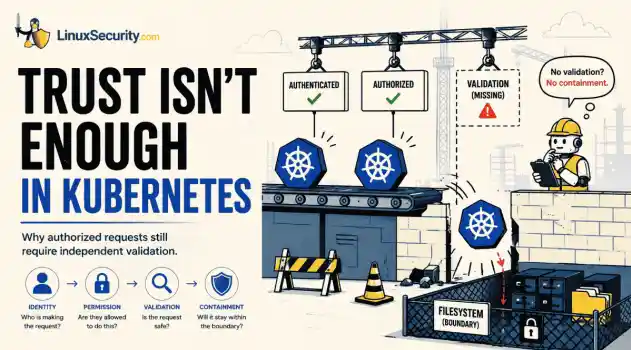
 security advisory path traversal
 Two newly fixed storage bugs in Kubernetes showed more than just a problem with path traversal. They found a common security flaw in the cloud: powerful parts often think that requests accepted by a higher system are safe to run. This is a simple lesson for the platform and security teams: RBAC can accept a request without showing that its parameters will stay within a certain filesystem boundary. This is clear from a new study from SentinelLabs into flaws in the Kubernetes CSI drivers for NFS...
 Jul 24, 2026
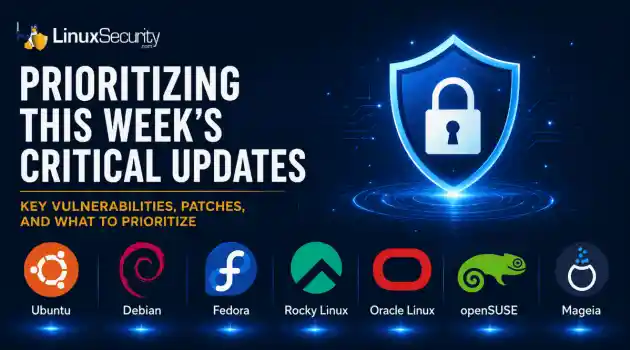 security advisory update
 A large volume of Linux security updates and advisories this week across major distributions once again, but it wasn't just the volume that was the story. Where maintainers and security teams focused their attention was evident in the concentration of fixes targeting Linux kernel updates, identity services, DNS infrastructure, and internet-facing software. . Instead of looking at each advisory in isolation, administrators gain more value from the general trends they reveal about Linux security...
Jul 23, 2026
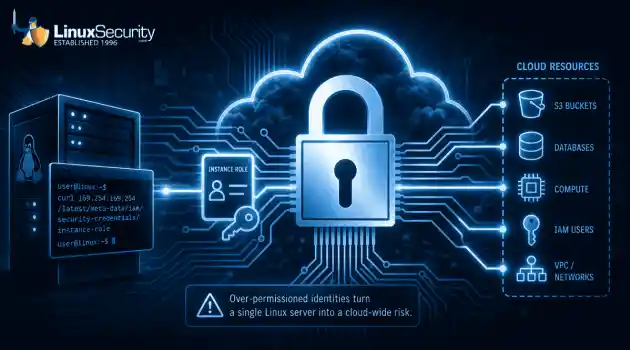 identity management security tactics
 For years, we secured our Linux infrastructure by building walls: VPCs, security groups, and hardened SSH configurations. We treated the cloud like a virtual data center, assuming that if we kept the "bad guys" out of the network, our workloads were safe. . That model is no longer sufficient. Today, one of the most common paths from an initial compromise to a major cloud breach is the identity assigned to your Linux workload. When an attacker gains code execution on a Linux instance—through a...
Jul 17, 2026
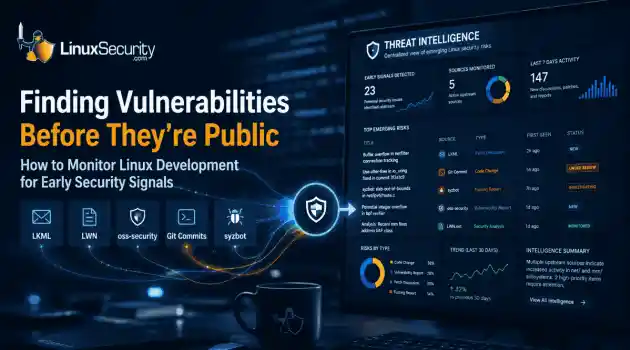 security practices patch management
 Most of us don't hear about a kernel vulnerability until a CVE lands in our inbox or the vulnerability scanner starts complaining. By then, the patch isn't new anymore. Kernel developers may have been passing it around for review, arguing over the implementation, or revising it for days before anyone outside that community noticed it. None of those discussions are secret. They're sitting in mailing list archives, Git commits, and patch reviews where they've been the whole time. The strange...
Jul 14, 2026
 Linux security cyber attacks
 Every Linux server in your fleet produces thousands of events every minute. From journald logs and auditd records to kernel-level eBPF hooks, your systems are constantly talking. Most of that noise is just the mundane churn of system services, CI/CD runners, or routine administrative automation. But among that noise, an attacker might be establishing a foothold, moving laterally, or setting up persistence. The challenge for any security team is: how do you separate the routine from the...
Jul 13, 2026
 Refine features
X Clear Filters
Get the latest News and Insights
Get the latest Linux and open source security news straight to your inbox.
Community Poll
Should Linux servers automatically install security updates?
Loading...
Explore Latest Linux Security features
We found -2 articles for you...
102
 security enhancementmalware protectionfirefox
Exploring Security Enhancements in Firefox 3 for Better Protection
Lets take a look at the security features of Firefox 3. Since its release, I have been testing it out to see how the new security enhancements work and help in increase user browsing security. One of the exciting improvements for me was how Firefox handles SSL secured web sites while browsing the Internet. There are also many other security features that this article will look at. For example, improved plugin and addon security. . Introduction Bill Keys Features Warning users of potential harmful websites while surfing the Internet is an important security feature of a web browser. Being able to clearly warn the user without being a computer expert is one of the problems Firefox tried to solve with Firefox 3.0. They have two features that do this: Google-powered Malware Protection and a feature called . Introduction Bill Keys Features Warning users of potential harmful websites while surfing the Intern. security, features, firefox, since, release, testing. . Anthony Pell
 Apr 16, 2010
•
Apr 16, 2010
•
102
data protectionencryptionsecurity enhancementHow to Encrypt Shell Scripts Using SHC Utility for Improved Security
Do you have scripts that contain sensitive information like passwords and you pretty much depend on file permissions to keep it secure? If so, then that type of security is good provided you keep your system secure and some user doesn't have a "ps -ef" loop running in an attempt to capture that sensitive info (though some applications mask passwords in "ps" output). There is a program called "shc" that can be used to add an extra layer of security to those shell scripts. SHC will encrypt shell scripts using RC4 and make an executable binary out of the shell script and run it as a normal shell script. This utility is great for programs that require a password to either encrypt, decrypt, or require a password that can be passed to a command line argument. . Download shc ( http://www.datsi.fi.upm.es/~frosal/ ) and untar it: tar -xzvf shc-X.X.tgz cd shc-X.X/ make make install A binary named " shc " will be created along with some test programs. Let's give it a try. Create a file called: " script.sh " and add the following contents: ############################### script.sh ############################## #!/bin/sh echo "I love Duane's articles and will send him a donation via PayPal." ############################### script.sh ############################## Now run the command: shc -f script.sh The switch " -f " specifies the source script to encrypt. The above command will create two files: script.sh.x.c and script.sh.x . The program " shc " creates C source code out of your shell script then encrypts it ( script.sh.x.c ). The encrypted shell script is: script.sh.x . Run that binary and see the output: ./script.sh.x I love Duane's articles and will send him a donation via PayPal. Now copy the original " script.sh " file to a floppy disk or some other system for backup or in case you need to edit it in the future. Then, delete it from the server and delete the " script.sh.x.c " file itcreates. Neat feature You can also specify a time limit on the shell script so that it will no longer execute after a certain date and you can specify a custom message to echo back to the user. Run this command on the " script.sh " file we created earlier in this tut: shc -e 09/10/2004 -m "Dude it is too late to run this script." -f script.sh ./script.sh.x ./script.sh.x has expired! Dude it is too late to run this script. In the above command the date October 9, 2004 is set as the expiration date ( -e 09/10/2004 ) and the custom message was set to display to the user ( -m "Dude it is too late to run this script." ) when the binary is executed. Note the date format is dd/mm/yyyy. Check out the man pages for more info on " shc ". Remember that the binary is only encrypted on the local system. If you encrypt a script that transmits sensitive information in clear text across a network, you will need some other encrypted communication channel to transmit that information. Duane Dunston received his B.A. and M.S. degrees from Pfeiffer University and he has his GSEC certification from SANS. Hey,Ann Curry! . Download shc (http://www.datsi.fi.upm.es/~frosal/) and untar it: tar -xzvf shc-X.X.tgz cd shc-X.X/ m. scripts, contain, sensitive, information, passwords, pretty, depend. . Duane Dunston
Mar 02, 2010
•

102
security enhancementopen sourceSELinuxEnGarde Secure Linux Overview: Security Design By Guardian Digital
Secure By Design: How Guardian Digital Secures EnGarde Secure Linux ABSTRACT What is EnGarde Secure Linux? EnGarde Secure Linux is not just another "repackaged" Linux distribution, but a modern open source system built from the ground up to provide secure services in the threatening world of the modern Internet. EnGarde Secure Linux is the creation of Guardian Digital, Inc. a pioneer in open source security since 1999, and has been developed since then in collaboration with the worldwide community of open source security enthusiasts and professionals. Guardian Digital provides a secure and consistent environment for EnGarde Secure Linux through the Guardian Digital WebTool and the Guardian Digital Secure Network. A server-only system, EnGarde Secure Linux is administered securely and remotely using the WebTool, a custom interface that both simplifies server administration and guides the system user in maintaining a secure configurations for all of the services that comprise EnGarde. The Guardian Digital Secure Network maintains the consistency and security of EnGarde by providing system upgrades and security patches that have been constructed by Guardian Digital's engineering team to relieve the user of the burden of maintaining the system in a consistent and secure state. Defense In Depth In EnGarde Secure Linux Security is the primary consideration in designing every element of EnGarde Secure Linux. Guardian Digital applies basic security principles like "least privilege", "no unnecessary services" and "default-deny" rules to every level of EnGarde from access to kernel itself to defense of the network perimeter. Security begins with the selection of the best available open source packages, chosen and tailored for maximum security and following software security best-practices. The next level of protection comes from a complete re-engineering of the standard Linux security modelusing Security Enhanced Linux (SELinux). SELinux implements the principle of "Mandatory Access Control" which places each program and process under the control of its own SELinux policy, limiting its access to files and resources and effectively containing any intrusions or compromises. EnGarde Secure Linux builds on this secure foundation by placing all administration of EnGarde and its services under the control of the Guardian Digital WebTool. The Guardian Digital WebTool is a secure, remote graphical administration interface that is carefully tailored, not just to simplify administration, but to help maintain secure practices and configurations. For example, EnGarde, through the WebTool, limits user and IP access by default for most services like FTP file transfers and POP/IMAP mail retrieval. For services that must be publicly accessible like Web service and mail transport, the WebTool offers simple setup of SSL-enabled encrypted services. The WebTool also mandates secure practices like encrypted passwords and prevents hazardous configurations like open mail relays. EnGarde Secure Linux extends its secure environment through the use of a carefully integrated selection of the best open source security tools for detecting compromises and intrusions at all levels. EnGarde generates special security-focused system logs to help the administrator identify potential compromises, and adds to this host-based intrusion detection tools. EnGarde monitors the system for potential network compromises and intrusions using the open source Snort intrusion detection system, adding its own NetDiff port status monitoring software. Summary Linux and open source systems have long been renowned for their stability, versatility and scalability. EnGarde Secure Linux adds the feature crucial to providing services on the modern Internet -- security. Guardian Digital builds security into every element of EnGarde by selecting thebest available open source tools and services available and configuring them with security as the top priority. Recognizing that security can only be maintained in a consistent and stable environment, Guardian Digital relieves the user of the burden of "hardening" the system and following secure practices by designing secure administration into its WebTool and by updating and securing the system through the Guardian Digital Secure Network. For an in-depth exploration of the EnGarde Secure Linux security environment, see the full version of this document at "Secure By Design" full text . . Guardian Digital implements a strong framework for EnGarde Secure Linux, emphasizing security through minimalism, secure coding practices, and auditing tools. EnGarde Secure Linux, Secure Administration, SELinux, Open Source Security. . Brittany Day
Oct 09, 2006
•

Get the latest News and Insights
Get the latest Linux and open source security news straight to your inbox.
Community Poll
Should Linux servers automatically install security updates?
Search Topics
Powered By

Linux Security - Your source for Top Linux News, Advisories, HOWTOs and Feature Releases
QUICK LINKS
subscribe to newsletters!
Like staying secure? So do we.
Sign up for updates, tips, and alerts!