


Stay Ahead With Linux Security Features
 security advisory attack
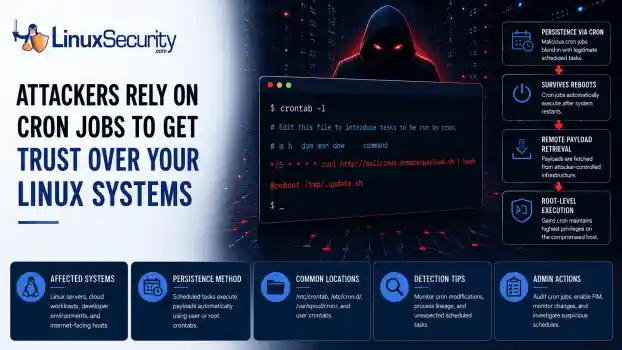
 A Linux server gets cleaned up after an intrusion. The suspicious process is terminated, credentials are rotated, and the system is rebooted during maintenance. Everything seems secure. A few hours later, the same outbound connection appears again. . Situations like that point to persistence . The attacker no longer needs the original exploit because something on the host continues restoring access behind the scenes. Finding that mechanism is often more important than understanding how the...
 Jun 08, 2026
 threat detection scalability
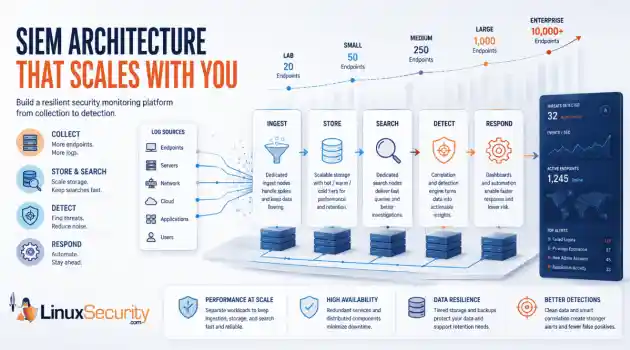
 Building a SIEM is easier than scaling one. Most open-source deployments start as a simple "all-in-one" server. It is easy to set up, but that design rarely survives the transition from a lab to a production workload. . A SIEM watching 20 endpoints is not doing the same job as one watching 500. More endpoints mean more logs; more logs require more storage; more storage makes search heavier. Eventually, the very architecture that made your lab easy to deploy becomes the reason your production...
Jun 04, 2026
 security advisory apache
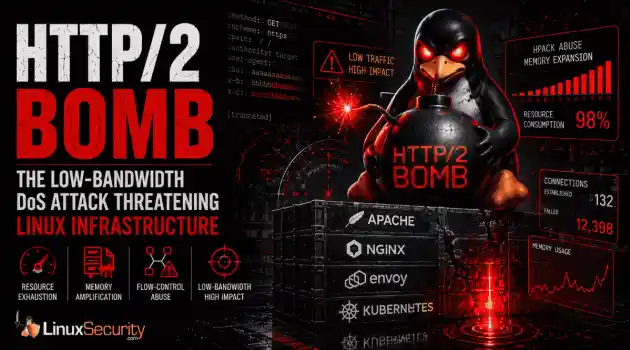
 A newly disclosed attack technique called HTTP/2 Bomb is drawing attention because it targets the software that sits at the front of much of the Linux internet. Apache HTTP Server, NGINX, Envoy, and the ingress layers that many Kubernetes environments depend on can be forced into consuming disproportionate amounts of memory using relatively small amounts of attacker traffic. . For Linux administrators, the concern is not the HTTP/2 protocol itself. It is the possibility that a single...
Jun 04, 2026
 security advisory important
 The compromise of Nx Console shows how much infrastructure now sits behind a single developer account. GitHub repositories, CI/CD pipelines, container build systems, Terraform projects, Kubernetes deployments. None of those systems was the initial target. The workstation was. . Attackers did not need a Linux privilege escalation bug or a remote code execution chain. They needed developers to trust a tool they were already using. For many organizations, that was enough. What Happened? Federal...
Jun 03, 2026
 security advisory open-source
 You remove the malware. You rotate the compromised credentials. You patch the original vulnerability and close the ticket. Two weeks later, the attacker is back. . What happened? You didn't lose the battle at the exploit; you lost it at the cleanup. In many modern Linux intrusions, the malware you found wasn't the main problem—it was the fallback mechanisms left behind. These hooks quietly restore attacker access the moment you look away. If you clean a host but miss these persistence layers,...
Jun 02, 2026
 Refine features
X Clear Filters
Get the latest News and Insights
Get the latest Linux and open source security news straight to your inbox.
Community Poll
What got you started with Linux?
Loading...
Explore Latest Linux Security features
We found -1 articles for you...
102
 open-sourcesecurity risksautomation
Microsoft Just Showed How Easily Trusted Software Pipelines Can Be Abused
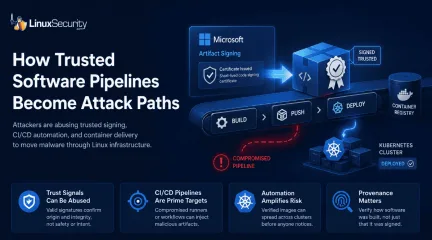
Microsoft announced this week that it disrupted a malware-signing operation that helped cybercriminals distribute ransomware disguised as legitimate software. According to the company, a threat actor called Fox Tempest abused Microsoft Artifact Signing to generate short-lived code-signing certificates for malicious payloads. . The operation highlights a growing problem across modern Linux infrastructure. Signed packages, trusted repositories, container registries, and automated CI/CD pipelines now move software through production environments with almost no friction. If an artifact is signed and passes verification checks, most systems assume it belongs there. Attackers are learning how to abuse that trust directly. Instead of bypassing security controls, they are starting to move through the same trusted software channels administrators rely on every day. Modern Linux Infrastructure Was Built to Trust Signed Software Modern Linux ecosystems run on layers of cryptographic trust. RPM and DEB packages rely on GPG verification. OCI image signing is now common across Kubernetes environments. GitHub Actions, GitLab CI, and Jenkins pipelines automatically build and publish software into production registries with very little manual review once workflows are established. Most of the time, this works exactly as intended. The problem is that signatures only verify origin and integrity. They do not guarantee that software is safe, that a build pipeline was uncompromised, or that a maintainer account upstream was not hijacked. In many environments, malicious code no longer needs to break into production directly. It only needs to arrive through infrastructure that the organization already trusts. That shift matters because Linux environments increasingly deploy software automatically. GitOps workflows, Kubernetes image verification policies, OCI registries, and CI/CD automation were all designed to remove friction from delivery pipelines. Attackers have started treating that automation itselfas the attack surface. Attackers Are Weaponizing Trusted Software Pipelines The Fox Tempest operation arrives alongside a growing wave of software supply chain security incidents targeting ecosystems that Linux teams use every day. Threat actors continue poisoning npm and PyPI packages, compromising developer environments, abusing CI/CD infrastructure , and hijacking dependencies trusted by thousands of downstream systems. Recent campaigns tied to malicious PyPI packages, the Shai-Hulud npm compromise, and repository hijacks involving VS Code extensions all followed the same pattern. Attackers inserted malicious code into trusted delivery paths and let automation handle the distribution. These attacks succeed because modern infrastructure trusts software automatically . If a package is signed or published through a recognized pipeline, many security controls treat it as legitimate before any deeper inspection occurs. Attackers understand this now. Instead of trying to evade trust systems, they are beginning to weaponize them. Why Kubernetes and CI/CD Pipelines Became Supply Chain Attack Paths Containerized infrastructure sped the entire cycle up. CI/CD pipelines now push workloads directly into Kubernetes clusters, cloud registries, and GitOps workflows with barely any human interaction once deployment logic is wired together. Signed OCI images move between development, staging, and production continuously. In many environments, nobody touches the release path unless something fails. The issue is that container signing only proves identity. A Sigstore Cosign signature confirms who signed the image . It does not prove the container was built securely or that the contents are trustworthy. Vulnerable dependencies, exposed secrets, poisoned build artifacts, and malicious packages can still move through the pipeline fully signed and fully verified. A compromised GitHub Action inside a production CI/CD pipeline could inject cloud credentials into a container layer during build time,sign the final image automatically, and push it into an internal registry trusted by Kubernetes admission policies. From there, GitOps automation may deploy the workload across clusters before anyone realizes the pipeline itself was compromised. That is what modern software supply chain attacks actually look like operationally. The pipeline stays green. The deployment succeeds. Kubernetes pulls and runs the image exactly the way it was designed to. Production just inherits the compromise automatically. Why SBOMs Are Not Enough Software bills of materials became the industry's answer to visibility problems. SBOMs help organizations track dependencies inside applications and containers, which is useful, especially in large Kubernetes environments where dependency sprawl gets out of control quickly. But SBOMs only describe contents. They do not prove build provenance, software attestation, or CI/CD pipeline integrity. An SBOM can tell you a malicious package exists inside an image after the fact. It cannot prove whether the build runner was compromised, whether a maintainer account upstream was hijacked, or whether a trusted release workflow injected something malicious during artifact generation. Verification without context creates blind trust. That is increasingly where attackers operate. CI/CD Pipelines Are Now Prime Targets for Supply Chain Attacks Build infrastructure quietly became one of the most sensitive attack surfaces in modern Linux environments. GitHub Actions runners, GitLab pipelines, Jenkins servers, artifact signing systems, and Kubernetes deployment automation often hold privileged access across entire organizations. Compromising one part of the release chain can allow attackers to distribute malware through systems already trusted by production workloads. Attackers no longer need to bypass security controls if they can become part of the trusted software delivery process itself. This is why building provenance and software attestation frameworks like SLSAis getting more attention. Organizations are realizing that verifying software signatures alone is no longer enough. They also need to verify how the software was built, where it originated, and whether the release workflow itself remained trustworthy. How Linux Teams Should Secure Their Software Pipelines The answer is not abandoning software signing or automated deployments. Linux ecosystems still depend on them. But organizations need to stop treating “signed and verified” as the end of the security conversation. Teams running Kubernetes should start enforcing Kubernetes image verification and OCI image signing policies at admission time instead of relying solely on registry trust. Tools like Kyverno and OPA Gatekeeper can block unsigned or untrusted container images before they ever reach production clusters. CI/CD pipeline security also needs stronger isolation. GitHub Actions runners and GitLab CI systems should be treated like production infrastructure, not disposable automation. Immutable runners, short-lived credentials, restricted secrets access, and hardened build environments reduce the blast radius when pipelines get compromised. Container scanning needs to continue after deployment as well. Trivy and Grype help detect vulnerable packages during build stages, but runtime visibility matters just as much. Falco can detect suspicious process execution, shell access, privilege escalation attempts, or unexpected network activity inside running Kubernetes containers. Linux teams should also verify software provenance directly. Sigstore Cosign, in-toto attestations, and the SLSA framework provide ways to validate how software was built, where artifacts originated, and whether release workflows were tampered with somewhere inside the CI/CD pipeline. Most importantly, organizations need to reduce automatic trust wherever possible. Signed software should still be inspected. Build systems should still be monitored. Deployment pipelines should still be treated as attack surfaces. Because attackers already are. The Dangerous Assumption Linux Needs to Rethink For years, signatures served as one of the strongest trust signals in software distribution. If code was signed, verified, and distributed through a recognized repository or trusted OCI registry, many organizations assumed it was safe enough to deploy automatically. Linux infrastructure was built around that assumption. Attackers are increasingly learning how to hide inside it. The next major supply-chain compromise probably will not arrive as an obviously malicious binary or a noisy intrusion attempt. It will arrive the same way trusted software always does: signed, verified, pushed through CI/CD automation, and deployed into production by infrastructure designed to trust it. Related Reading Linux Supply Chain Attacks Threaten DevOps Teams and Security Why CI/CD Pipelines Became Targets in Software Supply Chain Attacks RubyGems Attack Highlights Open Source Supply Chain Risks for Linux Teams The Next Wave of Supply Chain Attacks: NPM, PyPI, and Docker Hub Incidents Set the Stage for 2026 Why Software Supply Chain Security Matters in Linux Systems Understanding Security Threats In Open-Source Software Supply Chains . The operation highlights a growing problem across modern Linux infrastructure. Signed packages, trus. microsoft, announced, disrupted, malware-signing, operation, helped, cybercrimina. . MaK Ulac
 May 20, 2026
•
May 20, 2026
•
102
 security advisorydependency managementsoftware integrity
Why Linux Supply Chain Attacks Are Becoming a Nightmare for DevOps Teams
Linux has long carried a reputation for resilience, bolstered by open-source reviews, hardened kernels, and transparent development pipelines. While that trust is well-founded, attackers have shifted their focus to a more vulnerable target: the surrounding software supply chain. . Instead of breaking Linux directly, malicious actors are poisoning the delivery pipeline. The shift is obvious when you look at the last few years of incidents. Compromised maintainers, malicious packages, dependency confusion, and poisoned updates frequently land on systems long before defenders realize the code has changed. While security teams are busy patching traditional vulnerabilities, attackers are quietly slipping through package managers and CI/CD workflows we assumed were trustworthy. The XZ Utils backdoor fundamentally changed the tone of this conversation. The XZ Backdoor: The Scenario Everyone Feared In early 2024, attackers inserted a backdoor into XZ Utils , a compression library embedded across Linux distributions and SSH-related workflows. The malicious code targeted liblzma (a data compression library) and created a path to intercept SSH authentication under specific conditions. It was subtle, heavily obfuscated, and positioned deep enough in the stack that most environments would never notice it during routine reviews. But the most dangerous part wasn’t the payload itself—it was how access was gained. A contributor operating under the alias "Jia Tan" slowly built trust inside the project over months. The pattern started with normal, helpful commits, routine maintenance, and participation, before the poisoned update eventually landed. This long-game approach mirrors what’s happening across open-source ecosystems today: attackers are playing the long game rather than relying on smash-and-grab compromises. The backdoor was ultimately caught by Microsoft engineer Andres Freund after he noticed strange CPU behavior in Debian test environments. If that anomaly had gone unnoticed for a fewmore release cycles, the blast radius would have been catastrophic. The Pattern Didn't Stop with XZ In March 2026, a supply chain attack hit Axios , one of the most widely used HTTP client libraries in the JavaScript ecosystem. Attackers got access to a maintainer’s npm account and quietly published two compromised versions, 1.14.1 and 0.30.4, before anyone caught it. The Axios source code itself wasn’t altered. That part mattered. Instead, the attackers slipped a malicious dependency called plain-crypto-js into the release chain, which is a much easier place to hide when everyone’s focused on the main project diff and not the packages underneath it. Once installed, npm automatically ran post-install scripts tied to the dependency. The code was heavily obfuscated and built to stay unnoticed long enough to deploy a remote access trojan across Linux, macOS, and Windows systems. Researchers later connected the infrastructure and forensic overlap to North Korean operators. What unsettled a lot of security teams wasn’t the sophistication. It was the timing. The poisoned packages were live for only a few hours, but Axios pushes tens of millions of downloads every week, so developer workstations, CI runners, and production pipelines started pulling the update almost immediately without anyone stopping to inspect a routine dependency refresh. That’s the part that supply chain attacks keep exposing now. Attackers do not always need to compromise the primary codebase anymore. A transitive dependency buried deep enough in the update path can move through trusted channels quietly, especially in environments where automated installs happen faster than meaningful review ever does. Takeaway : Open-source trust models are incredibly vulnerable to patient attackers. To learn more about how organizations are improving software transparency, you can review the CISA Software Bill of Materials Guidance Linux Repositories as Active Attack Surfaces The problem extends far beyond Linuxdistributions themselves. Language ecosystems are hit constantly because developers install dependencies—third-party code modules used to speed up development—at scale with almost zero scrutiny. Go Modules: In 2025, researchers uncovered malicious Go modules (such as prototransform, go-mcp, and tlsproxy) that deployed destructive shell scripts to wipe Linux disks through /dev/sda. The payload didn't even attempt to extort the user via ransomware; it destroyed the systems outright. PyPI Packages: Packages frequently serve as delivery mechanisms for credential theft and remote access tooling. Some have abused Gmail SMTP infrastructure and WebSockets to blend exfiltration traffic into normal outbound communications, easily bypassing monitoring in smaller environments. Node.js Ecosystem: The event-stream compromise remains one of the clearest examples of this evolution. A maintainer handed project ownership to a new contributor who gradually introduced malicious code through a nested dependency targeting cryptocurrency wallets. npm audit failed to flag it because it wasn't tied to a known vulnerability at the time. You can read the original breakdown of the event-stream GitHub discussion to understand how social trust becomes an attack vector. Why Traditional Dependency Scanning Falls Short Many organizations treat tools like npm audit, Dependabot, or standard vulnerability scanners as a complete supply chain defense. They aren't. These tools are great for identifying known vulnerable versions tied to published advisories and helping with patch management. However, they fail to reliably catch: Compromised maintainer accounts Typosquatted or malicious packages Obfuscated payloads Malicious post-install scripts Dependency confusion attacks Insider sabotage Runtime exfiltration behavior The ua-parser-js compromise demonstrated this gap. Attackers hijacked the maintainer’s account and pushed malicious package versions that deployed cryptominers andcredential-stealing malware. The window lasted only a few hours, but thousands of developer systems and CI pipelines pulled the update automatically before any advisory was published. Ecosystems are trying to improve trust validation, and you can see how in the npm Registry Signatures and Provenance documentation . The Trap of Trust at Scale Modern applications routinely pull hundreds or thousands of dependencies through transitive package chains (where one dependency relies on another). Most teams cannot realistically audit all of them manually, leading to the dangerous assumption that "popular" equals "safe." Attackers know developers trust download counts, GitHub stars, and familiar names: Typosquatting: Campaigns exploit simple human errors. Packages like crossenv successfully harvested environment variables simply because someone missed a hyphen while trying to install cross-env. Dependency Confusion: In research by Alex Birsan, public packages using internal company names tricked package managers into pulling malicious versions from public registries rather than private ones. Giants like Apple, Microsoft, PayPal, and Tesla were impacted during testing. This attack chain works because the package resolution behavior itself is exploited. You can review the original Dependency Confusion Research to see how this vulnerability operates. How to Reduce Supply Chain Risk There is no single silver bullet. Because attackers target multiple parts of the pipeline simultaneously, teams need layered verification: Lockfiles and Integrity Validation Lockfiles (like package-lock.json or yarn.lock) pin exact dependency versions and verify integrity hashes. In production pipelines, use npm ci instead of npm install to enforce deterministic installs rather than recalculating dependency trees dynamically. It's a small change with a big security difference. SBOMs and Dependency Visibility Software Bills of Materials (SBOMs) provide much-needed visibility into what is running insideapplications. Tools like CycloneDX and Syft generate SBOMs for Linux systems and container images, helping teams quickly check whether suspicious components exist in their environments. To learn more about reproducible builds and software integrity frameworks, check out the SLSA Framework . Provenance and Signed Builds Projects like Sigstore modernize software provenance verification using cryptographic signing tied to CI/CD workflows, rather than relying on developer machines. This ensures we know where a package was built, which pipeline produced it, and if it was altered afterward. You can read the Sigstore project overview to learn more. Restrict Install-Time Execution Many attacks abuse post-install scripts that inherit broad execution privileges. Using flags like npm install --ignore-scripts stops an entire category of malicious behavior. High-trust production pipelines should strictly limit unnecessary execution paths and isolate build runners to prevent lateral movement. 5 Things Linux Teams Should Do This Week Require MFA for package maintainers Pin dependency versions in production Disable unnecessary install scripts Generate SBOMs during builds Monitor dependency changes in CI pipelines Open Source Security Relies on Human Processes Some of the hardest problems in supply chain security aren't technical: maintainer burnout, poor account security, weak review pipelines, and underfunded projects maintaining critical infrastructure. The colors.js and faker.js sabotage incident showed what happens when maintainers themselves become unpredictable risk factors. This wasn't an external intrusion; the maintainer intentionally broke downstream systems. The industry is slowly responding by requiring MFA, improving provenance tooling, and adopting reproducible builds. But adoption is uneven outside of large enterprises, and that gap is where attackers continue to operate. Treat Supply Chain Monitoring Like Endpoint Security The old assumption thatLinux repositories are inherently trustworthy no longer holds up under modern attack patterns. Defenders need visibility into dependency changes, unusual network behavior, build pipeline anomalies, and maintainer activity—not just CVEs. Because most supply chain compromises don’t arrive as traditional exploits. They arrive as routine updates: quietly, usually signed, and almost always trusted. If you’re tracking issues like this, Linux security newsletters are a great way to keep them on your radar. . Explore how supply chain attacks threaten Linux ecosystems and discover proactive measures for better security.. Linux Supply Chain Attack, Open Source Security, Software Integrity, Dependency Management. . MaK Ulac
May 06, 2026
•

102
 security practicesmalware protectionuser experience
Exploring Benefits Of Code Signing Solutions In Securing Software
Code signing involves approving applications, software code, scripts, or programs to authorize their origin. The goal is to ensure that the code is never tampered with. Certificate Authorities (CA) confirm the identity of the code-signing source and link a public key to a code-signing certificate. . Performing a code sign provides several critical benefits, including code authentication, code or software author validation, and cryptographic protection. By including a virtual signature in the software, builders can assure users that the code has not been altered or tampered with because it has become signed. This system uses a unique private key to generate a virtual signature, which is then validated via a corresponding public key. Implementing stringent safety practices around code signing enables software to maintain its integrity and authenticity and builds trust. As cyber threats evolve, sturdy code-signing practices will become increasingly imperative to safeguard the software environment from malicious activities. In this guide, you’ll learn more about the top advantages of code signing, detailing five key benefits for Linux admins and infosec professionals. How Are Hackers Exploiting Code Signing Certificates? One method modern-day hackers employ involves exploiting code-signing certificates. They can make malware appear legitimate by compromising a private key and certificate. Once they gain access to these cryptographic credentials, they can sign malicious code, making it seem like it comes from a trusted source. This tactic deceives users and security systems, allowing the malware to bypass various defenses. Given these state-of-the-art threats, builders and corporations are now more critical than ever to signal their code using a fairly steady certificate. This involves employing superior safety features to guard non-public keys, including hardware security modules (HSMs) or other steady cryptographic gadgets. Regularly updating and monitoring certificates can help detectunauthorized usage or potential breaches. What Are the Benefits of Code Signing Solutions? 1. Authenticates Code Integrity A code signing solution , such as a hash function, provides a comprehensive code integrity check. This function is applied when assigning the code and then again at the destination, ensuring proof of code integrity throughout the process. By creating a unique digital fingerprint for the software, any alteration or tampering will result in a mismatch. If, for any purpose, the key doesn’t suit, you may fail to download it or receive a protection warning, alerting you to capacity issues. This approach not only validates the authenticity of the code but also complements safety by preventing the execution of unauthorized or corrupted code, thereby shielding customers from malicious software programs. In addition to using the hash function, you can also gain verification via a timestamp. Some code-signing certificates provide this tool as part of their package. The timestamp feature adds an extra layer of security and trust by recording the exact time and date when the code was signed. It comes as a timestamp data strip, which sits alongside the signature. This now not only verifies the integrity of the code at the time of signing but also guarantees that the signature stays valid even though the signing certificate expires or is revoked. Consequently, users can consider that the code changed into signed with a valid certificate at the desired time, similarly enhancing the general safety and reliability of the software. 2. Ensures Company Authenticity and Reputation You can adopt a code signing process to validate and approve software, programs, and additional code. Doing so safeguards you against cyberattacks, corruption, or tampering. Implementing this technique ensures that only confirmed and depended-on code is performed, protecting your systems from malicious threats. A trustworthy certificate will shield your highbrow belongings and your organization's reputation,ensuring that clients and customers can depend upon the authenticity and integrity of your software program. Additionally, it enables construct persons to accept as true with self-belief, as they can be confident that their code has not been altered or compromised. In an era wherein cyber threats continuously evolve, adopting a sturdy code signing method is crucial for keeping security and belief in your software program products. When customers and carriers believe you and do your all to guard their personal information, they’re much more likely to spend money on your services. In addition, they will feel safe downloading files and programs from you, knowing that you prioritize their security and privacy. This stage of trust and assurance ends in improved patron loyalty, as clients appreciate the reliability and integrity of your offerings. Satisfied clients aren't only in all likelihood to preserve the usage of your services. Still, they can also advocate them to others, expanding your purchaser base through tremendous phrase-of-mouth. Building and retaining this consideration is crucial for lengthy-term success and a boom in today’s competitive marketplace. Ensuring robust security measures and transparent practices can contribute to a strong, loyal customer relationship. 3. Boosts Revenue In this virtual age, socially engineered campaigns like spoofing and phishing are increasingly conventional. The culprits at the back of these schemes exploit the vulnerabilities of individuals who operate inside the virtual sphere by injecting virus payloads, ransomware , or malware into software systems. These assaults can cause excessive information breaches, economic losses, and damage to a business enterprise's popularity. The state of affairs has been exacerbated by the appearance of AI technology , which has supplied attackers with greater state-of-the-art tools to create convincing fake messages and automate attacks at a bigger scale. As a result, it has become even more vital for individuals andagencies to enforce robust cybersecurity measures, live vigilance, and educate themselves about those threats to shield their virtual belongings and keep belief with their stakeholders. Network platform providers and software publishers are increasingly mandating the code signing system, which necessitates a reliance on certificate authority (CA). By requiring code to be signed with a virtual certificate from a good CA, these entities ensure that software programs are allotted to users competently and securely. This method facilitates affirming the authenticity and integrity of the software program, stopping unauthorized alterations, and protecting customers from malicious code. As a result, customers could have extra self-assurance inside the software they download and deploy, understanding it's been vetted and accepted by a trusted source. This tremendous adoption of code signing practices no longer simply complements typical cybersecurity but also fosters agreement between software developers and their customers, contributing to a more steady virtual atmosphere. This is useful to big agencies, small companies, and start-ups. Why? When you pride yourself on defending your customers, vendors, and clients' records, you may benefit from trust among them. This agreement ends with a more robust courting agreement with your stakeholders, ensuring they are assured of their interactions with your enterprise. As a result, you'll boost authenticity and heighten your brand’s presence inside the market. This stronger popularity effectively draws new customers and encourages present ones to stay dependable, riding client retention. In the longer term, those factors collectively contribute to multiplied revenue, as a trusted and legit brand is much more likely to peer sustained commercial enterprise boom and profitability. 4. Creates A Secure, Safe Experience For Your Users As mentioned, the code signing process helps you build trust among your clients and gain it from your vendors. All partiesbenefit from embracing code-signed files or software, as this practice ensures the utmost security. When code is adequately demonstrated and authenticated, it prevents tampering and guarantees that the software program has no longer been altered since it was signed. This security stage is critical in protecting sensitive statistics and preserving the integrity of software program structures. By adopting code signing, agencies can provide users with a more secure experience, reinforcing agreement with and strengthening relationships with customers and vendors. Ultimately, this proactive method of safety and integrity fosters a more steady and dependable virtual environment for anybody worried. In addition, embracing code signing ensures a sleek user experience. Signing the code via a good certificate authority reduces the chance of installation screw-ups and safety warnings. This seamless enjoyment is vital for retaining personal satisfaction, as it minimizes interruptions and confusion for the duration of the installation system. By imparting users with a straightforward and honest setup revel in, you beautify their self-belief in your software and build a positive reputation. This no longer contributes to a higher general user enjoyment but reinforces the reliability and credibility of your software program, encouraging persistent use and fostering patron loyalty. Without investing in the proper methods and gear, you’re prone to information breaches. Such breaches may have excessive repercussions for your popularity and finances. When sensitive statistics are compromised, it erodes consideration among your clients and partners. It can bring about economic losses because of felony prices, regulatory fines, and the costs associated with remediation and damage management. The lengthy-term effect on your enterprise may be even more adverse, as the bad publicity and loss of patron confidence can also lead to decreased income and a weakened market position. Therefore, prioritizing strong security measuresand investing in effective protection techniques is crucial to shield your business and maintain its integrity and profitability. 5. Flawless Integration With Various Platforms The code signing system has advanced to aid numerous platforms and devices, with predominant ones consisting of Windows, Apple iOS, Linux, and Java, as well as mobile and net-primarily based technologies like Android and Adobe AIR. This extensive compatibility is crucial as code distribution continues to extend across numerous digital ecosystems, making it increasingly essential for developers and groups to ensure the authenticity and integrity of their software programs. One of the significant thing benefits of using code signing is the capability to set up a trusted relationship between the software and its users. When a bit of software is signed with a digital certificate from a good certificates authority (CA), it offers a cryptographic assurance that the code has no longer been altered or tampered with because it turned into signed. This virtual signature acts as a digital seal, uniquely linking the code to the signer's identity, making it nearly impossible to replicate or forge. This is vital in retaining the acceptance as accurate with customers, who rely upon those assurances to ensure that the software program they're putting in or the usage of is legitimate and secure. Many structures advise or require that code signing be performed with the aid of dependent certificate authorities to enhance security and save you from the distribution of malicious software programs. Trusted CAs play a vital role in verifying the identification of the software program publisher and issuing certificates that are identified by using diverse working systems and programs. This practice helps mitigate the danger of falling prey to cyber scammers who might try to distribute malicious code disguised as legitimate software programs. Using certificates from mounted and dependable authorities, developers can ensure their code is safeguardedagainst unauthorized alterations and that users are blanketed from capability threats. Additionally, using trusted certificates permits developers and companies to reject motion instructions from untrusted sources. This delivered layer of safety helps prevent unauthorized access and decreases the risk of malware infiltration. It also fosters a safer digital environment by ensuring that only verified and authenticated software is executed, protecting users and systems from potential harm. Overall, a complete code signing technique that uses trusted certificates and adheres to platform-specific recommendations drastically complements protection. It not only facilitates preserving the integrity of the software program being dispensed but also builds trust among users and stakeholders. By embracing these practices, developers and groups contribute to a more secure virtual panorama, reinforcing self-belief inside the software supply chain and minimizing cyber threats. Our Final Thoughts on the Benefits of Code Signing Solutions Code signing solutions are a surefire way to avoid information breaches and ensure the integrity of your software program. Whether you are a start-up or a large business enterprise, the benefits of code signing will assist you in earning acceptance as authentic with your clients and carriers and significantly enhance your sales. With over 560,000 new cyber threats emerging every day , it's far vital to implement robust safety features to defend your business. Adopting code signing practices will enhance your security posture, mitigate risks, and guard your organization's reputation. . Application signing is essential for verifying the integrity of software and safeguarding it against modifications, thus bolstering overall security.. Sign Code, Secure Software, Code Integrity, Cyber Threats, Authentication. . Brittany Day
Aug 17, 2024
•
102
 open sourcedata encryptionsoftware transparency
Biden's Cybersecurity Order Requires Federal Software Compliance Standards
On Wednesday, May 12th, in the wake of the recent Colonial Pipeline ransomware attack that shut down one of the largest US pipelines for nearly a week, President Biden signed an executive order placing strict new standards on the cybersecurity of all software sold to the federal government. This order is part of a broad, multi-layered initiative to improve national security by incentivizing private companies to practice better cybersecurity or risk being locked out of federal contracts. . For the first time, the United States will require all software purchased by the federal government to meet, within six months, a series of new cybersecurity standards. Although the companies would have to “self-certify,” violators would be removed from federal procurement lists, which could kill their chances of selling their products on the commercial market. The new order also requires all federal agencies to encrypt data, whether it is in storage or while it is being transmitted. This order addresses a disconcerting trend: cyberattacks - the vast majority of which are email-borne - are rapidly evolving to become more sophisticated, prevalent and far-reaching than ever before. Many of these attacks target critical infrastructure - a point most recently highlighted by the Colonial Pipeline ransomware outbreak. Over the past year, approximately 2,400 ransomware attacks have hit corporate, local and federal offices. Biden’s new executive cybersecurity order recognizes the critical importance of Open Source in securing the software supply chain, stating that the government must ensure "to the extent practicable, to the integrity and provenance of open-source software used within any portion of a product." It is not surprising that the report specifically addresses open-source security. After all, according to open-source company Tidelift, 92% of applications contain open-source components. Luckily, the open-source community itself is already combating this issue with the Software Package DataExchange (SPDX), which aims to enable software transparency through a Software Bill of Materials (SBOM) - a formal record containing the details and supply chain relationships of various components used in building software - that already meets the executive order's requirements. In addition, The Linux Foundation’s Open Source Security Foundation (OpenSSF) has also been working to secure open-source software and its components through its mission of “collaboration to secure the open-source ecosystem”. Also, the Linux Foundation recently announced a new open-source software signing service: the sigstore project , which seeks to improve software supply chain security by enabling the easy adoption of cryptographic software signing backed by transparency log technologies. Besides sigstore, the Linux Foundation oversees multiple projects designed to maintain trusted source code supply chains including in-toto , The Update Framework (TUF) and OpenChain (ISO 5230). The open-source community is also addressing the order’s call for the encryption of data at rest and in transit with the renowned open-source project Let's Encrypt , the world's largest certificate authority for TLS certificates. The bottom line is that Open Source shows significant promise in meeting today and tomorrow’s most significant cybersecurity challenges. It has become clearly apparent that cybersecurity needs to be a top priority - not just for the federal government, but for everyone. David A. Wheeler, the Linux Foundation's Director of Open Source Supply Chain Security, emphasizes the importance of community involvement in securing the open-source supply chain, "We couldn't do this without the many contributions of time, money, and other resources from numerous companies and individuals; we gratefully thank them all. We are always delighted to work with anyone to improve the development and deployment of open-source software." I’m pleased to see this type of legislation put into place. Cybersecurity and data privacy areserious, universal concerns that must be addressed individually by businesses, as well as at the national level. This order offers vendors a great enough incentive that it is hard to imagine they would choose not to comply. While there is no silver bullet, it is encouraging to see that the open-source community is well on its way to meeting this order’s critical demands. . The federal government imposes updated cybersecurity regulations for software acquired by its agencies, bolstering defenses across the board.. Enhanced Cybersecurity Standards, Open Source Initiatives, Software Supply Chain Compliance. . Brittany Day
May 24, 2021
•

Get the latest News and Insights
Get the latest Linux and open source security news straight to your inbox.
Community Poll
What got you started with Linux?
Search Topics
Powered By

Linux Security - Your source for Top Linux News, Advisories, HOWTOs and Feature Releases
QUICK LINKS
subscribe to newsletters!
Like staying secure? So do we.
Sign up for updates, tips, and alerts!
Discover faster search, smarter navigation, and deeper Linux security insights. Read More