Audit Linux privileges now to limit compromise, escalation, and system-wide damage. Review Linux Privileges×


Stay Ahead With Linux Security Features
 security advisory update
 A large volume of Linux security updates and advisories this week across major distributions once again, but it wasn't just the volume that was the story. Where maintainers and security teams focused their attention was evident in the concentration of fixes targeting Linux kernel updates, identity services, DNS infrastructure, and internet-facing software. . Instead of looking at each advisory in isolation, administrators gain more value from the general trends they reveal about Linux security...
 Jul 23, 2026
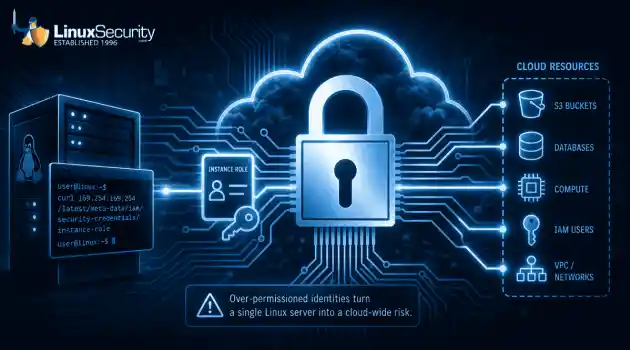 identity management security tactics
 For years, we secured our Linux infrastructure by building walls: VPCs, security groups, and hardened SSH configurations. We treated the cloud like a virtual data center, assuming that if we kept the "bad guys" out of the network, our workloads were safe. . That model is no longer sufficient. Today, one of the most common paths from an initial compromise to a major cloud breach is the identity assigned to your Linux workload. When an attacker gains code execution on a Linux instance—through a...
Jul 17, 2026
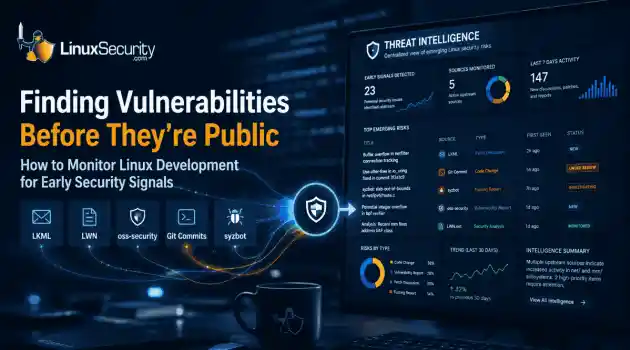 security practices patch management
 Most of us don't hear about a kernel vulnerability until a CVE lands in our inbox or the vulnerability scanner starts complaining. By then, the patch isn't new anymore. Kernel developers may have been passing it around for review, arguing over the implementation, or revising it for days before anyone outside that community noticed it. None of those discussions are secret. They're sitting in mailing list archives, Git commits, and patch reviews where they've been the whole time. The strange...
Jul 14, 2026
 Linux security cyber attacks
 Every Linux server in your fleet produces thousands of events every minute. From journald logs and auditd records to kernel-level eBPF hooks, your systems are constantly talking. Most of that noise is just the mundane churn of system services, CI/CD runners, or routine administrative automation. But among that noise, an attacker might be establishing a foothold, moving laterally, or setting up persistence. The challenge for any security team is: how do you separate the routine from the...
Jul 13, 2026
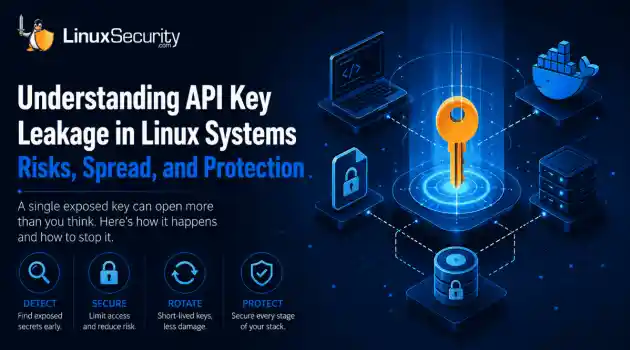 open-source infrastructure risk
 Security scanners flag exposed API keys in public repositories every day. The initial response is usually predictable: delete the commit, revoke the credential, and move on. That’s a mistake. . In a real Linux environment, an API key never stays in one place. By the time it hits a public repo, it’s already everywhere. It’s in the CI/CD pipeline. It’s in your container registry. It’s in the build logs. It’s in the backups. Git makes this worse because the history never dies. Deleting a file in...
Jul 11, 2026
 Refine features
X Clear Filters
Get the latest News and Insights
Get the latest Linux and open source security news straight to your inbox.
Community Poll
Should Linux servers automatically install security updates?
Loading...
Explore Latest Linux Security features
We found -3 articles for you...
102
 open-sourcecybersecuritysecurity model
How Secure Is Linux? Exploring Security Design and User Privilege Models
So, how secure is Linux? That’s a question every sysadmin has probably asked themselves at some point, whether they’re setting up a shiny new server or just letting their mind wander while staring at a terminal. . You’ve likely heard the praise for Linux: open-source, robust, and designed with security baked right in. But what does that actually mean? I mean, we all know no system is impenetrable, but Linux comes pretty close in ways that make it stand out. The kernel itself is packed with features that keep things buttoned up, from user privilege management to mandatory access controls like SELinux or AppArmor. If you’ve spent time hardening a system—tweaking SELinux policies, locking down sysctl.conf, or setting up kernel lockdown—you know there’s a lot of flexibility here. More than most other operating systems can offer, that’s for sure. But here’s the thing: there’s a reason Linux stays ahead in the security game. Its open-source nature means every line of code is out there for anyone to inspect, which is pretty handy when you’re hunting bugs. Compare that to Windows, where security by obscurity leaves you relying on a small team behind closed doors—and they’re not exactly crowdsourcing their fixes. That openness isn’t flawless, but it does give Linux the edge when it comes to spotting and patching vulnerabilities fast. Between the user-driven privilege model (seriously, not everyone is root, unlike in Windows) and the sheer diversity across distros and architectures, Linux makes life hard for attackers trying to exploit systems en masse. It’s not bulletproof, and misconfigurations are still a sysadmin’s Achilles' heel. But when Linux is set up correctly, those attackers are in for an uphill battle. Much of that stability disappears when quiet changes accumulate across permissions, logs, or update chains — a wider pattern commonly described as system drift in Linux . What Makes Linux Secure by Design? When it comes to security, Linux users are ata decided advantage over their Windows- or Mac-using counterparts. Unlike proprietary OSes, Linux is the most secure OS by design, as Linux security features are built into the system. The increasingly popular open-source OS is highly flexible, configurable, and diverse. Linux also implements a strict user privilege model and offers a selection of built-in kernel security defenses to safeguard against cybersecurity vulnerabilities and attacks. Linux source code is transparent to ensure any network security issues are short-lived despite being inevitable on even the most secure OS. Let’s look at Linux's features and how they contribute to robust data and network security. If you want a deeper breakdown of the core features of Linux that shape its security, we cover them in our dedicated guide. The Open-Source Security Advantage Linux security vulnerabilities are generally identified and eliminated very rapidly since their source code undergoes constant, thorough review by the vibrant, global open-source security community. In contrast, vendors like Microsoft and Apple employ a method known as “security by obscurity,” where source code is hidden from outsiders in an attempt to conceal security issues from threat actors. This approach is generally ineffective in preventing modern exploits because it undermines the security of the “hidden” source code by preventing outsiders from identifying and reporting data and network security weaknesses before malicious actors. When it comes to discovering security bugs, a small team of proprietary developers is no match for the worldwide community of Linux user-developers who are deeply invested in helping it maintain its status as the most secure OS. A Superior User Privilege Model Unlike Windows, where “everyone is an admin,” Linux greatly restricts root access through a strict user privilege model. On Linux, a superuser owns all the privileges, and ordinary users are only granted enough permissions to accomplish their tasks. Because Linux usershave low automatic access rights and require additional permissions to open attachments, access files, or adjust kernel options, it is harder to spread malware and rootkits on a Linux system. Thus, these inherent restrictions serve as a key defense against system compromise and attacks on network security. These controls work alongside basic integrity checks such as SHA256 hashing, which we cover in our guide to Linux integrity verification methods . Built-In Kernel Security Defenses The Linux kernel boasts an array of built-in security defenses, including firewalls with packet filters, UEFI Secure Boot firmware verification mechanisms, Linux Kernel Lockdown configuration options, and SELinux or AppArmor Mandatory Access Control (MAC) security enhancement systems. By enabling and configuring these Linux security features, known as Linux kernel self-protection, administrators can maintain the safest possible OS. Security through Diversity Linux environments allow for much diversity, as there are various distros, system architectures, and component companies that businesses can pick to meet their needs. This diversity not only helps satisfy users’ individual requirements but also enhances the secure OS so that attacks in network security are more difficult to achieve and cybersecurity bugs are harder to find. If cloud security breaches are to take place, however, malicious actors cannot use those tactics on a wide range of Linux systems, thanks to their diversity. In contrast, the homogeneous Windows “monoculture” makes these systems relatively easy and efficient attack targets. In addition to the design diversity seen in Linux, certain secure Linux distros are differentiated in ways that specifically address advanced security and privacy concerns shared among pentesters, reverse engineers, and data and network security researchers. Highly Flexible & Configurable There are vastly more configuration and control options available to Linux security administrators than to Windowsusers. For instance, Linux sysadmins have the ability to use SELinux or AppArmor. to lock down their system. These security policies offer granular access controls, providing a critical additional layer of security throughout an already secure operating system. Linux Kernel Lockdown configuration options strengthen the divide between userland processes and kernel code, and admins can harden the sysctl.conf file, the main kernel parameter configuration point for a Linux system, to give their server a sturdier foundation for their secure OS. Why Is Linux an Increasingly Popular Target among Cybercriminals? Linux powers the majority of the world’s high-value devices and supercomputers, and the secure OS’s user base is steadily growing. Unfortunately, cybercriminals have taken note of these cybersecurity trends. Malware authors and operators are targeting Linux systems in their malicious campaigns more frequently. The past few years have been plagued with emerging Linux malware strains. That being said, Linux is still a relatively small target, with 96% of new malware targeting Windows. Also, the recent increase in Linux malware breaches is not a reflection of whether or not Linux is a secure OS. The majority of attacks on Linux systems can be attributed to misconfigurations and poor administration, highlighting a widespread failure among Linux sysadmins to prioritize data and network security. Luckily, as Linux malware continues to become increasingly prevalent and problematic, Linux offers built-in protection against malware attacks through its strict user privilege model and design diversity. A selection of excellent reverse engineering and malware scanning toolkits, like REMnux, Chkrootkit, Rkhunter, Lynis, and Linux Malware Detect (LMD), is available to help admins detect and analyze malware on their systems. Our Final Thoughts: How Secure Am I As A Linux User? Alright, here’s the deal: Linux is an incredibly secure operating system, but let’s not pretend it’s magic. Ifyou neglect your configuration or ignore basic security practices, even the best-built systems will eventually come crashing down. Misconfigured servers, outdated setups, or just plain laziness—these open the door for attackers, no matter how locked down the kernel is. Sure, Linux has the tools: SELinux, AppArmor, Chkrootkit, you name it. But tools don’t mean much if they’re collecting dust. At the end of the day, it’s on the sysadmin to piece it all together, steer clear of the bad habits, and maintain systems with care. It’s not glamorous or exciting, but guess what? That’s how you stay secure. Honestly, security is like a pile of Lego bricks; the potential is there, but someone has to build it right. That said, Linux is still one of the best choices you can make when it comes to online security. No platform is invincible, but Linux gives you more control, more flexibility, and some serious advantages over Windows or macOS. The diversity across distros alone makes it harder for attackers to recycle their tactics or build one-size-fits-all exploits. And while the learning curve can rear its ugly head now and then—yeah, SELinux policies will test your patience—it’s worth it. You trade a bit of convenience for peace of mind, and that’s not a bad deal. As the saying goes (alright, maybe not literally), “The most secure system is the one turned off and tossed to the bottom of the ocean.” You’ve got to strike a balance and configure Linux to be as secure as needed without making it unusable. If you’re willing to put in the effort, Linux can be as close to "locked down" as you want. . You’ve likely heard the praise for Linux: open-source, robust, and designed with security baked ri. secure, linux, that’s, question, every, sysadmin, probably, asked, themselves. . Brittany Day
 Jun 09, 2025
•
Jun 09, 2025
•
102
security advisorynetwork threatscybersecurityExploring Linux Security Features and Their Role Against Attacks
Choosing the safest operating system (OS) is a key determinant of your online security. After all, this software manages the memory and processes throughout your server. . Experts agree that Linux is a highly secure OS , if not the most secure OS by design. In this article, we will examine the key features, principles, and capabilities that contribute to Linux's robust security. Additionally, we will evaluate the protection Linux offers against cybersecurity vulnerabilities and threats like malware, viruses, and rootkits. Secure by Design When it comes to security, Linux Security users are at a decided advantage over their Windows- or Mac-using counterparts. Unlike proprietary OSes, Linux is the most secure OS by design, as Linux Security features are built into the system. The increasingly popular open-source secure OS is highly flexible, configurable, and diverse. Linux Security OS also implements a strict user privilege model and offers a selection of built-in kernel security defenses to safeguard against cyber security vulnerabilities and attacks. Linux source code is transparent to ensure any network security issues are short-lived despite being inevitable on even the most secure OS. Let’s look at Linux features and how they contribute to data and network security. The Open-Source Security Advantage Linux Security vulnerabilities are generally identified and eliminated very rapidly since their source code undergoes constant, thorough review by the vibrant, global open-source security community. In contrast, vendors like Microsoft and Apple employ a method known as “security by obscurity,” where source code is hidden from outsiders in an attempt to conceal network security issues from threat actors. This approach is generally ineffective in preventing modern exploits in cyber security because it undermines the security of the “hidden” source code by preventing outsiders from identifying and reporting data and network security weaknesses prior to malicious actors.When it comes to discovering security bugs, a small team of proprietary developers is no match for the worldwide community of Linux Security user-developers who are deeply invested in protecting Linux Security to help it maintain its status as the most secure OS. A Superior User Privilege Model Unlike Windows, where “everyone is an admin,” Linux greatly restricts root access through a strict user privilege model. On Linux, a superuser owns all the privileges, and ordinary users are only granted enough permissions to accomplish their tasks. Because Linux users have low automatic access rights and require additional permissions to open attachments, access files, or adjust kernel options, it is harder to spread malware and rootkits on a Linux system. Thus, these inherent restrictions serve as a key defense against system compromise and attacks on network security. Built-In Kernel Security Defenses The Linux Security kernel boasts an array of built-in security defenses , including firewalls with packet filters, UEFI Secure Boot firmware verification mechanisms, Linux Kernel Lockdown configuration options, and SELinux or AppArmor Mandatory Access Control (MAC) security enhancement systems. By enabling and configuring these Linux security features , known as Linux kernel self-protection, administrators can maintain the safest Operating System. Security through Diversity Linux Security environments allow for much diversity, as there are various distros, system architectures, and components companies can pick to meet their business needs. This diversity not only helps satisfy users’ individual requirements but also enhances the secure OS so that attacks in network security are more difficult to achieve and exploits in cyber security are harder to find. If such cloud security breaches are to take place, however, malicious actors cannot use those tactics on a wide range of Linux systems, as Linux Security features keep every system diverse. In contrast, the homogeneous Windows“monoculture” makes their systems a relatively easy and efficient attack target. In addition to the design diversity seen in Linux, certain secure Linux distros are differentiated in ways that specifically address advanced security and privacy concerns shared among pentesters , reverse engineers , and data and network security researchers. Highly Flexible & Configurable There are vastly more configuration and control options available to Linux Security administrators than to Windows users. For instance, Linux sysadmins have the ability to use SELinux or AppArmor to lock down their system. These security policies offer granular access controls, providing a critical additional layer of security throughout a secure operating system. Linux Kernel Lockdown configuration options strengthen the divide between userland processes and kernel code, and admins can harden the sysctl.conf file , the main kernel parameter configuration point for a Linux system, to give their server a sturdier foundation for their secure OS. Why Is Linux an Increasingly Popular Target among Cybercriminals? Linux powers the majority of the world’s high-value devices and supercomputers, and the secure OS’s user base is steadily growing. Unfortunately, cybercriminals have taken note of these cybersecurity trends. Malware authors and operators are targeting Linux systems in their malicious campaigns more frequently. The past few years have been plagued with e merging Linux malware strains. That being said, Linux is still a relatively small target, with 96% of new malware targeting Windows . Furthermore, the recent increase in Linux malware breaches is not a reflection of whether or not Linux is a secure OS. The majority of attacks on Linux systems can be attributed to misconfigurations and poor administration, highlighting a widespread failure among Linux sysadmins to prioritize data and network security. Luckily, as Linux malware continues to become increasingly prevalent and problematic, Linux offersbuilt-in protection against malware attacks through its strict user privilege model and design diversity. A selection of excellent reverse engineering and malware scanning toolkits like REMnux, Chkrootkit, Rkhunter, Lynis, and Linux Malware Detect (LMD) are available to help admins detect and analyze malware on their systems. Our Final Thoughts: How Secure Am I As A Linux User? Having a secure OS is crucial in maintaining robust data and network security online. However, the security features Linux offers are not a complete safeguard against malware, rootkits, and other attacks. Cybersecurity is dependent upon defense in depth, security practice implementation, and smart online behavior, all of which play a central role in your ability to improve your security posture. That being said, choosing a secure OS is of utmost importance, as the OS is the most critical piece of software running on your computer. Linux is an excellent choice, as it has the potential to be highly secure due to its open-source code, strict user privilege model, diversity, and relatively small user base. However, Linux is not a “silver bullet” when it comes to digital security. The OS must be properly and securely configured, and sysadmins must practice secure, responsible administration in to prevent attacks. Also, it is crucial to keep in mind that tradeoffs exist in terms of security and usability. LinuxSecurity Founder Dave Wreski explains, “The most secure system is one that is turned off, covered in cement, and located at the bottom of the ocean - but this system is obviously not very usable. Admins should configure their systems to be as secure as is practical within their environment. In regards to convenience, Linux has a bit of a learning curve but offers significant security advantages over Windows or MacOS. It’s a tradeoff that’s well worth it if you ask me.” . Discover the essential features of Linux's robust security architecture, from user permissions to kernel integrity, highlighting itsadaptability and community support. choosing, safest, operating, system, determinant, online, security. . Brittany Day
Mar 19, 2025
•


Get the latest News and Insights
Get the latest Linux and open source security news straight to your inbox.
Community Poll
Should Linux servers automatically install security updates?
Search Topics
Powered By

Linux Security - Your source for Top Linux News, Advisories, HOWTOs and Feature Releases
QUICK LINKS
subscribe to newsletters!
Like staying secure? So do we.
Sign up for updates, tips, and alerts!