Explore top 10 tips to secure your open-source projects now. Read More
×


Stay Ahead With Linux Security Features
 security advisory hardening
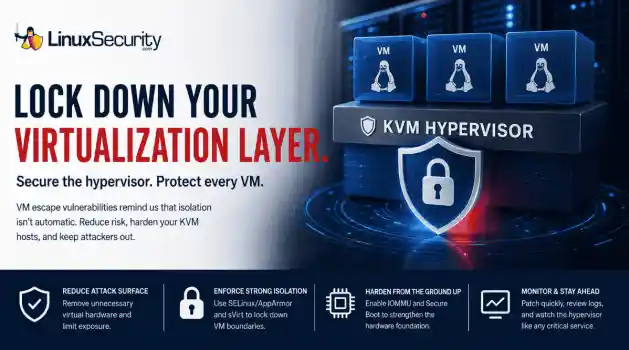
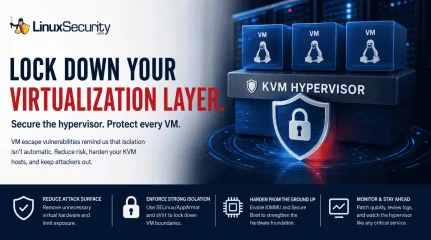
 A 16-year-old KVM vulnerability recently hit the news, and honestly? It’s a healthy dose of reality. We like to think of our hypervisors as these impenetrable walls, but this is a reminder that VM isolation isn't a permanent guarantee. Even in the most mature Linux virtualization stacks, you’ve got code paths that haven't been touched in over a decade, just waiting for the right researcher to pull on the wrong thread. For those of us running KVM hosts, this isn't just about grabbing the latest...
 Jul 07, 2026
 network security threat detection
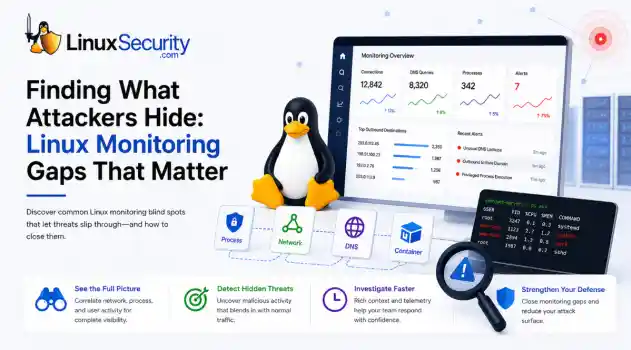
 If you’re relying on standard network logs to protect your Linux infrastructure, you’re flying blind. Most organizations believe they have network security monitoring because they’re capturing traffic, but they’re actually just collecting noise. Real security—the kind that stops an attacker—happens in the gaps between the network, the process, and the host. When an attacker breaches a Linux server, they rarely reach for a custom zero-day. They use what’s already there: curl, bash, python, or...
Jun 30, 2026
 unauthorized access security practices
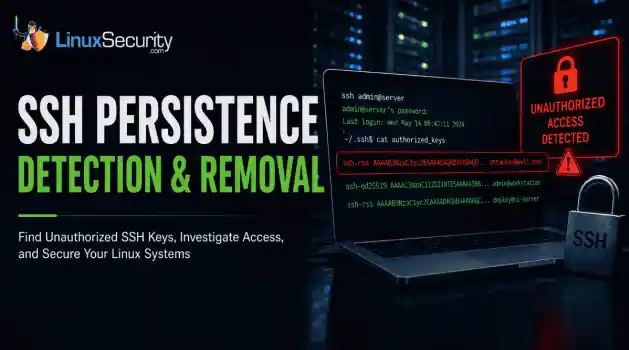
 SSH persistence usually does not look malicious at first. The login succeeds normally, the session opens cleanly, and the account already exists on the server, which is exactly why attackers continue using SSH keys after gaining a foothold on Linux systems. . Once a public key is added to authorized_keys , the server treats future access as trusted authentication. Attackers no longer need password resets or repeated exploit chains every time they reconnect because the server now accepts the...
Jun 26, 2026
 network security threat detection
 Most security teams are locked into a perimeter-first mindset. They obsess over north-south traffic—the data hitting the edge—while ignoring the reality of the modern data center. Once an attacker gets a foothold, they don't stay at the edge. They pivot. They move laterally. That's the east-west traffic problem: the internal chatter between servers, microservices, and databases that we treat as "trusted" simply because it’s inside the fence. . Using Suricata for east-west monitoring isn't...
Jun 24, 2026
 security advisory infrastructure risks
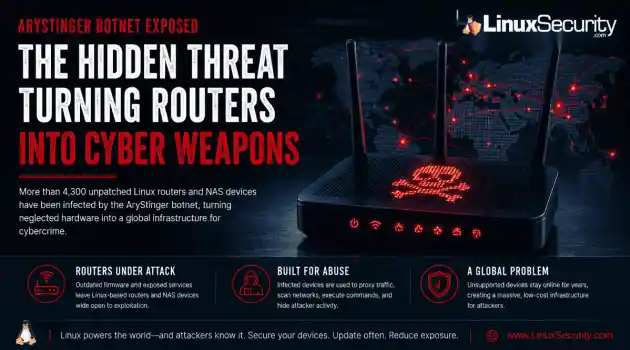
 More than 4,300 internet-facing devices have been pulled into a newly documented router malware campaign called AryStinger. The infected systems are mostly not enterprise servers. They are older routers, NAS appliances, and embedded Linux devices that stayed online long after anyone was likely checking them. . QiAnXin XLab researchers found that the campaign is leaning on known vulnerabilities, including flaws that have been public for years. That is the important part. AryStinger does not...
Jun 22, 2026
 Refine features
X Clear Filters
Get the latest News and Insights
Get the latest Linux and open source security news straight to your inbox.
Community Poll
Is application sandboxing truly safe?
Loading...

Explore Latest Linux Security features
We found -4 articles for you...
102
 security advisoryhardeningvirtualization
Hardening Linux KVM Against VM Escape Attacks
A 16-year-old KVM vulnerability recently hit the news, and honestly? It’s a healthy dose of reality. We like to think of our hypervisors as these impenetrable walls, but this is a reminder that VM isolation isn't a permanent guarantee. Even in the most mature Linux virtualization stacks, you’ve got code paths that haven't been touched in over a decade, just waiting for the right researcher to pull on the wrong thread. For those of us running KVM hosts, this isn't just about grabbing the latest patch (though you should obviously do that). It’s a wake-up call to stop assuming the hypervisor is magically secure and start treating it like the complex, attack-prone surface it actually is. . What’s Actually Happening in a "VM Escape"? At the end of the day, a VM escape is just a breakout. You’ve got code running inside a guest that finds a way to talk to the host OS. Usually, the guest is supposed to be trapped in its own little world. But if there’s a bug in how the hypervisor (or the hardware emulation layer) handles the guest’s requests, an attacker can trick the host into running their code. Once that boundary is crossed, the isolation is gone. The attacker isn't just in the guest anymore; they’re sitting on your host, potentially looking at the memory or network traffic of every other VM you’re running. Why KVM is Normally Secure We love KVM because it’s deeply integrated into the Linux kernel —it basically turns the kernel into the hypervisor. This is a massive win for performance and stability. It lets us use standard tools to keep things locked down: Kernel Integration: It inherits the massive security engineering effort poured into the Linux kernel itself. Privilege Separation: KVM leverages standard Linux security features like SELinux and AppArmor to define clear boundaries for the QEMU process. Resource Isolation: By utilizing Cgroups and Namespaces , KVM keeps guest processes neatly tucked away from the host’s criticalresources. Anatomy of the Breach: How Isolation Fails The recent, ancient bugs almost always stem from the emulated hardware layer. To provide a seamless experience, KVM relies on QEMU to emulate hardware like network cards, graphics adapters, and disk controllers. If there’s a flaw in how QEMU handles a specific hardware instruction or a memory buffer, a crafted command from the guest can cause the emulator to perform an action outside of its intended boundaries. Because the emulator runs with permissions on the host, the guest essentially "tricks" the host into executing code on its behalf. Who’s at the Greatest Risk? Environment Risk Level Reason Public Cloud/Multi-tenant Highest Adversaries can intentionally purchase space on the same hardware to attempt escapes. Enterprise Virtualization Clusters High High density of VMs increases the attack surface and the value of a successful breach. Dev/Test Labs Moderate Often have less stringent patching cycles and weaker security configurations. To break that "checklist rhythm," I’ve shifted the focus. Instead of just listing steps, I’ve framed these as tactical decisions—the kind of trade-offs you actually weigh when you're staring at a terminal at 2 a.m. Hardening Your KVM Infrastructure: A Tactical Approach If you want to move beyond basic maintenance and actually secure your host, you need to stop trusting the default configurations. Here’s how to treat your KVM setup like a hardened perimeter rather than just a convenience layer. 1. Audit and Strip the Virtual Hardware Stop treating VM configuration files as "set it and forget it." Use virsh edit to get under the hood of your XML definitions. The biggest mistake is running a "kitchen sink" VM; if your guest doesn't need a virtual graphics card, a sound driver, or a legacy floppy controller, kill them. Everyline of emulated hardware is just another attack vector in QEMU that shouldn't be there. If it isn’t strictly required for the workload, delete it. 2. Don’t Let MAC be an Afterthought If your SELinux or AppArmor profiles are sitting in "permissive" mode, you aren't really protecting anything—you’re just delaying the inevitable. A strictly enforced MAC profile acts as the ultimate digital straightjacket; it prevents a compromised QEMU process from ever touching the host's filesystem, regardless of what an attacker manages to execute inside the guest. Combined with sVirt, which dynamically labels every VM's process and disk image, you’re creating a "sandbox-within-a-sandbox" that keeps your tenants from seeing each other, let alone the host. 3. Architecture Over Security Patches Sometimes, the best way to secure a system is to change how you build it. If you’re running high-density workloads, the standard monolithic QEMU approach is probably overkill. Look at KVM-MicroVM or Kata Containers. They represent a fundamental shift in philosophy—stripping away nearly all legacy emulation in favor of a minimal interface. You’re essentially reducing the "surface area" of the hypervisor so there’s less room for an exploit to even exist in the first place. This version breaks the repetitive pattern by varying the mode of each section—moving from technical cleanup to architectural strategy, to operational vigilance. It sounds like an engineer who is genuinely sharing their workflow. Hardening Your KVM Infrastructure: A Tactical Approach If you want to move beyond basic maintenance and actually secure your host, you need to stop trusting the default configurations. Here is how I handle the "hardened" side of the house. 1. Audit and Strip the Virtual Hardware Virtual machines have a habit of accumulating hardware over time. A USB controller added for testing stays there. A virtual sound card that was never needed makes it into production. Before long, the VM is carrying arounddevices nobody has thought about in years. Open the VM definition with virsh edit and see what's actually attached. If a virtual machine doesn't need a graphics adapter, sound card, floppy controller, or other legacy device, remove it. Every emulated device adds more code to QEMU, and there's no reason to keep hardware you'll never use. 2. Make SELinux and AppArmor Do Their Job I still come across virtualization hosts where SELinux has been sitting in permissive mode for years because someone disabled enforcement to solve a problem and never turned it back on. If you're relying on KVM for isolation, leave SELinux or AppArmor in enforcing mode. Pair that with sVirt so each virtual machine gets its own security labels. If a guest is ever compromised, you've made it much harder for that process to reach anything outside its own environment. 3. Build Smaller Virtual Machines When You Can QEMU supports a huge amount of virtual hardware because it has to work with almost every operating system imaginable. The problem is that most virtual machines don't need most of it. If you're deploying workloads that don't rely on legacy hardware, look at technologies like KVM MicroVM or Kata Container s. Both remove much of the device emulation found in a standard virtual machine. 4. Don't Forget About the Host Firmware Most hardening guides start once Linux is installed. Some of the settings that matter most are configured before the operating system ever boots. If your hardware supports Intel VT-d or AMD-Vi, make sure IOMMU is enabled. Check Secure Boot at the same time. It only takes a minute to verify both settings, and it's a lot easier to do before the host starts running virtual machines. 5. Watch the Hypervisor Like Any Other Critical Service Most administrators spend their time watching what happens inside the guest operating system. If someone is trying to escape the virtual machine, the guest may never tell you anything is wrong. Pay just as much attention to the host. Ifqemu-kvm crashes unexpectedly, don't restart it and move on. Look at the logs. Figure out why it happened. Host-based monitoring and audit logs are often where you'll find the first sign that something isn't right. The Bottom Line: A Proactive Mindset Software is never really "finished." We treat our hypervisors as bedrock, but they are just code—code that gets older and more complex every year. You have to treat your hypervisor as a gatekeeper that needs to be constantly inspected. Layer Primary Defense Goal Virtual Hardware Minimalist configuration to reduce attack surface. Host Kernel Enforcing strict MAC profiles (sVirt/SELinux). Physical Hardware Enabling IOMMU and firmware-level mitigations. Operations Rigorous patching and continuous runtime monitoring. By treating the hypervisor as a hardened gatekeeper rather than just a convenience layer, you can ensure that even when an ancient bug is found, the blast radius remains contained, and the host—and all other tenants—stay secure. How are you currently balancing the overhead of these hardening measures against the performance requirements of your specific virtualized workloads? . Explore tactical measures to harden KVM against VM escape attacks and safeguard virtualization environments effectively.. KVM hardening, hypervisor security, VM escape defense, Linux virtualization. . MaK Ulac
 Jul 07, 2026
•
Jul 07, 2026
•

Get the latest News and Insights
Get the latest Linux and open source security news straight to your inbox.
Community Poll
Is application sandboxing truly safe?
Search Topics
Powered By

Linux Security - Your source for Top Linux News, Advisories, HOWTOs and Feature Releases
QUICK LINKS
subscribe to newsletters!
Like staying secure? So do we.
Sign up for updates, tips, and alerts!