You've probably trained your team to look for red flags. Odd sender names, urgent language, mismatched links. But a well-crafted spoofed email won't trip any of those wires. It looks legitimate, sounds legitimate, and often comes from a domain that p...
You've probably trained your team to look for red flags. Odd sender names, urgent language, mismatched links. But a well-crafted spoofed email won't trip any of those wires. It looks legitimate, sounds legitimate, and often comes from a domain that passes every automated check you throw at it.
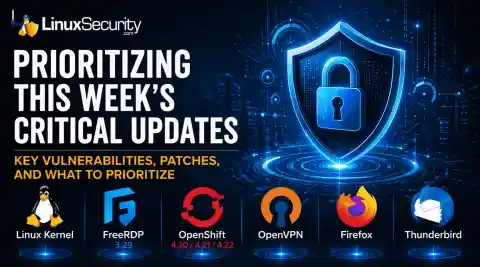
Most Linux teams don't struggle to find vulnerabilities anymore. They struggle to decide which ones deserve attention first. Between daily scanner results, vendor advisories, and hundreds of new CVEs each month, the challenge isn't visibility—it's prioritization.
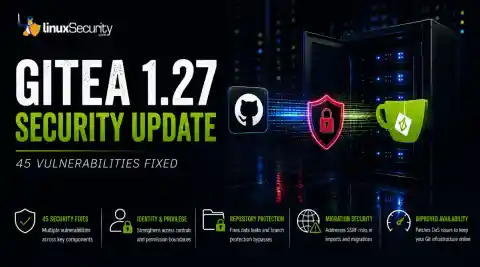
For organizations that run a self-hosted Git platform, it’s no longer just about hosting static code repositories. Today, Git servers are responsible for deployment pipelines, API tokens, SSH keys, package repositories, and the automation scripts that push code directly. Confirm that the upgrade addresses known vulnerabilities but also provides production environments.
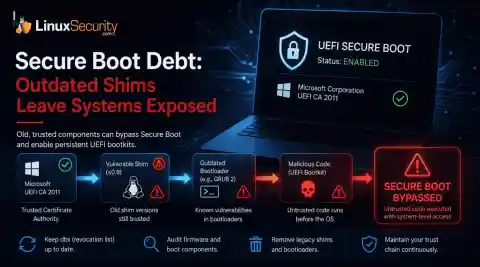
ESET researchers identified 11 old and forgotten Linux UEFI shim bootloaders at versions 0.9 and below that can be used to bypass UEFI Secure Boot on any UEFI-based machine that trusts Microsoft’s Microsoft Corporation UEFI CA 2011 third-party certificate authority, regardless of the installed operating system (OS). Reported shims can be exploited to execute untrusted code during system boot, enabling attackers to deploy malicious UEFI bootkits even on systems with UEFI Secure Boot enabled.
Before the week gets away from you, take a look at what's landed across the Linux ecosystem.
The volume of security advisories hasn't slowed, and while not every update demands an emergency maintenance window, several deserve to move to the top of your patch queue. This week's updates span the kernel, remote desktop infrastructure, VPNs, containers, browsers, and the utilities Linux systems quietly depend on every day.
Individually, these look routine. Together they show how quickly attackers can take advantage of organizations that let routine patches pile up.
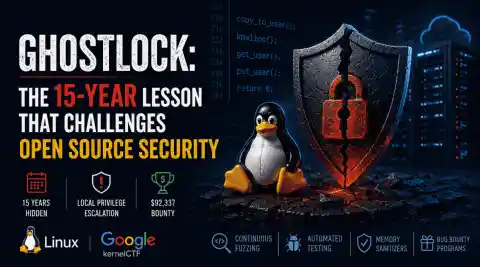
When researchers announced GhostLock, many people focused on the exploit. What stood out to me wasn't just what the vulnerability could do, but how long it had remained hidden. The flaw had lived in the Linux kernel for roughly 15 years before it was publicly identified by researchers. That means the flaw survived hundreds of kernel releases and years of upstream development before it was publicly documented.
It raises an uncomfortable question about one of open source's oldest assumptions. One of the enduring arguments in favor of open source is that transparency improves security. If anyone can inspect the code, vulnerabilities should be easier to discover and fix. GhostLock doesn't disprove that idea, but it does force us to ask how well it scales when the Linux kernel contains tens of millions of lines of code.
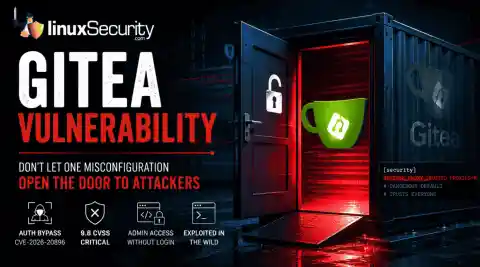
If you’re running Gitea in a container, stop what you’re doing and check your versioning right now. We’re looking at a critical vulnerability—CVE-2026-20896—shipped directly in Gitea’s official Docker images. It’s a 9.8 CVSS-rated "open door" that lets any unauthenticated attacker stroll in and impersonate any user on your system, admin account included, without needing a password or a token.
The reality? This isn't some complex, low-level kernel exploit. It’s a classic "secure-by-default" failure where one bad configuration template is quietly gutting your entire authentication model.
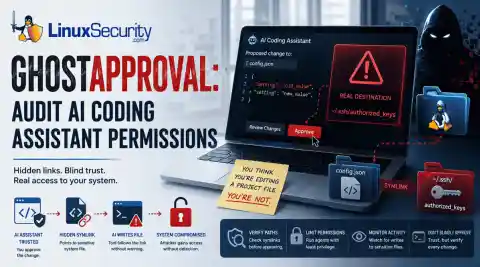
AI coding assistants have become a staple in many Linux developers' daily workflows. Whether you're generating boilerplate, refactoring code, or updating configuration files, it's easy to assume these tools stay safely inside your project directory.
When developer accounts are blocked, the impact is felt far beyond a single login screen. For many projects, these accounts are the access points for the entire delivery pipeline. If a maintainer is locked out, the flow of security updates stops. In a world where hackers move fast, a stalled pipeline is a massive vulnerability.
The Common Unix Printing System (CUPS) still sits on millions of Linux systems, usually in the background, rarely monitored, and often trusted more than it should be. We saw a wake-up call in late 2024 when a series of vulnerabilities revealed how printer auto-discovery could be abused to enable remote code execution.
One unauthenticated HTTP request is all it takes. From there, attackers can move from the edge straight into your internal network, operating from a system your Linux servers already trust.
CVE-2026-21643 in FortiClient EMS isn’t just another SQL injection. It turns a management server into a pivot point, giving attackers the same access paths your administrators rely on.
A single unpatched server opens a path into systems that were never meant to be exposed, and because nothing appears broken, that access can remain in place for weeks without drawing attention.
I keep seeing Rust show up in places it never could have five years ago. Kernel-adjacent tools. Security agents. Parsers that used to be a pile of careful C and comments warning you not to touch anything. It’s not because developers suddenly got more patient or because everyone decided memory safety was fun. The cost equation changed, and AI coding is a big part of why.
Seeing the word “telnet” on a system tends to trigger a reaction. For some admins, it means risk. For others, it means legacy noise that can be ignored. The problem is that those reactions often fire before anyone stops to ask a quieter, more important question. Is this a client sitting idle, or is there a service listening for connections?
MongoBleed, tracked as CVE-2025-14847, is a high-severity flaw in MongoDB that allows unauthenticated attackers to read small pieces of a server’s memory. In simple terms, a remote client can ask MongoDB to process a malformed compressed message, and the database may respond with extra bytes it never intended to send.
React2Shell is a server-side vulnerability that turns a normal web request into code execution. It allows unauthenticated remote code execution, without credentials, tokens, or prior access. The resulting commands run as the same Linux service user that hosts the application.
CISA added CVE-2021-26829 to its Known Exploited Vulnerabilities catalog after confirming that attackers are already using the ScadaBR stored XSS flaw in real environments. The news barely made a ripple outside OT circles, but anyone responsible for keeping older SCADA stacks running on Linux should pay attention.
Linux administrators deal with steady pressure from patching, configuration changes, and the slow accumulation of technical debt. Environments rarely break because of one vulnerability.